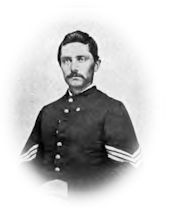
Saturday, 22d—After an all night run, we landed this morning at daylight at Goodrich’s Landing, on the Louisiana side, from which place we marched two miles up the river and went into bivouac, where we remained all day. There were four brigades in the expedition, comprising about five thousand men, and commanded by Brigadier General Stephenson. There is a camp of several thousand negro refugees here, old men, women and children, they having fled from the plantations. They are fed on Government rations doled out to them, which cannot take the place of their accustomed corn bread and pork. They are poorly cared for, the place being a miserable camp of filthy hovels, and are dying by the hundreds of disease and neglect.
Diary of Alexander G. Downing; Company E, Eleventh Iowa Infantry
Friday, 21st—We packed our knapsacks and started at 10 o’clock for the landing two miles above Vicksburg and a mile below our camp. Our regiment with the Thirteenth went on board the “Fanny Bell,” and at dark started up the river.
Thursday, 20th—It has rained most of the day. On dress parade this evening orders were read for the brigade to prepare to march in the morning with ten days’ rations and one hundred rounds of ammunition. The sick are to be left in camp.
Wednesday, 19th—A thunderstorm last night cooled the air some, though it is still extremely hot. There was a boat blown up this morning down at the wharf and thirty or forty lives were lost, mostly negroes. The boat was being loaded with ammunition and the explosion was caused by a negro’s dropping a box of loaded shells. A number of persons thrown into the water were rescued from drowning.
Tuesday, 18th—We were relieved from picket this morning. It looks pretty bad in walking the streets of Vicksburg to see the destruction caused by our shells. Many buildings are completely demolished, while others have great holes made in their walls —I counted as high as ten holes in a wall. I noticed a shell lying in the bottom of a cistern, whose fuse must have been put out when it struck the water and so it only knocked a hole in the wall, but it drained the water out of the cistern.
Monday, 17th—Our company went out on picket this morning. There is always danger of cavalry raids, particularly evenings. Some more of the sick boys were examined this morning by the doctor. The boys were hoping to get a sick furlough. There is some homesickness in the regiment, but a number will be made well by a thirty-day furlough. I am in good health and it is more than a year since I have had to report to the doctor, and then he marked me “not fit for duty” for only three days.
Sunday, 16th—We had regimental inspection this morning at 8 o’clock. The regiment showed itself in splendid order. A man from the Fifteenth Iowa was buried this morning, having died of fever.[1] Some of the sick boys of our regiment started home today on their furloughs. Mark Titus was the only one from our company, though some of the boys still have the fever.
[1] John Chrismore, Knoxville, Iowa. He died August 15th and was buried In National Cemetery at Vicksburg, Section G, grave 172.—Roster Iowa Soldiers, Vol. II, p. 926.
Saturday, 15th—This is my birthday—twenty-one years old today. I was detailed to help dig a grave for the body of Rufus C. Walter, of Company G, who died last night. He had been wounded and lived here in camp in a hammock which was tied to trees, or to posts set in the ground when there were no trees.
Friday, 14th—All is quiet. Orders came today to send all of the sick home on thirty-day furloughs.
Thursday, 13th—It is rumored that our brigade is to go to Natchez, Mississippi, in a few days, but we cannot tell whether it is true or not. I was on police duty today, for the first time, down in Vicksburg. There are more than a hundred men detailed each day to keep order in the city, and nobody is allowed on the streets without a pass from the provost marshal. We work on eight-hour shifts, and each man has a certain part of a street to patrol for two hours at a time, after which he is off duty for a period of four hours. I was on duty in a residence district, and while I was walking my beat, a lady came out of her home for an afternoon’s walk. I of course had to ask her to show her pass. I must have looked pretty fierce to her, with loaded gun, fixed bayonet and all accouterments on. I asked her kindly for her pass and she answered that she had none, whereupon I told her what my orders were; that she would have to return to her home and not come out on the streets again without a pass, or I would have to take her to the provost marshal’s office. She thanked me very politely as I closed her gate, saying that she wanted to obey orders and that she would send out and procure a pass before going on the street again. This lady is certainly experiencing war at her own dooryard, yet she showed the good breeding of the Southern lady.


