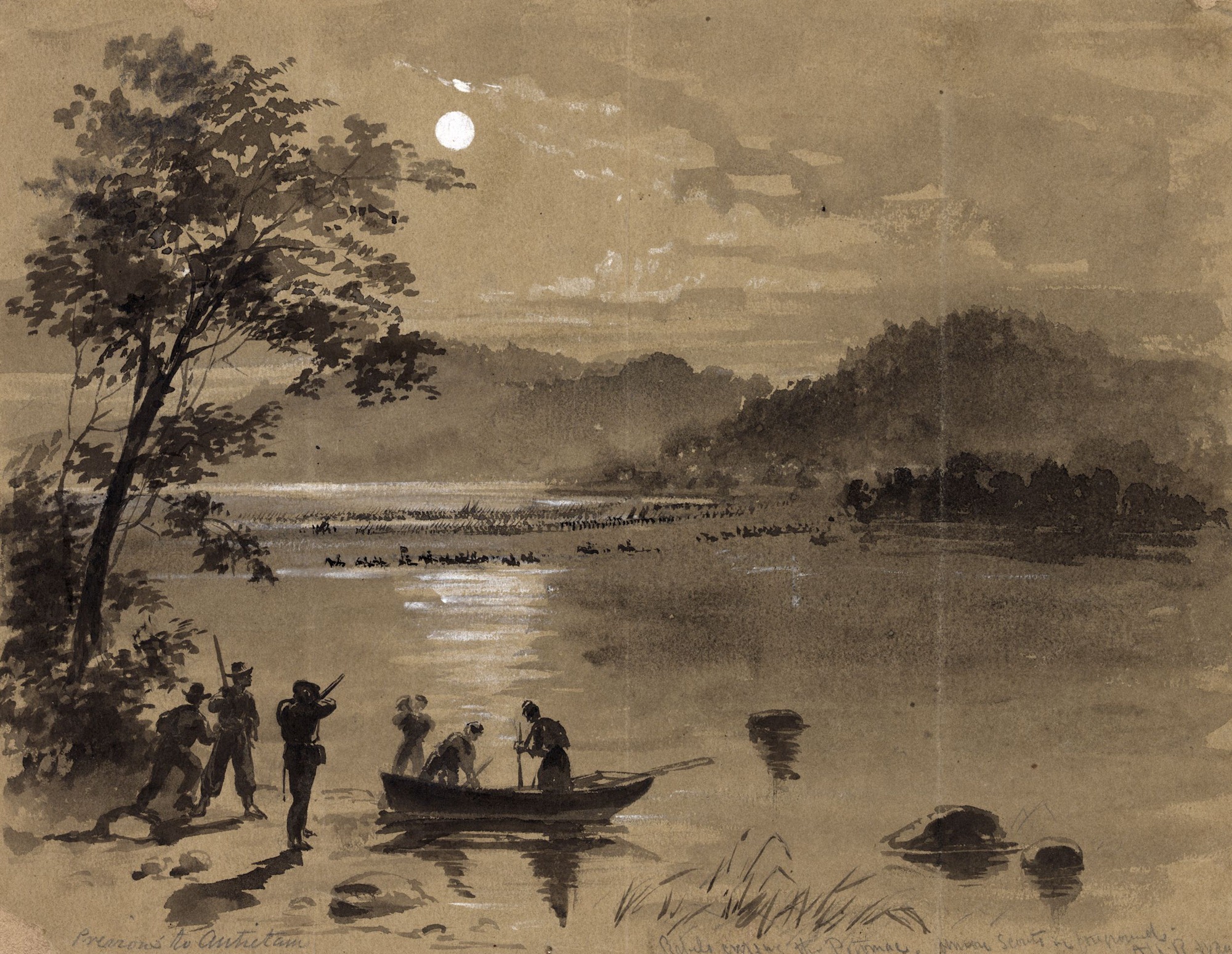
Title: Previous to Antietam. Rebels crossing the Potomac. Union scouts in foreground.
Signed lower right: Alf. R. Waud.
Title inscribed below image.
Library of Congress image.
Title: Previous to Antietam. Rebels crossing the Potomac. Union scouts in foreground.
Signed lower right: Alf. R. Waud.
Title inscribed below image.
Library of Congress image.
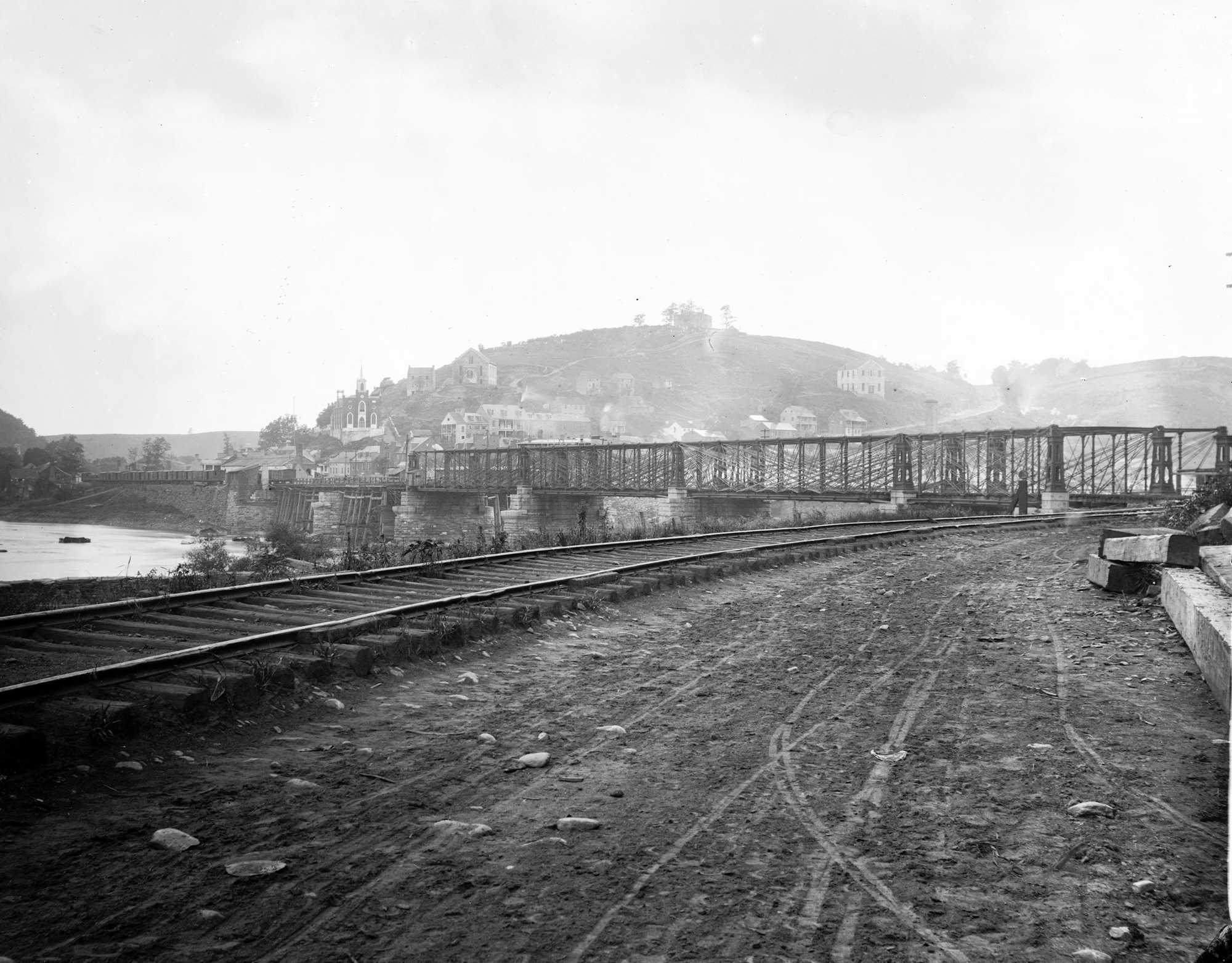
The Baltimore & Ohio (B & O) railroad bridge was once a majestic wood covered bridge that spanned the Potomac River and carried train traffic on the B & O Railroad for 23 years prior to the outbreak of the Civil War…. With the secession of Virginia in April, 1861, the bridge became a tenuous connector between the Confederacy and the Union. The bridge was over an important border, the Potomac River, and constantly had to worry about attacks from both sides of the war. During four years of Civil War, the bridge would be built and destroyed nine times – four times by war, five times by floods.
On June 14, 1861, as the Confederates were leaving Harpers Ferry, Brig. Gen. Joseph Johnston ordered the burning of all bridges on the Potomac under Southern control. The bridges that were destroyed were Point of Rocks, Shepherdstown, and Berlin. The Berlin Bridge is called Brunswick today. The Harpers Ferry region was a dangerous border area for the next eight months, disallowing rebuilding of the bridge. When the Union army occupied Harpers Ferry in February of 1862 and B & O bridge builders accompanied them. A new iron trestle was completed atop the original piers in less than three weeks, which allowed for supplies to be sent to the Union forces in Harpers Ferry and further south.
The Confederates regained Harpers Ferry on September 15, 1862 but just a few days later they would abandon that post. On September 18, 1862, the bridge was destroyed for a second time by Confederates when they left Harpers Ferry due to the outcome of the Battle of Antietam in Shepherdstown. B & O bridge builders returned with the Union army a few weeks later and had the bridge operational once again by early October.
_______
Information from National Park Service (link).
Library of Congress image.
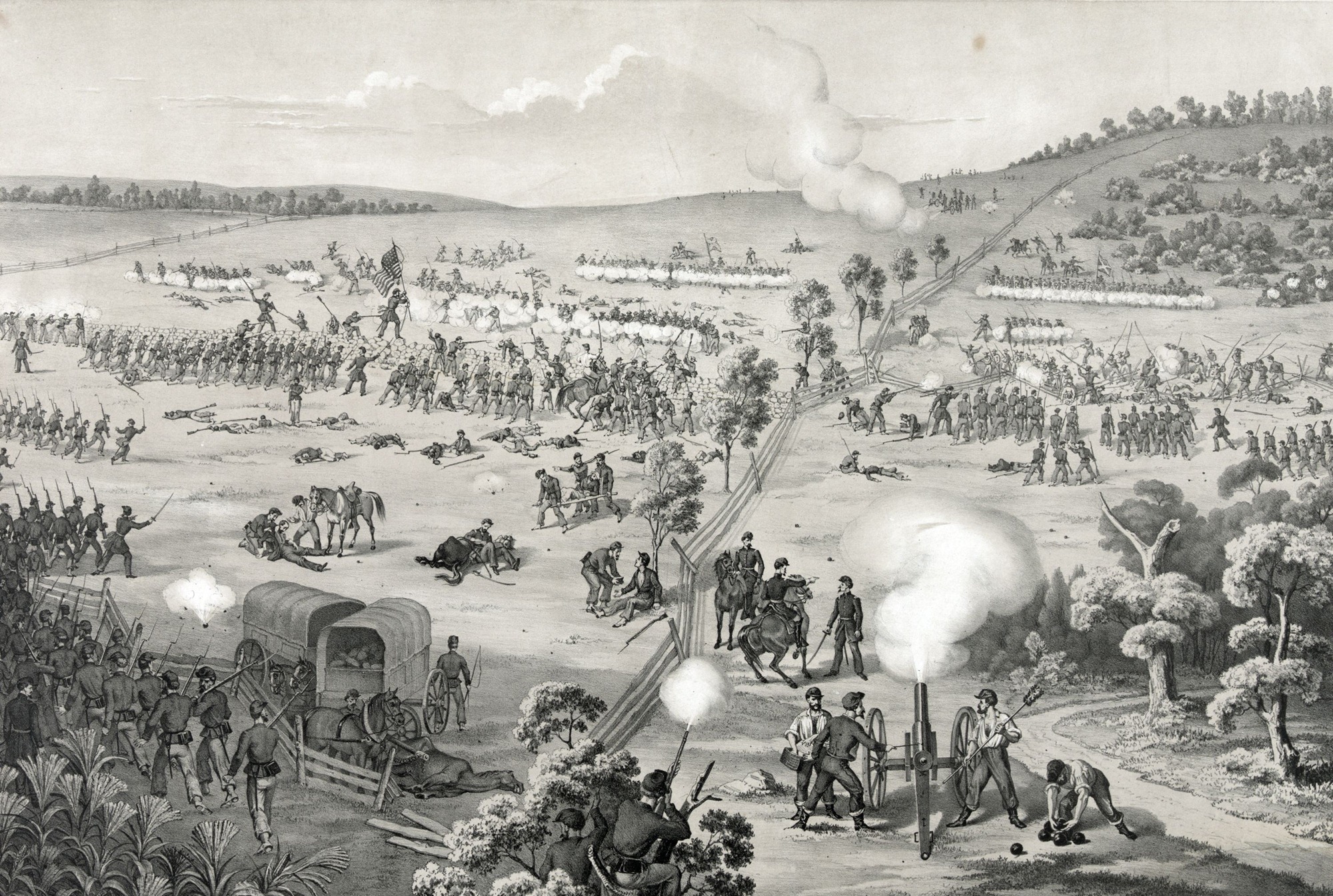
“The glorious charge of the 23rd & 12th Ohio Volunteers (Col. Scammon) against the 23rd and 12th North Carolina under the rebel Gen. Garland, who was killed in the charge.”
Library of Congress image.
The Battle of South Mountain — known in several early Southern accounts as the Battle of Boonsboro Gap — was fought September 14, 1862, as part of the Maryland Campaign of the American Civil War. Three pitched battles were fought for possession of three South Mountain passes: Crampton’s, Turner’s, and Fox’s Gaps. Maj. Gen. George B. McClellan, commanding the Union Army of the Potomac, needed to pass through these gaps in his pursuit of Confederate General Robert E. Lee’s Army of Northern Virginia. Despite being significantly outnumbered, Lee’s army delayed McClellan’s advance for a day before withdrawing.
Samuel Garland, Jr., (December 16, 1830 – September 14, 1862) was an American attorney from Virginia and Confederate general during the American Civil War. He was killed in action during the Maryland Campaign while defending Fox’s Gap at the Battle of South Mountain.
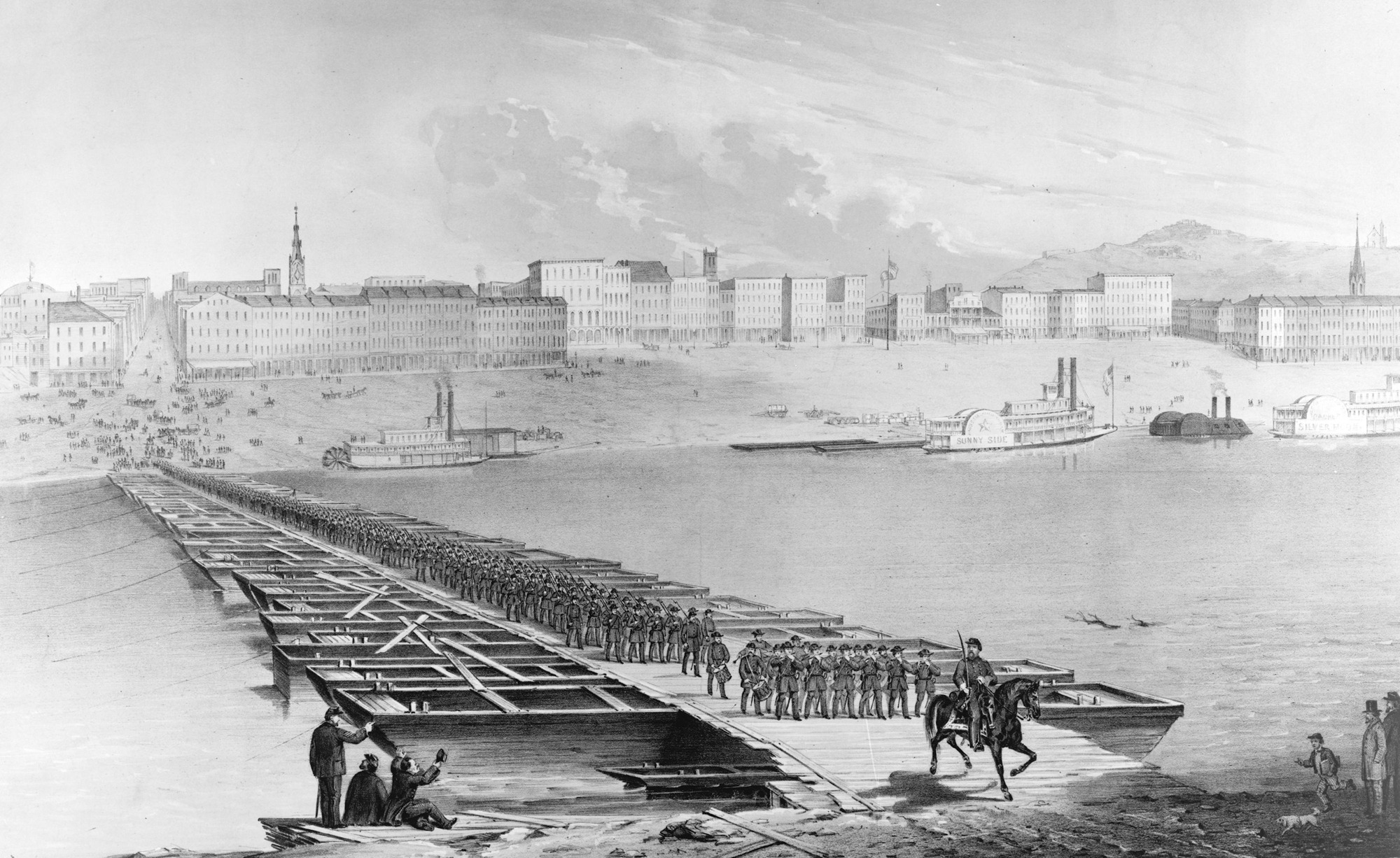
Sketched by A.E. Mathews, 31st Reg’t. O.V.; Print showing Union soldiers of the 21st Regiment of Wisconsin Volunteers marching across a pontoon bridge in Cincinnati, Ohio. (Uncropped image file lists field and staff officers, as well as officers of the line.) Library of Congress image.
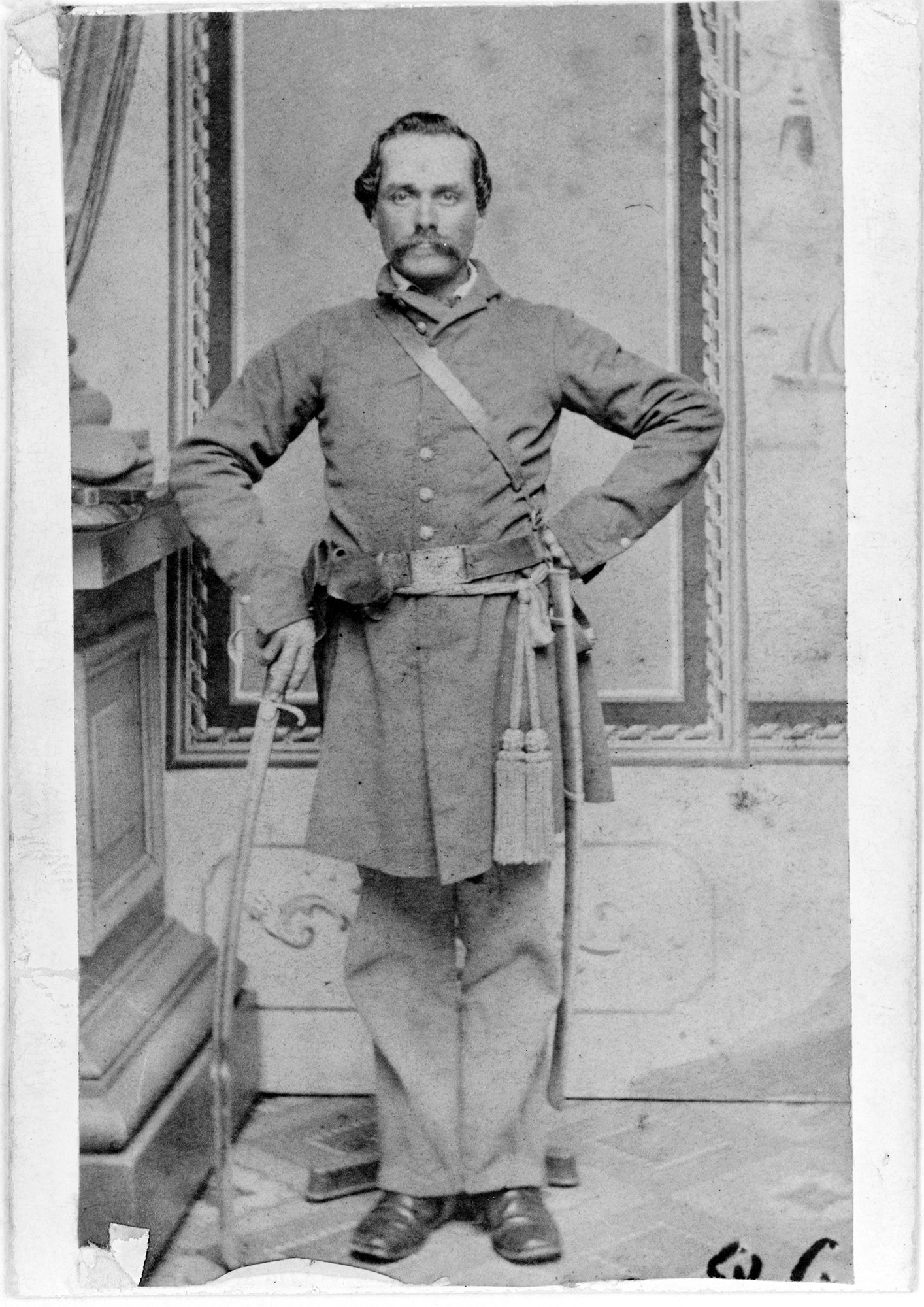
“Unidentified Confederate(?) officer, full-length portrait, standing, with sword in right hand”
photographic print on carte de visite mount: albumen.
Library of Congress image.
Civil War Portrait 008
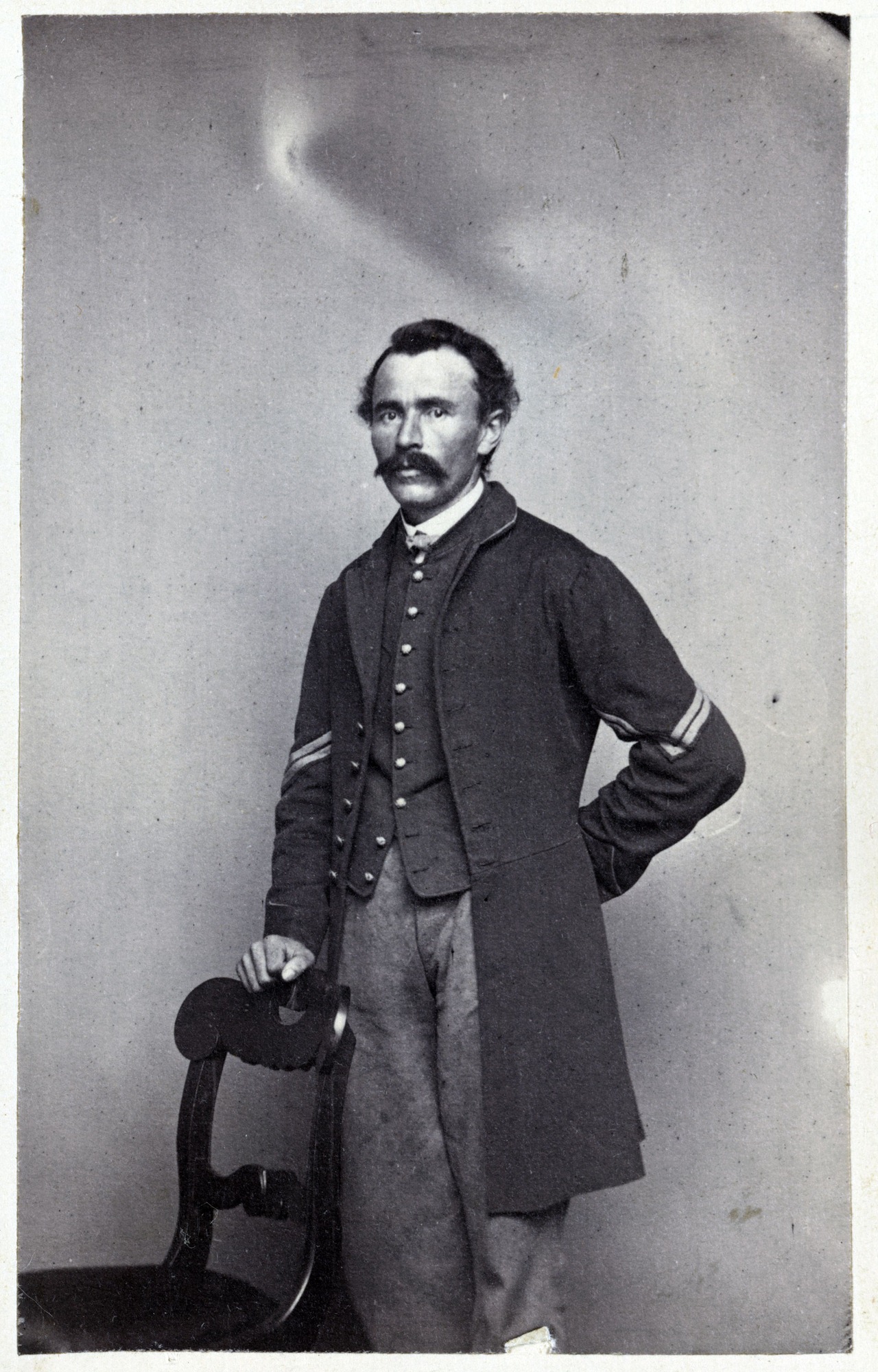
Photograph shows Corporal Theodore (or Theodor) Tesch of Co. B, 26th Wisconsin Infantry Regiment, in uniform.
Library of Congress image.
1 photographic print : albumen, on carte de visite mount ; 9.6 x 6.0 cm.
Civil War Portrait 006
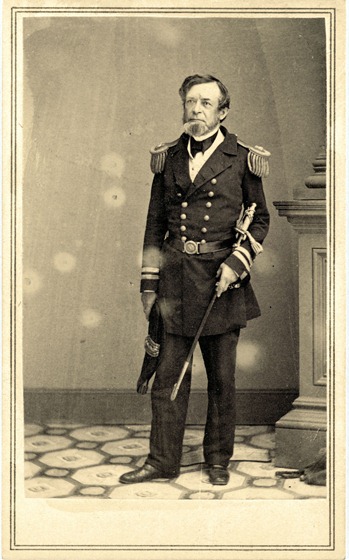 Wikipedia: Andrew Hull Foote (September 12, 1806 – June 26, 1863) was an American naval officer who was noted for his service in the American Civil War and also for his contributions to several naval reforms in the years prior to the war. When the war came, he was appointed to command of the Western Gunboat Flotilla, predecessor of the Mississippi River Squadron. In that position, he led the gunboats in the Battle of Fort Henry. For his services with the Western Gunboat Flotilla, Foote was among the first naval officers to be promoted to the then-new rank of rear admiral. (more)
Library of Congress image.
Civil War Portrait 005
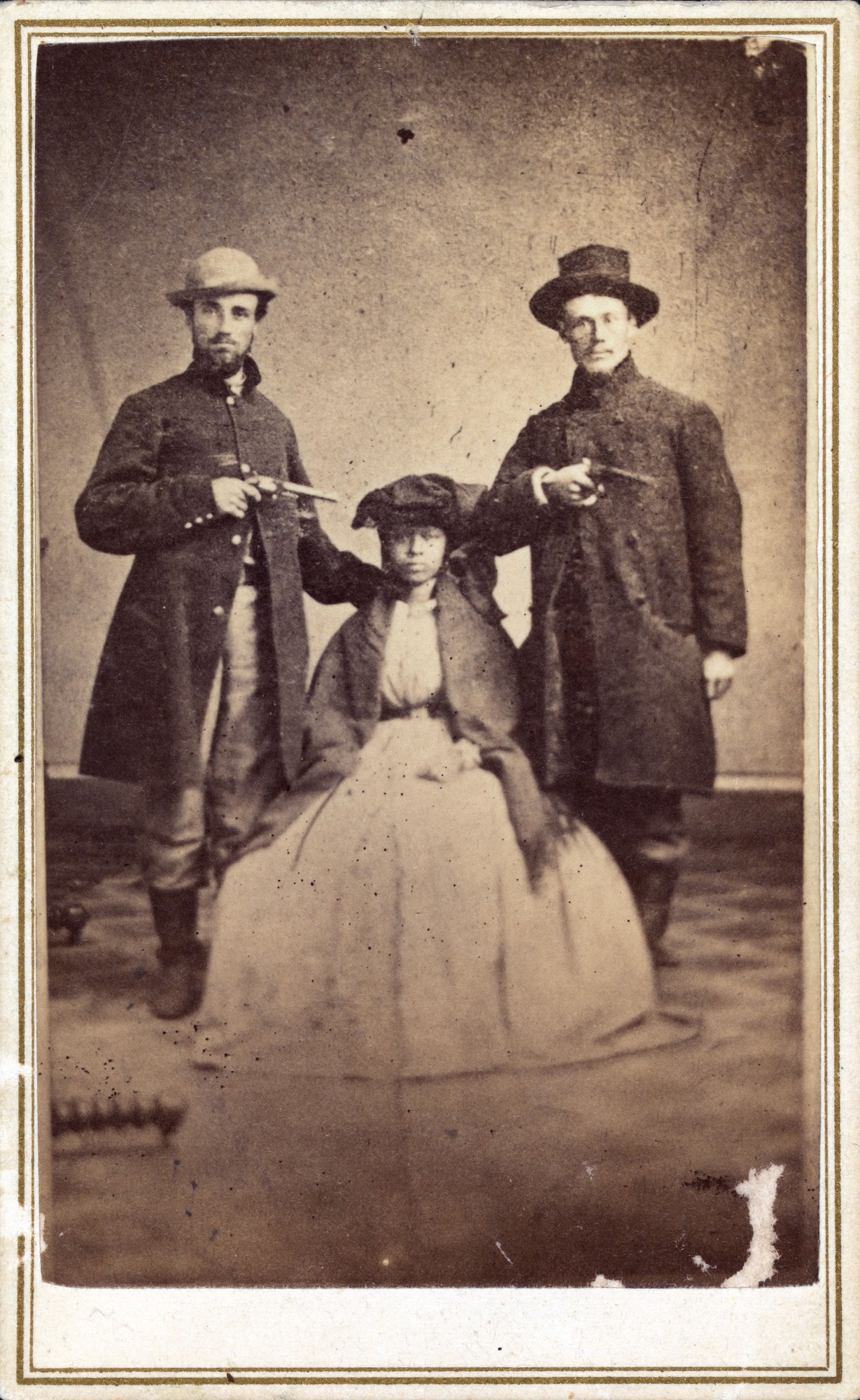 Update: 8/16/2013 — The photo is more fully described at Oxford African American Studies Center. Berch and Rockwell had escorted an escaped teenage slave to the home of Underground Railroad operator Levi Coffin in Cincinnati. They spent a couple of days at the Coffin home and, before sending the girl off to Racine, where some of the soldiers’ friends were ready to take the girl in, the trio posed for the photo. (Thanks to ‘Also Curious’ in comment below.)
__________
This image is indexed on the Library of Congress website under “Fugitive slaves – Wisconsin.”
Jesse L. Berch, quartermaster sergeant, 25 Wisconsin Regiment of Racine, Wis. [and] Frank M. Rockwell, postmaster 22 Wisconsin of Geneva, Wis.
J. P. Ball’s Photographic Gallery, No. 30 West 4th St., betw. Main and Walnut Sts. Cincinnati, O.
Photographer: James Presley Ball
1 photographic print on carte de visite mount : albumen ; 10 x 6 cm.
Photograph showing two men standing, with their guns drawn, and an African American woman sitting between them, full-length portrait, facing front (Rockwell standing on the woman’s right).
From Gladstone Collection of African American Photographs
Library of Congress image.
Civil War Portrait 004
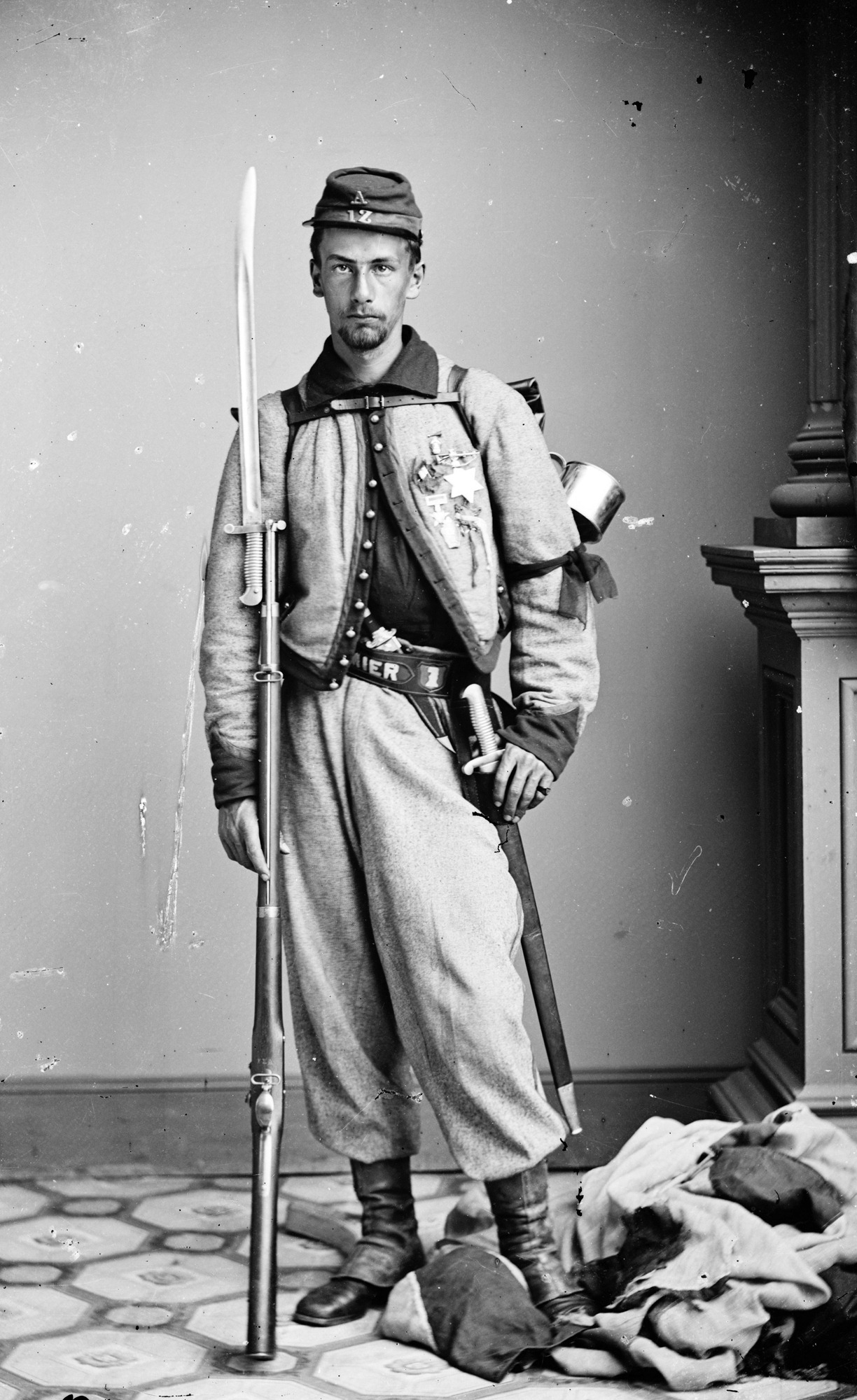
Library of Congress image.
Wikipedia: Brownell enlisted as a member of the 11th New York Volunteers, the “Fire Zouaves,” and was assigned to Company A. In the first days of the war, as the 11th entered Alexandria, Virginia on May 24, 1861, Ellsworth took him and several other men to capture the telegraph office. On the way there, one of Ellsworth’s men spotted a Confederate flag atop the Marshall House inn. Ellsworth’s group entered the inn and quickly cut down the flag, but they encountered the proprietor, James Jackson, as they descended the stairs. Jackson killed Ellsworth with a shotgun blast to the chest, and Brownell responded in kind by fatally shooting the innkeeper. For this, he was rewarded with a commission in the regular army and served as an officer for the next two years, retiring in 1863 with the rank of first lieutenant.
City of New York poster offering a $50 bounty for enlisting in any regiment.
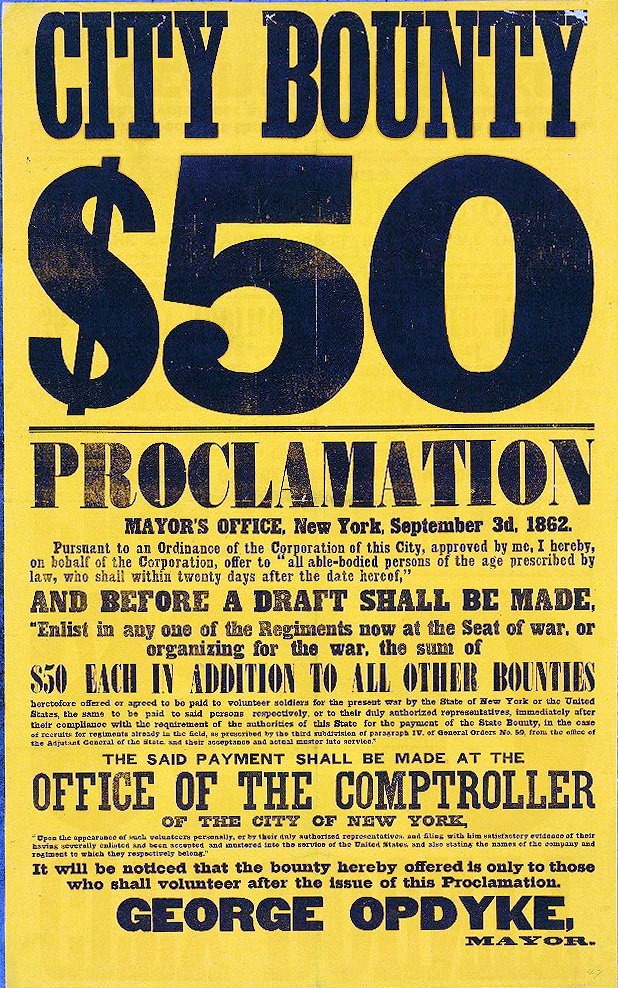
Library of Congress, American Memory image
 Follow on facebook
 RSS
RSS email
email