Library of Congress image:
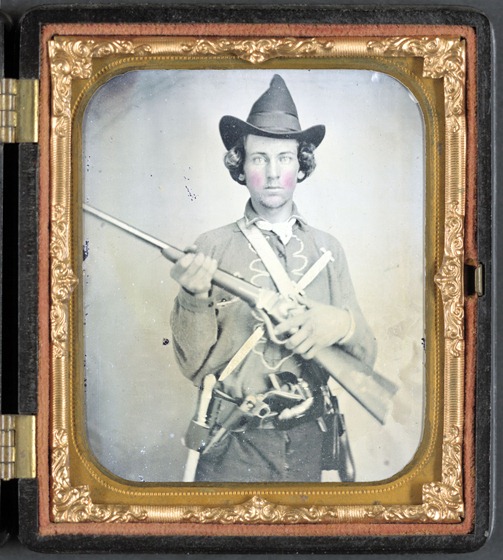
Unidentified cavalry soldier in Confederate uniform with slant breech sharps carbine, two knives, and two revolvers.
“Possibly a Border Ruffian from Missouri or Kansas.”
Medium: sixth-plate ambrotype, hand-colored ; 9.4 x 8.4 cm (case)
Donated to the Library of Congress 2012 by Tom Liljenquist; Liljenquist Family Collection of Civil War Photographs.
The Last Full Measure: The Liljenquist Family Collection.
________________
Image edited for fade correction and clarity. MpG
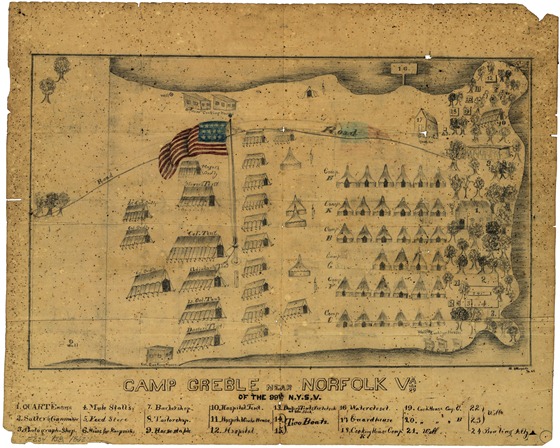
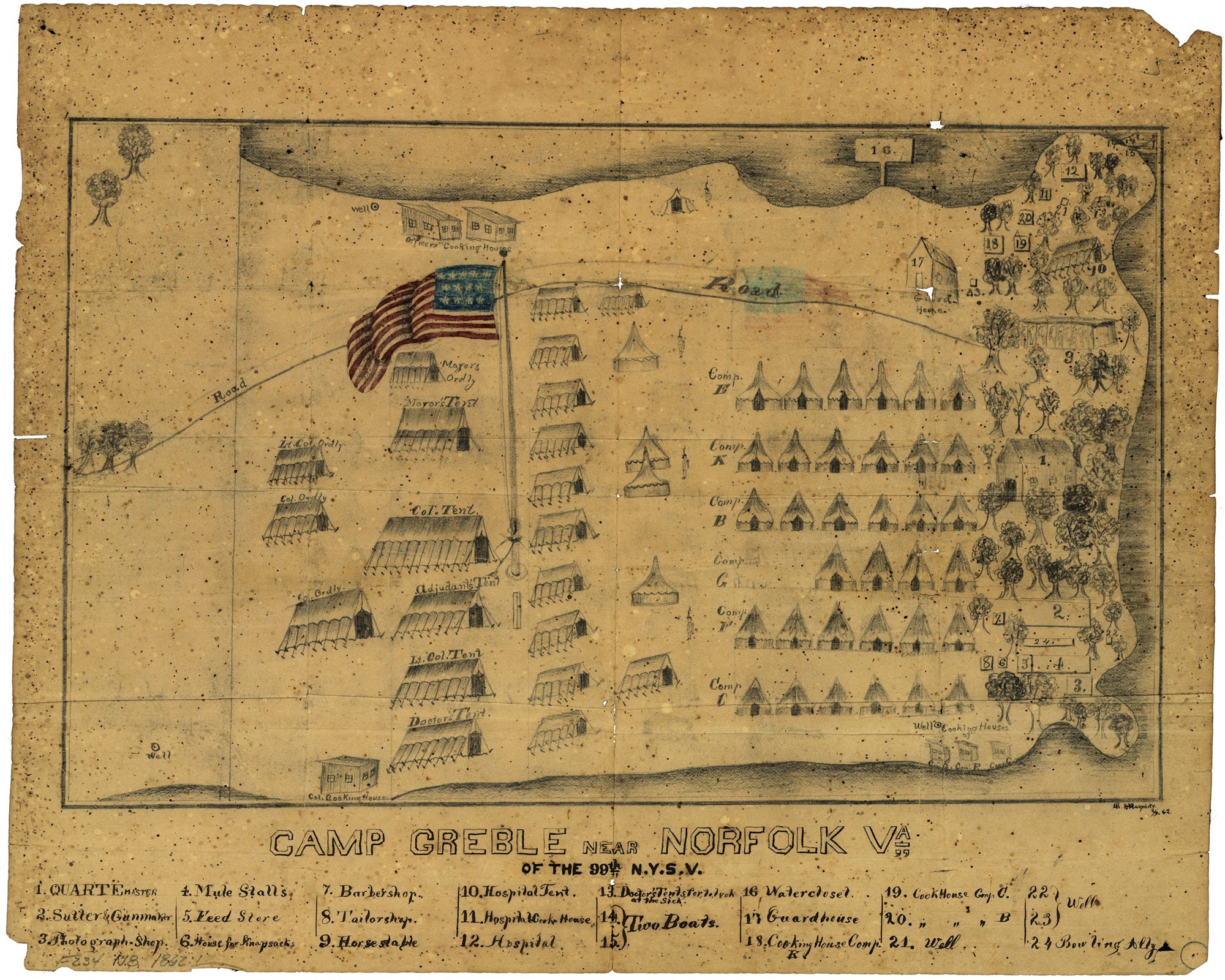
September 2, 1862
Drawn by Frank. Maynicke.
Camp Greble was named in honor of Lieutenant John Trout Greble killed at the Battle of Big Bethel, Virginia (June 10, 1861) and the first Union Army officer to die in the Civil War. In 1861, Frank Maynicke, a native-born Prussian, enlisted as a private in the New York State Volunteers (N.Y.S.V.). He was eventually transferred to Company F of the 99th N.Y.S.V., serving in the Union Coast Guard. In January 1864, he was captured near Smithfield, Va., and was a prisoner of war in Richmond, Va., and Andersonville, Ga.
Twenty-four locations are indexed including “Sutter & Gunmaker, “Photograph Shop,” “House for Knapsacks,” and “Bowling Alley.” Tents of officers and various companies are identified as are cooking houses.
___________
Virginia Historical Society image hosted on line at Library of Congress.
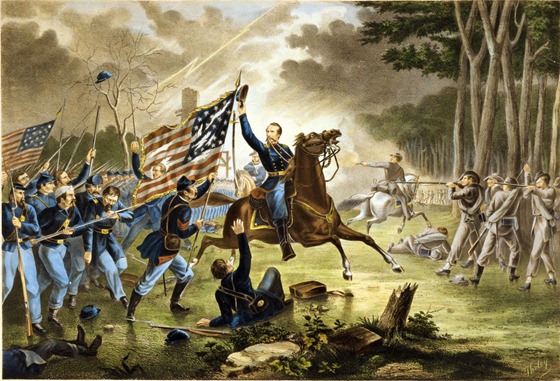
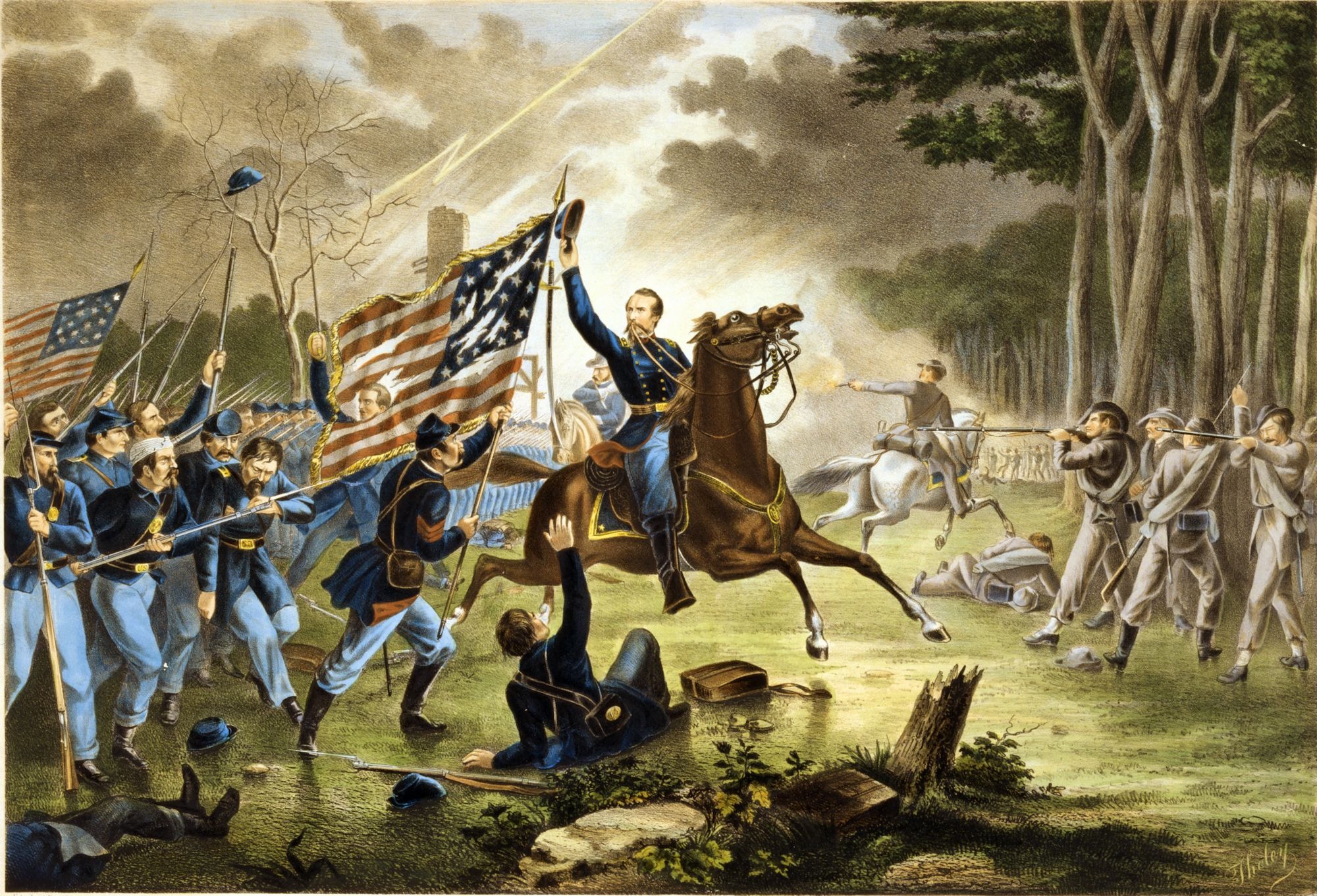
A lithograph from an original sketch, Augustus Tholey, a French-born lithographer, published 1867. Library of Congress image.
Philip Kearny, Jr. (June 2, 1815 – September 1, 1862) was a United States Army officer, notable for his leadership in the Mexican-American War and American Civil War. He was killed in action in the 1862 Battle of Chantilly. (Wikipedia)
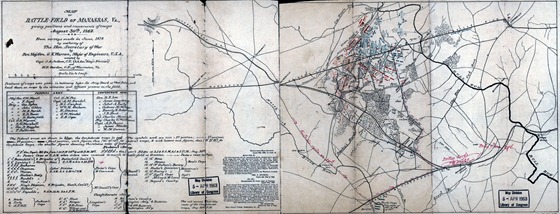
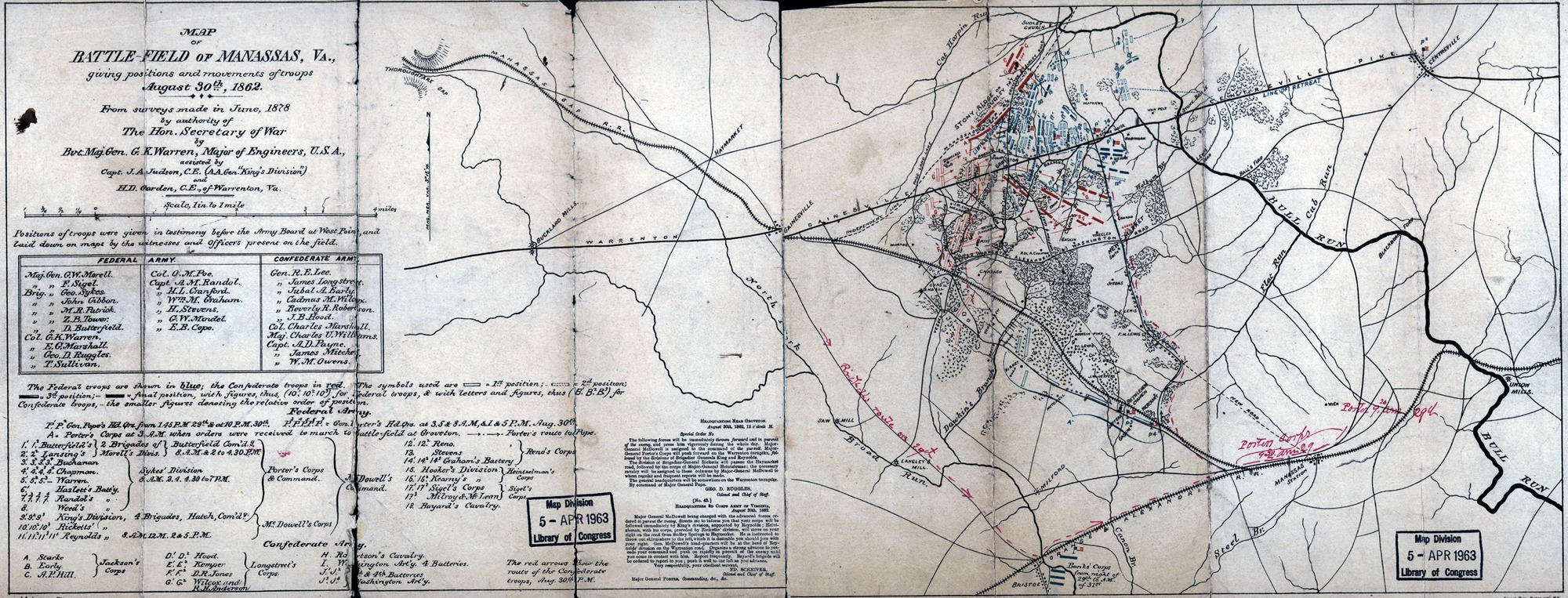
Map of battle-field of Manassas, Va., giving positions and movements of troops, August 30th, 1862; Creator, Warren, G. K.
Notes
- Scale 1:63,360.
- LC Civil War Maps (2nd ed.), 577.4
- “Positions of troops were given in testimony before the Army Board at West Point, and laid down on maps by the witnesses and officers present on the field.”
- “The Federal troops are shown in blue; the Confederate troops in red.”
- “The red arrows show the route of the Confederate troops, Aug. 30th, p.m.”
- Map has been annotated in red ink to show “Rickett’s route on 29th,” “Porter 9:20 a.m. 29th,” and “Porter’s corps 9:30 a.m. 29.”
Library of Congress map
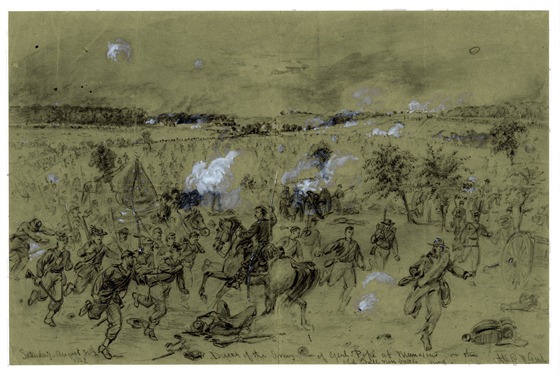
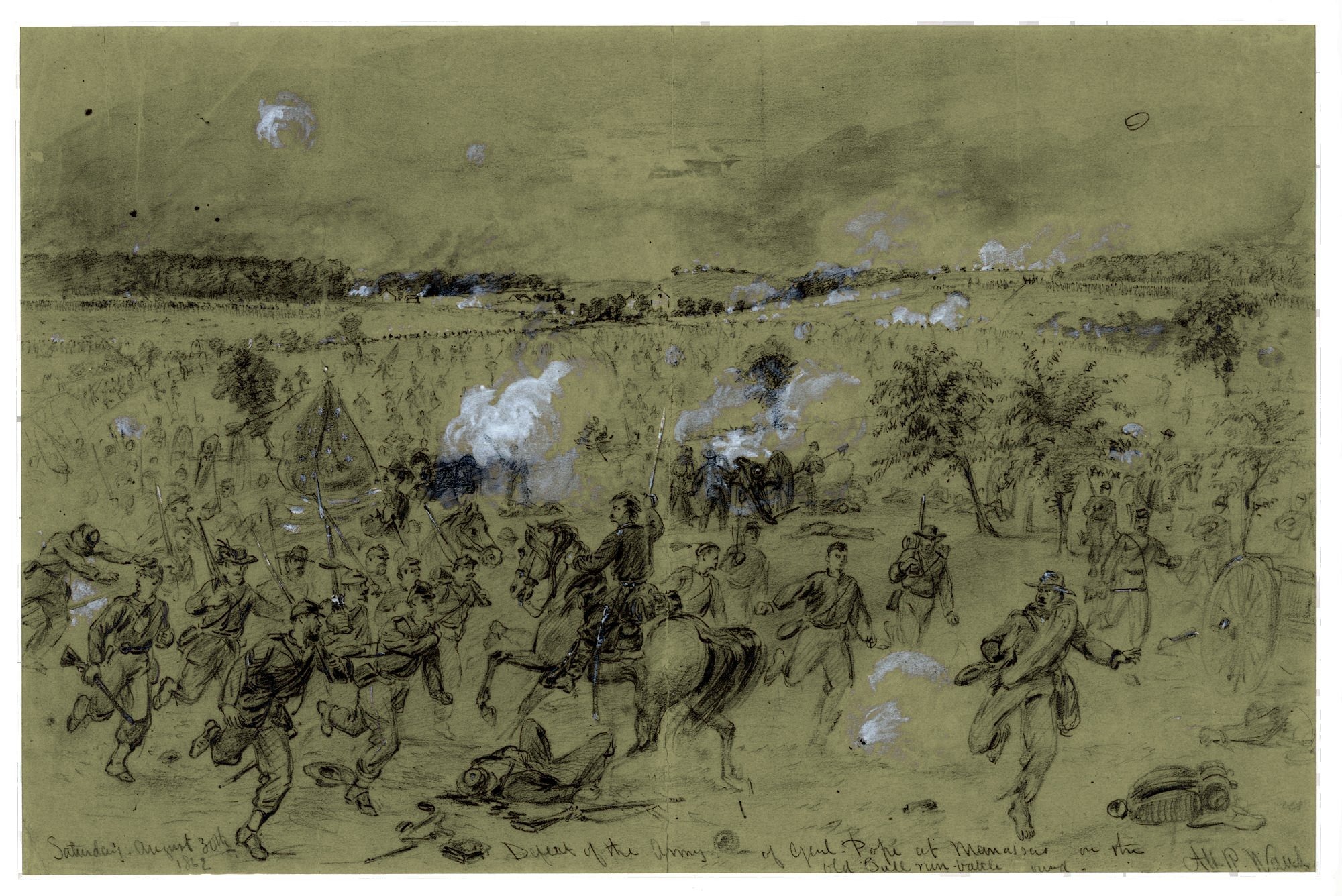
Defeat of the Army of Genl. Pope at Manassas on the Old Bull run battleground.
Library of Congress image.
- Signed lower right: Alf. R. Waud.
- Title inscribed below image.
- Inscribed lower left: Saturday August 30th 1862. Inscribed on verso: Advance of the rebel, Genl. Hills division. 30th of August 1862. In the distance is the enemies guns on the heights of Groveton. Groveton is situated to left of the middle of the sketch. Dogners [?] house in the centre. Battery in foreground captured by Penders troops. Troops in foreground part of Sch[urz]’s command. The officer on horseback may be Col. Koltes but I am not sure.
- Inscribed in ink on verso, lower right: Edwin E.F. Store [?].
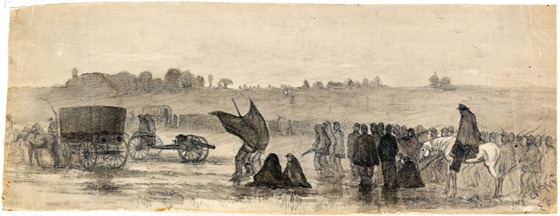
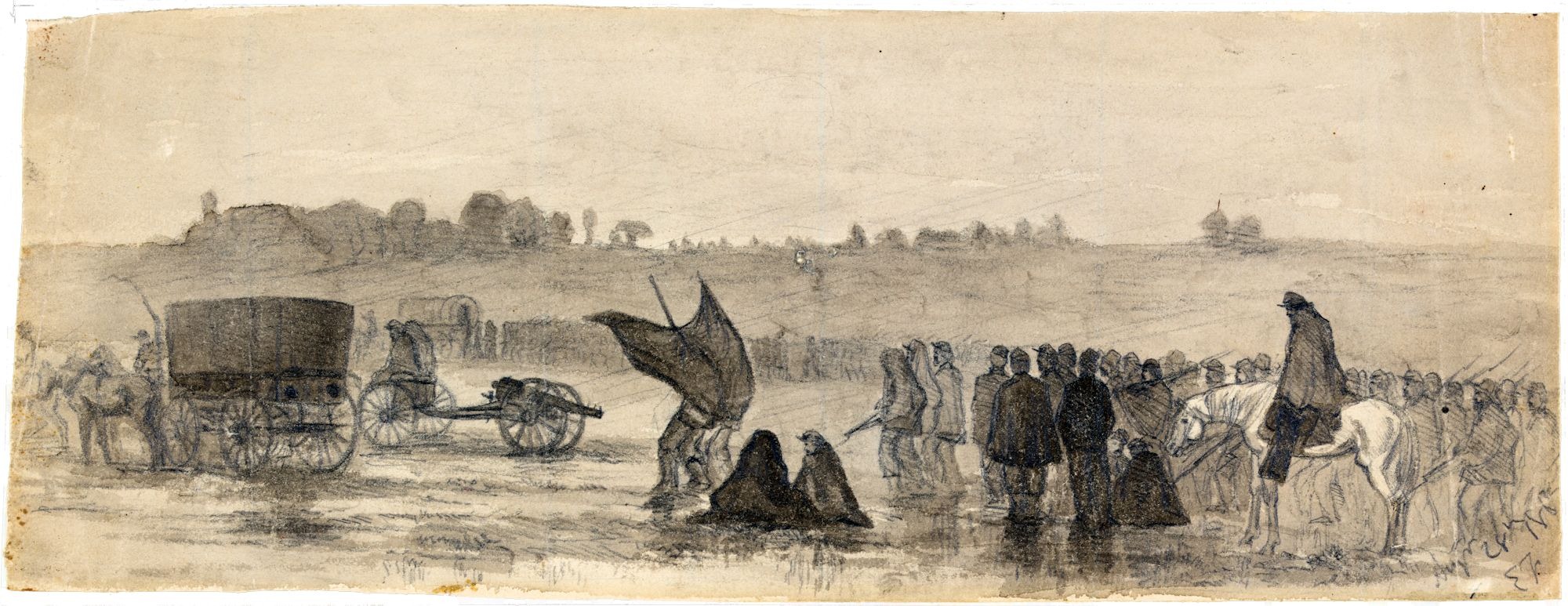
This drawing seems to titled and dated wrong on the Library of Congress page for this image. The rainy evening retreat of Pope’s forces was on August 30, not the 28th, and it was to Centreton, not Groveton or Mnassas Junction. Where the title and date came from is not identified on LOC page.
Title: “Retreat of the Army of the Rappahannock (Gen. Pope) to Groveton, Manassas Junction”; drawing by Edwin Forbes, date August 28, 1832 on the LOC page for this image.
Library of Congress image.
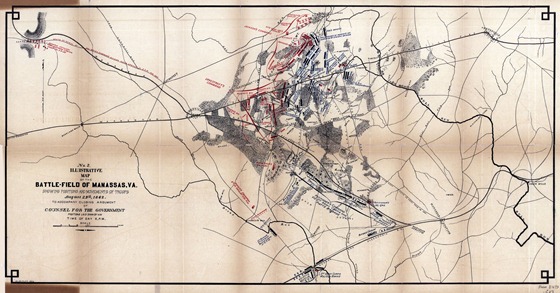
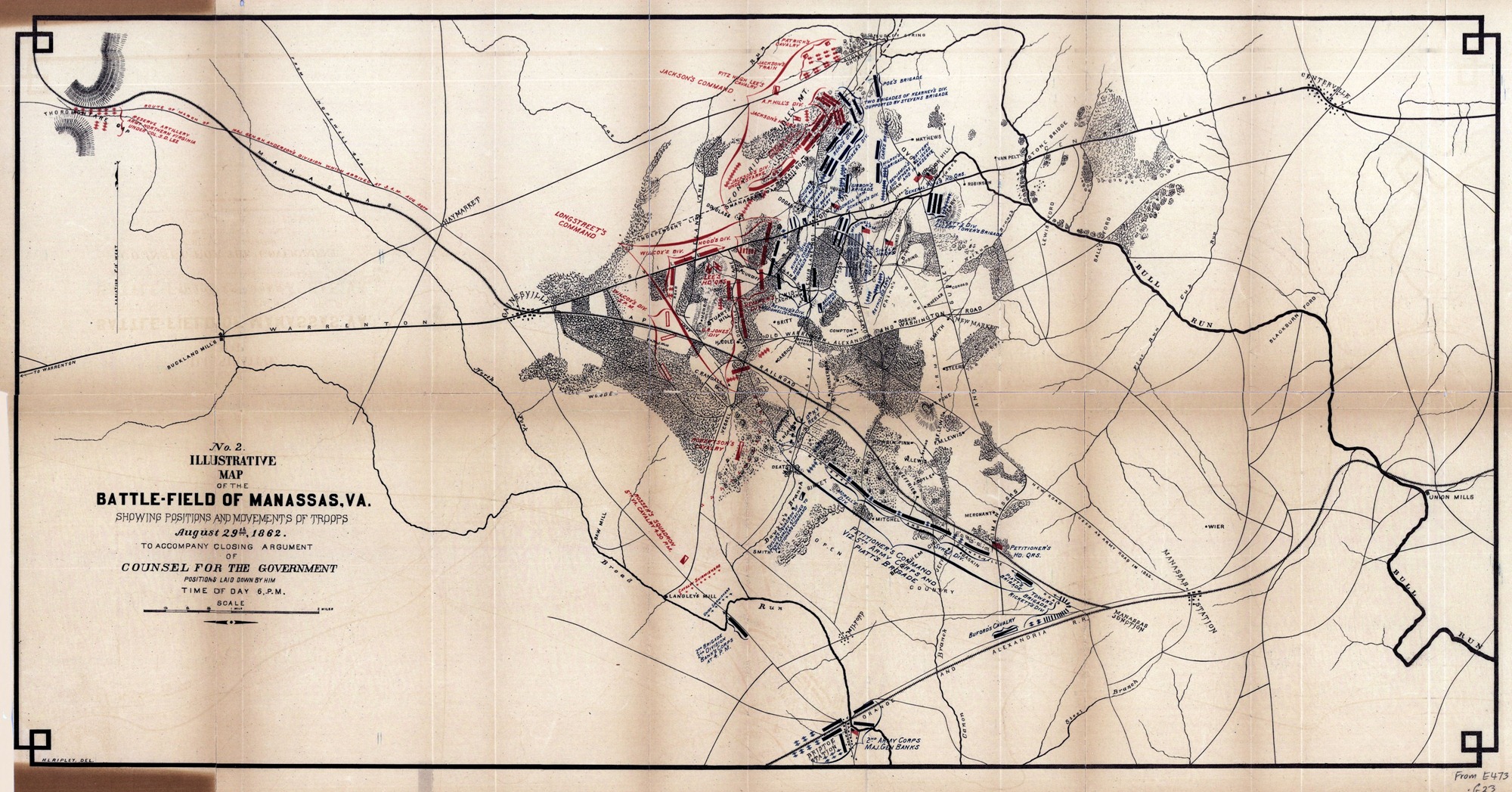
Folding map from: Argument of Asa Bird Gardner, counsel for government, after conclusion of the evidence in the case of Fitz-John Porter, before the Board of Army Officers at West Point, January 1879.
Illustrative map of the battlefield of Manassas, Va., showing positions and movement of troops August 29th, 1862. : to accompany closing argument of counsel for the government, positions laid down by him, time of day 6 P.M.
Library of Congress map.
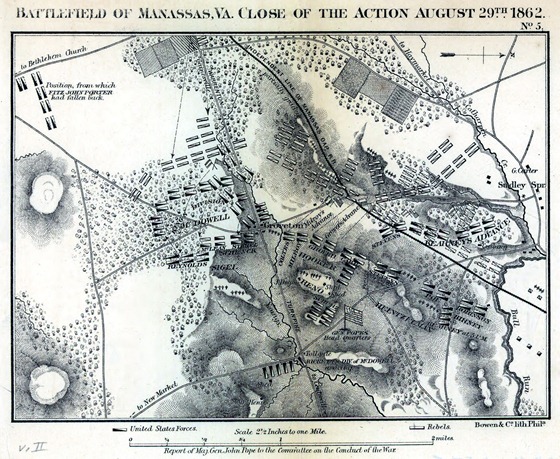
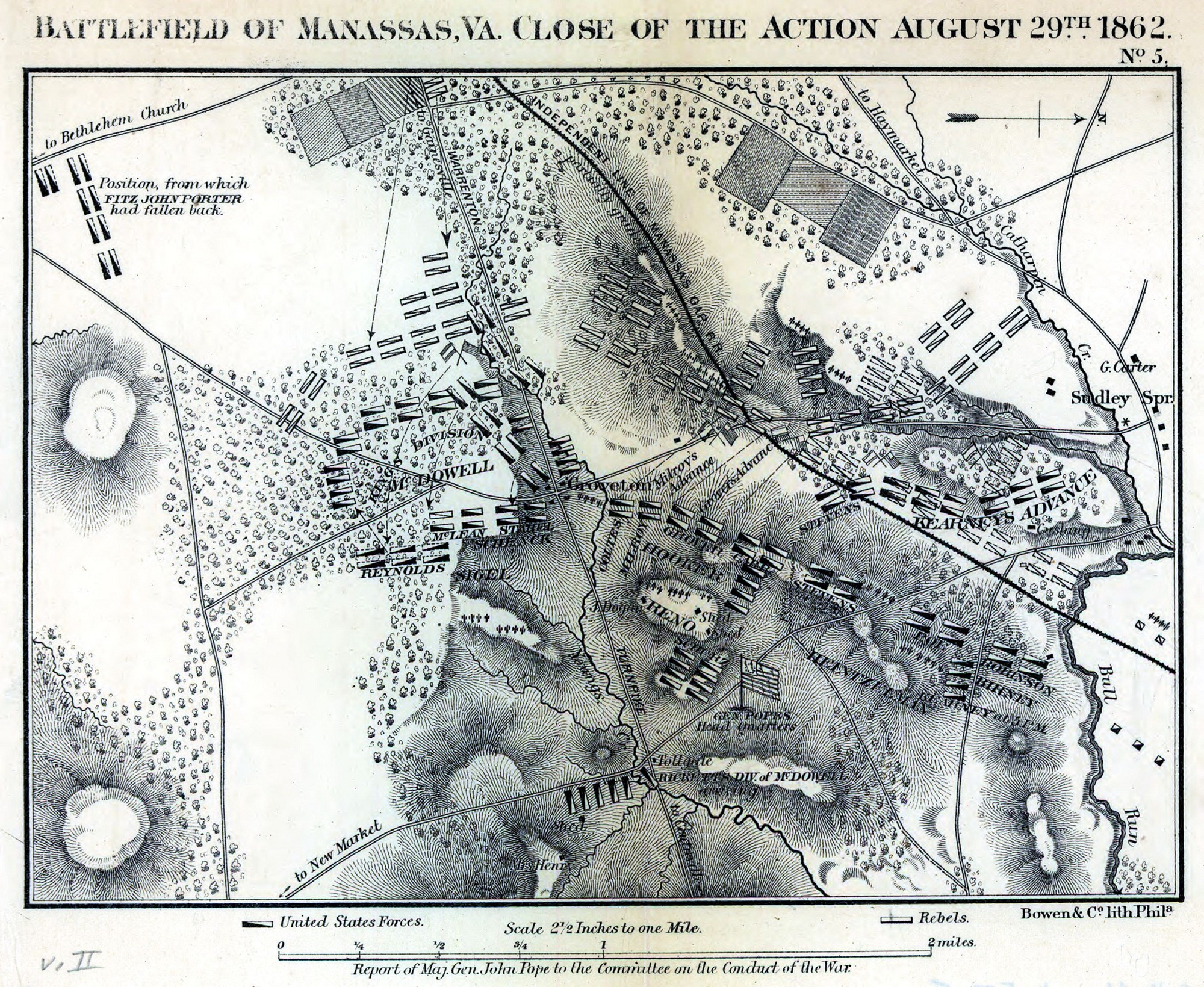
Accompanies “Report of Major General John Pope to the hon. Committee on the Conduct of the War.”
Handwritten note on verso reads as follows: There is very little in accuracy in this map. Porter is entirely misplaced & thrown some miles in front of his true position. Kings division of McDowell’s Corps never reached the position assigned beyond Groveton. Kearney also is thrown too far forward. A map of the positions on 28″ 29″ & 30th was sent to the War Department when Gen. Belknap was there by Gen. Porter before this colored map was thought of-with the request it might be used in compiling any map of 2d Bull Run. The data on that map was verified by Confederate as well as our officers.
Library of Congress map.
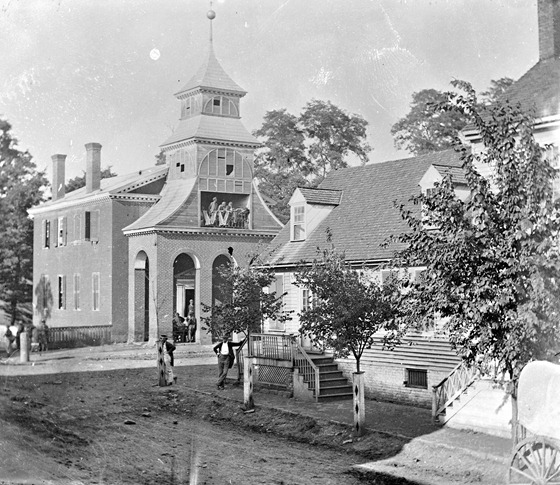
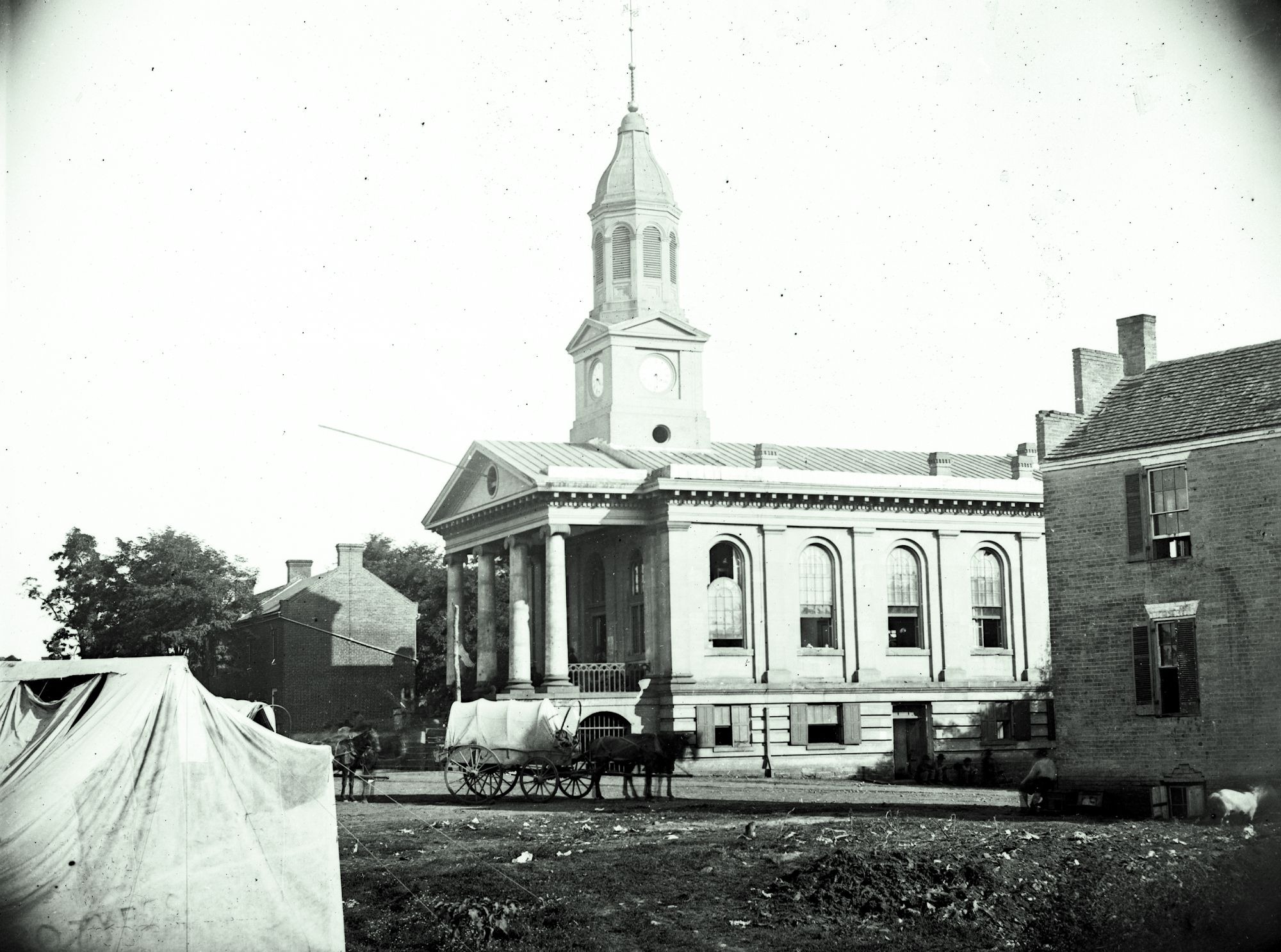
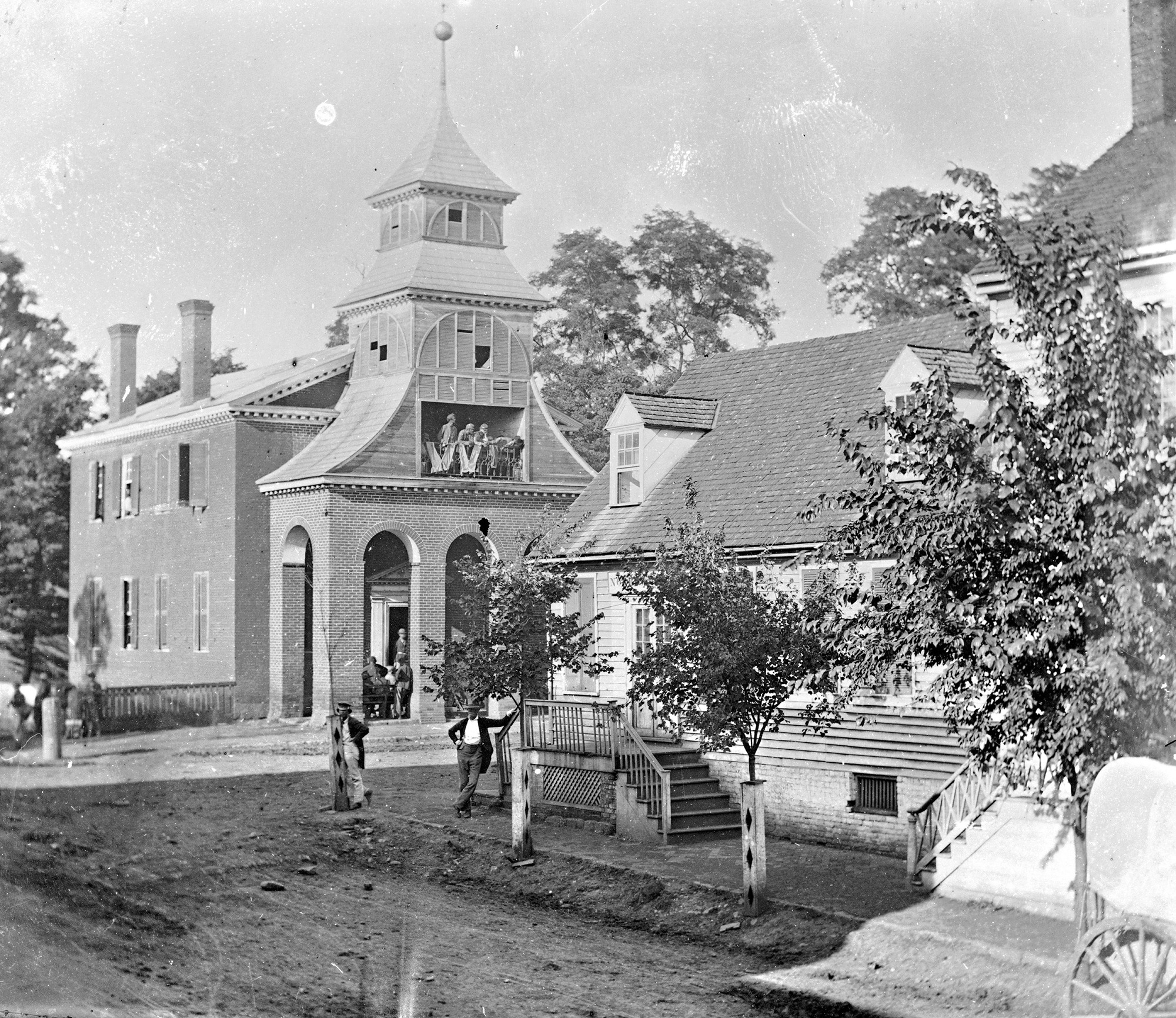
Culpeper Court House, Va. Court house, with a group of Confederates captured at Cedar Mountain on balcony; photo by Timothy H. O’Sullivan in August 1862.
Library of Congress image.