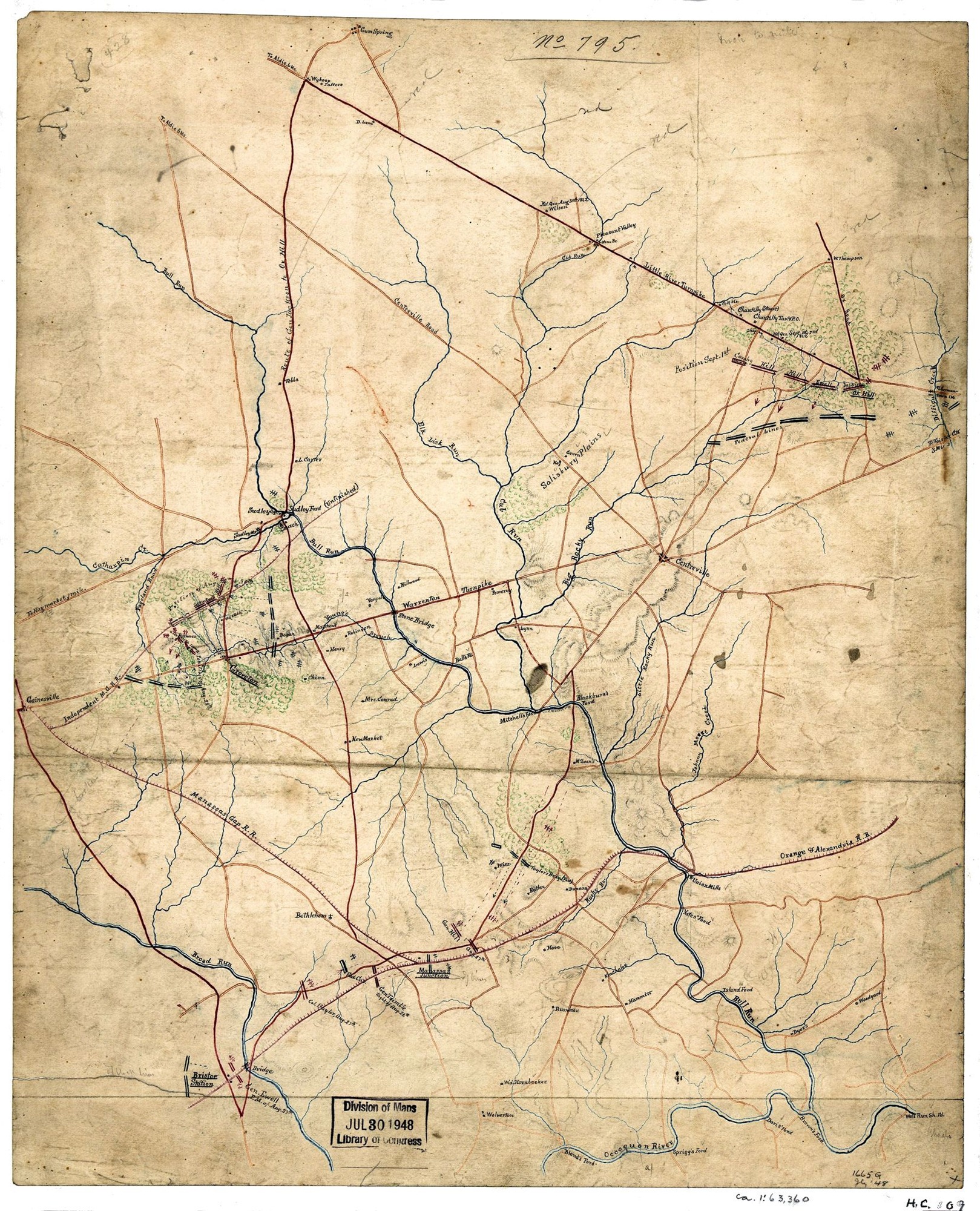
– Scale 1:126,720 (“half an inch to the mile”).- LC Civil War Maps (2nd ed.), 573.7- From U.S. Congress. Joint Committee on the Conduct of the War, in two volumes. Supplemental to Senate report no. 142, 38th Congress, 2d session (Washington, Government Printing Office, 1866). v. 2, fol. p. 190.- Accompanies “Report of Major General John Pope to the hon. Committee on the Conduct of the War.” 217 p.- “No. 4” is in the upper right margin.- Map indicates roads, railroads, place names, drainage, and troop positions.Library of Congress map
Library of Congress
Library of Congress image.
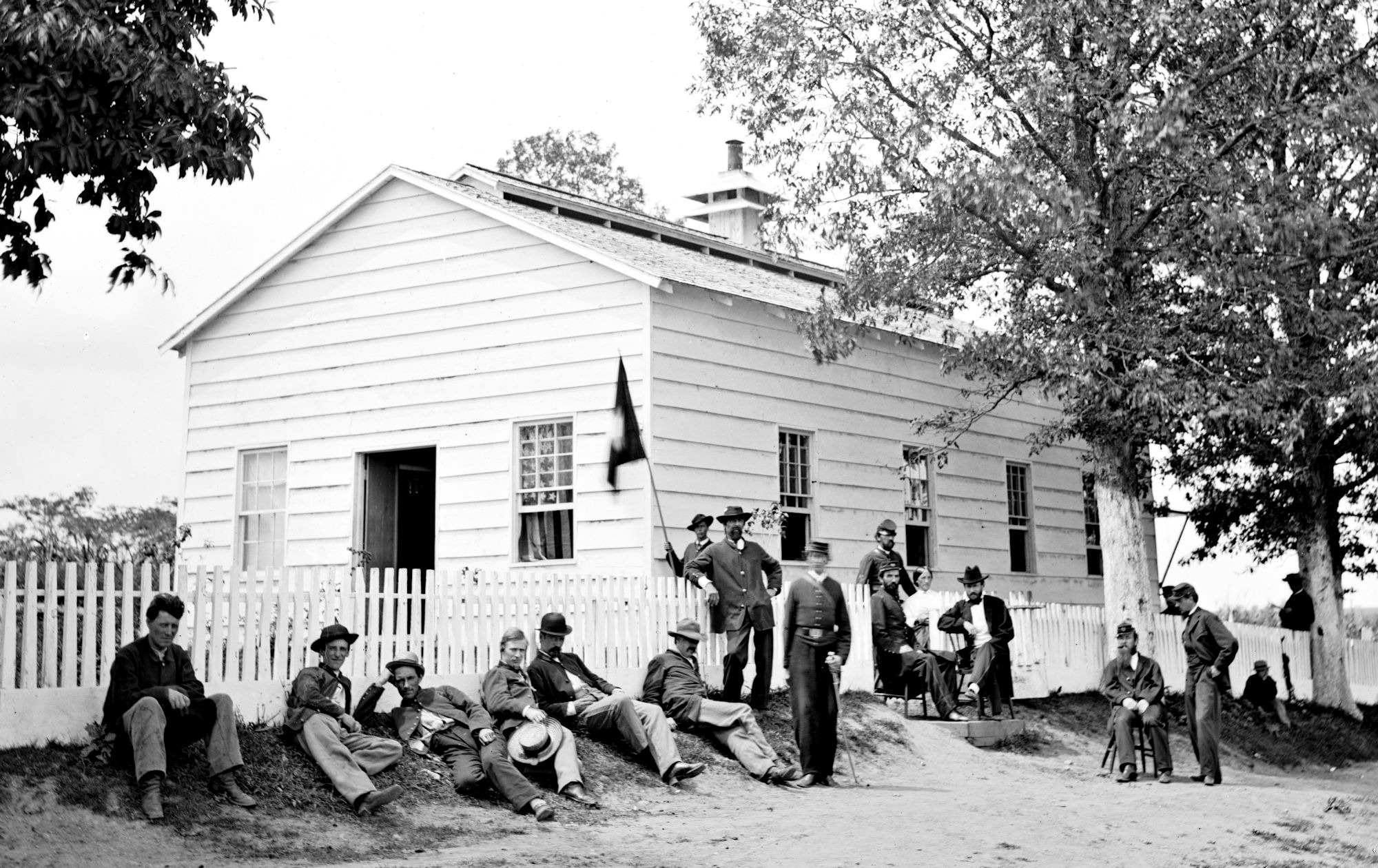
Title: [Washington, D.C. Hospitals, Signal Corps camp quarters near Georgetown]
August 1862

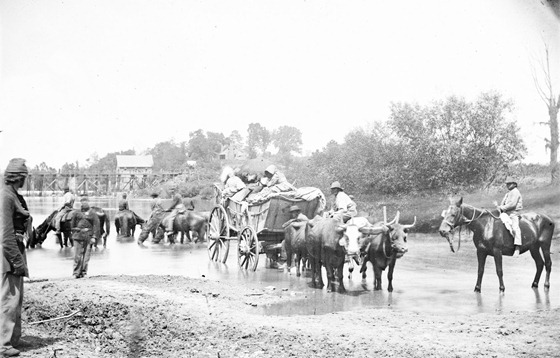
Rappahannock River, Va.; Fugitive slaves fording the Rappahannock – also Union soldiers along and in the river. Photo by Timothy H. O’Sullivan in August 1862.
Library of Congress image.
(Click on image for larger version)
Sketch showing positions of Second Corps, A.N.Va., August 26th to September 2, 1862 : embracing engagements at Bristoe Station, Manassas Junction, Groveton or Second Manassas, and Ox Hill or Chantilly, Va.
– Shows names of some residents.
– Relief shown by hachures.
– Title and scale from Stephenson’s Civil War maps, 1989.
– Pen-and-ink, colored pencil, and pencil mounted on cloth.
– Similar to the map reproduced in the Atlas to accompany the official records of the Union and Confederate Armies, 1891-95, pl. 111, no. 1.
Library of Congress map.

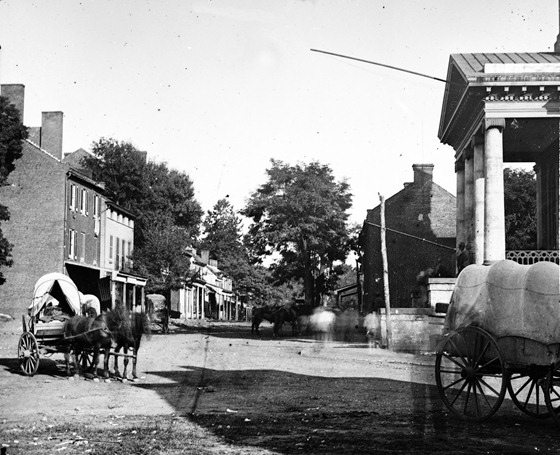
Warrenton, Va. Street in front of courthouse; by Timothy H. O’Sullivan in August 1862.
Library of Congress image.
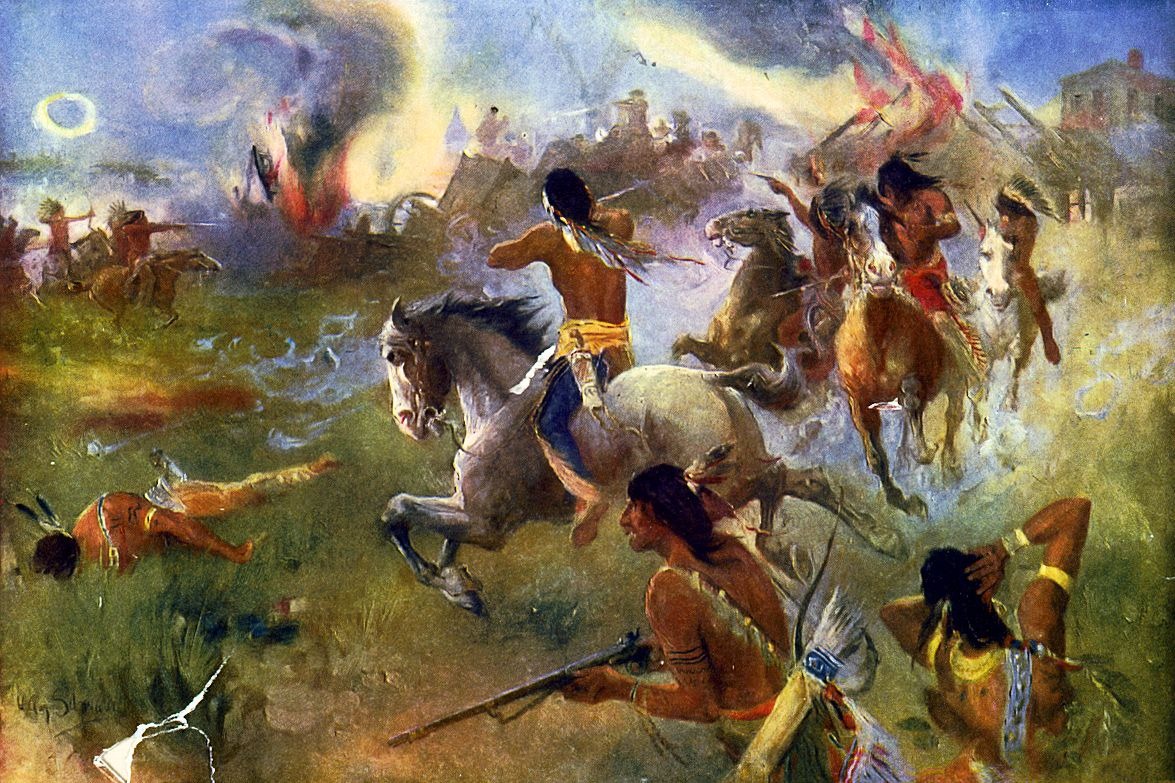
On August 18, 1862, a Union recruiting party was ambushed by Sioux warriors not long after leaving New Ulm. Survivors rushed back to warn the town. The town was attacked the next day, with warriors firing from a bluff above. A second attack occurred on August 23, when New Ulm was completely encircled by the attacking Indians.
_____________________
Battle between Sioux Indians and settlers in August 1862.
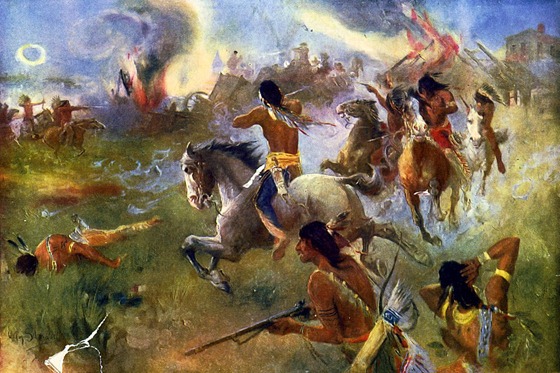
The siege of New Ulm, Minn, painted by H. Aug. Schwabe about 1902. Library of Congress image.
____________________
Battles of New Ulm (from Wikipedia)
The Battles of New Ulm were two battles in the Dakota War of 1862 in August. The settlement of New Ulm, Minnesota had 900 settlers around the time and was the largest settlement near the Sioux reservation. After the Battle of Fort Ridgely, the town was seen as a tempting target for a Sioux attack. The topography of the town also presented an advantage for the Sioux, since the land rises some 200 feet out of the Minnesota River valley in two large steps, with wooded area to provide cover for an attack.
On August 18, 1862, a recruiting party for Civil War volunteers left New Ulm, but was ambushed in Milford Township. The survivors raced back to town and warned the settlers of an impending attack. The townspeople prepared for the attack by erecting barricades on the streets and packing the women and children into any available brick buildings. The first attack came on August 19, with about 100 Sioux warriors firing on the city from the bluff behind the town. A small number of civilians returned the fire as best as they could. Later in the day, a thunderstorm discouraged the Indians from continuing their attack, and there were no chiefs present to give orders. The first battle ended with six settlers killed and five wounded.
After the first attack, Charles Eugene Flandrau reached the city as part of a detachment from St. Peter and Le Sueur. Dr. Asa W. Daniels, Dr. Otis Ayer, and Dr. William Worrall Mayo (father of William James Mayo and Charles Horace Mayo) were also part of this group. Dr. Mayo and Dr. William R. McMahan of Mankato set up a hospital in the Dacotah House and Drs. Ayer and Daniels set up a hospital in a store across the street. This undoubtedly helped in the treatment of the wounded.
Flandrau’s forces were bolstered by about a hundred men from Mankato, two companies from Le Sueur, and militias from Brown County, Nicollet County, St. Peter, Lafayette, and New Ulm. In all, Flandrau had about three hundred citizen-soldiers under his command, but most were poorly armed. Meanwhile, more than a thousand settlers were barricaded on New Ulm’s main street. On Saturday, August 23, around 9:30 in the morning, the Sioux began their second attack on the city. The Sioux were superior in numbers, and were able to encircle the entire town. The defenders of New Ulm set many buildings on fire in an attempt to create an open space without cover. Captain William B. Dodd, second in command, was killed while leading soldiers beyond one of the barricades of the city. After nightfall, Flandrau ordered that the rest of the buildings outside of the barricades to be burned. In all, 190 structures within the city were destroyed. The next morning, August 24, the Indians reappeared, fired some harmless long-range shots, and then withdrew. Flandrau convened with his officers later that day and decided to evacuate the city, due to a shortage of ammunition and food and epidemics of disease. The following morning, August 25, 2000 people, including 153 wagons and a large number of refugees, left the city and headed to Mankato, about 30 miles to the east. The procession was escorted by about 150 troops and made it through to Mankato safely.

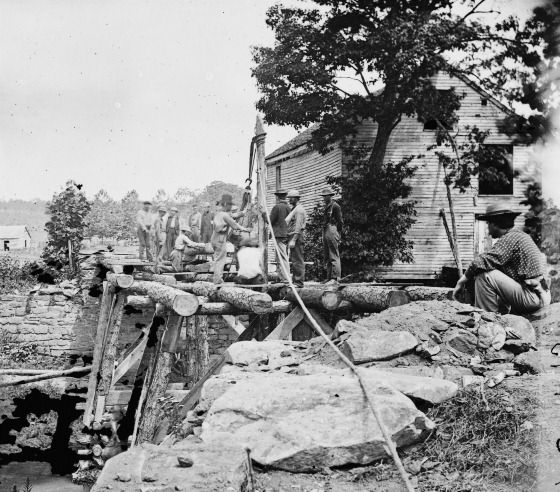
Troops building bridges across the north fork of the Rappahannock in the vicinity of Fauquier Sulphur Springs, Va., by Timothy H. O’Sullivan in August 1862.
It is highly likely that the fellow on the right is the photographer, O’Sullivan. This is the fifth photo I’ve found in this period of time – July and August 1862 – where he appears in the image.
Library of Congress image.
____
The four other images from the summer of 1862 with images that include O’Sullivan were published in the following posts:
- Timothy H. O’Sullivan. — A Photographer at Manassas.
- Locomotive on the Orange & Alexandria Railroad in Virginia – in foreground with back to camera, dressed the same as in the top image.
- Federal battery fording a tributary of the Rappahannock – on right side of image next to the same wagon as is in the above two images.
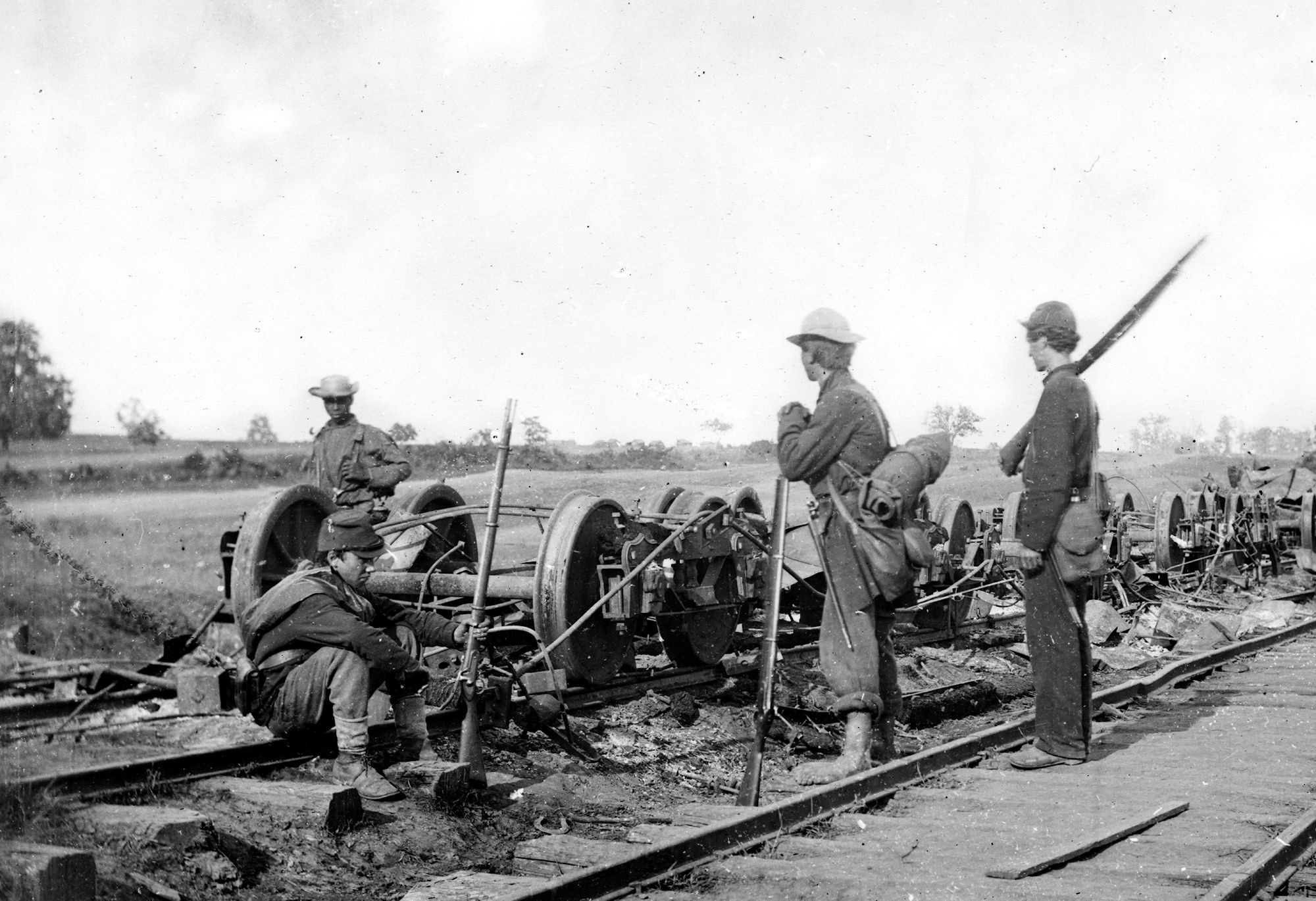
Manassas Junction, Va. Soldiers beside damaged rolling stock of the Orange & Alexandria Railroad; photograph taken by Timothy H. O’Sullivan.
Library of Congress image.
(click on image to view larger version)
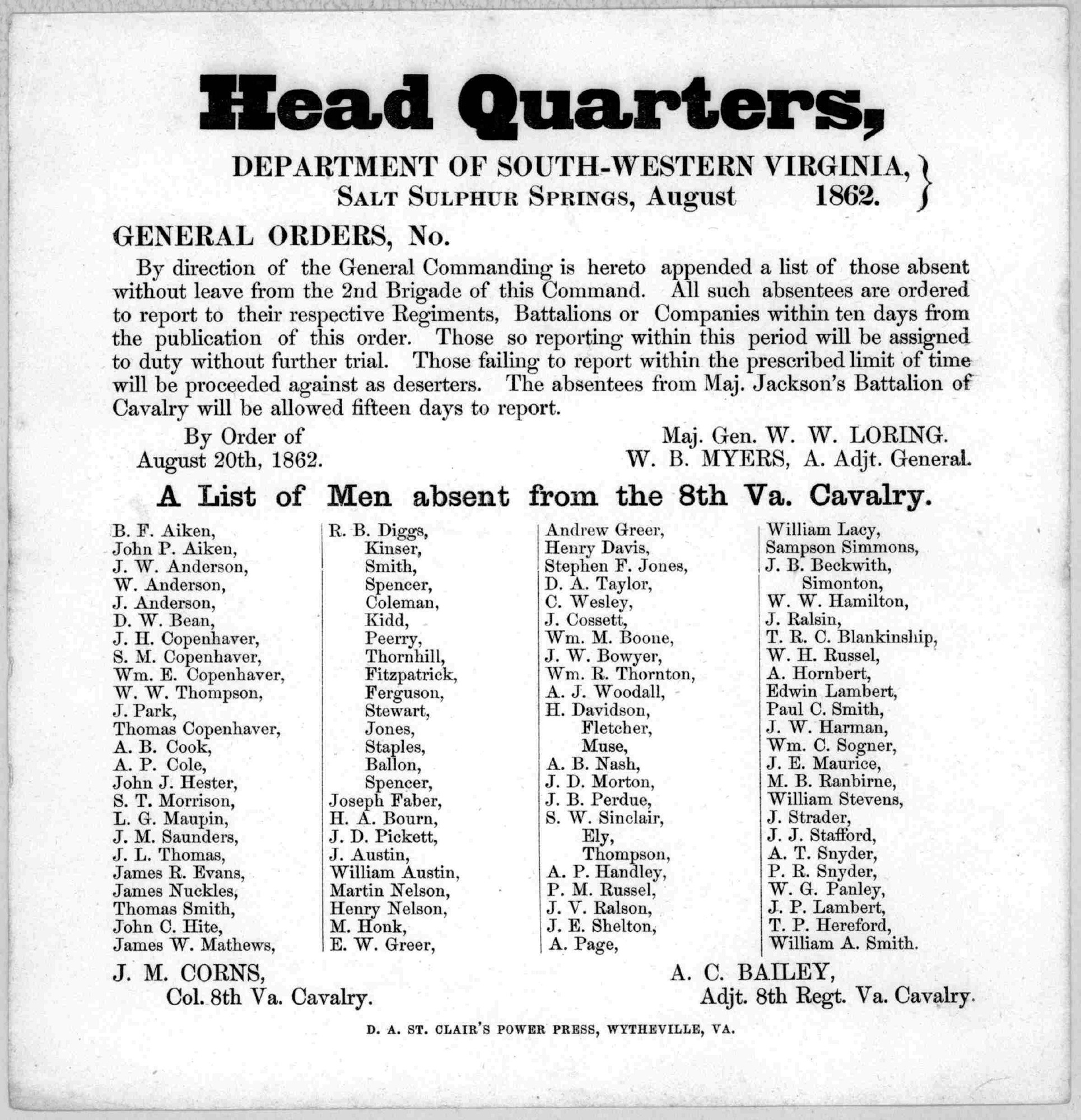
Head Quarters,
DEPARTMENT OF SOUTH-WESTERN VIRGINIA,
Salt Sulphur Springs, August……….1862.
GENERAL ORDERS, No.
By direction of the General Commanding is hereto appended a list of those absent without leave from the 2nd Brigade of this Command. All such absentees are ordered to report to their respective Regiments, Battalions or Companies within ten days from the publication of this order. Those so reporting within this period will be assigned to duty without further trial. Those failing to report within the prescribed limit of time will be proceeded against as deserters. The absentees from Maj. Jackson’s Battalion of Cavalry will be allowed fifteen days to report.
By Order of
August 20th, 1862.
- Maj. Gen. W. W. LORING.
- W. B. MYERS, A. Adjt. General.
- A List of Men absent from the 8th Va. Cavalry.
- B. F. Aiken,
- John P. Aiken,
- J. W. Anderson,
- W. Anderson,
- J. Anderson,
- D. W. Bean,
- J. H. Copenhaver,
- S. M. Copenhaver,
- Wm. E. Copenhaver,
- W. W. Thompson,
- J. Park,
- Thomas Copenhaver,
- A. B. Cook,
- A. P. Cole,
- John J. Hester,
- S. T. Morrison,
- L. G. Maupin,
- J. M. Saunders,
- J. L. Thomas,
- James R. Evans,
- James Nuckles,
- Thomas Smith,
- John C. Hite,
- James W. Mathews,
- R. B. Diggs,
- Kinser,
- Smith,
- Spencer,
- Coleman,
- Kidd,
- Peerry,
- Thornhill,
- Fitzpatrick,
- Ferguson,
- Stewart,
- Jones,
- Staples,
- Ballon,
- Spencer,
- Joseph Faber,
- H. A. Bourn,
- J. D. Pickett,
- J. Austin,
- William Austin,
- Martin Nelson,
- Henry Nelson,
- M. Honk,
- E. W. Greer,
- Andrew Greer,
- Henry Davis,
- Stephen F. Jones,
- D. A. Taylor,
- C. Wesley,
- J. Cossett,
- Wm. M. Boone,
- J. W. Bowyer,
- Wm. R. Thornton,
- A. J. Woodall,
- H. Davidson,
- Fletcher,
- Muse,
- A. B. Nash,
- J. D. Morton,
- J. B. Perdue,
- S. W. Sinclair,
- Ely,
- Thompson,
- A. P. Handley,
- P. M. Russel,
- J. V. Ralson,
- J. E. Shelton,
- A. Page,
- William Lacy,
- Sampson Simmons,
- J. B. Beckwith,
- Simonton,
- W. W. Hamilton,
- J. Ralsin,
- T. R. C. Blankinship,
- W. H. Russel,
- A. Hornbert,
- Edwin Lambert,
- Paul C. Smith,
- J. W. Harman,
- Wm. C. Sogner,
- J. E. Maurice,
- M. B. Ranbirne,
- William Stevens,
- J. Strader,
- J. J. Stafford,
- A. T. Snyder,
- P. R. Snyder,
- W. G. Panley,
- J. P. Lambert,
- T. P. Hereford,
- William A. Smith.
- J. M. CORNS,
Col. 8th Va. Cavalry. - A. C. BAILEY,
Adjt. 8th Regt. Va. Cavalry.
D. A. ST. CLAIR’S POWER PRESS, WYTHEVILLE, VA.
Broadsides, leaflets, and pamphlets from America and Europe

Library of Congress image.
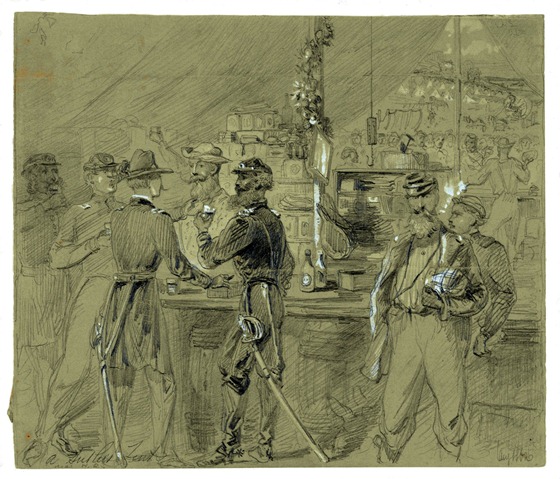
Detailed sketch of the interior of a sutler’s tent, with several full-length portraits of unidentified officers drinking at a bar in the foreground, drawn in August 1862, byArthur Lumley.