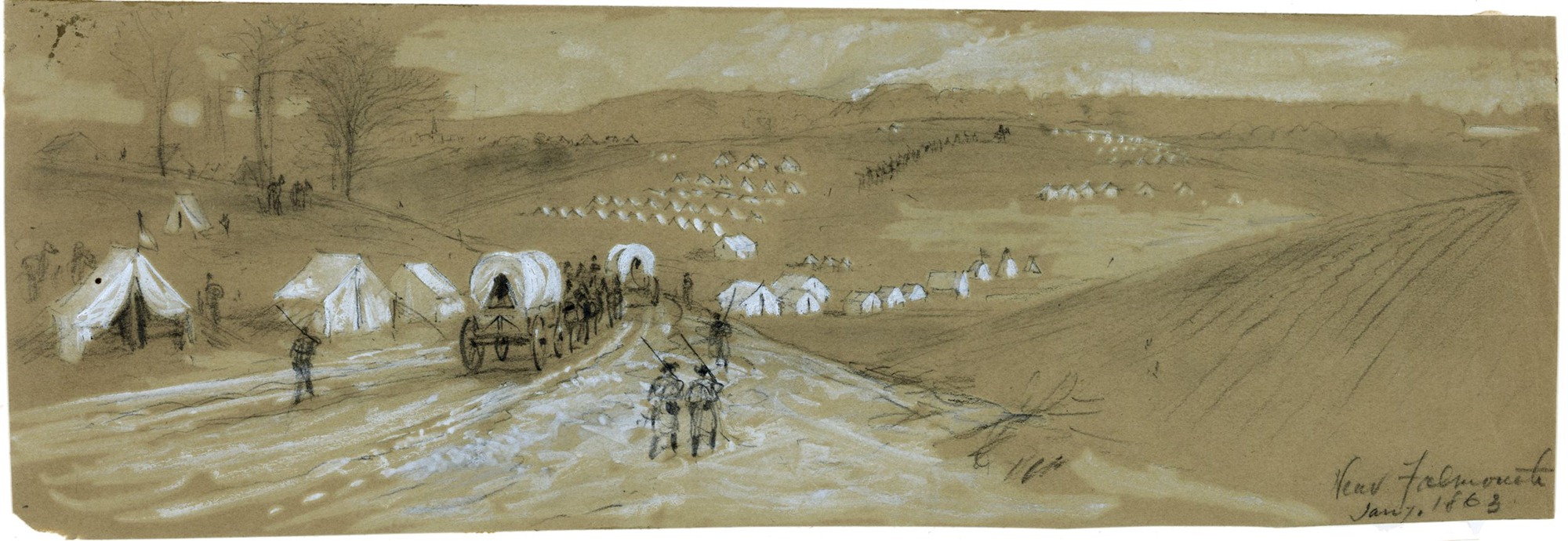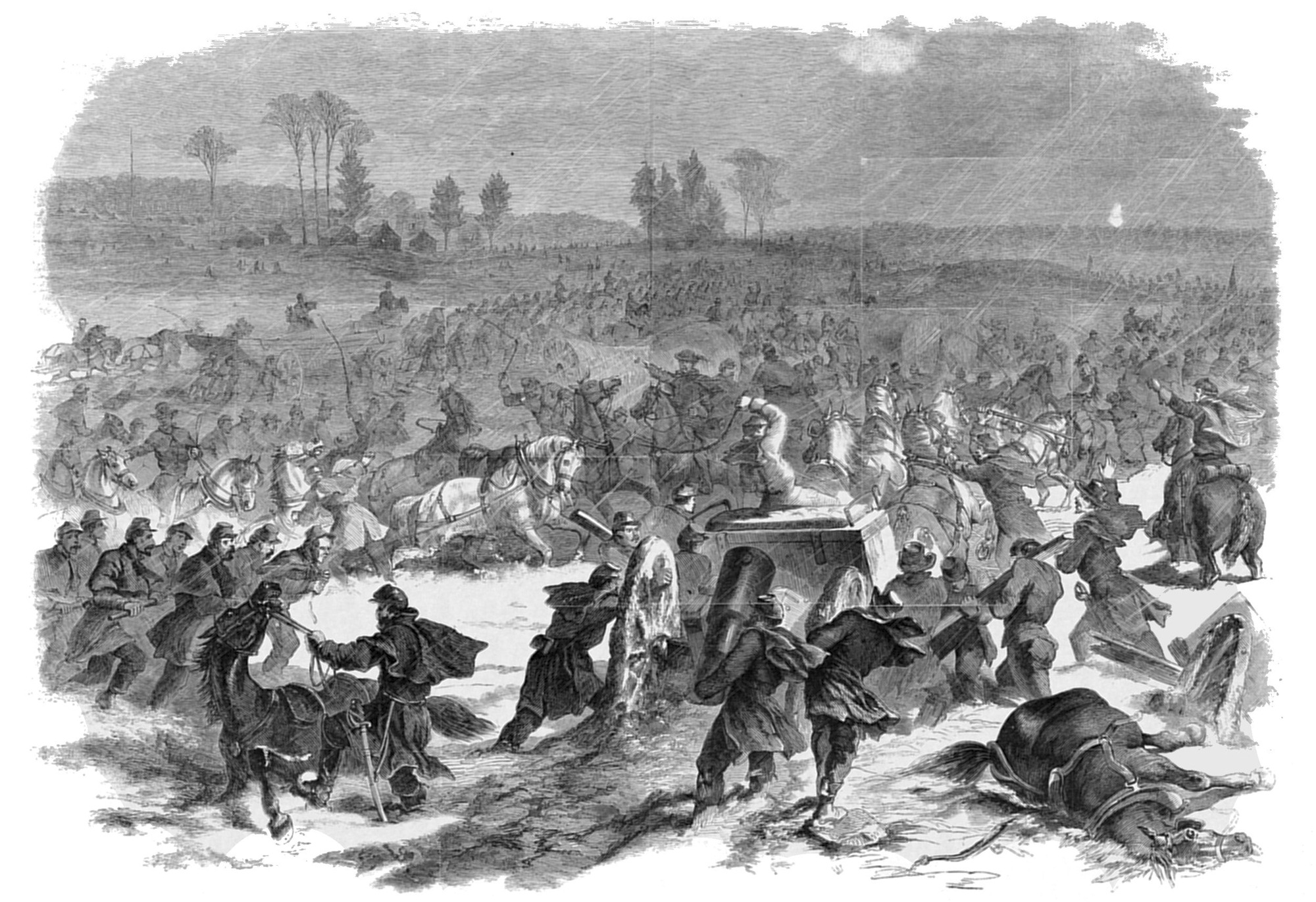
March of the Army of the Potomac Towards Richard’s Ford, Rappahannock River, Under General Burnside, Interrupted by the Storm of Wednesday, January 21. (Published in Frank Leslie’s Illustrated Newspaper, February 14, 1863)
March of the Army of the Potomac Towards Richard’s Ford, Rappahannock River, Under General Burnside, Interrupted by the Storm of Wednesday, January 21. (Published in Frank Leslie’s Illustrated Newspaper, February 14, 1863)
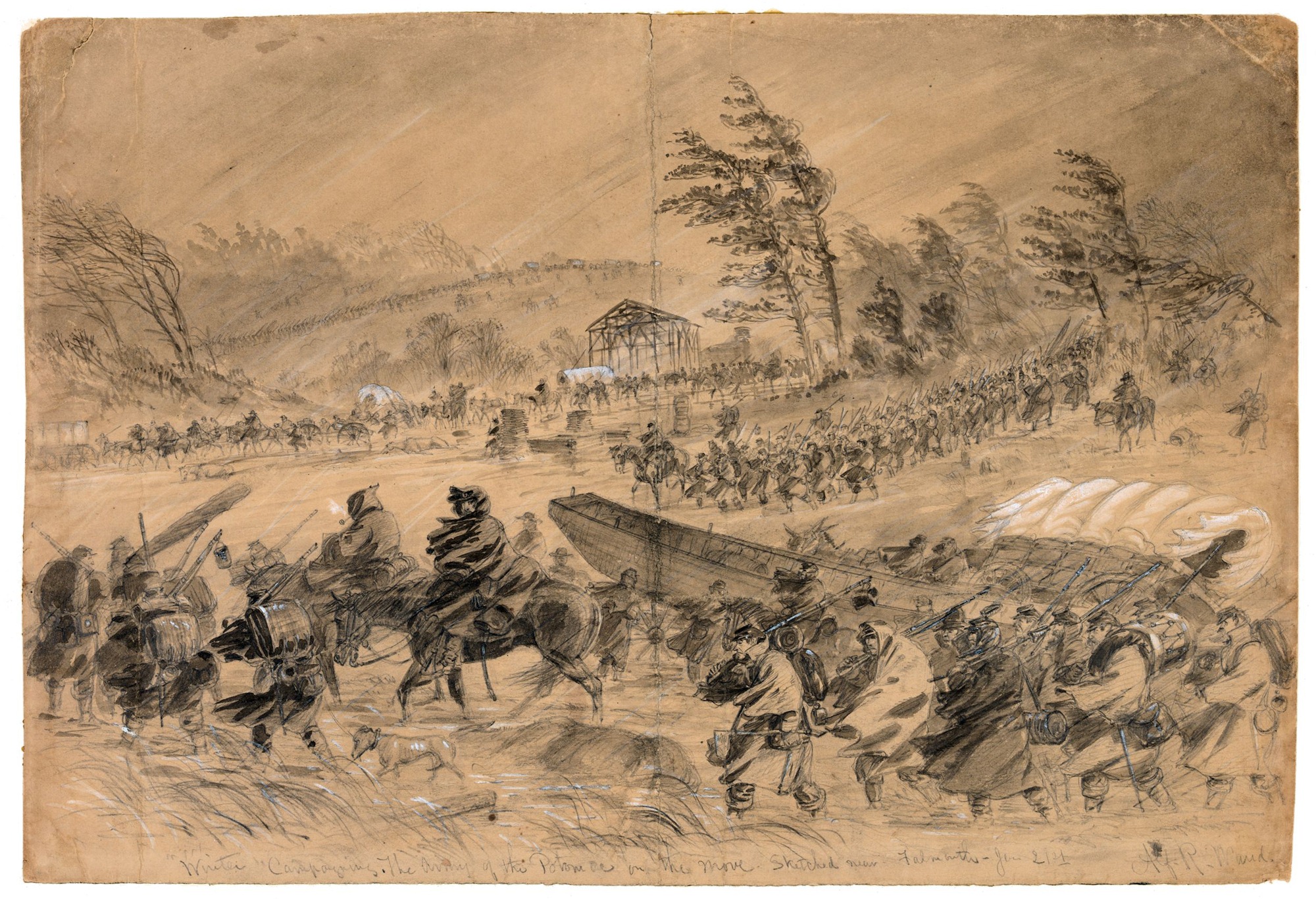
Summary: Exhibit caption: Alfred R. Waud depicts Union forces coping with the challenge of winter weather in 1863 as they advanced toward the Rappahannock River. He skillfully delineates formations of soldiers, wagons, and animals traversing the foreground, middle ground, and background of the scene and vividly captures the impact of blustery winter wind and snow in their bent and bowed forms. The British-born Waud won wide acclaim for his visual reportage of Civil War battles and soldiers’ living conditions because he incorporated impressive amounts of accurately observed details into compositions that convey strong expressive effects. More than 1,200 sketches he created for Harper’s Weekly are preserved in the Prints & Photographs Division. (January 21, 1863. Library of Congress image.)
The New York Times correspondent wrote of the night depicted in the image:
It was a wild Walpurgus night, such as Goethe paints in the “Faust” while the demons held revel in the forest of the Brocken. All hopes that it would be a “mere shower” were presently blasted. It was evident we were in for a regular northeaster, and among the roughest of that rough type. Yet was there hard work done that fearful night. One hundred and fifty pieces of artillery were to be planted in the position selected for them by General Hunt, Chief of Artillery—a man of rare energy and of a high order of professional skill. The pontoons, also, were drawn down nearer toward the river, but it was dreadful work; the roads under the influence of the rain were becoming shocking; and by daylight, when the boats should all have been on the banks, ready to slide down into the water, but fifteen had been gotten up—not enough for one bridge, and five were wanted!
The night operations had not escaped the attention of the wary rebels. Early in the morning a signal-gun was fired opposite the ford, reminding one of that other signal-gun fired by them on the morning of Thursday the 11th December, when we began laying the pontoon opposite Fredericksburg, and which was the token for the concentration of the whole force at that point. It was indispensable that we should secure all the advantages of a surprise; and though our intention was thus blown to their ears early on Wednesday morning, we were, nevertheless, forty-eight hours ahead of them, and with favorable conditions should have been able to carry our position before they could possibly concentrate.
Accordingly a desperate effort was made by the Commanding General to get ready the bridges. It was obvious, however, that, even if completed, it would be impossible for us, in the then condition of the ground, to get a single piece of artillery up the opposite declivity. It would be necessary to rely wholly upon the infantry—indeed, wholly on the bayonet. Happily, if the rebels should prove to be in strong force, the country is too thickly wooded to admit of much generalship, and it was hoped that our superior weight of metal would carry the day.
Early in the forenoon I rode up to the head-quarters of Generals Hooker and Franklin, about two miles from Banks’s Ford. The night’s rain had made deplorable havoc with the roads. The nature of the upper geologic deposits of this region affords unequaled elements for bad roads. The sand makes the soil pliable, the clay makes it sticky, and the two together form a road out of which, when it rains, the bottom drops, but which is at the same time so tenacious that extrication from its clutch is all but impossible.
The utmost effort was put forth to get pontoons enough into position to construct a bridge or two. Double and triple teams of horses and mules were harnessed to each pontoon-boat. It was in vain. Long, powerful ropes were then attached to the teams, and a hundred and fifty men were put to the task on each boat. The effort was but little more successful. They would flounder through the mire for a few feet—the gang of Liliputians with their huge-ribbed Gulliver—and then give up breathless. Night arrived, but the pontoons could not be got up. The rebels had discovered what was up, and the pickets on the opposite bank called over to ours that they “would come over to-morrow and help us build the bridge.”
That night the troops again bivouacked in the same position in the woods they had held the night before. You can imagine it must have been a desperate experience—and yet not by any means as bad as might be supposed. The men were in the woods, which afforded them some shelter from the wind and rain, and gave them a comparatively dry bottom to sleep on. Many had brought their shelter-tents; and making a flooring of spruce, hemlock, or cedar boughs, and lighting huge camp fires, they enjoyed themselves as well as the circumstances would permit. On the following morning a whisky ration, provided by the judicious forethought of General Burnside, was on hand for them.
Thursday morning saw the light struggling through an opaque envelop of mist, and dawned upon another day of storm and rain. It was a curious sight presented by the army as we rode over the ground; miles in extent, occupied by it. One might fancy some new geologic cataclysm had o’ertaken the world; and that he saw around him the elemental wrecks left by another Deluge. An indescribable chaos of pontoons, wagons, and artillery encumbered the road down to the river—supply-wagons upset by the road-side—artillery “stalled” in the mud—ammunition. trains mired by the way. Horses and mules dropped down dead, exhausted with the effort to move their loads through the hideous medium. A hundred and fifty dead animals, many of them buried in the liquid muck, were counted in the course of a morning’s ride. And the muddle was still further increased by the bad arrangements—or rather the failure to execute the arrangements that had been made. It was designed that Franklin’s column should advance by one road and hooker’s by another. But, by mistake, a portion of the troops of the Left, Grand Division debouched into the road assigned to the centre, and cutting in between two divisions of one of Hooker’s corps, threw every thing into confusion. In consequence, the woods and roads have for the past two days been filled with stragglers, though very many of them were involuntary stragglers, and were evidently honestly seeking to rejoin their regiments. It was now no longer a question of how to go on; it was a question of how to get back.
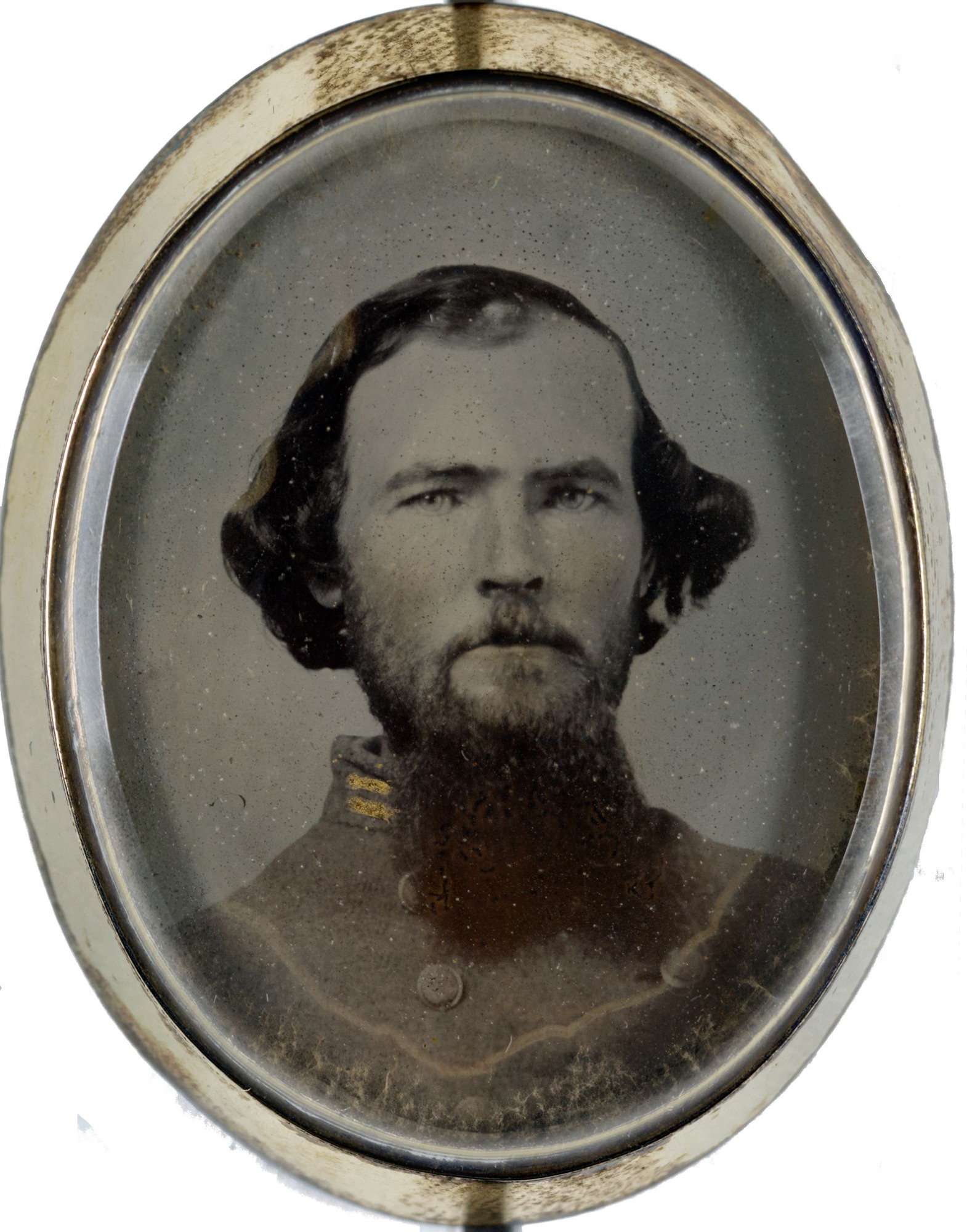
Medium: 1 photograph : ambrotype, hand-colored ; 5.0 x 3.7 cm (brooch)
Gift; Tom Liljenquist; 2012;
Liljenquist Family Collection of Civil War Photographs; Ambrotype/Tintype photograph filing series; Library of Congress Prints and Photographs Division.
Record page for image is here.
Civil War Portrait 018
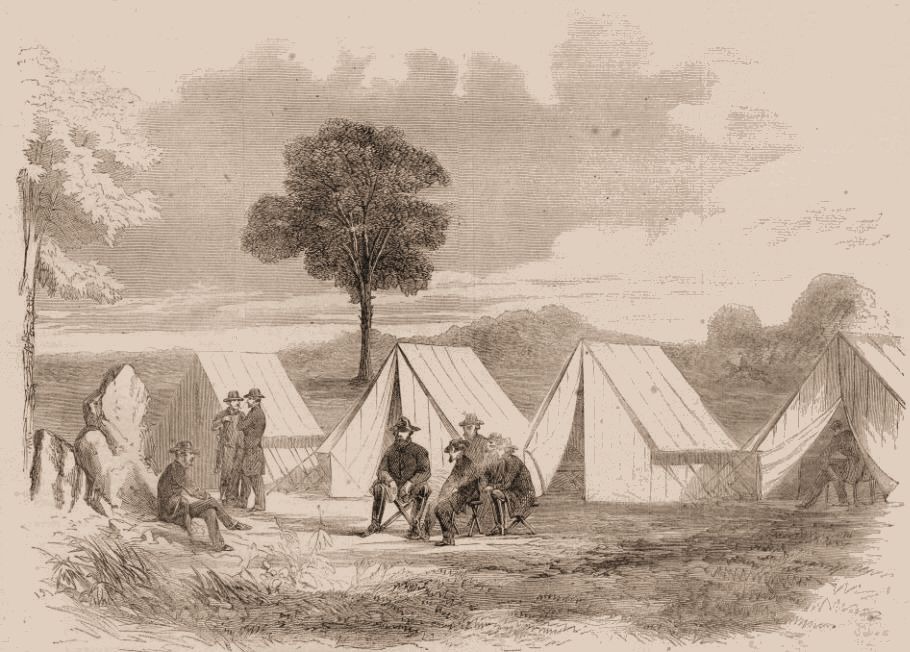
WE publish on page 109 a picture of STONEWALL JACKSON IN CAMP, from a sketch by Mr. Vizetelly, the artist of the London Illustrated News, who has cast his lot among the rebels. This sketch was made some weeks since, and was sent from Secessia in the vessel which was lately captured off Charleston. All the documents found on board were transmitted to Admiral Dupont. Some of them, such as the correspondence between Benjamin and the rebel agents in Europe, have been published in the papers. What became of Mr. Vizetelly’s drawings we can not tell; but the one we reproduce was kindly traced for us, by permission of the Admiral, and thus sees the light—rather unexpectedly to its author—in our columns.
(Published in Harper’s Weekly, February 14, 1863)
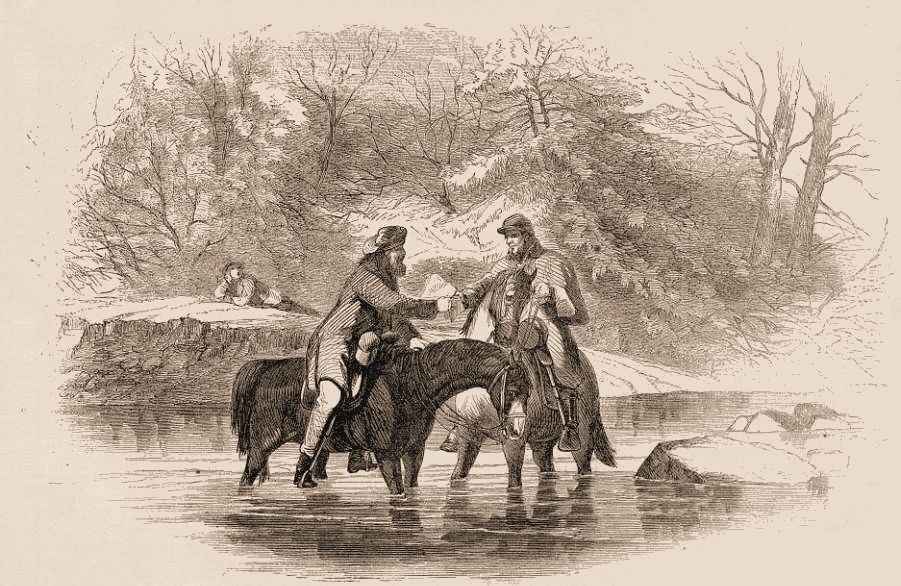
ONE of our correspondents, Mr. Oertel, has illustrated one of the few amenities of war, the INTERCHANGE OF CIVILITIES BETWEEN TWO MOUNTED PICKETS on the Upper Rappahannock. When the war first broke out the pickets on either side used to fire at each other on sight, and it gave our officers a good deal of trouble to check the murderous practice. The rule is now the other way. The pickets no sooner find themselves within hailing distance than they begin to converse; and the chat generally ends in an interchange of rations, liquor, and newspapers. This custom is severely reprobated by most of our Generals, but is very common nevertheless. Mr. Ocrtel writes: “During the recent engagement at Fredericksburg it was a most essential precaution to guard against a flank movement by the enemy, and the fords above on the river were vigilantly watched. This important duty was assigned to the Sixth New York Cavalry, who by former experience knew all the fords and roads thereabout well, and they were there by special order of General Burnside, commanded by Lieutenant-Colonel M’Vicar. They are at the post still. The duty is arduous, and one of danger, being at the extreme right, and in sight and within easy reach of the enemy. The pickets sometimes meet, by special agreement, in the middle of the river, first laying down their arms at their respective shores, and in this wise they friendly converse, and exchange such commodities as tobacco and newspapers.”
(Published February 7, 1863, in Harper’s Weekly.)
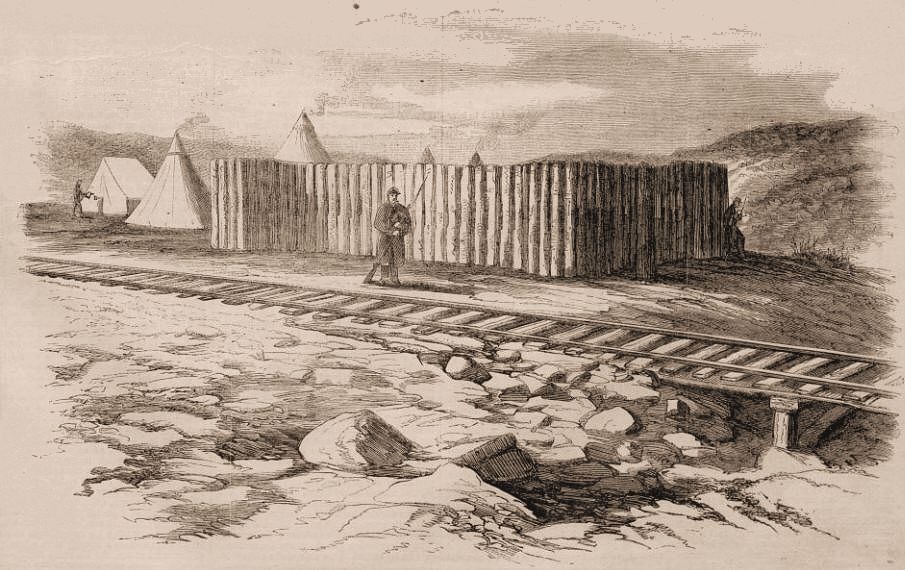
ON this page we reproduce a sketch sent us by our special artist in Tennessee, Mr. Frank Beard, representing one of the numerous STOCKADES erected on the line of the Louisville and Nashville Railroad for the protection of the track. Every bridge of consequence is guarded by one of these stockades, and most of the stations likewise. Garrisoned by a few disciplined troops, these stockades can resist the attack of a very large force indeed. What a picture of grim war these stockades conjure up!
(Published February 7, 1863, in Harper’s Weekly.)
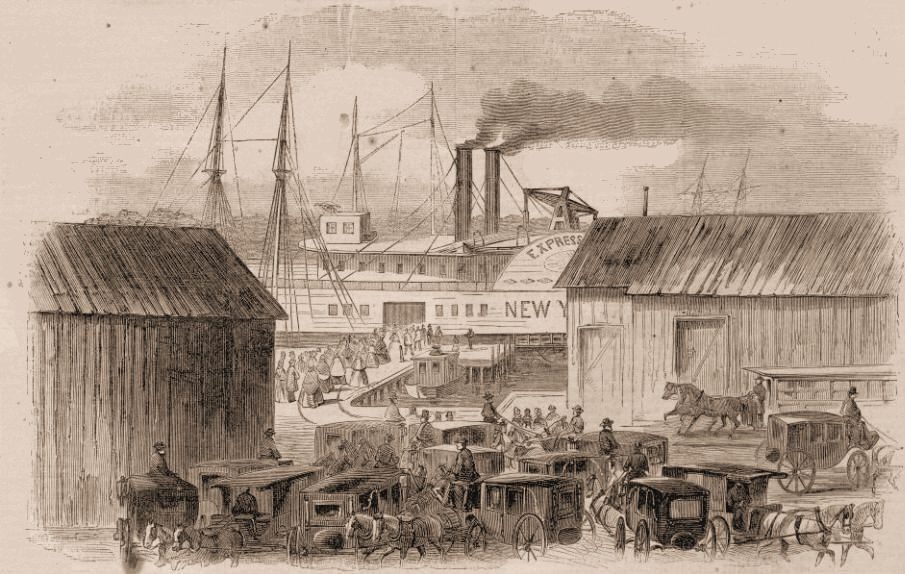
One day last week the steamer New York took 450 women and children from Washington to the realms of Secessia. They all had, or claimed to have, friends or relatives in Jeff Davis’s kingdom, and were sent South at Government expense. Among the number were several young women whose departure from the Federal capital will lighten the duties of the provost-marshal. The Washington Star says:
Had their baggage passed without inspection they would have added much also to the necessities of the Southerners in dry goods, shoes, medicines, and many other articles and goods much required at the present time in Jeff Davis’s domains. Eight officers were engaged all last night in examining the baggage that had been sent down. In many of the trunks were found dress goods of various kinds and textures, pins, needles, thread, etc., which articles were, of course, excluded.
In one very large trunk a sufficient quantity of dry goods was found to fully stock a country store. Some of the trunks had ten, fifteen, and as high as twenty-five. pairs of shoes. No passenger, however, was allowed to take more than two pairs. One lady, when asked why she desired to take so many, replied that she generally wore out two pair per month! All this morning the wharf and the neighborhood of Sixth Street was crowded with ladies and gentlemen, who resorted there to witness the departure and for the purpose of saying farewell to friends.
Judging from the expressions we heard in the crowd secesh sympathizers predominated. A gentleman asked an old lady who was going off whether she was pleased at her departure. She replied, “Yes, thank God! it is a great pleasure to get to a Government conducted by gentlemen, and not by Yankee boors.” A crowd immediately gathered around, and then commenced expressions of contempt from fair lips for the United States Government generally, and the President and Cabinet in particular. One young lady remarked to a friend as she bade her good-by, “Be sure and write quickly; you know how to get the letter through.” Another lady remarked that she hoped to return ere long, but with the victorious Confederate army.
(Published January 24, 1863, in Harper’s Weekly.)
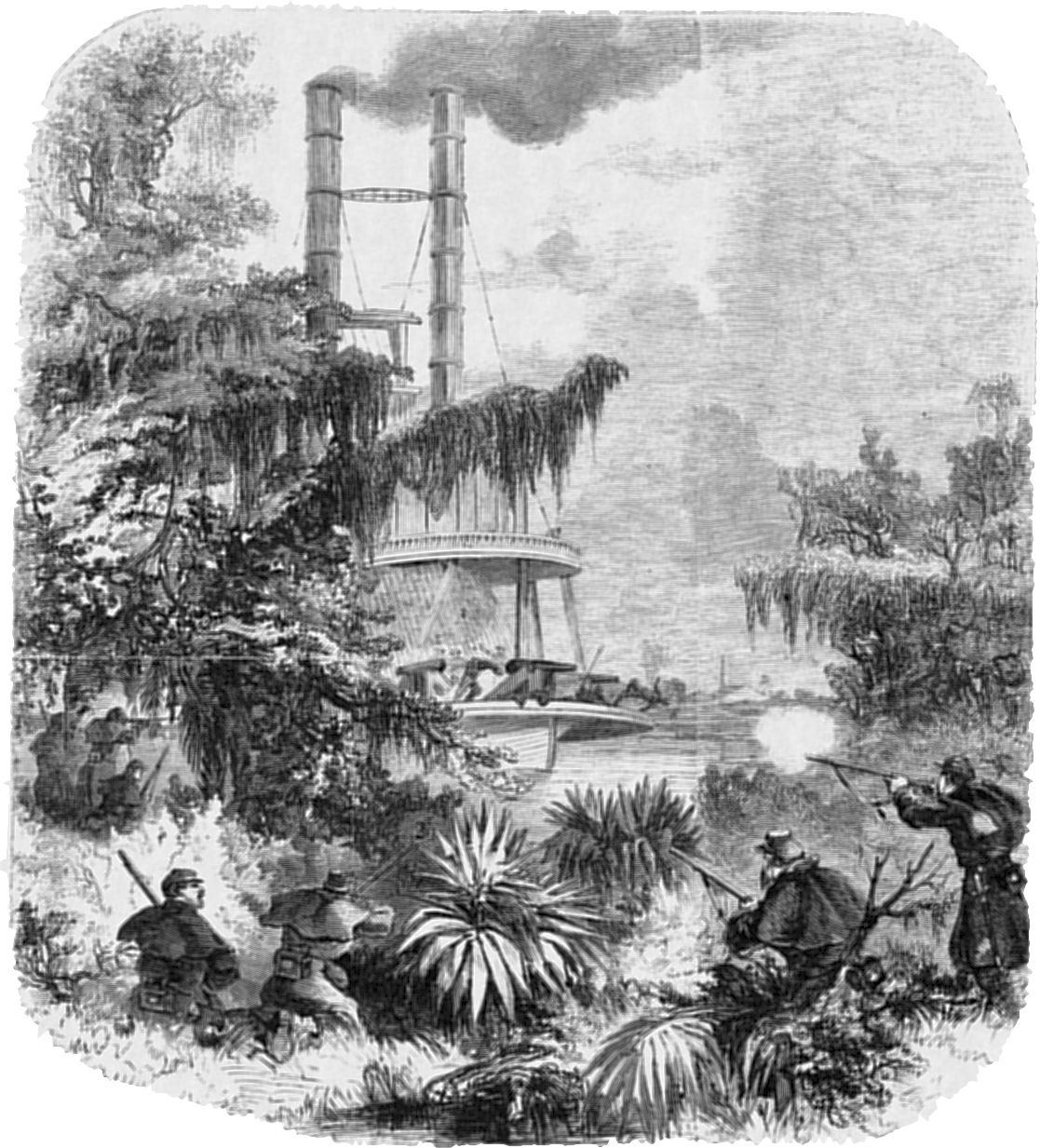
Sharpshooters of the 75th New York Vol., Picking off the Gunners on the Rebel Gunboat J. A. Cotton, in the Action at Bayou Teche, January 14. (Published in Frank Leslie’s Illustrated Newspaper, February 21, 1863)
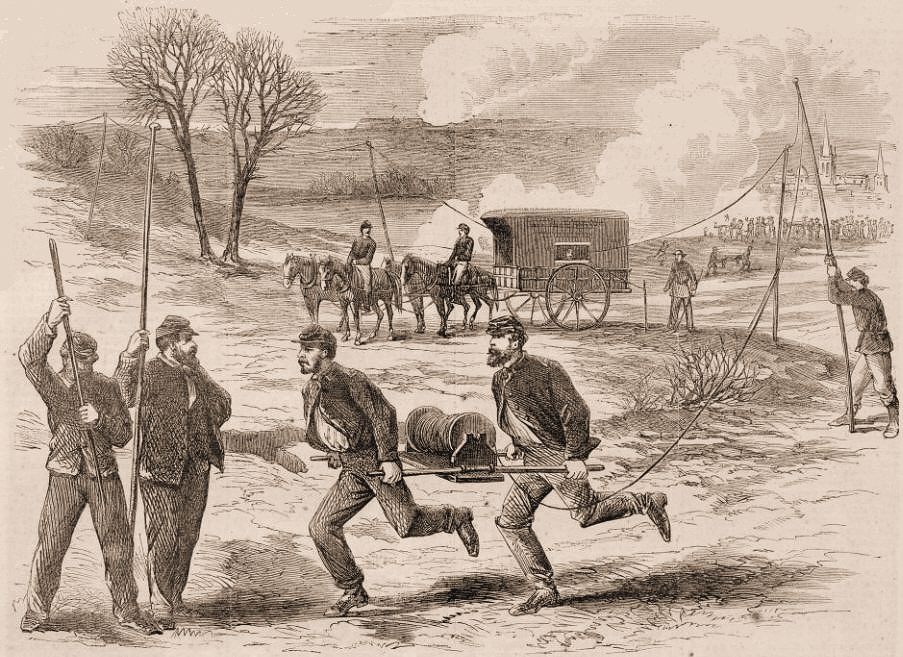
On this page Mr. Waud has illustrated for us the Army Telegraph. Of this important institution he says: “The army signal-telegraph has been so far perfected that in a few hours quite a large force can be in constant connection with head-quarters. This, while a battle is progressing, is a great convenience. The wire used is a copper one insulated, raised on light poles, made expressly for the purpose, on convenient trees, or trailed along fences. The wire and the instrument can be easily carried in a cart, which as it proceeds unwinds the wire, and, when a connection is made, becomes the telegraph-office. Where the cart can not go the men carry the drum of wire by hand. In the picture the cart has come to a halt, and the signal-men are hastening along—some with the drum, while others with crow-bars make the holes for the poles, upon which it is rapidly raised.
“The machine is a simple one, worked by a handle, which is passed around a dial-plate marked with numerals and the alphabet. By stopping at the necessary letters a message is easily spelled out upon the instrument at the other end of the line, which repeats by a pointer every move on the dial-plate. The whole thing is so simple that any man able to read and write can work it with facility.”
Published January 24, 1863, in Harper’s Weekly
 Follow on facebook
 RSS
RSS email
email