Following the American Civil War Sesquicentennial with day by day writings of the time, currently 1863.

Miscellaneous document sources

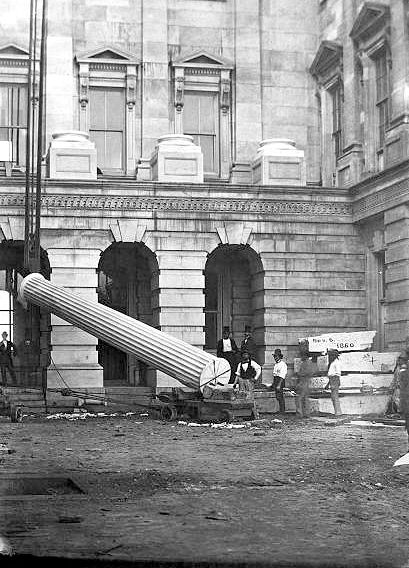
The "Lincoln column," first monolith raised, Nov. 1860, Presidential election, being S. column of connecting corridor

The “Lincoln column,” first monolith raised, Nov. 1860, Presidential election, being S. column of connecting corridor

Date Created/Published: 1860 Nov. 6.

Photo shows construction at U.S. Capitol, including African American workmen with a column named in the photograph to recognize Abraham Lincoln’s election as president on Nov. 6, 1860.

http://hdl.loc.gov/loc.pnp/cph.3b32800

Note:  The Library of Congress web page has the date for the photo as November 6, which was election day.  The results were not known until the next day, so the LOC date in not correct.  Without significant  further research, I think the best that can be said is for the date is some time in November 1860. The title should likely also say that this was the first monolith raised in November.  The construction was quite far along at this point in time, with many other columns in place.

The “Lincoln column,” first monolith raised, Nov. 1860, Presidential election, being S. column of connecting corridorThe “Lincoln column,” first monolith raised, Nov. 1860, Presidential election, being S. column of connecting corridor

Richmond Daily Dispatch, November 9, 1860


—A dispatch from Springfield, Ill, speaking of Lincoln’s visit to the polls to vote on Tuesday, says:

‘Mr. Lincoln advanced as rapidly as possible to the voting table, and handed in his ticket, upon which, it is hardly necessary to say, all the names were Republicans. The only alteration he made was the cutting off of his own name at the top, where it had been printed.–As he emerged, after voting, from the temporary enclosure, the manifestations of enthusiasm were frequent, and Mr. Lincoln, removing his hat, bowed in acknowledgment.’

No. 16
General Orders

Headquarters,
Department of Texas,
San Antonio,
October 30th, 1860

The Colonel commanding takes pleasure in publishing to the Department a statement of the combats of the troops in Texas, which have not been previously noticed in orders, either from General or Department Head Quarters.

Many scouts and expeditions in which high soldierly qualities were evinced are not mentioned, it being the purpose to notice only those in which actual conflicts took place.

First.  On the 29th of September, 1859, Lieut. Wm. B. Hazen, 8th Infantry, with two non-commissioned officers and eight men of Company F, 8th Infantry, left Fort Inge in pursuit of a party of Indians that had carried away two negro boys, and driven off a large number of horses belonging to Mr. H. Ragsdale on the Frio.  The pursuit was commenced at tattoo on the evening of the 29th September, and, notwithstanding a heavy rainand chilling norther, was prosecuted with so much vigor that the Indians were overtaken at the head of the Nueces river, and immediately charged.  The Indians attempted to escape, but were brought to bay after a rapid chase, — one of their number killed and one wounded, — when they again took flight over a broken country, and eluded pursuit by dashing down the precipitous bank of a ravine and into a dense cedar brake.  Had not the Indians been mounted on fleet American horses, the attack would have resulted more disastrously to them.  One of the negro boys (the other had been killed by the Indians), and one hundred and thirty horses were recovered.

Excerpt from “Colonel Lee’s Report on Indian Combats in Texas,” as published in  Southwestern Historical Quarterly Online, Volume 39, July 1935, pages 22 to 31.

For the rest of the report visit Colonel Lee’s Report on Indian Combats in Texas at the Texas State Historical Association web site.

Washington, October 24, 1860.

Hon. John B. Floyd,

Secretary of War:

Sir : Being about to furnish the President with some statistics in reference to the unprecedented drought which has afflicted Kansas Territory for more than fourteen months, I have to request that you will favor me with replies to the following queries, viz:

1st. What amount of rain has fallen in that Territory during the last fourteen months?

2d. What has been the state of the atmosphere ?

Together with such comments as you may deem proper to submit as to the causes of the existing famine in said Territory.

I have the honor to be, sir, very respectfully,

THADDEUS HYATT.


JACKSON, TENN., SUNDAY, October 21, 1860.

DEAR BROTHER—You may be surprised to learn that I am in Tennessee, but you have possibly heard already that I had gone to Illinois. I got Judge Wright and Bob Sims both to fill my place in Murray, and started from Atlanta to Centralia last Friday morning. It had rained nearly all the night before, and continued to rain until we got to Chattanooga. Within a half mile of the depot, at Chattanooga, our engine ran off the track. We would have lost the connection but for the Memphis train waiting for us. They had, however, already waited so long that they could not wait for us to get supper; and as I was quite hungry, and didn’t relish the prospect of riding all night without eating, and as I furthermore didn’t like to pass through the region of land-slides and impending rocks in such a wet and dark time, I staid all night in Chattanooga. Yesterday morning, I started again and got to the “Grand Junction” last night about 10 o’clock. There I had to stay all night for a train. This morning, the train came and I took it at 8 o’clock, and arrived here about 11. This place is forty-eight miles from the Grand Junction. It is now about 3½ o’clock in the afternoon. I am to leave here at 9:45 tonight, and, with good luck, shall reach Centralia at 9½ in the morning, in time for the grand gathering there to-morrow. You will readily conjecture that my present detention at this place is owing to its being Sunday. You will readily imagine that it has been a weary, heavy day to me.

I am an utter stranger here, in face and in name. The landlord at the Junction evidently knew me from reputation, but this one does not. I am all alone here; but I am wearing through the day better than you would imagine.

I think Douglas is strong in this part of Tennessee, but I have no doubt but that Bell will carry the State. Douglas is to speak at this place on Tuesday.

And now for the reason of this unexpected trip on my part: When I got to Atlanta, Dr. Hambleton showed me a dispatch, which he had just got from Mr. Douglas, inquiring when you would meet him in Illinois, and Hambleton told me that it was published in the papers that you were going to Illinois. Hambleton was afraid that the “when” in Douglas’ dispatch implied that he expected you with certainty at sometime, and he might wait for you, and so give up his Georgia appointments. The truth is, he seemed very uneasy, lest Douglas might not go to Georgia at all, unless you or I should meet him, as Hambleton had promised him one of us would do. He did not acknowledge to me in terms that he had made such a promise, but I became perfectly satisfied that he made some such promise. The only doubt I have is as to what the exact promise was. I think it was that you would meet Mr. Douglas; but it is possible that it was in the alternative—you or I. At all events, he begged me to come and I came. When I got to Atlanta, I found that Ben Hill had spoken to a very large crowd there the night before, and had got resolutions passed for a fusion of all parties in Georgia, so as to run a ticket which should be pledged to neither of the candidates, but pledged only to vote for that one who would have the best chance to beat Lincoln when the vote should be cast. The Douglas men and Bell men were all for it, and a number of the Breckinridge men also. I am inclined to think that if it is well managed, it may be a strong, wise and successful movement. I am afraid that it may be distasteful to Douglas men in some parts of the State, because it is inaugurated by Bell men; but I hope not I find that there is great apprehension in the public mind from the prospect of Lincoln’s election. The almost universal expectation seems to be that Carolina will secede; that the General Government will try to force her back, and that the whole South will make common cause with her. I say this seems to be the expectation, and it also seems to be the sentiment, of the people—Douglas men, Bell men and all. I really look upon that as the probable result. I do not know whether I shall speak to-morrow or not. I certainly shall not do so unless I am satisfied that Mr. Douglas really desires it. I feel, however, that, if circumstances should be favorable, I could give the Illinois men a talk which may do them good. My sheet is out. I have no envelope. Good-bye. You will not hear from me again until you see me in Atlanta. May God preserve us all!

Linton Stephens to his brother, from Biographical sketch of Linton Stephens (Late Associate Justice of the Supreme Court of Georgia), published 1877
Washington D.C.

Octr. 16, 1860

To James Buchanan

President of the U.S.A. Sir:

Having just returned from the Territory of Kansas, where I have been an eyewitness to the deplorable and starving condition of that scorched and famine stricken land, I come to implore of the Executive as an act of clemency in behalf of its suffering inhabitants, that all Government lands now offered for sale in that Territory may be witheld from market, and more especially those lands embraced in (proclamation No 669) what is known as the New York Indian Reserve.

You need be informed Sir, of but half the desolations and heart rending scenes I have witnessed among that heroic & industrious but unfortunate people to arouse your utmost sympathies.

Thousands of once thrifty and prosperous American Citizens are now perishing of want. winter is upon them. of clothing they are nearly bereft. food they have not to last them through the cold season that is approaching. of over a hundred thousand people upon Kansas soil six months ago, at last one quarter or a third have left. of the remainder it is safe to say that 40,000 at this moment see nothing but exodus or starvation at the end of the sixty days now just before them. from 10 to 20 thousand look with only despairing eyes upon November. thousands cannot subsist a month longer unaided. other thousands are living upon the little which their neighbors deprive themselves of to give to them; neighbors equally unfortunate, and with whom the starvation is merely a question of but a few days longer. while still other thousands if not at once relieved must perish from hunger or the diseases that follow in its train. Some have already died. others are daily dying.

While the hours grow darker and the days wax longer for the living to whom relief comes not, and whose eyes are aching with watchings for the succor that delays.

In confirmation of these frightful statements I refer your Excellency to the accompanying extracts from my diary while in Kansas recently, and from numerous letters sent to me from various districts of the famine land.

Had the blood of this poor people in 1860 been as valuable for coinage into votes as it was in 1856 your Department would have long since been made aware of their miseries, and it would not have remained for the discharge of a mere mechanical duty to have brought to your notice the sickening fact that the more discharge of the duty was in its terrible workings a practical cruelty, such as no Despotism on Earth would intentionally be guilty of, and such as being once brought to the notice of your Department it cannot but rejoice to have escaped committing.

Commending these facts to your careful consideration, I have the honor Sir, to subscribe myself

Very Respectfully Yours

Thaddeus Hyatt

Westfield, Chatauqua Co. NY
Oct 15, 1860

Hon. A. B. Lincoln
.

Dear Sir,

.

My father has just home from the fair and brought home your picture and Mr. Hamlin’s.  I am a little girl only eleven years old, but want you should be President of the United States very much so I hope you won’t think me very bold to write to such a great man as you are.  Have you any little girls about as large as I am if so give them my love and tell her to write me if you cannot answer this letter.  I have got 4 brothers and part of them will vote for you anyway and if you will let your whiskers grow I will try and get the rest of them to vote for you you would look a great deal better for your face is so thin.  All the ladies like whiskers and they would tease their husbands to vote for you and then you would be President.  My father is a going to vote for you and if I was a man I would vote for you to but I will try and get everyone to vote for you that I can.  I think that rail fence around your picture looks very pretty.  I have got a little baby sister she is nine weeks old and just as cunning as can be.  When you direct your letter direct to Grace Bedell Westfield, Chatauqua County, New York.  I must not write any more answer this letter right off

.

Good bye

.

Grace Bedell

.

Abraham Lincoln Letters and Documents at the Detroit Public Library

Sir Richard Burton:

“The station was sighted in a deep hollow.  It had a good stone corral and the visual haystack, which fires on the hilltops seem to menace.  Amongst the station folks seem to menace.  Amongst the station folks we found two New Yorkers, a Belfast man, and a tawny Mexican named Anton.  The house was unusually neat, and even displayed signs of decoration in the adornment of the bunks with osier taken from the neighboring creek.  We are now in the land of the Pa Yua… I observed however, that none of the natives were allowed to enter the station house.”

Romancing Nevada’s Past: Ghost Towns and Historic Sites of Eureka, Lander and White Pine Counties.

RICHMOND, VA., October 7, 1860.

DEAR COLONEL COLT: — I am sorry to say it will not be possible for the Prince of Wales to accept your kind invitation. After leaving New York we propose to proceed to Albany before going to Boston, so that we shall not be able to visit Hartford.

Had arrangements permitted it, the Prince would have been much pleased to inspect your celebrated establishment.

I am yours very truly,
Newcastle

From “Armsmear: The Home, The Arm, and The Armory of Samuel Colt,” A Memorial, 1866

Oct 6th 1860

Raleigh

Dr Sam G Lane!
Dear Cousin!

I have been intending to write to you ever since I left Pennsylvania, but have been prevented by sickness and [unclear: close ] confinement to the store — I recd. your letter last week & thank you truly for the courtesy and kindness of feeling it manifested you are not mistaken in regard to my feelings toward my friends [unclear: of] the good old Keystone” and a letter from home is indeed green spot in the cheerless [illeg.] deserts of North Carolina.

Immediately on receipt of yours I wrote – at considerable length – to Fitz Hugh stating every instance of my conclusion with

[page 2]
McPherson and asking as a personal favor his reconsideration of the matter. I have not since heard from Fitz. H. but from previous knowledge of the man I fear he will not be likely to change his position if he has taken it against McP—– Feeling as I do under great obligation to McP. I should be very sorry to be made innocently the cause of anything sending to injure him — please explain this to him that he may not think me ungrateful for his many acts of kindness towards me. had I any influence in Franklin Co. I should certainly give it in his favor.

Political excitement is running high and all our banks have refused to discount till after the election. Great financial troubles [illeg.] [illeg.]

[page 3]
of Lincoln’s election. Breckenridge will most likely carry this state though Bell will run him very close. Douglas will not poll a large vote as his supporters are very few & weak– I have been frequently questioned about my political views, and have expressed myself far more strongly in favor of the northern institutions than when in Penna. There is far more freedom of sentiment here than I supposed and I know several persons who take the N. Y. Tribune and read Helper, though a violent republican would not be tolerated and voting for Lincoln would be considered a capital offence. Should S. Carolina, Alabama, & Mississippi secede and an attempt be made to enforce Lincoln’s administration, N. Carolina will certainly join the ‘southern [illeg.] [illeg.] [unclear: under] no other

[page 4]
circumstances.

I am not very much pleased with Raleigh. it is a remarkably slow & [unclear: aristocratic] place, been confined to the store from 6 A.M. to 11 P.M. I have seen very little of society – and – though noticed by several persons of position I shall mingle very little in it as I am still so much of a Yankee to submit to patronage. I do not think under present circumstances it would do to trouble McPherson though I should like very much to have a letter from him to Branch. I feel I may not be able to [unclear: retain] [illeg.] situation long, as I have been very sick nearly ever since my arrival and am too weak to attend to business as it should be done. Please do not mention that Miss [unclear: Wirginan] promised to express

(Source: Valley of the Shadow, University of Virginia)