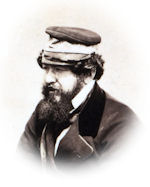
December 26th.—No answer yet. There can be but one. Press people, soldiers, sailors, ministers, senators, Congress men, people in the street, the voices of the bar-room—all are agreed. “Give them up? Never! We’ll die first!” Senator Sumner, M. De Beaumont, M. De Geoffroy, of the French Legation, dined with me, in company with General Van Vliet, Mr. Anderson, and Mr. Lamy, &c.; and in the evening Major Anson, M.P., Mr. Johnson, Captain Irwin, U.S.A., Lt. Wise, U.S.N., joined our party, and after much evasion of the subject, the English despatch and Mr. Seward’s decision turned up and caused some discussion. Mr. Sumner, who is Chairman of the Committee on Foreign Relations of the Senate, and in that capacity is in intimate rapport with the President, either is, or affects to be, incredulous respecting the nature of Lord Russell’s despatch this evening, and argues that, at the very utmost, the Trent affair can only be a matter for mediation, and not for any peremptory demand, as the law of nations has no exact precedent to bear upon the case, and that there are so many instances in which Sir W. Scott’s (Lord Stowell’s) decisions in principle appear to justify Captain Wilkes. All along he has held this language, and has maintained that at the very worst there is plenty of time for protocols, despatches, and references, and more than once he has said to me, “I hope you will keep the peace; help us to do so,”—the peace having been already broken by Captain Wilkes and the Government.
The American Civil War
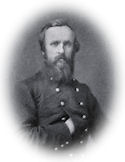
Thursday, December 26. — A cloudy day — thawing and muddy. The colonel is planning an expedition through Raleigh to Princeton to capture what is there of the enemy, — viz. six hundred sick with a guard of about one hundred men, arms and stores, with a possibility of getting Floyd who is said to be without guard at and to burn the railroad bridges near Newbern. The plan is to mount one-half the force on pack mules and ride and tie — to make a forced march so as to surprise the enemy. He does not seem willing to look the difficulties in the face, and to prepare to meet them. He calls it forty or fifty miles. It is sixty-seven and one-half. He thinks men can move night and day, three or four miles an hour. Night in those muddy roads will almost stop a column. With proper preparations, the thing is perhaps practicable. Let me study to aid in arranging it, if it is to be.
Dear wife! how is she? — Soon after breakfast the sun chased the clouds away and we had a warm spring day. The bluebirds are coming back if they ever left. Our twenty-first fine day this month.
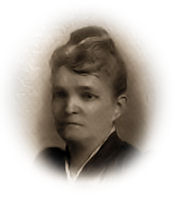
Dec. 26, 1861.—The foul weather cleared off bright and cool in time for Christmas. There is a midwinter lull in the movement of troops. In the evening we went to the grand bazaar in the St. Louis Hotel, got up to clothe the soldiers. This bazaar has furnished the gayest, most fashionable war-work yet, and has kept social circles in a flutter of pleasant, heroic excitement all through December. Everything beautiful or rare garnered in the homes of the rich was given for exhibition, and in some cases for raffle and sale. There were many fine paintings, statues, bronzes, engravings, gems, laces—in fact, heirlooms, and bric-à-brac of all sorts. There were many lovely Creole girls present, in exquisite toilets, passing to and fro through the decorated rooms, listening to the band clash out the Anvil Chorus.
This morning I joined the B.’s and their party in a visit to the new fortifications below the city. It all looks formidable enough, but of course I am no judge of military defenses. We passed over the battle-ground where Jackson fought the English, and thinking of how he dealt with treason, one could almost fancy his unquiet ghost stalking about.

______
Note: To protect Mrs. Miller’s job as a teacher in New Orleans, the diary was published anonymously, edited by G. W. Cable, names were changed and initials were often used instead of full names — and even the initials differed from the real person’s initials.
December 26.—A skirmish took place near Camp Boyle, Columbia, Ky., this evening. Last night the National pickets having reported a strong force of rebels in the neighborhood, Colonel Haggard, commanding at the camp, ordered out a party of men, with Major Ousley at their head, to go in pursuit. Arriving in the vicinity this morning, they saw nothing of the enemy. They waited, however, for some time, and being hungry, ordered supper at the hotel, and supper being ready they all sat down and were enjoying it finely, when a sentinel rushed in and gave an alarm. The Nationals all broke for their horses, but before a horse was mounted, a shot from one of Capt. Palmer’s men brought the rebel color-bearer to the ground. The poor fellow was a Scotchman—too brave a man to be enlisted in such a cause. The troops rushed up to him and wanted him to surrender, but he would not, and hurraing for Jeff. Davis, drew his revolver and was about to shoot, when one of the Nationals gave him a quietus that brought him to terms. The rebels were about six hundred strong, but retreated after receiving some two or three rounds. Colonel Haggard’s small party then also left the field, having killed five of the enemy and wounded some others.—Louisville Journal, December 30.
—Major Gower, commanding a squadron of the First Iowa Cavalry, arrived at Jefferson City, Mo., with one captain, thirteen men, and ten wagon loads of stores, captured from Gen. Price’s army.—Gen. Halleck’s Despatch.
—Philip St. George Cocke, Brigadier-General in the Confederate army, accidentally or designedly killed himself at his residence in Powhatan County, Va. He was a wealthy, public-spirited gentleman, and a well-behaved and accomplished officer. Brigadier-General Cocke was a graduate of the United States Military Academy at West Point. He entered that institute as a cadet in 1828, graduated July, 1832, was immediately appointed to a brevet second lieutenancy in the Second artillery; promoted to adjutant of his regiment in 1833. He resigned in 1834. He was a native of Virginia, and at the breaking out of the present rebellion was commissioned a general in the Confederate army.—Norfolk Day Book, December 28.
—Andrew Kessler, Jr., a member of the late Maryland House of Delegates, was released from Fort Warren on taking the oath of allegiance, and returned to his home in Frederick, Md.—General Banks issued a stringent order in regard to the seizure of forage without the owner’s consent, and another prohibiting the sale of liquor to soldiers.—Philadelphia Press, December 28.
—In the Senate, at Washington, Mr. Hale, of Now Hampshire, offered a resolution calling upon the President to transmit to the Senate copies of all despatches which had passed between the Government and that of Great Britain relative to the seizure of Mason and Slidell. Mr. Sumner objected to its consideration. Mr. Hale advocated its passage in a speech of considerable length, in which he opposed the restitution of the rebel envoys, and advocated in preference a war with Great Britain. The resolution was laid over under the rule.—Mr. Garrett Davis, Senator from Kentucky, gave notice of his intention to introduce a bill confiscating every species of property of all persons who have had any connection with the rebellion, either in a civil, military, or naval capacity.—Mr. Harlan, of Iowa, introduced a bill to establish a Provisional Government in all the seceded States.
—A Fire broke out in the Government stables, near the Observatory, in Washington, D. C., and from one hundred and fifty to two hundred horses out of six hundred which it contained, were burnt to death. The fire was supposed to have resulted from carelessness.
—The Sixth New Hampshire regiment, numbering one thousand and twenty-three men, Col. Nelson Converse, passed through New York for Washington. They had been encamped at Keene, Cheshire County, since November 15. Before they left, Gov. Berry presented them with a stand of colors—The First battalion of the First Massachusetts Cavalry, numbering four hundred and fifty men, arrived at New York, and left for Annapolis in the afternoon, to join Gen. Burnside’s expedition.
—The steamer Arago arrived at New York from Europe, bringing as a passenger Lieut.-Gen. Winfield Scott, and intelligence that the party in Europe advocating a war with the United States, was “greatly encouraged in their cry for blood.”—N. Y. Herald, December 27.
—First Lieutenant J. C. Ives, Topographical Engineers, U. S. A., having tendered his resignation under circumstances showing him to be disloyal to the U. S. Government, was, by direction of the President, dismissed the service from this date.—General Orders, No. 110.
—The rebel general, John B. Floyd, issued an address to the troops under his command, dated at the “camp, near Dublin depot,” Western Virginia, in which he expressed his admiration of the manner in which they had conducted a campaign of five months, and urged them to respond to the distinguished compliment paid the “army of the Kanawha,” by the Confederate Government, in assigning them to the defence of Kentucky.—(Doc. 238.)
WEDNESDAY 25
This has been “Christmas day” and a very pleasant day, not cold enough to freeze, but the air clear and braceing. I have spent the day at home fixing up things and did not go out till evening when I spent a couple of hours at Chas room with Mr Copersmith, Mis Wells and Chas & Sallie. It has been quite a noisey day about the house. Our three boys and the Two Lincoln boys have been very busy fireing off Crackers & Pistols. Willie & Thomas Lincoln staid to Dinner at 4 o’clock. Julia has been practiceing some with her pistol.

______
The three diary manuscript volumes, Washington during the Civil War: The Diary of Horatio Nelson Taft, 1861-1865, are available online at The Library of Congress.
Christmas Day we spent with Joseph again in camp, going round by Alexandria to pick up Chaplain Hopkins and take him with us. We had taken some goodies and little traps with us for the men in the hospitals in Alexandria and were glad to find the nice arrangements that had already been made by Madame M. She had got Col. Davies to detail some of the 16th men to bring her Christmas greens, and had dressed all the wards with festoons and garlands, little flags, mottoes, etc., besides arranging for a grand Christmas dinner for her “boys.”
The Mansion House Hospital too was resplendent with bright tissue papers and evergreens and Dr. Sheldon showed us with great pride his kitchen and store-room arrangements, which are excellent in every respect. Fifty roast turkeys were preparing for the Christmas feast, sixteen large loaf-cakes iced to perfection and decorated with the most approved filigree work, pies without number, cream puffs, cranberry sauce, puddings of all sorts, etc., etc.—altogether the most Christmas-like scene we have looked upon, and all arranged with the greatest order and cleanliness.
Among the little things we took out were Mother’s and Jane’s socks, which we gave to men likely to go back soon to their regiments. The only boy without mittens got Mrs. Smith’s.
After our own camp dinner, at which the Colonel and the Doctor joined us, we sat round the last and best chimney yet built, and talked about old times five or six months ago, which now seem like so many years. J. says his Christmas Eve was dreary enough in his tent, and they all agreed that our coming was the only thing that prevented their Christmas Day from being so too.
December 25.—Two spans of a bridge across the Charleston River, Mo., on the Hannibal and St. Joseph’s Railroad, were burned by the rebels this night.— Cincinnati Enquirer, December 27.
—This day about noon, the stout gunboat Florida, C. S. N., concluded to celebrate Christmas eve by a small set-to with the insolent Lincoln cruiser New London, which was lying off the mouth of the harbor of Mobile, Ala. The Florida ran down to the westward of Sand Island, and challenged the New London to come on, which she did, and for an hour or two a lively cannonade at long taw furnished an excitingly interesting exhibition for the entertainment of the great audience which viewed it— the four thousand men who garrison Forts Morgan and Gaines, as well as the crews of the blockading vessels, being the spectators. The Florida could not come to close quarters with the enemy by reason of the shoal water of a bar intervening, and could she have got out it is likely she would have had more than she could attend to with the several blockaders that were lying off in deep water. The engagement was lengthy, and many shots were fired on both sides, and ended by the New London backing out, as usual. The Florida was not touched, but it is thought that three of her pills took effect on the enemy. All but these three were seen to strike the water, but the thousands of eyes which watched could not tell where these three went to if they were not stopped by the New London. She was evidently hit hard, for after backing out of the fight she signalled the fleet, and one of them ran down and lay alongside of her for several hours, rendering assistance, it is supposed. The spectators say that the Florida’s long and terrible guns were admirably served, the practice being excellent, placing the shot and shell all around the mark, so close, in many instances, as to apparently dash the water upon the Lincolnite’s decks. The engagement, is said to have been a most animating and exciting scene as witnessed from the forts.—Mobile Evening News, December 26.
—The Lighthouse, situated on Morris’ Island, Charleston, S. C., harbor, and which for many years has guided the mariner to the harbor, was blown up to-night by order of the military authorities. Only a heap of ruins marks the spot where it stood. — Charleston Courier, December 28.
December 24th.—This evening came in a telegram from Europe with news which cast the deepest gloom over all our little English circle. Prince Albert dead! At first no one believed it; then it was remembered that private letters by the last mail had spoken despondingly of his state of health, and that the “little cold” of which we had heard was described in graver terms. Prince Albert dead! “Oh, it may be Prince Alfred,” said some; and sad as it would be for the Queen and the public to lose the Sailor Prince, the loss could not be so great as that which we all felt to be next to the greatest. The preparations which we had made for a little festivity to welcome in Christmas morning were chilled by the news, and the eve was not of the joyous character which Englishmen delight to give it, for the sorrow which fell on all hearts in England had spanned the Atlantic, and bade us mourn in common with the country at home.
December 24.—Gen. Pope’s cavalry, sent to Lexington, Mo., captured two rebel captains, one lieutenant, and four men, with horses, &c. They destroyed the foundry and ferry boats at Lexington.—General Halleck’s Despatch.
—A card from J. J. McKeever, President of an organization known as the “Southwest Co.,” appeared in the Memphis Appeal, announcing that the third special messenger would leave Memphis on the 1st of January, “taking mail matter for all parts of the world.”
—The U. S. War Department issued orders stopping the enlistment of cavalry soldiers. The Government had all the cavalry that were necessary.
—A bill to increase the duties on tea, coffee, sugar, and molasses passed the U. S. Congress. The duties were raised on tea to twenty cents per pound, on coffee to five cents, on sugars to two and a half, three, five, and eight cents, and on molasses to six cents. It was estimated that the increase would add to the revenue six millions of dollars a year.
—Bluffton, S. C., was occupied by the Union forces under General Stevens. The town was found deserted.—N. Y. Herald, Dec. 30.
—The Thirty-fifth regiment of Indiana volunteers, under the command of Colonel John C. Walker, left Jeffersonville, for active service in Kentucky.—Indianapolis Journal, Dee. 26.
December 23rd.—There was a tremendous storm, which drove over the city and shook the houses to the foundation. Constant interviews took place between the President and members of the Cabinet, and so certain are the people that war is inevitable, that an officer connected with the executive of the Navy Department came in to tell me General Scott was coming over from Europe to conduct the Canadian campaign, as he had thoroughly studied the geography of the country, and that in a very short time he would be in possession of every strategic position on the frontier, and chaw up our reinforcements. Late in the evening, Mr. Olmsted called to say he had been credibly informed Lord Lyons had quarrelled violently with Mr. Seward, had flown into a great passion with him, and so departed. The idea of Lord Lyons being quarrelsome, passionate, or violent, was preposterous enough to those who knew him; but the American papers, by repeated statements of the sort, have succeeded in persuading their public that the British Minister is a plethoric, red-faced, large-stomached man in top-boots, knee-breeches, yellow waistcoat, blue cut-away, brass buttons, and broad-brimmed white hat, who is continually walking to the State Department in company with a large bulldog, hurling defiance at Mr. Seward at one moment, and the next rushing home to receive despatches from Mr. Jefferson Davis, or to give secret instructions to the British Consuls to run cargoes of quinine and gunpowder through the Federal blockade. I was enabled to assure Mr. Olmsted there was not the smallest foundation for the story; but he seemed impressed with a sense of some great calamity, and told me there was a general belief that England only wanted a pretext for a quarrel with the United States; nor could I comfort him by the assurance that there were good reasons for thinking General Scott would very soon annex Canada, in case of war.


