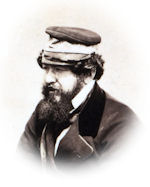
October 11th.—Mr. Mure, who has arrived here in wretched health from New Orleans, after a protracted and very unpleasant journey through country swarming with troops mixed with guerillas, tells me that I am more detested in New Orleans than I am in New York. This is ever the fate of the neutral, if the belligerents can get him between them. The Girondins and men of the juste milieu are ever fated to be ground to powder. The charges against me were disposed of by Mr. Mure, who says that what I wrote of in New Orleans was true, and has shown it to be so in his correspondence with the Governor, but, over and beyond that, I am disliked, because I do not praise the peculiar institution. He amused me by adding that the mayor of Jackson, with whom I sojourned, had published “a card,” denying point blank that he had ever breathed a word to indicate that the good citizens around him were not famous for the love of law, order, and life, and a scrupulous regard to personal liberty. I can easily fancy Jackson is not a place where a mayor suspected by the citizens would be exempted from difficulties now and then; and if this disclaimer does my friend any good, he is very heartily welcome to it and more. I have received several letters lately from the parents of minors, asking me to assist them in getting back their sons, who have enlisted illegally in the Federal army. My writ does not run any further than a Federal judge’s.
The American Civil War
11th.—Sent off ambulances to-day to commence bringing forward the sick of my regiment, and whilst they were gone, after having put my hospital in good order for their reception, I stepped over again to Commodore Jones’ house to see how the guards stationed there had succeeded in carrying out their orders. Till I entered the house, I thought I had seen evidences of extreme vandalism, but the wanton destruction here beggars everything I have before witnessed. Furniture broken; feather beds opened, and their contents emptied over house and yard; even those beautiful family pictures were ground to atoms and thrown to the winds. But I need not describe here, for the impression is deeply stamped in memory, more durable and more accurate than words and letters can ever make. Everything destructable was destroyed. [1]
In handling over the papers I picked up the Commodore’s “Journal of a cruise in the U. S. ship Relief—bearing the broad pennant of Commodore Jones—Thos. A. Downer, Esq., Commander,” which I have preserved, and also a letter from a son of Commodore Tatnall (late of the rebel Merrimac) to Commodore Jones, written from the Meditterranean, asking to be relieved from duty there, and to be permitted to return to America.[2]
As it will be a matter of interest to me, in future, to study my predictions as to the course and conduct of this war—to rejoice and be vain over those which prove correct, and to laugh at or be ashamed of those which prove false, I shall continue to record them as I have begun; and here I enter one in which I hope to take interest a long time hence. As I have constantly predicted, we have had no fight here nor shall we have; and I now very much doubt whether we shall have a fight even at Manassas, and for this reason: “After all the feints of the enemy here to draw Gen. Banks from Harper’s Ferry had failed, they, seeing that we have got foot-hold in North Carolina, will fall back on their fortifications at Centerville and Manassas, and then presenting a bold front with a small body, will cover the withdrawal of the larger part of their force, which they will distribute in Kentucky, Missouri, Tennessee and Western Virginia, and I very much doubt whether they will retain enough at Manassas to make a respectable fight. Kentucky and Tennessee are to become the theatre of war; and if I am not greatly mistaken, Kentucky will have trying times between this and the first of January. I hope that Gen. McClellan is taking the same view of things, and is preparing to meet it.” What I have here marked as a quotation is a copied from a letter this day written to a friend on the prospects of the war.
[1] It is worthy of remark here, that thus whilst this wanton destruction was going on, a half a mile away, everything on the place of Mr. Johnson, (a loyalist, whose house and garden were in the very midst of the encampments,) though unguarded was unmolested ; every article he had to dispose of was bought and paid for, at high prices, by the soldiers. Even thus early could we read the soldier’s aversion to guarding, or having guarded the property of rebels.
[2] This letter I handed to a lady connection of the Tatnall family, who was with me at the time, and she found means of restoring it to them.
October 11.—The Confederate steamer Nashville, commanded by Lieutenant Pegram, successfully ran the blockade at Charleston, South Carolina.—The rebel Government having released and sent home fifty-seven prisoners, the National authorities ordered the release of an equal number of Confederate prisoners.—Baltimore American, October 16.
—An unsuccessful attempt to seize the steamboats Horizon and Izetta, plying on the Kanawha River, was made by the rebels.—(Doc. 76.)
—The New Orleans Picayune, of this day, contains the following: We have been permitted by Gen. Twiggs to see and to copy a telegraph despatch received by him to-day from Hon. J. P. Benjamin, Acting Secretary of War, dated at Richmond, on the 9th instant: ” Gen. D. E. Twiggs:
“Your despatch is received. The department learns with regret that the state of your health is such as to cause you to request to be relieved from active duty.
Your request is granted; but yon are expected to remain in command until the arrival of Gen. Mansfield Lovell, who has been appointed to succeed you, and who leaves for New Orleans to-morrow. J. P. Benjamin.”
—The Platte River bridge, near St. Joseph’s, was burned, and they are now obliged to cross in small boats and on rafts. Fifteen hundred regulars from Utah crossed this night, and many of them with their families. Being so many of them, some were obliged to cross on the rafts. They had ropes across the river, and these on the raft took hold of the end and polled, and it drew them across; but some one —a secessionist, they think—had cut the rope, and when they were about in the middle of the river it gave way and they floated down stream a short distance, and the raft hit against a tree and turned them all over, drowning a wife and only child of one man, three only children of another family, and a babe of eleven months old of another family. The bodies have not yet been recovered from among the rubbish. It was very dark, and they were obliged to come along and leave them. Some spoke not a word, but looked heart-broken; others mourning for a loved wife or children. Oh! it was a sight to melt a heart of stone.—Baltimore American, October 21.
—Lieut. Harrell, commanding the steamer Union, of the Potomac flotilla, stationed at the month of Acquia Creek, learning that the rebels had fitted out a large schooner in Quantico or Dumfries Creek, and had collected a considerable body of troops there, with the intention of crossing the Potomac, determined that the schooner should be destroyed. He accordingly organized an expedition, and with one boat and two launches entered the mouth of the creek about half-past two o’clock this morning. The schooner was discovered some distance up, in charge of a single sentry, who fled and gave the alarm. She was immediately boarded and set on fire, and when her destruction was rendered certain, Lieut. Harrell’s men returned to their boats and pulled again for the steamer. Their position was fully revealed by the light of the burning schooner, and they were fired upon continuously from both banks of the narrow stream; but not one of them was injured, though their clothing in many instances was perforated with bullets. The success of the enterprise was complete.—(Doc. 76.)
—The Brickel Battery N. Y. S. V., under the command of Lieutenant-Colonel Andrew Brickel, left New York for the seat of war.
—The New Orleans Picayune of this day contains the following: “Yesterday was the first day for the execution of the Governor’s orders in regard to passports. Hereafter, persons wishing to leave the city, either by steamer or by railroad train, will be obliged to provide themselves with a passport, for which application must be made at the Governor’s office, between the hours of nine and three o’clock. Persons residing on the line of the Jackson Railroad, and whose business requires them to travel frequently, can obtain a monthly passport, on application to Mr. T. S. Williams, the General Superintendent. Military officers will accompany each train, and all travellers detected without the requisite pass will be arrested and brought back to the city.”
—The Missouri State Convention met at St. Louis. A resolution was introduced directing inquiry into the expediency of confiscating all the property of these engaged in or abetting the rebellion, and appropriating the proceeds to reimbursing loyal men for the losses they have sustained in maintaining the National or State Governments. Final action was not taken, but the convention, by a majority of four, refused to reject the resolution.—St. Louis Republican, October 12.
10th.—We have commenced moving our camp equipage from Camp Vanderwerken to this place, to be named Camp Griffin—I suppose for Capt. Griffin, of one of the batteries of the regular army. Capt. G., with his battery, has been one of us and with us since we crossed the Potomac. We have had much trouble and vexation to-day in establishing medical headquarters for the regiments of our brigade, but after much ordering of us and changing of orders, we are at last to take charge of the stone house of Mr. Jno. N. Johnson, in which, and in the tents we are able to pitch, we hope to make comfortable all the sick of our brigade.
October 10.—Six pickets of the Fourth cavalry regiment, stationed four or five miles from Paducah, Kentucky, were attacked by a large force of rebels this morning. Two were mortally wounded and two taken prisoners, with their horses and equipments. The rebels had divided their force, and in the excitement fired into each other. They then fled, each party taking the other for the National cavalry.— Boston Transcript, October 11.
—The gunboat Wachusett was launched at the Navy Yard at Charlestown, Mass.
—Intelligence that the Sumter was still cruising among the Windward Islands, was received at Panama, N. G., by the British steamer from St. Thomas.—Panama Star, October 10.
—The Twenty-ninth and Thirtieth regiments of Indiana Volunteers, under the command of Colonels Miller and Bass, arrived at Louisville, Kentucky, en route for the seat of war.— Louisville Journal, October 11.
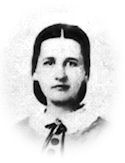
October 10th, 1861.—War has come home to the Bradford neighborhood! . . . Last night, October 9th, Captain Richard H. Bradford was shot in the breast and instantly killed, while leading his men in an attack on Santa Rosa Island. He was everybody’s darling. We were so proud of him, too. Father went to bear the sad news to Uncle Richard and Aunt Nancy. May God help them for this is hard to bear. Cousin Edward Bradford, his brother, is bringing his body home. The telegram said they would stop over a few hours in Madison and the casket would lie in state in the court house there, that Madison might do him honor. Then they will come on and he will be buried in God’s Acre at Pine Hill.
Mr. William Routh was killed also, he was engaged to be married to Cousin Sallie and she fainted dead away when she heard the terrible news. Oh! War is worse even than I thought.
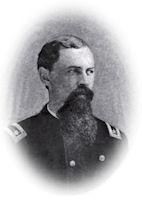
Bird’s Point, October 10, 1861.
I have just finished a dinner of cider, cake, bread, butter, etc. We have just been paid off and of course have to indulge in a few delicacies for awhile. Last Tuesday we were ordered to strike tents and pack for a march. It wasn’t much of a march though for we were put on the cars and rolled out to Charleston, 12 miles from here, where we camped on a beautiful little prairie adjoining town. The 11th Illinois, Taylor’s artillery and two companies of cavalry and our regiment formed the party. I think we were out looking after that damned Jeff Thompson, who is reported everywhere from Ironton down to New Madrid. I don’t believe he has a thousand men, for there seems to be nothing reliable about any of the reports we have of him. The natives up at Charleston told us that Jeff was at Sykestown, 12 miles from there, with 5,000 or 6,000 troops, and our pickets had several little fights with his, or what we supposed to be his, but—well, the generals may know better but we that stay in the ranks think that there is no enemy nearer than Columbus save a few small bands of bushwhackers, who, under the impression that they are upholding principles eternal and doing their country service, gobble up everything sweet or sour, that weighs less than a ton. We came down from Charleston Thursday. We marched about 10 miles of the way through an immense (it seemed so to me) cypress swamp. I think Mrs. Stowes. “Dred” would have enjoyed that swamp hugely. It was rather an interesting piece of scenery for a first view, but I don’t think I should enjoy living in sight of it. The 18th, Colonel Lawler, worked six or eight weeks in this swamp repairing bridges the secesh had burnt, and it put half their men on the sick list. We got our pay in treasury notes but they are as good as the gold. Lots of the boys have traded them off for gold “even up.” I get $21 this time for two months and five days, our other boys got $14 or $15. I am third sergeant now, our second having been appointed sergeant major. I think I should rather be sergeant, for the field officers make a kind of servant of the sergeant major. I send you a couple of daguerreotypes to let you see what a “skeleton” I have become. Our boys are all very well. The 17th is in a pretty hard condition, nearly half of them sick and as a regiment pretty badly used up. We have been paid twice and they only $10 yet.
October 9th.—A cold, gloomy day. I am laid up with the fever and ague, which visit the banks of the Potomac in autumn. It annoyed me the more because General McClellan is making a reconnaissance to-day towards Lewinsville, with 10,000 men. A gentleman from the War Department visited me to-day, and gave me scanty hopes of procuring any assistance from the authorities in taking the field. Civility costs nothing, and certainly if it did United States officials would require high salaries, but they often content themselves with fair words.
There are some things about our neighbours which we may never hope to understand. To-day, for instance, a respectable person, high in office, having been good enough to invite me to his house, added, “You shall see Mrs. A., sir. She is a very pretty and agreeable young lady, and will prove nice society for you,” meaning his wife.
Mr. N. P. Willis was good enough to call on me, and in the course of conversation said, “I hear McClellan tells you everything. When you went away West I was very near going after you, as I suspected you heard something.” Mr. Willis could have had no grounds for this remark, for very certainly it has no foundation in fact. Truth to tell, General McClellan seemed, the last time I saw him, a little alarmed by a paragraph in a New York paper, from the Washington correspondent, in which it was invidiously stated, “General McClellan, attended by Mr. Russell, correspondent of the London Times, visited the camps to-day. All passes to civilians and others were revoked.” There was not the smallest ground for the statement on the day in question, but I am resolved not to contradict anything which is said about me, but the General could not well do so; and one of the favourite devices of the Washington correspondent to fill up his columns, is to write something about me, to state I have been refused passes, or have got them, or whatever else he likes to say.
Calling on the General the other night at his usual time of return, I was told by the orderly, who was closing the door, “The General’s gone to bed tired, and can see no one. He sent the same message to the President, who came inquiring after him ten minutes ago.”
This poor President! He is to be pitied; surrounded by such scenes, and trying with all his might to understand strategy, naval warfare, big guns, the movements of troops, military maps, reconnaissances, occupations, interior and exterior lines, and all the technical details of the art of slaying. He runs from one house to another, armed with plans, papers, reports, recommendations, sometimes good humoured, never angry, occasionally dejected, and always a little fussy. The other night, as I was sitting in the parlour at headquarters, with an English friend who had come to see his old acquaintance the General, walked in a tall man with a navvy’s cap, and an ill-made shooting suit, from the pockets of which protruded paper and bundles. “Well,” said he to Brigadier Van Vliet, who rose to receive him, “is George in?”
“Yes, sir. He’s come back, but is lying down, very much fatigued. I’ll send up, sir, and inform him you wish to see him.”
“Oh, no; I can wait. I think I’ll take supper with him. Well, and what are you now,—I forget your name—are you a major, or a colonel, or a general?” “Whatever you like to make me, sir.”
Seeing that General McClellan would be occupied, I walked out with my friend, who asked me when I got into the street why I stood up when that tall fellow came into the room. “Because it was the President.” “The President of what?” “Of the United States.” “Oh! come, now you’re humbugging me. Let me have another look at him.” He came back more incredulous than ever, but when I assured him I was quite serious, he exclaimed, “I give up the United States after this.”
But for all that, there have been many more courtly presidents who, in a similar crisis, would have displayed less capacity, honesty, and plain dealing than Abraham Lincoln.
9th.—We have remained bivouaced all day, and there is talk of our moving our camp to this place to-morrow. This will advance us another three miles in the direction of Richmond. On the 8th of August we arrived in Washington— two months ago yesterday. We are now eight miles nearer Richmond than then. At this rate when shall we reach that famous city? If we do not go faster, I fear Mr. President Lincoln will never dine there at the head of his armies. But these delays are doubtless necessary on the start. War is new to us. Our armies had to be organized and educated to war. Munitions had to be procured, and as most of those belonging to the nation had been appropriated by the South, much of them had to be manufactured. Our navy had to be called home from the four quarters of the world, and innumerable other preparations had to be made, of which we uninitiated are wholly ignorant. Gen. McClellan seems to be active, and we doubt not that under the counsels of the veteran General Scott, matters will be pushed forward as rapidly as circumstances will permit. True, many of us think that Gen. McClellan’s “Stand by me and I’ll stand by you” speech was not in refined taste—in about as good taste as Pope’s proclamation—but as we do not expect or desire exhibitions of delicate taste on the battle-field with an unscrupulous enemy, we overlook the departure from it in our General, and accord to him full confidence, as to both his will and ability to lead us to victory.
We are at present within half a mile of the splendid mansion of the late Commodore Thos. Ap’ Catesby Jones. I visited that and his splendid grounds, found them deserted by the whites; a few of the old and almost helpless negroes being left on the place. The soldiers had entered, and made some havoc amongst books and papers. The fine furniture stood in every room in the house, and the walls were covered by the finest paintings, including the family pictures. But the strictest orders, denouncing severe punishment to depredators, were posted about the house, and a strong guard placed to enforce them. I picked up a few articles of little value, except as relics from the home of this once happy and popular family, now in rebellion against the Government to which they were indebted for the favors and protection to which they owed their prosperity. I was strongly inclined to take down the family pictures, and to remove them to where they could be taken care of till happier times befall us, that they might then be returned to the family, by whom they must be held in high estimation, but I feared that the motive would be misconstrued, and that it would lead to trouble.
OCTOBER 9TH.—Contributions of clothing, provisions, etc. are coming in large quantities; sometimes to the amount of $20,000 in a single day.
Never was there such a patriotic people as ours! Their blood and their wealth are laid upon the altar of their country with enthusiasm.
I must say here that the South Carolinians are the gentlest people I ever met with. They accede to every requisition with cheerfulness; and never have I known an instance where any one of them has used subterfuge to evade a rule, however hard it might bear upon them. They are the soul of honor, truth, and patriotism.


