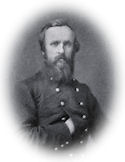
August 13.—Still rain. My horse hitched to a tree on the brow of a hill very near my tent broke loose during the night, and, it is said, rolled down the steep hill and swam the river. This morning he was seen trotting about in high feather on the opposite side of the river. He was caught and brought back unhurt, to the surprise of all who saw the place he must have gone down. Our right wing has been sent for to return to Bulltown. Captains Drake and Woodward who are out guerrilla hunting are still absent and not heard from for twenty-four hours.—P. M. Still raining. Captains Drake and Woodward have returned. They caught two of the pickets of the guerrilla party they were after but failed in surprising them, owing to a boy who gave information of their coming. They found a few good Union men; the mass of the people most ignorant. [They] describe the country in the edge of Webster County as precipitous and difficult; the people timid but cunning. They also brought two other prisoners, men who have been in the secession army.
The American Civil War
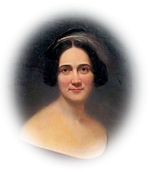
August 13th.—Hon. Robert Barnwell says, “The Mercury’s influence began this opposition to Jeff Davis before he had time to do wrong. They were offended, not with him so much as with the man who was put into what they considered Barnwell Rhett’s rightful place. The latter had howled nullification and secession so long that when he found his ideas taken up by all the Confederate world, he felt he had a vested right to leadership.”
Jordan, Beauregard’s aide, still writes to Mr. Chesnut that the mortality among the raw troops in that camp is fearful. Everybody seems to be doing all they can. Think of the British sick and wounded away off in the Crimea. Our people are only a half-day’s journey by rail from Richmond. With a grateful heart I record the fact of reconciliation with the Wigfalls. They dined at the President’s yesterday and the little Wigfall girls stayed all night.
Seward is fêting the outsiders, the cousin of the Emperor, Napoleon III., and Russell, of the omnipotent London Times.

August 13.—The New Orleans Delta of to-day rejoices over the contemplated expulsion of all citizens of the United States “from the Confederated States.” The law, it states, is, and the fact is confirmed from other sources, that all owning citizenship to the Federal Government are to be banished from the Confederated States. The Delta says:
“We cannot afford to tolerate enemies in our midst, because, forsooth, they may have the discretion to keep silent and to bear no arms in their hands. The man of Massachusetts, or the man of Kentucky, living, and perhaps thriving in our midst, has no business at this time to be among us, if he allows a reasonable suspicion to exist that he is not also cordially with us.”
—A severe skirmish took place a few miles from Grafton, Va., on the Fairmount and Webster road. Information having been received that a regularly organized body of rebels, living in the county, were lodged within a few miles of Webster, General Kelly sent Captain Dayton, of Company A, Fourth Virginia Regiment, with fifty men, from Webster to disarm them. After scouting nearly twenty-four hours he came suddenly on them, and after an hour’s severe fighting, succeeded in killing twenty-one and putting the others to flight, without loss to his command. The rebels numbered 200, and were composed of the worst characters of the county, led on by Zack Cochrane, sheriff under Gov. Letcher.—Ohio Statesman, August 16.
—The banks of New York, Philadelphia, and Boston agreed to take fifty millions of the Government loan, they to be the sole recipients of the Treasury notes.
William Gray, Franklin Haven, and J. Amory Davis were chosen a committee by the Boston bank directors to confer with the committees of the New York and Philadelphia banks in regard to the Government loan. The meeting adopted the following instructions to the Committee:
“That the Committee be authorized to say to the gentlemen of the Committees from the New York and Philadelphia banks, that, in the judgment of the gentlemen here assembled, the banks and bankers of Boston and of the State of Massachusetts and its people are prepared, ready, willing, and determined to do all in their power, in view of their duty to themselves, their trusts and their country, to aid it in suppressing the present rebellion by furnishing men and money to the utmost extent of their ability, now, henceforth and forever.”— N. Y. Evening Post, August 14.
—General Pope, at St. Louis, Mo., issued a general order, establishing regulations for the navigation of the Missouri River.—(Doc. 181.)
August 12. Monday.—Showery all day. Sent to Clarksburg H. T. Martin. He will probably be sent to Columbus for safe keeping. I gave him a letter to my brother-in-law to insure him attention there in case he should need. It is impossible to avoid mistakes in these cases. Union men may make charges merely to gratify personal animosity, knowing that in the nature of things a full investigation is impossible.
During Monday night a squad of the Tenth Regiment returned from the Buckhannon road with the body of one of the wild men of the mountains found in this country. He followed their regiment, shooting at them from the hills. They took him in the Bulltown region. He wore neither hat nor shoes, was of gigantic size—weighing two hundred and thirty pounds; had long hooked toes, fitted to climb—a very monster. They probably killed him after taking him prisoner in cold blood—perhaps after a sort of trial. They say he was attempting to escape.
_______
WESTON, VIRGINIA, August 12, 1861.
DEAR UNCLE:—We are still getting on nicely. We have a good deal more excitement now than usual. Wagon and cattle trains and small parties are fired on by guerrillas from the hills on two of the roads leading from here. Dr. Joe has about eight or ten in charge who have been wounded in this way. Two only have been killed. None in our regiment. The men all laugh at “squirrel guns” and the wounds they make. Several would have been killed if shot in the same part by the conical balls of our military guns. The “deadly rifle” of olden times shoots too small a bullet, and is too short in its range; but as Cassio says, it is often “sufficient.” We send out parties who bring in prisoners— sometimes the right men, sometimes not. All this keeps up a stir. In a week or two we shall get up a regular system of scouring the country to get rid of these rascals. The Union men here hate and fear them more than our men.
The threatened invasion by Lee from eastern Virginia hangs fire. They will hardly venture in, unless they come in a few days, as we are daily getting stronger. I hope you are still getting better.
Good-bye,
R. B. HAYES.
S. BIRCHARD.
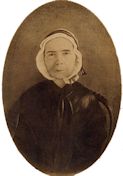
12th.—Still nothing from the army. We go on here quietly and happily—as happily as the state of the country will allow. The household peaceful and pleasant. The ladies—all of us collect in one room—work, while one reads some pleasant book. We are mercifully dealt with, and I hope we are grateful for such blessings.
The Northern papers tell us that General Patterson has withdrawn from the Northern army. The reason thereof is not mentioned; but we shrewdly suspect that the powers at Washington are not entirely satisfied that he was so completely foiled by General Johnston. General Johnston was fighting the battle of Manassas before General P. knew that he had left the Valley. The rumour that he had gone to join McDowell was unfounded. For many days there was no intercourse between the section occupied by the Federal army and that occupied by ours; pickets were placed on every road, to prevent any one from passing towards General P. Gentlemen who had come to Winchester and Berryville on business for a few hours, were not allowed to return home for days. So how could the poor man know what was going on? We only fear that his place may be supplied by one more vigilant. General Scott, too, has been almost superseded by General McClellan, who seems just now to be the idol of the North. The Philadelphia papers give a glowing description of his reception in that city. It was his luck, for it seems to me, with his disciplined and large command, it required no skill to overcome and kill the gallant General Garnett at Rich Mountain. For this he is feted and caressed, lionized and heroized to the greatest degree. I only hope that, like McDowell and Patterson, he may disappoint their expectations.
August 12.—Charles J. Faulkner, late U. S. Minister to France, was arrested in Washington by the Provost Marshal. The order for his arrest was issued from the War Department. A heavy detachment of infantry accompanied the Marshal to guard against any disturbance that the arrest might prompt. Mr. Faulkner acknowledged the authority, and signified his readiness to accompany the officer. He was taken to the jail, where the other prisoners of war are confined. Mr. Faulkner occupies a lower floor of the jail, and has a ward adjoining that of Dr. Fleming, of Virginia, who is also a prisoner and a man of wealth and influence. When first arrested, he was somewhat excited, but he shortly recovered himself, and during the afternoon conversed freely with one of the officers on the condition of France. When asked how the rebellion was regarded there, he answered, “France, sir, deeply regrets it.” He also stated that he had his passes all ready, and intended to leave for his home in Virginia today. In his conversation he carefully avoids expressing any opinion as to the political condition of the country. The charges upon which the arrest is based, are his successful efforts to procure arms in Europe for the use of the rebels, and the fact that he was going home to assume command of a regiment of rebels who had elected him colonel.—N. Y. Times, August 13.
—Abraham Lincoln, President of the United States, in accordance with a resolution of Congress, issued a proclamation, appointing a day of public fasting and prayer, to be observed by the people of the United States with religious solemnities and the offering of fervent supplications to Almighty God for the safety and welfare of the country, His blessings on the national arms, and a speedy restoration of peace.—(Doc. 178.)
—At one o’clock this afternoon, the office of the Democrat, a secession sheet published at Bangor, Me., was visited by a large number of people. During an alarm of fire, a crowd entered the office, cleared it of every thing it contained, and burned the contents in the street. Mr. Emery, the editor of the paper, escaped unharmed. A man who made some demonstrations in opposition to the acts of the mob, was badly used, but was finally rescued and put in jail.
—Judge Catron, of the United States Supreme Court, was expelled from Nashville, Tenn., by a Vigilance Committee, for his refusal to resign his office under the United States Government.—Baltimore American, August 14.
—Gen. Wool was ordered to the command of the Southeastern District of Virginia, headquarters at Fortress Monroe.—The Eleventh Regiment of New York Volunteers (First Fire Zouaves) left Washington for New York.—Troy Times, August 13.
—Twenty-two released prisoners of war arrived at Fortress Monroe from Norfolk, Va., under a flag of truce. They comprise the following persons:—Surgeons, Edward T. Taylor, First New Jersey; Jacob A. Stewart, First Minnesota; Eugene Peugnet, Seventy-first Now York; Foster Swift, Eighth New York; S. O. Thunkins, Fourth Maine; B. F. Buckstone, Fifth Maine; Wm. H. Allen, Second Maine; Jas. M. Lewis, Second Wisconsin; Gustavus Winston, New York Eighth; Chas. DeGraw, do.; _____ Normal, Seventy-ninth New York. These surgeons remained at Sudley Church and the stone building after the battle, attending the wounded, and were taken prisoners. They remained, some at Bull Run and others at Manassas Junction, attending upon the wounded for two weeks after the battle, and then were sent to Richmond. Finally they were released on parole and sent within the national lines, via Norfolk They have been courteously and kindly treated by the military authorities of the “Confederate ” States, and give the most unqualified denial to all stories of the killing or ill-treatment of the wounded. Mrs. Curtis, of New York, who went out a day or two after the battle and was taken prisoner, is also released.—(Doc. 179.)
—Ben. McCulloch, in a general order, congratulated “the army under his command” upon the victory at Wilson’s Creek, and hoped that “the laurels they had gained” would “not be tarnished by a single outrage.” He also issued a proclamation to the people of Missouri, calling upon them to act either for the North or the South.—(Doc. 180.)
August, ‘61.
Dear Girls: I have wrenched this opportunity from Abby to take my turn in writing you. It is as good as a fight to attempt to do anything useful in this family. Each one considers it her peculiar province, and if I manage to tuck in a handkerchief or two in the next box of hospital supplies I shall consider myself successful beyond expectation—speaking of which, T. D. brought in a splended lot last night that we had commissioned him to get the night before. . . . Abby says, “would you like three or four hundred brown duck havelocks for any of the brigade?” They can be bought ready-made. If so, find out from the quartermaster of the DeKalb regiment which pattern he thinks best, and let us know. In this connection I would advise that you answer all questions that we ask, and don’t suppose that they are put in to fill up. Mother and Charley are still in Astoria; they drove out in C’s little wagon Tuesday evening. I think mother repented before she got to the corner. I arranged her toes under the iron bar of the dash-board so that she could have that at least to hold on by, in case the horse went off the slow walk which Charley promised to keep to. . . . We have been holding a family conclave down in Mother’s room in which it has been decided,—that is, after bullying the girls into consent,—that Charley and I go up to Lenox on Monday, and engage rooms for the following Friday somewhere, if not in Lenox then in Lebanon. But go we must—the girls will slave themselves to death if we stay in town, and nothing short of heroic decision on our part will induce them to leave.
Cairo, August 11, ’61.
Our Canton boys came down on time, and right glad I am to have them here. Colonel Ross’s 17th Regiment got here the same day by the river. The boys were sworn into our company the day after they arrived, and the day following a lieutenant in the Fulton Blues came over to get them to join his company. I am glad he was too late. We have all been over to the Point to visit the Canton boys of the 17th, and found them looking very well. Will Trites, alone, looks unwell. A few weeks at home is what he really needs, for he will not give up work and go on the sick list as he ought to, as long as he can stand. Billy Stockdale, Chancey Black, George Shine, Billy Resor and Jesse Beeson are in No. 1 condition. Their tents are pitched in old Bird’s cornfield from which the corn has just been cut and you can imagine that the stubble is not equal to feathers to lie upon. They call us boys that live in barracks in Cairo, Sunday soldiers and Fourth of July braves; the same names we applied to them when they were in Camp Mather. The Canton boys in our company get along finely. They are in the best of spirits and already appear quite soldierly. They are well satisfied with the company which now numbers 90 men and will be full this week. We all room together except John Wallace and Milo Farewell. We are now drilling about six hours a day, but the greenhorns act as though they think it fun. We don’t suffer from the heat as much as one would think, and can you believe it the health of the camp is better now than ever before. We have not in our company a man on the sick list. Major Smith (our old friend Marion), says that the 17th have been healthier at Bird’s Point than they ever were before; and so every regiment says that comes here. If there are any very old people in Canton that want to live 50 or 60 years longer, advise them to come to Cairo. Mosquitoes and fleas are around these times. The whole family are here.
August 11.—The Hagerstown Herald of today says: The Union men of the border counties in Virginia continue to seek refuge in Maryland from the frightful tyranny which the rebels are practising in that State. Within the last week upward of fifty have crossed the river from Berkeley and Morgan counties, leaving behind them their families and homes, to avoid being pressed into the service. One of the number brought with him the following notice, which ho took from a blacksmith’s shop in Morgan County:
All the militia belonging to the Eighty-ninth Regiment V. M., are ordered to meet at Oakland, on Monday next, as early as they can, in order to march to head-quarters, Winchester, forthwith—and I would make a friendly request of those men that failed to go before, for them to turn out now like true-hearted Virginians, and what they have done will be looked over, but if they do not regard this call they will work their own ruin.—They can never be citizens of Virginia, and their property will be confiscated. The General will send a troop of horse to Morgan as soon as we leave, and all those men that fail to do their duty will be hunted up, and what the consequence will be I am unable to say.
Samuel Johnston,
July 24,1861. Col. S9th Regiment V. M.
This is the condition of affairs to which the citizens of Maryland are invited by their legislators and the sympathizers with secession.
—Early this morning, Gen. Siegel, in command of the force lately under Gen. Lyon at Wilson’s Creek, fell back to Springfield in good order, and subsequently to Rolla, Mo.—N. Y. Times, August 15.
—General Hurlburt, in command of the national forces at Palmyra, Mo., issued an order to. the county authorities of Marion County, Mo., requiring the delivery by them of a stated amount of rations to his troops every day, and threatening, if the order was not promptly obeyed, to billet the regiment upon the city of Palmyra.—(Doc. 177.)
——-
Late addition to Volume 3:
August 11.—Capt. Varian, of the Eighth regiment battery, N. Y. S. M., published a statement upon the reference to his command in Gen. McDowell report of the battle of Bull Run. “Seventeen of his men steadily refused to overstay their term upon any condition, and these finally carried the rest with them.”— N. Y. Times.
August, ‘61.
Dear Girls: Did you give the company captains my little books by Ordronneaux? If not, please do so. They have much useful advice, and as each captain ought to be the father of his company, and look after its welfare in every respect, some such little manual might be useful to them.
In regard to your enquiry about sending the Tribune and Independent to the hospitals regularly from the publication office, I would say that I have already so ordered 10 copies of the Independent sent every week for the coming three months, beginning with this week’s issue. It is prepaid and will be delivered free by Adams Express at the hospital. Charlie has gone down this morning to order the Semiweekly World or Tribune sent in the same way. . . You will receive 12 Independents which he has put up for the Columbia or any other hospital, and some packages for the chaplain of the 16th. . . .
The young men of the New York Christian Association who have been in Washington and Alexandria making the rounds of the hospitals, writing letters for the men and ministering generally, send word that they have never known a single chaplain of any regiment present himself to enquire for his sick or wounded, that there is no resident chaplain, and no one at hand to read or pray for a dying man, or to conduct the funeral services of the dead in the city hospitals. This must be especially the case with the Alexandria hospital—for in that town hardly any clergymen are left. . . . It would be encouraging to know that somebody was detailed in each hospital for special chaplain’s duty. Cannot some arrangement be made? . . .
You must tell us something more about the men of the 16th. . . . How do they cook their food and how is it distributed? Is the camp kept drained and clean? What do the men sleep on? Have they chances for bathing, washing clothes, etc.? . . . Two-thirds of the New York regiments as examined by the Sanitary Commission are crowded too many in a tent—regardless of ventilation—and liable next month to some terrible pestilence. The only sign, so far, that I can see of God’s mercy and the justice of our cause, is the absence as yet of any serious epidemic. . . . But as carelessness, bad habits, hot weather, etc., only sow seeds of sickness to ripen in autumn, we may yet have that plague too, overtake us.

August, ‘61.
I think that the best you can do is to make your own private arrangement for missionary work two days a week, say, in the Columbia College and two in the Alexandria hospital. I mention these because I suppose they are the two you would be likely to have best access to, and where your suggestions would be best received. You would have to do it with the consent of, or knowledge of, the head physician, superintendent, or whatever Cerberus it is who guards the portals. . . . You need not wait to find out what anybody else is doing. You have a grand scheme on hand for making the hospitals military posts and so entitled to chaplains, but I hardly think you will succeed. . . .
Shall I not apply to Professor Smith for information about a graduate of Union Theological Seminary who would be glad of such an appointment and who has qualifications for such special missionary work?—some one who could be set to work at once, under the “young men’s” auspices or your private patronage, and afterward get a government commission if such are granted. . . .
How strange some of the statements in Russel’s last letter are! That there was no hand to hand fighting at Bull Run. No batteries charged and taken by the Federalists. No masked batteries at all on the side of the rebels, etc., and then that horrid, insulting, false editorial from the London Times in yesterday’s Tribune! I am sure that is aiding and abetting our enemies if anything is, and Russell as the representative of such a paper ought not to be allowed within our lines again. . . .
Do you two ever refresh yourselves by a drive out into the country—for pleasure purely,—with your thoughts so busy always?
Headquarters of the Army,…….
Washington, Aug. , 1861.
My dear Mrs. Howland: If you will send me the names of the persons you want appointed to act as Chaplains for the Hospitals, I will get the Lieutenant-General to give them (not a regular commission) but an authority to visit and have free access to the Hospital at all times.
This will invest with full authority, but no rank or emolument.
Yours very truly,
H. Van Rensselaer.
Georgeanna, also wrote a private letter to President Lincoln asking that Hospital Chaplains should be appointed and handed it in herself at the back door of the White House; and, acting upon Abby’s idea, E. wrote Prof. H. B. Smith of the Union Theological Seminary, asking him to suggest the right person, and soon received the following answer:
. . I hope I have found the right man. Young Hopkins, son of President Mark Hopkins of Williams College, has just been in, and will think of it. If he can and will accept, he is as near being just the man as need be. He is not ordained, but I suppose can be, if necessary. Will you write me, if it is so? He is a Christian gentleman, every way, and a very able man intellectually. If you think well of him, and he agrees, when shall he come? Please write soon.
I have the most entire confidence in Mr. Hopkins’ discretion and courtesy. He does not seek mere position, he only wants to do good.
Yours truly,
H. B. Smith.
When he sent up his letter of introduction from Professor Smith to a and E. in Washington, he expected to be descended upon in the Ebbitt House parlor by two elderly women all ready to superintend him. A year later he wrote to Georgeanna. in acknowledging her photograph, “ It is the very identical countenance which demolished so delightfully my ideal Miss Woolsey with iron grey curls, black silk dress and spectacle-case.”
Mr. Hopkins did most admirable work in the voluntary unofficial position he consented to occupy at first. Later, wishing a more formal connection with the army service, he secured proper official recognition in the General Hospital, and still later he accepted an appointment in the field as regimental Chaplain.


