Following the American Civil War Sesquicentennial with day by day writings of the time, currently 1863.

The American Civil War

Post image for Mary Chesnut’s Diary.—”Mary Hammy saw lights glancing about among the trees, and we all heard guns. So we sat up. “

July 11th.—We did hear cannon to-day. The woman who slandered Mrs. Davis’s republican court, of which we are honorable members, by saying they—well, were not young; that they wore gaudy colors, and dressed badly—I took an inventory to-day as to her charms. She is darkly, deeply, beautifully freckled; she wears a wig which is kept in place by a tiara of mock jewels; she has the fattest of arms and wears black bead bracelets.

The one who is under a cloud, shadowed as a Yankee spy, has confirmed our worst suspicions. She exhibited unholy joy, as she reported seven hundred sick soldiers in the hospital at Culpeper, and that Beauregard had sent a flag of truce to Washington.

What a night we had! Maria had seen suspicious persons hovering about all day, and Mrs. Preston a ladder which could easily be placed so as to reach our rooms. Mary Hammy saw lights glancing about among the trees, and we all heard guns. So we sat up. Consequently, I am writing in bed to-day. A letter from my husband saying, in particular: “Our orders are to move on,” the date, July 10th. “Here we are still and no more prospect of movement now than when I last wrote to you. It is true, however, that the enemy is advancing slowly in our front, and we are preparing to receive him. He comes in great force, being more than three times our number.”

The spy, so-called, gave us a parting shot: said Beauregard had arrested her brother in order that he might take a fine horse which the aforesaid brother was riding. Why? Beauregard, at a moment’s notice, could have any horse in South Carolina, or Louisiana, for that matter. This man was arrested and sent to Richmond, and “will be acquitted as they always are,” said Brewster. “They send them first to Richmond to see and hear everything there; then they acquit them, and send them out of the country by way of Norfolk to see everything there. But, after all, what does it matter? They have no need for spies: our newspapers keep no secrets hid. The thoughts of our hearts are all revealed. Everything with us is open and aboveboard.

“At Bethel the Yankees fired too high. Every daily paper is jeering them about it yet. They’ll fire low enough next time, but no newspaper man will be there to get the benefit of their improved practise, alas!”

—Alexander H. Stephens delivered an elaborate speech at Augusta, Georgia, defending the cause of secession and pointing out the way to the success of the southern rebellion.— (Doc. 83.)

—This morning a young man presented himself at the quarters of one of the Pennsylvania Regiments, near Shuter’s Hill, opposite Washington, dressed in a suit of blue navy flannel, surmounted with a lieutenant’s epaulettes, and introduced himself as “Lieut. Smith of Company A, 6th Massachusetts Regiment.” Not being suspected at the time, he was allowed to inspect the works at Fort Ellsworth, and to witness the departure of the Zouaves toward Fairfax. Not until he had safely returned to Washington and been carried by the cars some miles on the road to Baltimore, was it discovered that a secessionist had been in camp.—N. Y. Tribune, July 13.

—The companies sent to the relief of Col. Smith, at Monroe, Missouri, returned to Hannibal this evening, and report the road unobstructed between Hannibal and Monroe. On arriving at the latter place, they formed a junction with Col. Smith’s force, which was intrenched in the Academy buildings. The rebels, 1,200 strong, were grouped over the prairie, out of reach of Col. Smith’s rifles. They had two pieces of artillery, which were brought to bear, but the distance was so great that the balls were almost spent before reaching the lines. Col. Smith’s artillery was of longer range, and did considerable execution. The fight lasted until dusk, and the last shot from the Federal side dismounted one of the rebels’ guns. Just at that moment Governor Wood, of Illinois, fell on their rear with the cavalry sent from Quincy and completely routed them, taking seventy-five prisoners, one gun, and a large number of horses. About twenty or thirty rebels were killed. Not one of the Unionists was killed, although several were severely wounded. General Tom Harris, the rebel leader, escaped.—Chicago Tribune, July 12.

—The New-Orleans Delta, of this day, says that further persistence of the Confederate States in the endeavor to obtain the recognition of our nationality is useless. It also says that the British Ministry have not the courage nor the inclination to apply to the Confederate States the rules which they have uniformly applied to other nations. It adds: “Too much importance has been assigned to the idea that France and England would break the blockade to get Southern products.” The editor, therefore, proposes a recall of the Southern Commissioners, and to refuse the recognition of resident Consuls of all the Powers which will not recognize similar officers of the Confederate States abroad.

—The rebels at New Orleans, La., have taken a powerful tug-boat, covered her with railroad iron, and put her machinery below the waterline. They have also built a new boat completely of iron, very sharp, with a sharp point below the waterline, intended to run down the Federal vessels of war. The latter will be commanded by Capt. Seward Porter, formerly of Portland, Maine.—National Intelligencer, July 16.

—The Charleston Mercury of this day publishes the following:—The Sixteenth Regiment S. C. M., comprising eight beat companies, were on the Green yesterday for inspection (?). A more ridiculous farce could not possibly have been enacted than that gone through with yesterday—that is, if regarded in a military point of view. If six hundred citizens, drawn up in two ranks, without arms or equipments, ununiformed, and ignorant of the first principles of a soldier’s duty, can be called a regiment, this was a regiment.

We forego further comment, only remarking, that what is a farce now, to be enjoyed by idle juveniles, may be at no distant day a tragedy over which the State will mourn.

—At St. Louis, Mo., about 400 men belonging to Col. McNeil’s regiment, a reserve corps, visited the State Journal office early this morning, removing the type, paper, etc. They then read an order from Gen. Lyon prohibiting the further publication of that sheet.

Col. McNeil published a proclamation to the people of Missouri, stating that the suppression of the State Journal was in consequence of its giving aid and comfort to those in active rebellion against the authority of the United States Government, encouraging the people to take up arms against that authority, to commit acts of violence and oppression against loyal citizens, and by the fabrication of false reports respecting the United States troops, inciting disaffected citizens to the commission of overt acts of treason, with a view of entirely subverting the Federal authority in the State.—N. Y. World, July 16.

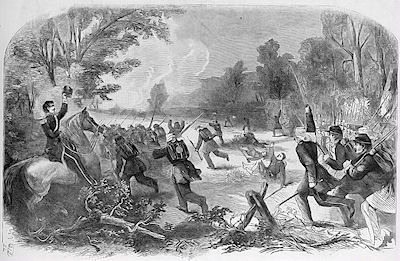
—A Battle was fought this afternoon at Rich Mountain,1 about two miles east of Roaring Run, Va. where the rebels, numbering about two thousand, under command of Col. Pegram, were strongly intrenched.

Battle_of_Rich_MountainAbout 3 o’clock this morning Gen. McClellan ordered four regiments—the Eighth, Tenth, Thirteenth Indiana, and Nineteenth Ohio Regiments, under the command of Gen. Rosecrans —to proceed along the line of the hills southeast of the enemy’s intrenched camp on the Beverly road, where it crosses Rich Mountain, two miles east of the enemy’s position, with orders to advance along the Beverly road and attack the east side of the work—Gen. McClellan being prepared to assault the west side as soon as the firing should announce the commencement of the attack. The capture of a courier, who mistook the road through the enemy’s camp for the route of the Federal troops, placed the enemy in possession of intelligence of the movement.

The rebels, about 2,500 strong, with heavy earthwork batteries, were intrenched on the western slopes of the Rich Mountain, about twenty-five miles east from Buckhannon, and two miles west from Beverly, which is on the east side of the mountain. They had selected the forks of the Roaring Creek, which empties after a northerly course into the Tygart’s Valley River, a branch of the Monongahela. The creek crosses the road in two places, about a mile apart.

The morning was cool and bracing, and the Federal troops were in capital spirits. Gen. Rosecrans ordered the brigade to cut a path through a thick growth of mountain pine trees and heavy undergrowth of brush for nearly nine miles, which occupied about ten hours, resting at noon.

Late in the afternoon Gen. Rosecrans came on the rear of the rebels, and, after a desperate fight of an hour and a half, completely routed them, driving them in the utmost disorder into the woods, and capturing all their guns, wagons, and camp equipage, or, as Gen. McClellan says, “all they had.” They also took several prisoners, many officers among them. Sixty of the rebels were killed and a large number wounded. Of the Union troops twenty were killed and forty wounded. Gen. McClellan had his guns mounted to command the rebels’ position, but he found that the gallantry of Rosecrans spared him the trouble of going into action. He is now moving on Beverly, and the advance command of Gen. Rosecrans are within three miles of that place.—(Doc. 84.)

_____

1 Rich Mountain is a gap in the Laurel Hill Range where the Staunton and Weston turnpike crosses it between Buckhannon and Beverly, and about four or miles out of the latter place. It is about as far from Laurel Hill proper, (that is, where the Beverly and Fairmount pike crosses it, and where the enemy is intrenched,) as Beverly is: some 15 or 16 miles. It is also about 25 miles  from Buckhannon.— Wheeling Intelligencer.

Post image for William Howard Russell’s Diary: Silencing the Press and Telegraph.—A Loan Bill.—Interview with Mr. Cameron.

July 10th.—To-day was spent in a lengthy excursion along the front of the camp in Virginia, round by the chain bridge which crosses the Potomac about four miles from Washington.

The Government have been coerced, as they say, by the safety of the Republic, to destroy the liberty of the press, which is guaranteed by the Constitution, and this is not the first instance in which the Constitution of the United States will be made nominis umbra. The telegraph, according to General Scott’s order, confirmed by the Minister of War, Simon Cameron, is to convey no despatches respecting military movements not permitted by the General; and today the newspaper correspondents have agreed to yield obedience to the order, reserving to themselves a certain freedom of detail in writing their despatches, and relying on the Government to publish the official accounts of all battles very speedily. They will break this agreement if they can, and the Government will not observe their part of the bargain. The freedom of the press, as I take it, does not include the right to publish news hostile to the cause of the country in which it is published; neither can it involve any obligation, on the part of Government to publish despatches which may be injurious to the party they represent. There is a wide distinction between the publication of news which is known to the enemy as soon as to the friends of the transmitters, and the utmost freedom of expression concerning the acts of the Government or the conduct of past events; but it will be difficult to establish any rule to limit or extend the boundaries to which discussion can go without mischief, and in effect the only solution of the difficulty in a free country seems to be to grant the press free licence, in consideration of the enormous aid it affords in warning the people of their danger, in animating them with the news of their successes, and in sustaining the Government in their efforts to conduct the war.

The most important event to-day is the passage of the Loan Bill, which authorises Mr. Chase to borrow, in the next year, a sum of £50,000,000, on coupons, with interest at 7 per cent, and irredeemable for twenty years—the interest being guaranteed on a pledge of the Customs duties. I just got into the House in time to hear Mr. Vallandigham, who is an ultra-democrat, and very nearly a secessionist, conclude a well-delivered argumentative address. He is a tall, slight man, of a bilious temperament, with light flashing eyes, dark hair and complexion, and considerable oratorical power. “Deem me ef I wouldn’t just ride that Vallandiggaim on a reay-al,” quoth a citizen to his friend, as the speaker sat down, amid a few feeble expressions of assent. Mr. Chase has also obtained the consent of the Lower House to his bill for closing the Southern ports by the decree of the President, but I hear some more substantial measures are in contemplation for that purpose. Whilst the House is finding the money the Government are preparing to spend it, and they have obtained the approval of the Senate to the enrolment of half a million of men, and the expenditure of one hundred millions of dollars to carry on the war.

I called on Mr. Cameron, the Secretary of War. The small brick house of two stories, with long passages, in which the American Mars prepares his bolts, was, no doubt, large enough for the 20,000 men who constituted the armed force on land of the great Republic, but it is not sufficient to contain a tithe of the contractors who haunt its precincts, fill all the lobbies and crowd into every room. With some risk to coattails, I squeezed through iron-masters, gun-makers, clothiers, shoemakers, inventors, bakers, and all that, genus which fattens on the desolation caused by an army in the field, and was introduced to Mr. Cameron’s room, where he was seated at a desk surrounded by people, who were also grouped round two gentlemen as clerks in the same small room. “I tell you, General Cameron, that the way in which the loyal men of Missouri have been treated is a disgrace to this Government,” shouted out a big, black, burly man—” I tell you so, sir.” “Well, General,” responded Mr. Cameron, quietly, “so you have several times. Will you, once for all, condescend to particulars?” “Yes, sir; you and the Government have disregarded our appeals. You have left us to fight our own battles. You have not sent us a cent…” “There, General, I interrupt you. You say we have sent you no money,” said Mr. Cameron, very quietly. “Mr. Jones will be good enough to ask Mr. Smith to step in here.” Before Mr. Smith came in, however, the General, possibly thinking some member of the press was present, rolled his eyes in a Nicotian frenzy, and perorated: “The people of the State of Missouri, sir, will power-out every drop of the blood which only flows to warm patriotic hearts in defence of the great Union, which offers freedom to the enslaved of mankind, and a home to persecuted progress, and a few-ture to civil-zation. We demand, General Cameron, in the neame of the great Western State …” Here Mr. Smith came in, and Mr. Cameron said, “I want you to tell me what disbursements, if any, have been sent by this department to the State of Missouri.” Mr. Smith was quick at figures, and up in his accounts, for he drew out a little memorandum book, and replied (of course, I can’t tell the exact sum), ” General, there has been sent, as by vouchers, to Missouri, since the beginning of the levies, six hundred and seventy thousand dollars and twenty-three cents.” “The General looked crestfallen, but he was equal to the occasion, “These sums may have been sent, sir, but they have not been received. I declare in the face of …” “Mr. Smith will show you the vouchers, General, and you can then take any steps needful against the parties who have misappropriated them.”

“That is only a small specimen of what we have to go through with our people,” said the Minister, as the General went off with a lofty toss of his head, and then gave me a pleasant sketch of the nature of the applications and interviews which take up the time and clog the movements of an American statesman. “These State organisations give us a great deal of trouble.” I could fully understand that they did so. The immediate business that I had with Mr. Cameron—he is rarely called General now that he is Minister of War— was to ask him to give me authority to draw rations at cost price, in case the army took the field before I could make arrangements, and he seemed very well disposed to accede; “but I must think about it, for I shall have all our papers down upon me if I grant you any facility which they do not get themselves.” After I left the War Department, I took a walk to Mr. Seward’s, who was out. In passing by President’s Square, I saw a respectably-dressed man up in one of the trees, cutting off pieces of the bark, which his friends beneath caught up eagerly. I could not help stopping to ask what was the object of the proceeding. “Why, sir, this is the tree Dan Sickles shot Mr. ____ under. I think it’s quite a remarkable spot.”

JULY 10TH.—There are indications of military operations on a large scale on the Potomac. We have intelligence that McDowell is making preparations to advance against our forces at Manassas. Gen. Johnston is expected to be there in time; and for that purpose is manœuvring Gen. Patterson out of the way. Our men have caps now—and will be found in readiness. They have short-commons under the Commissary Department; but even with empty stomachs, they can beat the Yankees at the ordeal of dying. Fighting is a sport our men always have an appetite for.

Post image for A Diary of American Events – July 10, 1861

—The Executive Government of the United States and correspondents arrived at a full understanding to-day, regarding the transmission of telegraphic despatches giving information as to movements of the army. So, hereafter, it will be necessary for the distant public to await the arrival of the mails before knowing what advances of troops have been made, as also what reinforcements have arrived. The Government alleges that it has been greatly embarrassed in its movements by the Washington correspondents of the New York press, and patriotically called upon them to co-operate in not publishing any movements prematurely. Should a battle occur, the Government will probably permit the official accounts to be transmitted.—N. Y. World, July 11.

—The Loan bill passed the House of Representatives to-day. It authorizes the Secretary of the Treasury to borrow on the credit of the United States, within twelve months from the passage of the act, a sum not exceeding two hundred and fifty millions of dollars, for which he is authorized to issue certificates of coupon, or registered stock, or treasury notes, the stock to bear interest not exceeding seven per centum per annum, payable semi-annually, irredeemable for twenty years, and after that period redeemable at pleasure. The United States treasury notes are to be fixed by the Secretary at not less than fifty dollars, payable three years after date, with interest at the rate of seven and three-tenths per centum per annum, payable annually on the notes of fifty dollars, and semi-annually on notes of larger denominations. The faith of the United States is solemnly pledged for the payment of the interest and the redemption of the principal of the loan; and for the full and punctual payment of the interest, the United States specially pledge the duties of import on tea, coffee, sugar, spices, wines and liquors, and also such excise and other internal duties or taxes as may be received into the treasury. In the debate on the bill, Mr. Vallandigham, of Ohio, took occasion to charge the Executive with a usurpation of power, and declared himself for a speedy, immediate, and honorable peace.—(Doc. 75.)

—The entire postal service, embracing post-offices, post-routes, and route agencies in Middle and West Tennessee, were discontinued by order of the Postmaster-General.—National Intelligencer, July 12.

—A Resolution passed the Lower House of the Virginia Legislature, at Wheeling, to-day, instructing Senators and requesting Representatives in Congress to vote for the necessary appropriations of men and money for a vigorous prosecution of the war, and to oppose all compromises until the rebellion is crushed out. The following resolution was offered by Mr. Vance, of Harrison:

Whereas, One Owen Lovejoy, a member from Illinois, has offered a resolution in the House of Representatives, having for its object the repeal of the fugitive slave law; therefore be it

Resolved, That our Senators in Congress be instructed, and our Representatives requested to vote against said resolution, or any other of like object.— N. Y. World, July 11.

—In the Senate of the United States the bill authorizing the employment of 500,000 volunteers, and making an appropriation of 600,000,000 dollars, for the purpose of suppressing the existing rebellion, was passed. Mr. Saulsbury of Delaware desired to amend, by inserting, in the place of 500,000 men, 200,000; he desired peace, he said, and had faith in compromise measures. To him it was pertinently replied that 200,000 men were too many for peace and too few for war; and the amendment was rejected—33 voting against it, and 5 (Messrs. Johnson of Missouri, Kennedy, Polk, Powell, and Saulsbury) in favor of it.

—Gen. Banks issued a proclamation, appointing Geo. R. Dodge, Esq., of Baltimore, , Marshal of Police, vice Col. Kenly, Provost Marshal, relieved.

He also directed the military occupation of Baltimore to cease, and ordered the regiments to resume their old positions in the suburbs of the city. The regiments affected by this order are the Eighteenth, Nineteenth, and Twenty, second Pennsylvania ; the Thirteenth and Twentieth New York, and Eighth Massachusetts, and the Massachusetts battery of light artillery. The soldiers will not be permitted to visit the city without permission, and then must leave their arms in camp.—Baltimore American, July 10.

—This afternoon, a gold medal, ordered by the citizens of New York, was presented by Mayor Wood to Brigadier-General Anderson, through his friend, John C. Murray, who was deputed to receive it on his behalf.—N. Y. Evening Post, July 10.

—The Thirty-third Regiment, New York Volunteers, commanded by Col. R. F. Taylor, numbering 859 men, passed through Baltimore to-day.—N. Y. Commercial Advertiser, July 11.

—Daniel S. Dickinson delivered an address at Amherst College, on the present state of affairs in the United States. It is replete with the customary vigor of its distinguished author, with that strong instinct of generous and genuine Democracy which belongs to his character, and is inspired by the largest patriotism and the wisest statesmanship. Mr. Dickinson declared himself for the maintenance of the Constitution and for the preservation of the integrity of the Republic at whatever cost. At the same time he exposed the folly of the secession theory and the wickedness of the secession practice; and, in all, he speaks like a man of the people and an American. Regarding the present crisis not without sorrow indeed, but without fear, he is for a zealous and speedy prosecution of the war, and for peace only on the basis of the entire submission of the rebels.—(Doc. 76.)

—The Twenty-seventh Regiment N. Y. S. V., commanded by Col. H. W. Slocum, 1,000 strong, left Elmira this afternoon for Washington.—N. Y. Evening Post, July 10.

—The House of Representatives passed the bill laid before Congress by Secretary Chase, empowering the President to close the ports of the seceding States. The vote on the passage of the bill wag 185 yeas to 10 nays.—N. Y. Evening Post, July 10.

—About two o’clock this morning the camp of the Federal troops, under Colonel Smith, of the Illinois Sixteenth, near Monroe station, thirty miles west of Hannibal, Mo., embracing 800 of the Iowa Third, 200 of the Illinois Sixteenth, and about 100 of the Hannibal Home Guards, was attacked by 1,600 secessionists, under Brigadier-General Harris.

Although the Federals were surprised, they repelled the attack, drove the rebels back, killed four, and wounded several, besides capturing five prisoners and seven horses. Harris retreated to Monroe, where another skirmish occurred, in which the rebels were again repulsed. Smith then took up a position and sent messengers for reenforcements from Quincy.—Baltimore American, July 12.—(Doc. 76½.)

—The Seventh Massachusetts Regiment, under command of Colonel D. N. Couch, left Taunton, Mass., this afternoon for the seat of war. —N. Y. Evening Post, July 10.

—The New Orleans True Delta of to-day has two characteristic articles, containing bold denunciations of the rebel leaders. One refers to the contemplated assembling of the Congress of the Confederate States in Richmond on the 20th inst., of the future of which no very sanguine anticipations are entertained. If the State of Louisiana, it says, is to be taken as a sample of the way things have been conducted, the result shows a treasury collapsed, a great city comparatively defenceless, a people full of chivalrous feeling discouraged, and an ardent and zealous local militia disappointed and disgusted. It suggests that the provisional government should immediately organize the local military strength, under the direction of capable and intelligent military officers, to which should be temporarily attached such scattering material as may be found unemployed in adjacent States, so as to familiarize it for any duty the future may require of it. The other article shows the absurdity of the donation reliance; states that the men who have managed to get the country into the war have proved themselves utterly incapable of carrying the rebel States safely and honorably through it, and asks why should not the people awake at once to the opportunity that will soon present, to find other men more fit to carry them with honor, glory, and success, to a triumphal termination of all their troubles? It is quite likely that the indignation of the people of the rebellious States will recoil upon the rebel leaders who have madly led them into this unfortunate war.

—Henry A. Wise of the rebel army issued a proclamation, calling upon the citizens of Western Virginia to rally to his standard, and holding out to them the promise of pardon for past oftbuces.—(Doc. 78.) ,

—A skirmish took place at Laurel Hill, Va., between the Federal troops under Gen. McClellan, and the rebels under Gen. Pegram. About 2 o’clock in the afternoon two large bodies were seen from a high hill in the neighborhood to leave the rebels’ camp. Instant preparations were made to resist. About 4 p. M., there was skirmishing in front by the Fourteenth Ohio and Ninth Indiana Regiments, which soon became very warm. The rebels advanced under cover of the woods when the Federals rushed forward, pouring in a sharp volley, killing several of the enemy. The rebel cavalry then advanced to take our skirmishers in flank. The Federal troops rapidly retreated, and the artillery dropped a couple of shells, one of which exploded among the cavalry when they instantly fell back. Again the Union troops rushed forward and pouring in another volley the rebels scattered in the woods, and the officers were seen attempting to rally them, but they could not be brought up again in a body. In the meantime the skirmishers picked off their officers, and several additional shells were thrown in. The Federal troops made a final rush, driving the rebels from their own rifle pits, and bringing back several of their blankets, canteens and guns. The rebel force engaged was a Georgia Regiment, 1,200 strong, and generally considered the crack regiment of this division of the rebel army.

The most astonishing bravery was displayed by the Federal skirmishers, and the only trouble was to keep the men from rushing into the midst of the enemy. The whole skirmish was a most spirited affair, and the Ohio and Indiana boys gave the Georgians some new idea of Yankee courage. A prisoner taken says that the Georgians refused to come into the woods again opposite to the Federal position, and they were all astonished and terrified. The rebel supply of provisions has been cut off, and they must soon come to extremities. The Union loss is one killed and three wounded. Indications have been seen of an attempt to open a new road by the rebels through which to escape or bring in provisions. Every outlet is watched, and they are trapped.

—The New Orleans Picayune of this day contains a particular account of a fight that occurred lately at the mouth of the Mississippi. —(Doc. 79.)
Boston, July 9, 1861

Yesterday we [the Battalion] went out to escort Gordon’s regiment off — the one raised by the subscription of the Boston gentlemen. There were, as I have told you, lots of my friends in it, and I should have been, sorry not to have bid them good-bye; but not till they were gone did I find that the one I should most wished to have seen was gone, and I did n’t even see him as the train went off. For Stephen Perkins joined as a Second Lieutenant at the last minute, and I did n’t know the fact till he was on his way to Virginia. It made me feel quite badly and I have n’t got over it yet. Off they all went, however, and apparently in good spirits and full of life and hope, and the last I saw of the train, Wilder Dwight, rapidly disappearing on its last platform, was waving his hat and dancing a saraband at me, which I returned from the pile of gravel on which we were drawn up, with my whole heart. Sam Quincy was swept by me as he stood on the lower step of a platform looking at his old friends in the cadets, but I did not catch his eye. He looked much as usual. When Hal Russell passed he caught my eye and went through a war dance, with that eager look on his face which a man has when bidding good-bye to old friends on his way to the wars, and when he only recollects pleasant things about them; but Stephen Perkins I did n’t see, even as the train went by. They’re on their way now and I certainly envy them very much. Next comes Frank Palfrey and then there is n’t much of any one to go after that. John Palfrey has come home, by the way, sick — a typhoid fever, but the symptoms are said to be mild. He was over-worked in the sun, surveying, but they do not seem to be apprehensive. Caspar Crowninshield has got home from Washington and expects a commission in the regular army, and, I have little doubt, will get it. . . .

Post image for Mary Chesnut’s Diary.—”Brewster came back with a paper from Washington with terrific threats of what they will do to us.”

July 9th.—Our battle summer. May it be our first and our last, so called. After all we have not had any of the horrors of war. Could there have been a gayer, or pleasanter, life than we led in Charleston. And Montgomery, how exciting it all was there! So many clever men and women congregated from every part of the South. Mosquitoes, and a want of neatness, and a want of good things to eat, drove us away. In Richmond the girls say it is perfectly delightful. We found it so, too, but the bickering and quarreling have begun there.

At table to-day we heard Mrs. Davis’s ladies described. They were said to wear red frocks and flats on their heads. We sat mute as mice. One woman said she found the drawing-room of the Spotswood was warm, stuffy, and stifling. “Poor soul,” murmured the inevitable Brewster, “and no man came to air her in the moonlight stroll, you know. Why didn’t somebody ask her out on the piazza to see the comet?” Heavens above, what philandering was done in the name of the comet! When you stumbled on a couple on the piazza they lifted their eyes, and “comet” was the only word you heard. Brewster came back with a paper from Washington with terrific threats of what they will do to us. Threatened men live long.

There was a soft, sweet, low, and slow young lady opposite to us. She seemed so gentle and refined, and so uncertain of everything. Mr. Brewster called her Miss Albina McClush, who always asked her maid when a new book was mentioned, “Seraphina, have I perused that volume?”

Mary Hammy, having a fiance in the wars, is inclined at times to be sad and tearful. Mrs. Preston quoted her negro nurse to her: “Never take any more trouble in your heart than you can kick off at the end of your toes.”

Post image for A Diary of American Events – July 9, 1861

—To-day the ship Mary Goodall was boarded by the crew of the pirate brig Jeff. Dayis, off Nantucket South shoals; but, being British property, was released. Captains Fifield, of the brig John Walsh, of Philadelphia; Smith, of the schooner S. J. Waring, and Deverani, of the Schooner Enchantress, of Newburyport, were put on board the Mary Goodall, by the Jeff. Davis, which had captured their vessels during the week. The Jeff. Davis sails under the French flag. She is commanded by Captain Postell, formerly of the United States Navy.—N. Y. Commercial Advertiser, July 18.

—The First Regiment of Maryland Volunteers, raised by Capt. McConnell, and mustering exactly one thousand men, left Frederick at day-break this morning by the turnpike for Hagerstown, under the command of Lieut. Col. Dushane. The enlistment of men for the Second Regiment is progressing rapidly at the headquarters, on Green street, near Baltimore. Companies A, B, C, and D, each consisting of 100 men, have been mustered into service. It is the intention of several military men, residents of Baltimore, to raise the Third Regiment called for by the President of the United States, as soon as the second shall take the field.—Baltimore American, July 11.

Post image for We—Charley, Eliza and Georgeanna.—left New York, July 2d,  to join the army and Joseph Howland in Washington, stopping on our way over night with Cousin Margaret Hodge in Philadelphia.—Woolsey family letters.
Georgeanna Muirson Woolsey to Cousin Margaret Hodge.

Washington, July 8, 1861.

My dear Cousin Margaret: I should have begun by dating my letter Ebbitt House, we having been established here since Saturday, spending the first three days of our visit, or probation, at the “National,” in the fifth story, a prey to several inconveniences, but refreshingly near processions. Joe sent his man down to meet us, and came himself after evening drill. He looks brown and well; is dashing round on horseback all day from camp to the War Department, and back again to camp, where he must spend seven hours a day drilling. Then all the cracks are filled up with our society out there. We go out every day in time for evening drill, and stay till it is time to shut up for the night, having a nice time in the door of Joe’s tent “in the cool of the day,” and this sort of thing we fondly thought was going to last an indefinite length of time, till yesterday, when Joe surprised us by the news that they were ordered into Virginia, and would leave on Tuesday or Wednesday. The Colonel has been made an acting Brigadier-General, and he and Joe were eight hours in the saddle yesterday, flying round selecting three regiments to form the Brigade with the Sixteenth. Joe has been in today on the same business, being entrusted to decide upon them and take whichever he thought best; and has chosen the Eighteenth, Twenty-first and Thirty-first—all from New York. So on Wednesday I suppose they will move over the bridge, and then we shall deliver our letters of introduction and plunge into occupation of some kind.

Washington is the stillest place for a city I have ever been in; nobody knows anything, or has anything to say. Everything is guess work. A few doleful little boys call the evening papers round the doors of the hotel, but in a tone that fixes a gloom upon you. I hate the “Eve-ening Star” already, and our only news comes via New York. The Tribune, Times and Herald have a great deal of information about what goes on here, and it generally proves true. . . . One longs now and then for a real living and lying “Extra” boy, with his mouth full of fearful statements, all disproved by his paper which you imprudently buy. We went, of course, to the opening of Congress and also to hear President Lincoln’s message, read on the fifth.

Charley has been about visiting the camps at Alexandria, Georgetown and Arlington, but for all this a pass is necessary, which can only be procured through General Mansfield on introduction by some one known to him. If Lenox knows anyone at home who knows the General it would save him half a day to get his letter before coming on. Charley got his through Colonel Davies who is a relative of the General’s. I hope Lenox will come on, but it is too bad that he will not see Joe. . . .

Here comes a regiment down this street. About 15,000 men have gone over into Virginia since we came on. Joe goes up in rank with his Colonel as his aid — is now Captain and Assistant Adjutant General—and the Brigade will be in McDowell’s Division. . . . The regiment has marched past— the Massachusetts Eleventh just from Harrisburg, all in beautiful order, gray uniforms and large clean havelocks. New England doesn’t do anything by halves. . . . And here goes another company, guarding thirteen well-filled baggage wagons and followed by its regiment. We have only to flourish our handkerchiefs and the dear fellows will kiss their hands, twirl their hats and manifest affection for the entire woman population of the North. They are the Fourth Maine, and are going over into Virginia. I must put up my letter and watch them marching along. Our love to the Doctor and the boys.

Post image for William Howard Russell’s Diary: Arlington Heights and the Potomac.—Washington.—The Federal camp.—General M’Dowell.—Flying rumours.

July 8th.—I hired a horse at a livery stable, and rode out to Arlington Heights, at the other side of the Potomac, where the Federal army is encamped, if not on the sacred soil of Virginia, certainly on the soil of the district of Columbia, ceded by that State to Congress for the purposes of the Federal Government. The Long Bridge which spans the river, here more than a mile broad, is an ancient wooden and brick structure, partly of causeway, and partly of platform, laid on piles and uprights, with drawbridges for vessels to pass. The Potomac, which in peaceful times is covered with small craft, now glides in a gentle current over the shallows unbroken by a solitary sail. The “rebels” have established batteries below Mount Vernon, which partially command the river, and place the city in a state of blockade.

As a consequence of the magnificent conceptions which were entertained by the founders regarding the future dimensions of their future city, Washington is all suburb and no city. The only difference between the denser streets and the remoter village-like environs, is that the houses are better and more frequent, and the roads not quite so bad in the former. The road to the Long Bridge passes by a four-sided shaft of blocks of white marble, contributed, with appropriate mottoes, by the various States, as a fitting monument to Washington. It is not yet completed, and the materials lie in the field around, just as the Capitol and the Treasury are surrounded by the materials for their future and final development. Further on is the red, and rather fantastic, pile of the Smithsonian Institute, and then the road makes a dip to the bridge, past some squalid little cottages, and the eye reposes on the shore of Virginia, rising in successive folds, and richly wooded, up to a moderate height from the water. Through the green forest leaves gleams the white canvas of the tents, and on the highest ridge westward rises an imposing structure, with a portico and colonnade in front, facing the river, which is called Arlington House, and belongs, by descent, through Mr. Custis, from the wife of George Washington, to General Lee, Commander-in-Chief of the Confederate army. It is now occupied by General M’Dowell as his head-quarters, and a large United States’ flag floats from the roof, which shames even the ample proportions of the many stars and stripes rising up from the camps in the trees.

At the bridge there was a post of volunteer soldiers. The sentry on duty was sitting on a stump, with his firelock across his knees, reading a newspaper. He held out his hand for my pass, which was in the form of a letter, written by General Scott, and ordering all officers and soldiers of the army of the Potomac to permit me to pass freely without let or hindrance, and recommending me to the attention of Brigadier-General M’Dowell and all officers under his orders. “That’ll do, you may go,” said the sentry. What pass is that, Abe?” inquired a non-commissioned officer. “It’s from General Scott, and says he’s to go wherever he likes.” “I hope you’ll go right away to Richmond, then, and get Jeff Davis’s scalp for us,” said the patriotic sergeant.

At the other end of the bridge a weak tête de pont, commanded by a road-work further on, covered the approach, and turning to the right I passed through a maze of camps, in front of which the various regiments, much better than I expected to find them, broken up into small detachments, were learning elementary drill. A considerable number of the men were Germans, and the officers were for the most part in a state of profound ignorance of company drill, as might be seen by their confusion and inability to take their places when the companies faced about, or moved from one flank to the other. They were by no means equal in size or age, and, with some splendid exceptions, were inferior to the Southern soldiers. The camps were dirty, no latrines—the tents of various patterns—but on the whole they were well castrametated.

The road to Arlington House passed through some of the finest woods I have yet seen in America, but the axe was already busy amongst them, and the trunks of giant oaks were prostrate on the ground. The tents of the General and his small staff were pitched on the little plateau in which stood the house, and from it a very striking and picturesque view of the city, with the White House, the Treasury, the Post Office, Patent Office, and Capitol, was visible, and a wide spread of country, studded with tents also as far as the eye could reach, towards Maryland. There were only four small tents for the whole of the head-quarters of the grand army of the Potomac, and in front of one we found General M’Dowell, seated in a chair, examining some plans and maps. His personal staff, as far as I could judge, consisted of Mr. Clarence Brown, who came over with me, and three other officers, but there were a few connected with the departments at work in the rooms of Arlington House. I made some remark on the subject to the General, who replied that there was great jealousy on the part of the civilians respecting the least appearance of display, and that as he was only a brigadier, though he was in command of such a large army, he was obliged to be content with a brigadier’s staff. Two untidy-looking orderlies, with ill-groomed horses, near the house, were poor substitutes for the force of troopers one would see in attendance on a general in Europe but the use of the telegraph obviates the necessity of employing couriers. I went over some of the camps with the General. The artillery is the most efficient-looking arm of the service, but the horses are too light, and the number of the different calibres quite destructive to continuous efficiency in action. Altogether I was not favourably impressed with what I saw, for I had been led by reiterated statements to believe to some extent the extravagant stories of the papers, and expected to find upwards of 100,000 men in the highest state of efficiency, whereas there were not more than a third of the number, and those in a very incomplete, ill-disciplined state. Some of these regiments were called out under the President’s proclamation for three months only, and will soon have served their full time, and as it is very likely they will go home, now the bubbles of national enthusiasm have all escaped, General Scott is urged not to lose their services, but to get into Richmond before they are disbanded.

It would scarcely be credited, were I not told it by General M’Dowell, that there is no such thing procurable as a decent map of Virginia. He knows little or nothing of the country before him, more than the general direction of the main roads, which are bad at the best; and he can obtain no information, inasmuch as the enemy are in full force all along his front, and he has not a cavalry officer capable of conducting a reconnaissance, which would be difficult enough in the best hands, owing to the dense woods which rise up in front of his lines, screening the enemy completely. The Confederates have thrown up very heavy batteries at Manassas, about thirty miles away, where the railway from the West crosses the line to Richmond, and I do not think General M’Dowell much likes the look of them, but the cry for action is so strong the President cannot resist it.

On my way back I rode through the woods of Arlington, and came out on a quadrangular earthwork, called Fort Corcoran, which is garrisoned by the 69th Irish, and commands the road leading to an aqueduct and horse-bridge over the Potomac. The regiment is encamped inside the fort, which would be a slaughter-pen if exposed to shell-fire. The streets were neat, the tents protected from the sun by shades of evergreens and pine boughs. One little door, like that of an ice-house, half buried in the ground, was opened by one of the soldiers, who was showing it to a friend, when my attention was more particularly attracted by a sergeant, who ran forward in great dudgeon, exclaiming “Dempsey! Is that you going into the ‘magazine’ wid yer pipe lighted?” I rode away with alacrity.

In the course of my ride I heard occasional dropping shots in the camp. To my looks of inquiry, an engineer officer said quietly, “They are volunteers shooting themselves.” The number of accidents from the carelessness of the men is astonishing; in every day’s paper there is an account of deaths and wounds caused by the discharge of firearms in the tents.

Whilst I was at Arlington House, walking through the camp attached to head-quarters, I observed a tall red-bearded officer seated on a chair in front of one of the tents, who bowed as I passed him, and as I turned to salute him, my eye was caught by the apparition of a row of Palmetto buttons down his coat. One of the officers standing by said, “Let me introduce you to Captain Taylor, from the other side.” It appears that he came in with a flag of truce, bearing a despatch from Jefferson Davis to President Lincoln, countersigned by General Beauregard at Manassas. Just as I left Arlington, a telegraph was sent from General Scott to send Captain Taylor, who rejoices in the name of Tom, over to his quarters.

The most absurd rumours were flying about the staff, one of whom declared very positively that there was going to be a compromise, and that Jeff Davis had made an overture for peace. The papers are filled with accounts of an action in Missouri, at a place called Carthage, between the Federals commanded by Colonel Sigel, consisting for the most part of Germans, and the Confederates under General Parsons, in which the former were obliged to retreat, although it is admitted the State troops were miserably armed, and had most ineffective artillery, whilst their opponents had every advantage in both respects, and were commanded by officers of European experience. Captain Taylor had alluded to the news in a jocular way to me, and said, “I hope you will tell the people in England we intend to whip the Lincolnites in the same fashion wherever we meet them,” a remark which did not lead me to believe there was any intention on the part of the Confederates to surrender so easily.