Following the American Civil War Sesquicentennial with day by day writings of the time, currently 1863.

The American Civil War

Camp Stephens, near Martinsburg, June 30, 1861.

I wrote to you last Monday, and immediately was ordered off on another expedition, in which I have been engaged the greater part of the past week. I was in charge of a small force engaged in destroying a bridge some ten miles from our camp on the railroad. It was a rather dangerous expedition, but I have become so much accustomed to the prospect of danger that it excites no alarm. I thought when we left Winchester that we certainly would have had a battle in a very few days; but two weeks have elapsed, and there is, I think, less reason to expect one now than there has been heretofore. The enemy is encamped on the opposite side of the Potomac some ten miles from here, but, I am satisfied, in less force than we have in this vicinity. Under such circumstances, if we get a fight we shall have to cross the river and make the attack. Our picket-guards occasionally come in contact, and the other day one of the Augusta Cavalry was severely wounded. I hope you are having good success as a farmer; so, if I should be left behind when the war is over, you may be able to take care of yourself. You think, Love, I write very indifferently about it. As to the danger to myself, I am free to confess that I feel perhaps too indifferent. Not so as to the separation from loved wife and little ones at home. I never knew what you were worth to me until this war began and the terrible feeling came upon me that I had pressed you to my bosom, perhaps, for the last time. I always keep upon my person the handkerchief which I took from your hand when we separated. It was bathed in tears which that sad moment brought to the eyes of my darling. I will continue to wear it. It may yet serve as a bandage to staunch a wound with. I keep one of your letters, which may serve to indicate who I am, where may be found the fond wife who mourns my death. May neither be ever needed to serve such a purpose! Enclosed I send a letter from James Edmonson to his grandmother. Say to Mrs. Chapin that she may rely upon my acting the part of comrade and friend to George. Kiss the children for me, and for yourself accept all that a fond lover and husband can offer.

Washington, June 3o, 1861.

Our journey on was a hard one. We reached Harrisburg late Friday p. m., and Baltimore at sunrise Saturday. Our passage through Baltimore was unmolested, but was one of the most impressive scenes imaginable. We marched through about 8 o’clock without music and with colors furled, in perfect silence, marching in quick time, only pausing once to rest. The streets were full of people, but we did not get one word of welcome or a single smile except from two little girls in an upper window and half a dozen old darkies standing in doorways. At the head of the column of eight hundred stern-faced men walked the Colonel with his sword sheathed and a hickory stick in his hand. Once a rough fellow in the crowd (a city official) asked tauntingly, “Where’s your music?” and Colonel Davies, gritting his teeth, replied, “In our cartridge boxes!” We were all fully armed and supplied with ammunition, and had received full instructions how to act in case of an attack. Tramp, tramp, tramp, went the Sixteenth through Baltimore in the early morning, and the crowd looked cold and bitter at us, and we looked stern and ready at them. All the road from Harrisburg to Washington is guarded by strong bodies of federal troops, and they are needed.

We got here safely at noon yesterday, and, after a couple of hours’ delay under the shade of the trees of the Capitol grounds, we marched out to “Camp Woolsey,” for so this camp is named in your honor! There are 100,000 soldiers in Washington.

I hope to see you very soon. I don’t know what you will do with yourself here, but, if you want to come, your coming will make me very happy. God bless you!

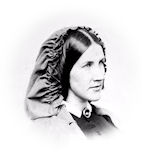
Post image for “If we find that we shall be allowed to march with the regiment, or rather ride, we could easily have grey flannel skirts and shirts made in Washington.”—Woolsey family letters, Georgeanna Muirson Woolsey to Eliza Woolsey Howland.

New York, Sunday.

My dear Eliza: In anticipation of a possible march on Tuesday I have got myself ready and hold myself under orders for any moment. As for some sort of a hospital costume, if we chance to need one, I have two grey cottonish cross-grained skirts, and a Zouave jacket giving free motion to the arms—so the skirts can be, one of them, always in the wash; and a white Zouave will take the place of the waist when that is in the tub. Four white aprons with waists and large pockets; two stick-out and washable petticoats to take the place of a hoop, and a nice long flannel dressing-gown, which one may put on in a hurry and fly out in, if the city is bombarded or “anything else.” Then for quiet and civil costume, I have only one dress made of black grenadine, like Mary’s, and a black Neapolitan straw with green ribbon will make it all very nice. I shall make up a trunk of towels and old scraps of linen and cotton, soap, cologne, oil-silk, sponges, etc., and have it stored away in the hotel in Washington for use, if necessary. Any towels or old sheets you may have to dispose of we shall probably find useful if we are able to do anything for the sick. I have also under consideration a small camp cooking affair, about two feet square, with lamp and all complete, which I shall probably get—cheap and very useful in an emergency—could cook up little things for ourselves at any rate. If we find that we shall be allowed to march with the regiment, or rather ride, we could easily have grey flannel skirts and shirts made in Washington. So I don’t see that we may not be very comfortable and useful, and consequently happy, even in following the war.

Post image for A Diary of American Events – June 30, 1861

—The Ninth Regiment of Massachusetts, numbering one thousand men, under the command of Colonel Cass, arrived at Washington.—National Intelligencer, July 1.

—This morning at daybreak fourteen rebel scouts attacked three pickets of the Fourth Pennsylvania Regiment, belonging to Company E, stationed on Shuter’s Hill, Va., four miles from Alexandria, wounding Lewellan Roemer, of Blue Bell, and killing Thomas Murray, of Norristown. The pickets returned the fire, killing two rebels and wounding a third. One of the slain was a sergeant of the Letcher Guard. The rebels beat a hasty retreat. The firing having been heard by the Union troops, a detachment of Zouave and another of the Fourth Pennsylvania Regiment reinforced the pickets, and followed in the trail of the rebels for some distance, finding four rifles and three revolvers, which the latter threw away in their hasty flight. One of the revolvers, very valuable, was marked with the name of John Johnson, a farmer living in that vicinity, who is a noted rebel. The Pennsylvanians behaved with great spirit and with the coolness of veterans, boldly holding their position, though wounded, in the hope of being reinforced.— N. Y. Herald, July 1.

—John Williams, who behaved so bravely in the skirmish at Matthias Point, carrying the American flag out of the fight in safety, though it was completely riddled with bullets as he went, was promoted to the post of Master’s Mate for his gallant conduct.—N. Y. Times, July 1.

—Yesterday the armed steamer Sumter, “of the Confederate States Navy,” ran the blockade of New Orleans, and got safely to sea. The New Orleans Picayune, in noting the fact, said:—”The first vessel of our little navy, the C. S. steamer-of-war Sumter, sailed on Saturday last, on a cruise, having ran the paper blockade of the Lincoln Abolition war steamers, off the mouth of the Mississippi. She has a picked crew, and her commander is known to be a most brave and chivalrous sailor, and he has under him a most gallant set of officers: Commander, Raphael Semmes; Lieutenants, John M. Kells, R. F. Chapman, W. E. Evans, J. M. Stribling; Paymaster, Henry Myers; Passed Assistant-Surgeon, Francis L. Gait; Lieutenant of Marines, Becket E. Howell; Midshipmen, Richard F. Armstrong, W. A. Hicks, A. G. Hudgins, J. D. Wilson; Gunner, Thomas C. Cuddy; Sail-maker, M. P. Beaufort; Engineers, First Assistant, acting as chief, Miles J. Freeman; Second Assistant, W. P. Brooks; Third Assistants, Matthew O’Brien and Simeon W. Cummings. She has a crew of sixty-five men and twenty marines.”

—The Charleston Mercury published the following on the Confederate Commissioners in Europe: It is now several months since our commissioners were sent to Europe. Thus far it seems they have got no further than England. Mr. Rost, one of them, has gone over to France; but as he can have no authority to act alone, we presume that he goes rather to ascertain the views of the Emperor of the French than to make a treaty. We infer from Mr. Rost’s departure from London to Paris that nothing has been accomplished in England.

Indeed, from the order in Council forbidding Confederate privateers bringing their prizes into British ports, we are only surprised that any of the Commissioners should have remained in London a day after this new order was issued. This is an act of quasi hostility, which, it appears to us, ought to have arrested a conference with the British authorities. It was well known that, whilst Great Britain has the greatest interest in the independence of the Confederate States, there is an element of antislavery fanaticism which would, in all likelihood, paralyze her counsels in our favor.

Why our commissioners have lingered so long in England, and have not gone directly to the greatest source of success, the government of France, we are at a loss to determine. By pretermitting the Emperor of the French, the British ministry have had the opportunity of obtaining, perhaps, his co-operation in the line of policy they design to pursue. By a direct communication with him, he would most probably have controlled instead of supporting the policy of England.

We, of course, do not know the means used by our government to conciliate the prompt acknowledgment of our independence by France and England, but it is clear, if we expected them to depart from that policy which the laws of nations strictly required, we must offer them inducements of industry. Our separation from the North, and our lower tariff, certainly gave them the prospect of great commercial advantages, from our independence; but the tariff might be changed—it might be made low from motives of present policy, and we might, after that policy is accomplished, in our independence have renewed higher duties. To present to these great States alluring assurances of present commercial advantages, it appears to us our commissioners ought to have proposed a low maximum of duties, to extend over many years yet to come.

It is absurd to suppose that either France or Great Britain will run the risk of disagreeable, if not hostile complications with the United States, without the security of clear advantages to be obtained. When we have fairly fought out our independence, of course all foreign nations will acknowledge us; but to take us by the hand when we are weak and want their aid, and when our position is surrounded with doubts—in their opinion, at least—as to our future success, we must offer such inducements, strongly appealing to their interests, as will indemnify them for all risk in taking us in their embraces by friendly commercial treaties.

Have our commissioners been empowered to offer to France and England a treaty guaranteeing for a number of years low duties on their manufactured commodities imported into the Confederate States? We fear not; for if they had been empowered to make such treaties, we are satisfied that they might have returned home with their mission completely successful, and the war on our frontier, on the part of the United States, reduced to a weak absurdity.
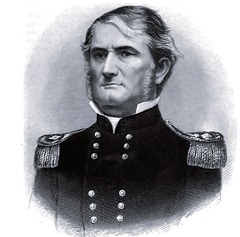
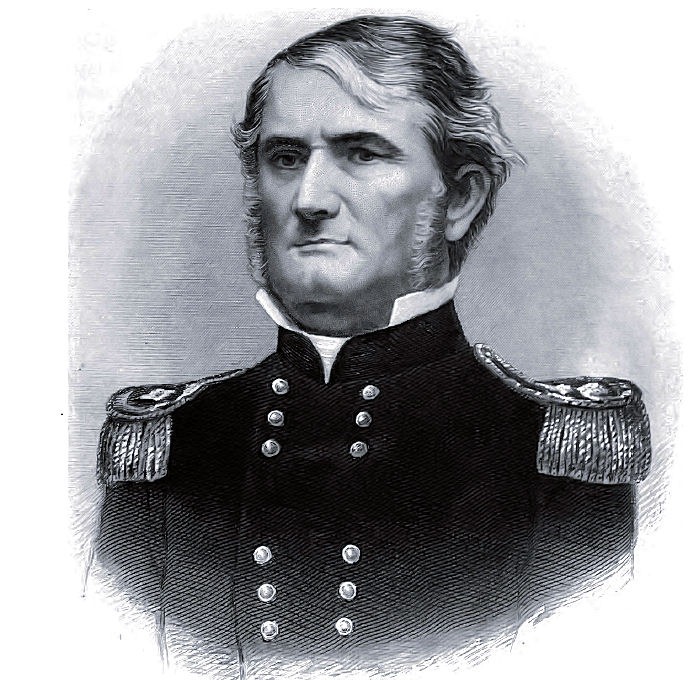
polk_leonidas—Leonidas Polk, better known as Bishop Polk, of Louisiana, having received the appointment of Major-General in the rebel service, assumed the command of his division. His headquarters were at Memphis, Term., in the neighborhood of which the troops comprising his command had their rendezvous. “This is the first instance,” says the Memphis Appeal “in the country ‘s history of the appointment of a high-church dignitary to a position of so much responsibility in the military service, and will, therefore, as a matter of course, evoke criticism among the old fogies of the red-tape school. But apart from the fact that the acceptance of this appointment was urged upon Gen. Polk with great earnestness by the President, the general-in-chief of the army, and other military officers of distinction who are well acquainted with his qualifications, there is much in the character and history of the appointee which inclines to the opinion that the selection is highly judicious, and one which will give great satisfaction. General Polk received a thorough military education at the West Point Academy, which he entered, from North Carolina, in 1828. He graduated with honor and entered the United States service, his first commission as second lieutenant of artillery bearing date July 1, 1827.

“He did not remain long in the army, however, but resigned in December of the same year, and embarked in another and different field of usefulness. General Polk will bring to the discharge of the duties of his position, a mature judgment, ripe scholarship, unusual activity of mind and body, great firmness and decision of character, a chivalric bearing, and the presence and mien of a thorough soldier. Though not a stickler for mere etiquette of the camp, he is a rigid disciplinarian, and, withal, the very man to win the confidence, and command the respect of his soldiers.”

—A correspondent of the Charlatan (S. C.) Courier, writing from Richmond, Va., says:— “There are few points of a war character which, just at this time, can appropriately form the subject of a letter. All eyes, however, are directed towards Manassas, and it is not improbable that by the time these lines reach your readers, the telegraph will have preceded me with the details of a great battle. The northern despatches all indicate the gradual approach of the two armies, the strengthening of outposts and various other movements which forerun hostilities. The southern press, on the contrary, are discreetly silent, and all we know is what we see ourselves, or hear from those who have seen for us; but the two sources of intelligence concur in the fact that unless the good Lord creates a modern Babel at Manassas and Alexandria, or drops down between the armies a veil of Cimmerian darkness, nature, personal gravitation, and animal magnetism will as certainly conspire to produce a collision as the multiplication table tells the truth.

“There are some yet, however, who affect to believe that we shall have a peace before we have a fight. The reaction so long predicted at the North having begun, the circulating petitions of merchants, bankers, clergymen, and other citizens of New York, which are pressing their peaceful influences upon Abraham Lincoln, are also operating here. The question is already being discussed in its various bearings, and the auspicious event has even been assigned a place this side of Christmas.

“We have no idea, however, of giving up the contest without, at least, one grand exhibition of the power, the prowess, and the resources of the people who have been stigmatized as the ‘ruffian rebels of the South.’ We went into the war on principle. Let us come out on principle, but not until we have left a mark upon our enemies that will secure for us for all time to come the respect of the world.

“Two hundred thousand men we have in the field will not be content to lay down their arms in peace until they have struck a blow that shall quiver through the North; and unless this be done, the millions they have left behind them will have their ‘welcome home’ alloyed by the thought that their husbands, sons, and brothers have returned without teaching that lesson of humiliation to an insolent foe, which, next to the Lord’s Prayer, has been the uppermost desire in every southern heart.

“In a civil point of view, as rapidly as circumstances will permit, the wheels of government are being geared and the machinery set in motion. The old adage that ‘large bodies move slowly,’ meets its falsification every hour. The operations of the various departments are in fall blast, and from the President down to the errand boy, every man moves as if he was a confederation of steel springs. Nor is this activity confined alone to the government. Artisans and merchants have all the work they can do in supplying the demands upon their several vocations incident to the presence of an army of needful soldiers.

“Blacksmiths are fabricating bowie knives; machinists are making arms and altering flint to percussion locks; millers are turning out floor; bakers are kneading bread by the ton, while butchers, grocers, and caterers generally are beleaguered day and night to supply the wants of the augmented population. Clothing, shoes, accoutrements, and camp equipage—all find ready sale. The frequent arrivals hereof poorly uniformed companies keep the ladies likewise up to their elbows in business.”
June 29.—I attended a fine luncheon yesterday at one of the public schools. A lady remarked to a school official that the cost of provisions in the Confederacy was getting very high, butter, especially, being scarce and costly. “Never fear, my dear madame,” he replied. “Texas alone can furnish butter enough to supply the whole Confederacy; we’ll soon be getting it from there.” It’s just as well to have this sublime confidence.

______

Note: To protect Mrs. Miller’s job as a teacher in New Orleans, the diary was published anonymously, edited by G. W. Cable, names were changed and initials were often used instead of full names — and even the initials differed from the real person’s initials.
Post image for “The President caught something of what I was saying, and asked me to repeat it, which I did, although I was scared to death.” Mary Chesnut’s Diary

June 29th.—Mrs. Preston, Mrs. Wigfall, Mary Hammy and I drove in a fine open carriage to see the Champ de Mars. It was a grand tableau out there. Mr. Davis rode a beautiful gray horse, the Arab Edwin de Leon brought him from Egypt. His worst enemy will allow that he is a consummate rider, graceful and easy in the saddle, and Mr. Chesnut, who has talked horse with his father ever since he was born, owns that Mr. Davis knows more about horses than any man he has met yet. General Lee was there with him; also Joe Davis and Wigfall acting as his aides.

Poor Mr. Lamar has been brought from his camp—paralysis or some sort of shock. Every woman in the house is ready to rush into the Florence Nightingale business. I think I will wait for a wounded man, to make my first effort as Sister of Charity. Mr. Lamar sent for me. As everybody went, Mr. Davis setting the example, so did I. Lamar will not die this time. Will men flatter and make eyes, until their eyes close in death, at the ministering angels? He was the same old Lamar of the drawing-room.

It is pleasant at the President’s table. My seat is next to Joe Davis, with Mr. Browne on the other side, and Mr. Mallory opposite. There is great constraint, however. As soon as I came I repeated what the North Carolina man said on the cars, that North Carolina had 20,000 men ready and they were kept back by Mr. Walker, etc. The President caught something of what I was saying, and asked me to repeat it, which I did, although I was scared to death. “Madame, when you see that person tell him his statement is false. We are too anxious here for troops to refuse a man who offers himself, not to speak of 20,000 men.” Silence ensued—of the most profound.

Uncle H. gave me three hundred dollars for his daughter Mary’s expenses, making four in all that I have of hers. He would pay me one hundred, which he said he owed my husband for a horse. I thought it an excuse to lend me money. I told him I had enough and to spare for all my needs until my Colonel came home from the wars.

Ben Allston, the Governor’s son, is here—came to see me; does not show much of the wit of the Petigrus; pleasant person, however. Mr. Brewster and Wigfall came at the same time. The former, chafing at Wigfall’s anomalous position here, gave him fiery advice. Mr. Wigfall was calm and full of common sense. A brave man, and without a thought of any necessity for displaying his temper, he said: “Brewster, at this time, before the country is strong and settled in her new career, it would be disastrous for us, the head men, to engage in a row among ourselves.”

As I was brushing flies away and fanning the prostrate Lamar, I reported Mr. Davis’s conversation of the night before. “He is all right,” said Mr. Lamar, “the fight had to come. We are men, not women. The quarrel had lasted long enough. We hate each other so, the fight had to come. Even Homer’s heroes, after they had stormed and scolded enough, fought like brave men, long and well. If the athlete, Sumner, had stood on his manhood and training and struck back when Preston Brooks assailed him, Preston Brooks’s blow need not have been the opening skirmish of the war. Sumner’s country took up the fight because he did not. Sumner chose his own battle-field, and it was the worse for us. What an awful blunder that Preston Brooks business was!” Lamar said Yankees did not fight for the fun of it; they always made it pay or let it alone.

Met Mr. Lyon with news, indeed—a man here in the midst of us, taken with Lincoln’s passports, etc., in his pocket—a palpable spy. Mr. Lyon said he would be hanged —in all human probability, that is.

A letter from my husband written at Camp Pickens, and saying: “If you and Mrs. Preston can make up your minds to leave Richmond, and can come up to a nice little country house near Orange Court House, we could come to see you frequently while the army is stationed here. It would be a safe place for the present, near the scene of action, and directly in the line of news from all sides.” So we go to Orange Court House.

Read the story of Soulouque,¹ the Haytian man: he has wonderful interest just now. Slavery has to go, of course, and joy go with it. These Yankees may kill us and lay waste our land for a while, but conquer us—never!

______

¹Faustin Elie Soulouque, a negro slave of Hayti, who, having been freed, took part in the insurrection against the French in 1803, and rose by successive steps until in August, 1849, by the unanimous action of the parliament, he was proclaimed emperor.

Post image for A Diary of American Events – June 29, 1861

—Colonel Allen of the First Regiment N. Y. S. V., was arrested at Fortress Monroe for court martial, by order of General Butler.—The Eleventh Regiment of Massachusetts Volunteers, under the command of Colonel George Clark, Jr., left Boston for the seat of war. The regiment, previous to their starting, were encamped at Camp Cameron. They were enlisted in April last, and sworn into the United States service about three weeks ago. They number 950 men, and are all armed with new smooth-bore Springfield muskets. In point of equipage, no regiment, perhaps, has exceeded the Eleventh. Their camping arrangements are complete, and they will enter upon their duties with no less than twenty-five baggage wagons, and eighty horses. So complete, indeed, are their arrangements that they will be dependent on the Government for nothing except food and ammunition.—N. Y. News, June 30.

—The steamer St. Nicholas was captured in the Potomac River, by a party of secessionists. The steamer left Baltimore, having on board about fifty passengers. Among those who went aboard previous to her departure, was a very respectable “French lady,” who was heavily veiled, and, pleading indisposition, she was immediately shown to her state-room, where she was kindly cared for by the females on board. There were also a party of about twenty-five men dressed in the garb of mechanics, carrying with them carpenters, tinners, blacksmiths’, and other tools. When near Point Lookout, the “French lady ” appeared on deck, not in crinoline, but in the person of a stalwart man, who was immediately surrounded by the party of mechanics above alluded to. Captain Kirwan of the steamer, demanded an explanation, when the “lady-man” informed him that he designed confiscating the steamer and going on a privateering expedition. Finding himself overpowered, Capt. Kirwan was compelled to submit, and the boat was handed over to the man and his crew, who took possession, and proceeded to run the steamer to a point known as “The Cone,” on the Virginia shore. Upon landing at that place, the steamer was boarded by a body of about 1,000 Virginia troops, when the passengers were all landed, and allowed to go on their way. About one hundred and fifty of the troops were then placed on board the steamer, Captain Kirwan and fourteen of the crew being retained as prisoners. Leaving the shore the steamer was run down as far as the mouth of the Rappahannock River, where the “new Captain” hailed three large brigs which were lying off a few miles from Fredericksburg. These vessels were immediately boarded, and not having a sufficient force on board to offer any resistance they were all then quietly delivered over to the party as prizes. The prizes, one of which was laden with coffee, a second with ice, and the third with coal, were run into Fredericksburg, Virginia, and delivered into the possession of the Virginians, the steamer being kept at that port, together with her captain and crew.—Baltimore American, July 2.

—An elaborate article respecting the constitutional power of the President of the United States to suspend the writ of habeas corpus, was published. It was prepared by Reverdy Johnson, of Maryland, in response to the opinion of Chief Justice Taney, of the Supreme Court of the United States.—(Doc. 58.)

—The Fifteenth Regiment N. Y. S. V., under the command of Colonel John McLcod Murphy, left Willet’s Point, N. Y., for Washington.

Two regiments, one of Alabamians and the other of Mississippians, reached Harper’s Ferry, Va., this morning, and destroyed the balance of the trestle work of the railroad bridge. They then went over to the Maryland shore, seizing all the boats they could lay their hands on, either breaking them up or taking them over the river. All the Union men of Harper’s Ferry were driven out by them.—N. Y. Herald, June 30.

—A skirmish took place at Bowners, twelve miles from Cheat River bridge, between portions of the Fifteenth and Sixteenth Ohio, the First Virginia regiments, and a company of rebel cavalry. The former were sent to protect the polls, and the latter, mistaking their number, attacked them, and were routed with the loss of several men, among them the lieutenant of the company. Several horses were captured. The only loss on the Federal side is N. O. Smith, of the Fifteenth Regiment.—Louisville Journal, July 1.

—The Twenty-fifth Pennsylvania Regiment, stationed at Washington, left that place for Edward’s Ferry. Lieutenant Hamilton H. Dutton, of Mississippi, having tendered his resignation, was dismissed from the navy of the United States.

An imposing ceremony took place this afternoon at Washington, in the President’s grounds on the front of the White House toward Virginia. The New York 12th Regiment of Militia, with Company G United States Infantry, formed a hollow square, enclosing the fountain and a pavilion, under which were the President and Mrs. Lincoln, surrounded by the members of the Cabinet and other distinguished gentlemen. The Rev. Dr. Pyne offered a fervent prayer for the Union, law and good Government, the well-being of the nation and of its appointed rulers, and the peace which comes with the restoration of order.

While the Marine Band was playing, the President hauled up the flag, which was slightly torn in the process. Simultaneously, cannon roared and shouts went up from the throng of civilians and lines of soldiers.

The soldiers having gone through with a leaf of the manual, cheers for the flag and the President were given heartily. Gen. Scott, with his staff and other officers, were on a portico adjoining.—N. Y. Tribune, June 30.

—During last night there was a skirmish between the New Jersey Zouaves and the rebels outside of Fall’s Church, Va. Two of the rebels were killed, and one of the Zouaves was wounded. The dead bodies were brought to Washington this morning.—N. Y. Commercial Advertiser, June 29.

Post image for Sworn into service.–Richard R. Hancock, Second Tennessee Cavalry.

Friday, 28th.—As Tennesseans were then offering their services faster than the state was prepared to arm and equip them, it was after hard begging that Governor Isham G. Harris gave his consent to have our company mustered into service; and as he would not receive more than seventy-six men, including the officers, eight of our company had to return home.

About eleven o’clock A. M., the Auburn Company (known afterward as the “Sangs”) was sworn into service by J. G. Picket.

(Muster-rolls in the book at this point will not be included here.)

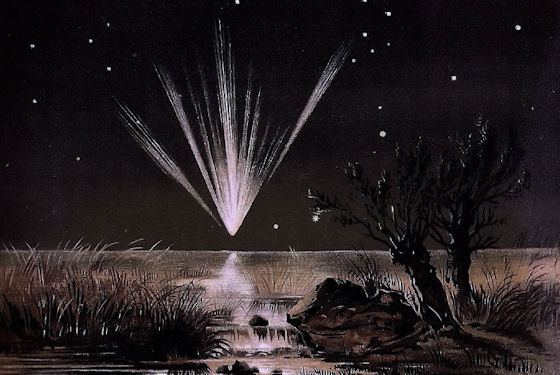
JUNE 28TH.—We have a flaming comet in the sky. It comes unannounced, and takes a northwestern course. I dreamed last night that I saw a great black ball moving in the heavens, and it obscured the moon. The stars were in motion, visibly, and for a time afforded the only light. Then a brilliant halo illuminated the zenith like the quick-shooting irradiations of the aurora borealis. And men ran in different directions, uttering cries of agony. These cries, I remember distinctly, came from men. As I gazed upon the fading and dissolving moon, I thought of the war brought upon us, and the end of the United States Government. My family were near, all of them, and none seemed alarmed or distressed. I experienced no perturbation; but I awoke. I felt curious to prolong the vision, but sleep had fled. I was gratified, however, to be conscious of the fact that in this illusory view of the end of all things sublunary, I endured no pangs of remorse or misgivings of the new existence it seemed we were about to enter upon.

June 28.—The steamer Pawnee arrived at the Navy Yard at Washington this morning, bringing the dead body of Capt. James H. Ward, of the steamer Freeborn, who was killed in an engagement yesterday, while attempting to cover a landing at Matthias Point, on the Potomac River.

The Freeborn was off the Point reconnoitring, when Capt. Ward discovered indications of a movement for the erection of a battery at that Point by the rebel soldiers encamped near there. On Wednesday night he sent up to the Pawnee at Acquia creek for Capt. Owens to send him a reinforcement of two boats’ crews to assist in effecting a landing. Two small cutters’ crews were sent down to the Freeborn, under Lieut. Chaplain, and with them a boat’s crew from the Freeborn, numbering from thirty to forty men in all. Lieut. Chaplain the next morning effected a landing, and succeeded in driving in the rebel pickets. Finding preparations for the erection of a rebel battery there, it was determined to throw up breastworks and mount guns thereon to give the enemy a warm reception should they attack the crews. Accordingly the men were set to work, under cover of the Freeborn’s guns, at throwing up a sandbag breastwork, and succeeded in working four hours and a half, and got their works completed about five in the evening. They then went to the boats to go on board for guns to mount on the work, when, just as they were embarking, they were surprised by the rebels, estimated at from one thousand to fifteen hundred strong, who poured in a heavy and continuous fire of musketry upon them from the bashes near by. Under cover of the guns of the Freeborn the crews precipitately made for the steamer, leaving a few of the men on shore, the guns of the Freeborn meanwhile opening with activity and precision apparently upon the enemy, who were concealed by the underbrush. Some ten shell were thrown among them, with what effect could not be seen, owing to their position.

Captain Ward behaved with great coolness, standing by the guns and directing the fire. When his gunner received a wound in the thigh, which disabled him, he immediately took his place, and was sighting the gun when he received a Minie musket ball, which killed him almost instantly.

The men left on the shore by the boats in their retreat swam out to the Freeborn—one of the men carrying on his back a wounded comrade named Bess, who had four musket balls shot into him. John Williams, coxswain of the third cutter, received a flesh wound in the leg while waving the Stars and Stripes, which he carried in his hand the whole time, behaving most gallantly under the hottest fire. The American ensign, which he never ceased to wave, was pierced with nineteen musket balls. Only three men of the boats were wounded, and the only life lost was that of the gallant Ward, who, the moment the enemy was discovered, blew the signal for the crews to come aboard, and instantly opened on the foe with his heavy guns.

While the crews were engaged on the breastworks, a slave, belonging to Dr. Hooe, approached the shore with a white flag on a pole, and getting aboard the Freeborn, informed Capt. Ward that the enemy were in the underbrush near by, one thousand strong. Still the work was continued, and made ready, as the event turned, for the rebels to occupy with guns.—(Doc. 55.)

—A Georgia Regiment arrived in Richmond, Va., without arms, the Governor of Georgia refusing to allow more arms to be taken from the State.—Richmond Examiner, June 29.

—Eight companies of rebel infantry and cavalry went from Knoxville, Tenn., to Cumberland and Wheeler’s Gap, to guard those places and prevent the federal troops from passing through Kentucky to the aid of the Union men in East Tennessee. They were encountered by the Union men in the mountains. —Louisville Journal, July 2.

—The Thirtieth Regiment N. Y. S. V. from Albany, under the command of Colonel Edward Frisbie; the Thirty-second N. Y. S. V., under the command of Colonel Matheson, and Colonel E. D. Baker’s California Regiment, left New York for the seat of war.—The latter for Fortress Monroe.—(Doc. 50.)

—The Charleston (S. C.) Courier, of to-day, prints the following from a private letter received from Manassas Junction:

“Our force is less than has been supposed. Two days ago it consisted of only about 7,000, and so also are all our forces at other points smaller than is supposed. Johnson, when he evacuated Harper’s Ferry, had not more than 7,000 effective men. Two thousand joined him about that time, and in one way and another, he has now a force of about 10,000 men. It was a military necessity, and he is the man to make the most of it. These facts account for the retreating and apparent indisposition to meet the foe. Their invasion of Virginia, and our inability to repel them, have been the result of the strange notion that we are engaged in a five years’ war, and of the consequent policy of rejecting, six weeks ago, at Montgomery, over 100,000 troops offered for twelve months. The scheme of requiring them for three years or the war, has produced great delay in the organization of the Southern army, and we are still very deficient, although now there is a willingness to accept on terms previously rejected. Our reliance, at present, is solely in the superior morale and desperate valor of our soldiers, and in the ability and judgment of our generals. Our cause has been greatly impeded and imperilled by this idea of a five years’ war, which nothing but the effect of this backwardness can produce.”

—Petitions for compromise, addressed to the President of the United States, which had been secretly circulated throughout the city of New York, were seized at the office of Frederick A. Guion. Mr. Guion issued an earnest remonstrance against the seizure.—(Doc. 51.)

—Colonels Magruder and Hardee were appointed Brigadier-Generals in the Confederate army.—The Nashville (Tenn.) City Council appropriated $750,000 for a residence for the President of the Southern Confederacy, as an inducement to remove the capital there.—The State Treasurer of Georgia gave notice that on account of the war with the Anti-Slavery States, the interest on the coupons and bonds of that State payable in New York, must be redeemed at Savannah.—An advertisement announces the reopening of the Confederate loan at several places in Georgia. It says that only $11,000,000 of the $15,000,000 have been subscribed for.—Nashville Union, June 28.

—General Banks at Fort McHenry issued a proclamation nullifying the protest and acts of the late police board of Baltimore.—(Doc. 52.)

—The Twenty-second Regiment N. Y. S. V., left Albany, N. Y., for the seat of war. The regiment is commanded by Colonel Walter Phelps, and is composed of men from the counties of Warren, Essex, Washington, and Saratoga. They belong to the class of hardy and industrious woodsmen, and intelligently understand the questions which underlie the present contest.—N. Y. Tribune, June 80.

—The First Regiment of New Jersey Volunteers left Trenton this morning for Washington in twenty-one cars, at 8 o’clock.—The Second and Third Regiments left this afternoon by way of the Camden and Amboy Railroad. The tents and other equipage —which Quartermaster-General Perine had, under the direction of Governor Olden, and at the request of the War Department, supplied them, went with each regiment.—N. Y. World, June 29.