Following the American Civil War Sesquicentennial with day by day writings of the time, currently 1863.

The American Civil War

—Gen. Lyon, with upwards of two thousand National troops, left Booneville, Missouri, for the Southwest.—N. Y. Times, July 7.

—The Military Board of Arkansas issued a proclamation, calling for 10,000 men to repel invasion by the National troops through Missouri. Each company is to arm itself with the usual weapons of the country, furnish its own tents and camp equipage, which will be paid for by the State. Regiments are ordered to organize for immediate service.—Memphis Appeal, July 4.

—A correspondent in Morgan county, Va., in a letter to the Baltimore American, gives the following account of affairs in that district: —We are now experiencing and witnessing the evils of secession in this county, where we have always enjoyed the blessings of liberty and the freedom of speech. We dare not open our mouths now. The Confederate troops, which came into our county on last Sunday (three hundred and fifty), have caused a great stampede among our Union men. One-third of the male population has gone to Maryland for fear of being impressed in the Confederate service. A perfect reign of terror prevails here; business is suspended, and our citizens are compelled to stand on guard without board or pay. Neither friend nor foe is allowed to cross the river at this place or Hancock, but fortunately the river is very low, and we can occasionally steal away and wade across at other places, to get our mails. Two gentlemen from Maryland were arrested here yesterday and taken to headquarters at Berkeley Springs, upon what charge I have not been able to learn. I presume they will be released to-day. It is impossible for us to learn the object of those troops, though it is reported to-day that they intend to march over to Hancock and take possession of a large quantity of flour and grain for the use of the army at Winchester.—Baltimore American, July 6.

—The Twenty-Fourth Regiment New York S. V. from Oswego, arrived at Washington.— N. Y. Tribune, July 4.

The Hudson.—Military school at West Point.—Return to New York.—Altered appearance of the city.—Misery and suffering.—Altered state of public opinion, as to the Union and towards Great Britain.

July 2nd.—At early dawn this morning, looking out of the sleeping car, I saw through the mist a broad, placid river on the right, and on the left high wooded banks running sharply into the stream, against the base of which the rails were laid. West Point, which is celebrated for its picturesque scenery, as much as for its military school, could not be seen through the fog, and I regretted time did not allow me to stop and pay a visit to the academy. I was obliged to content myself with the handiwork of some of the ex-pupils. The only camaraderie I have witnessed in America exists among the West Point men. It is to Americans what our great public schools are to young Englishmen. To take a high place at West Point is to be a first-class man, or wrangler. The academy turns out a kind of military aristocracy, and I have heard complaints that the Irish and Germans are almost completely excluded, because the nominations to West Point are obtained by political influence; and the foreign element, though powerful at the ballot box, has no enduring strength. The Murphies and Schmidts seldom succeed in shoving their sons into the American institution. North and South, I have observed, the old pupils refer everything military to West Point. “I was with Beauregard at West Point. He was three above me.” Or, ” M’Dowell and I were in the same class.” An officer is measured by what he did there, and if professional jealousies date from the state of common pupilage, so do lasting friendships. I heard Beauregard, Lawton, Hardee, Bragg, and others, speak of M’Dowell, Lyon, M’Clellan, and other men of the academy, as their names turned up in the Northern papers, evidently judging of them by the old school standard. The number of men who have been educated there greatly exceeds the modest requirements of the army. But there is likelihood of their being all in full work very soon.

At about nine a.m., the train reached New York, and in driving to the house of Mr. Duncan, who accompanied me from Niagara, the first thing which struck me was the changed aspect of the streets. Instead of peaceful citizens, men in military uniforms thronged the pathways, and such multitudes of United States’ flags floated from the windows and roofs of the houses as to convey the impression that it was a great holiday festival. The appearance of New York when I first saw it was very different. For one day, indeed, after my arrival, there were men in uniform to be seen in the streets, but they disappeared after St. Patrick had been duly honoured, and it was very rarely I ever saw a man in soldier’s clothes during the rest of my stay. Now, fully a third of the people carried arms, and were dressed in some kind of martial garb.

The walls are covered with placards from military companies offering inducements to recruits. An outburst of military tailors has taken place in the streets; shops are devoted to militia equipments; rifles, pistols, swords, plumes, long boots, saddle, bridle, camp beds, canteens, tents, knapsacks, have usurped the place of the ordinary articles of traffic. Pictures and engravings— bad, and very bad—of the “battles” of Big Bethel and Vienna, full of furious charges, smoke and dismembered bodies, have driven the French prints out of the windows. Innumerable “General Scotts” glower at you from every turn, making the General look wiser than he or any man ever was. Ellsworths in almost equal proportion, Grebles and Winthrops—the Union martyrs—and Tompkins, the temporary hero of Fairfax court-house.

The “flag of our country” is represented in a coloured engraving, the original of which was not destitute of poetical feeling, as an angry blue sky through which meteors fly streaked by the winds, whilst between the red stripes the stars just shine out from the heavens, the flag-staff being typified by a forest tree bending to the force of the blast. The Americans like this idea—to my mind it is significant of bloodshed and disaster. And why not! What would become of all these pseudo-Zouaves who have come out like an eruption over the States, and are in no respect, not even in their baggy breeches, like their great originals, if this war were not to go on? I thought I had had enough of Zouaves in New Orleans, but dîs aliter visum.

They are overrunning society, and the streets here, and the dress which becomes the broad-chested, stumpy, short-legged Celt, who seems specially intended for it, is singularly unbecoming to the tall and slightly-built American. Songs “On to glory,” “Our country,” new versions of “Hail Columbia,” which certainly cannot be considered by even American complacency a “happy land ” when its inhabitants are preparing to cut each other’s throats; of the “star-spangled banner,” are displayed in booksellers’ and music-shop windows, and patriotic sentences emblazoned on flags float from many houses. The ridiculous habit of dressing up children and young people up to ten and twelve years of age as Zouaves and vivandières has been caught up by the old people, and Mars would die with laughter if he saw some of the abdominous, be-spectacled light infantry men who are hobbling along the pavement.

There has been indeed a change in New York: externally it is most remarkable, but I cannot at all admit that the abuse with which I was assailed for describing the indifference which prevailed on my arrival was in the least degree justified. I was desirous of learning how far the tone of conversation” in the city” had altered, and soon after breakfast I went down Broadway to Pine Street and Wall Street. The street in all its length was almost draped with flags— the warlike character of the shops was intensified. In front of one shop window there was a large crowd gazing with interest at some object which I at last succeeded in feasting my eyes upon. A grey cap with a tinsel badge in front, and the cloth stained with blood was displayed, with the words, “Cap of Secession officer killed in action.” On my way I observed another crowd of women, some with children in their arms standing in front of a large house and gazing up earnestly and angrily at the windows. I found they were wives, mothers, and sisters, and daughters of volunteers who had gone off and left them destitute.

The misery thus caused has been so great that the citizens of New York have raised a fund to provide food, clothes, and a little money—a poor relief, in fact, for them, and it was plain they were much needed, though some of the applicants did not seem to belong to a class accustomed to seek aid from the public. This already! But Wall Street and Pine Street are bent on battle. And so this day, hot from the South and impressed with the firm resolve of the people, and finding that the North has been lashing itself into fury, I sit down and write to England, on my return from the city. “At present dismiss entirely the idea, no matter how it may originate, that there will be, or can be, peace, compromise, union, or secession, till war has determined the issue.”

As long as there was a chance that the struggle might not take place, the merchants of New York were silent, fearful of offending their Southern friends and connections, but inflicting infinite damage on their own government and misleading both sides. Their sentiments, sympathies, and business bound them with the South; and, indeed, till “the glorious uprising” the South believed New York was with them, as might be credited from the tone of some organs in the press, and I remember hearing it said by Southerners in Washington, that it was very likely New York would go out of the Union! When the merchants, however, saw that the South was determined to quit the Union, they resolved to avert the permanent loss of the great profits derived from their connection with the South by some present sacrifices. They rushed to the platforms—the battle-cry was sounded from almost very pulpit—flag raisings took place in every square, like the planting of the tree of liberty in France in 1848, and the oath was taken to trample Secession under foot, and to quench the fire of the Southern heart for ever.

The change in manner, in tone, in argument, is most remarkable. I met men to-day who last March argued coolly and philosophically about the right of Secession. They are now furious at the idea of such wickedness—furious with England, because she does not deny their own famous doctrine of the sacred right of insurrection. “We must maintain our glorious Union, sir.” “We must have a country.” “We cannot allow two nations to grow up on this Continent, sir.” “We must possess the entire control of the Mississippi.” These “musts,” and “can’ts,” and “won’ts,” are the angry utterances of a spirited people who have had their will so long that they at last believe it is omnipotent. Assuredly, they will not have it over the South without a tremendous and long-sustained contest, in which they must put forth every exertion, and use all the resources and superior means they so abundantly possess.

It is absurd to assert, as do the New York people, to give some semblance of reason to their sudden outburst, that it was caused by the insult to the flag at Sumter. Why, the flag had been fired on long before Sumter was attacked by the Charleston batteries! It had been torn down from United States’ arsenals and forts all over the South; and but for the accident which placed Major Anderson in a position from which he could not retire, there would have been no bombardment of the fort, and it would, when evacuated, have shared the fate of all the other Federal works on the Southern coast. Some of the gentlemen who are now so patriotic and Unionistic, were last March prepared to maintain that if the President attempted to reinforce Sumter or Pickens, he would be responsible for the destruction of the Union. Many journals in New York and out of it held the same doctrine.

One word to these gentlemen. I am pretty well satisfied that if they had always spoke, written, and acted as they do now, the people of Charleston would not have attacked Sumter so readily. The abrupt outburst of the North and the demonstration at New York filled the South, first with astonishment, and then with something like fear, which was rapidly fanned into anger by the press and the politicians, as well, as by the pride inherent in slaveholders.

I wonder what Mr. Seward will say when I get back to Washington. Before I left, he was of opinion—at all events, he stated—that all the States would come back, at the rate of one a month. The nature of the process was not stated; but we are told there are 250,000 Federal troops now under arms, prepared to try a new one.

Combined with the feeling of animosity to the rebels, there is, I perceive, a good deal of ill-feeling towards Great Britain. The Southern papers are so angry with us for the Order in Council closing British ports against privateers and their prizes, that they advise Mr. Rust and Mr. Yancey to leave Europe. We are in evil case between North and South. I met a reverend doctor, who is most bitter in his expressions towards us; and I dare say, Bishop and General Leonidas Polk, down South, would not be much better disposed. The clergy are active on both sides; and their flocks approve of their holy violence. One journal tells with much gusto of a blasphemous chaplain, a remarkably good rifle shot, who went into one of the skirmishes lately, and killed a number of rebels—the joke being in the fact, that each time he fired and brought down his man, he exclaimed, piously, “May Heaven have mercy on your soul!” One Father Mooney, who performed the novel act for a clergyman of “christening” a big gun at Washington the other day, wound up the speech he made on the occasion, by declaring “the echo of its voice would be sweet music, inviting the children of Columbia to share the comforts of his father’s home.” Can impiety and folly, and bad taste, go further?

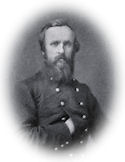
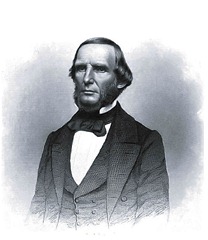
Post image for “I am sorry you are to be left with so much responsibility”—Rutherford B. Hayes

CAMP CHASE, July 2, 1861.

DEAREST:—The comet, or the storm, or something makes it cold as blazes this morning, but pleasant. Speaking of shirts, did I leave my shirts at home? I have but two or three here now. Have they been lost here, or how? You need not make me any if they are gone. I intend to wear flannel or mixed goods of some sort, but if there are a few tolerably good ones or collars, you may let Dr. Joe bring them up when he comes.

By the by, you know Dr. Joe has been appointed to our regiment, Dr. Clendenin having declined the Twenty-sixth. I wrote Dr. Joe a scolding letter in reply to his note abusing the governor. I did so because I felt confident that he was to be appointed in some way, and I didn’t want him to kick the fat in the fire by getting in a sensation about it before the matter was finally determined. Matthews and all are very glad. I am more interested in it than in anything else connected with the regiment.

I believe I told you it would be in good point if you could fix up one or two of my thick vests. I shall take away from here nothing but my gray travelling suit and thick vests. The military coats will conceal the vests, so they are as good as any other. Dr. Joe better get a good ready before he comes up. It may be difficult for him to get away. As for clothing and fixings, they can all be sent to him; but his business arrangements better be made, if possible, before he leaves. If he keeps well, as I think he will, he will enjoy this life very much. His rank and pay will be the same as mine. He is allowed two or three horses, and should have at least one. There is no stabling here at present, so he need not now bring his horse, if he would prefer not to keep him at the hotel or in Columbus.

Love to Grandma and all. Kisses for the dear boys. They will mourn the loss of their Uncle Joe. I should not be much loss to them now; when they get older I will try to help in their education. Birch, if possible, should be a soldier; Webb will do for a sailor; Ruddy will do for either or ‘most anything else. I am sorry you are to be left with so much responsibility; but, with your mother’s advice, do what you both agree is best and it will perfectly satisfy me.

Affectionately, yours ever,

RUTHERFORD.

MRS. HAYES.

Post image for “Neither do I believe that our blockade is likely to be effective in less than a hundred days.”–Adams Family Letters; Charles Francis Adams, Jr., To His Father

Boston, July 2, 1861

There is little news politically, for I am no longer in the way of getting it. There is a marked improvement in the general feeling and in the tone of the press towards England and my apprehensions of trouble would have entirely subsided but that I cannot but fear future trouble on account of this blockade. I fear that it is not effective and that some blundering British admiral will undertake to raise it for that reason, and this will surely lead to trouble. Neither do I believe that our blockade is likely to be effective in less than a hundred days. There are rumors, and pretty well authenticated, that Seward is losing ground in Washington and in New York very fast. Sumner has been here fiercely denouncing him for designing, as he asserts, to force the country into a foreign war, and Mr. George Morey tells me that to checkmate this, Sumner intends on the opening of Congress to make a speech on our foreign relations in which he will declare his entire satisfaction with the position of England and France. .. .

Henry Adams to his brother, Charles Francis Adams, Jr.

London, Tuesday, July 2,1861

My letters in the [New York] Times will give you pretty much all I have to say about politics. They are very correctly printed; at least the three first which are all that have reached me. There is no doubt in my mind that all the trouble with England arose from a mere blunder of the Ministry resulting from the suddenness of the change in affairs with us. Here it seems to have been thought with reason that the dissolution of the Union would go as it were by default, without much resistance, and the Ministry and even our warmest friends thought that this would be best for us as well as for themselves. The English are really on our side; of that I have no doubt whatever. But they thought that as a dissolution seemed inevitable and as we seemed to have made up our minds to it, that their Proclamation was just the thing to keep them straight with both sides, and when it turned out otherwise they did their best to correct their mistake. America seems clean daft. She seems to want to quarrel with all the world, and now that England has eaten her humble-pie for what was, I must say, a natural mistake from her point of view, I cannot imagine why we should keep on sarsing her. It certainly is not our interest and I have done and shall do all I can, to bring matters straight. As a counterpart to my letters in the Times, I am looking round here for some good paper to take you as its American correspondent. I don’t know that I can get one, but certainly it will be a good while before a fair chance is likely to happen. When it does I will let you know.

Seward’s tone has improved very much since that crazy despatch that frightened me so. If the Chief had obeyed it literally, he would have made a war in five minutes and annihilated our party here in no time at all. As it is we have worried through safely and are not likely to have much more trouble. There is nothing in the way of particulars to give you so far as I know, for there has been no great scene nor have I met with any very remarkable event. Our presentation was only memorable to my mind from having caused a relapse for me, which frightened me nearly to death.

As to your going to the war, I will tell you plainly how the case seems to me to stand. The Chief is unwilling to do anything about it. His idea is that the war will be short and that you will only destroy all your habits of business without gaining anything. If you will take my advice you will say no more about it; only make arrangements so as not to be taken by surprise, and when the time comes, just write and notify him. He will consent to that as a fait accompli, which he cannot take the responsibility of encouraging himself. . . .

Send us maps of the seat of war — the best ones.

Post image for A Diary of American Events – July 2, 1861

—Between 3 and 7 o’clock this morning the troops which have been concentrating at Hagerstown and Williamsport, Md., for several days past, crossed the ford at the latter place. Gen. Patterson reviewed them as they filed past him.

The morning was bright and beautiful, and the soldiers were in excellent spirits; the advance took place before daylight, the post of honor being assigned to Captain McMullen’s Independent Rangers, and the First Wisconsin, and the Eleventh Pennsylvania regiments. The advancing column consisted of the brigades of Abercrombie, Thomas, and Negley. The Independent Rangers behaved remarkably well, getting close up to the rebels, within a distance of only 75 yards. Abercrombie’s brigade led the advance, and the casualties of the conflict were almost exclusively on the First Wisconsin and Eleventh Pennsylvania Regiments. Col. Jarrett and Lieut.-Col. Coulter led the skirmishers, opening upon them at 400 yards. The whole of the rebel forces at Martinsburg, consisting of four regiments of infantry and one regiment of horse, were engaged in the action.

They had with them four pieces of artillery, part rifled cannon, and were commanded by Gen. Jackson. The first city troops of Philadelphia were assigned a position near the United States cavalry, under Captain Perkins, and behaved remarkably well. The casualties on the Federal side are two killed and several wounded. Several of the dead and wounded of the secession troops were left on the field in their hasty retreat. In anticipation of a retreat by the Federal forces, the rebels had levelled the fences on both sides of the turnpike even with the ground, so as to cut them off in the event of their retiring to the Potomac.

The first stand was made at Porterfield Farm, on the turnpike, near Haynesville, where it was necessary to destroy a barn and carriage-house, to make a charge upon the enemy. Here the conflict was fierce, the rebels standing well up to their work, and finally slowly retreating. Knapsacks and canteens were hastily thrown aside as incumbrances to a backward march. The rebels left behind them a number of blankets, and other articles of value, indicating a heavy loss.

—The Thirty-fourth Regiment, N. Y. S. V., left Albany for the seat of war. It is commanded by Colonel William Ledeu.—The Twenty-fifth Regiment N. Y. S. V., under the command of Colonel James E. Kerrigan, left their quarters on Staten Island, New York, for Washington.—N. Y. Tribune, July 4.

—The steamer Cataline was burned at Fortress Monroe, this evening.—Philadelphia, Press, July 5.

—The Legislature of Western Virginia organized at Wheeling. Lieut.-Governor Parsley took the chair in the Senate, and Daniel Frost of Jackson was elected Speaker of the House.

Governor Pierpont’s message was sent to both Houses, together with, a document from Washington, effectually recognizing the new Government. The message is a very able document and gives universal satisfaction. It is a succinct review of secession in Virginia, and of the causes leading to the formation of the present Government, and recommends an energetic cooperation with the Federal Government. (Doc. 29.)

—Twenty-seven thousand dollars belonging to the State were seized and carried to Wheeling by order of the Governor, from the Exchange Bank of Weston, Virginia, where it had been placed to the credit of the Western Lunatic Asylum by the State authorities. Capt. List was commissioned by Gov. Pierpont to go and take charge of the money, the work on the Asylum having been stopped, and there being reasonable apprehensions that the gold might fall into the hands of Letcher’s government. The Captain proceeded to Grafton, and upon making known his object to Gen. McClellan, in less than twenty-four hours a regiment of men, under Col. Tyler, were on the march. The expedition left Clarksburg on Sunday evening, and marching all night, reached Weston the next morning, about five o’clock. The people were all asleep, but the fine band which accompanied the expedition aroused the drowsy population by playing the Star-Spangled Banner. Col. Tyler took possession of the place, and Captain List went down and demanded the money in the name of the State of Virginia. No resistance was made, and the money was soon given up. The troops captured some twenty prisoners, all of whom were released upon examination, except the following, who were carried to Grafton and placed under guard: James T. Jackson, George J. Butcher, W. E. Lively, John Kearns, Jr., and J. Shumat. — Wheeling Intelligencer, July 3.

Georgetown Heights, July 1st, 1861.

Headquarters 79th Regiment.

Dear Mother:

At length I have an opportunity to inform you of my doings since we parted.

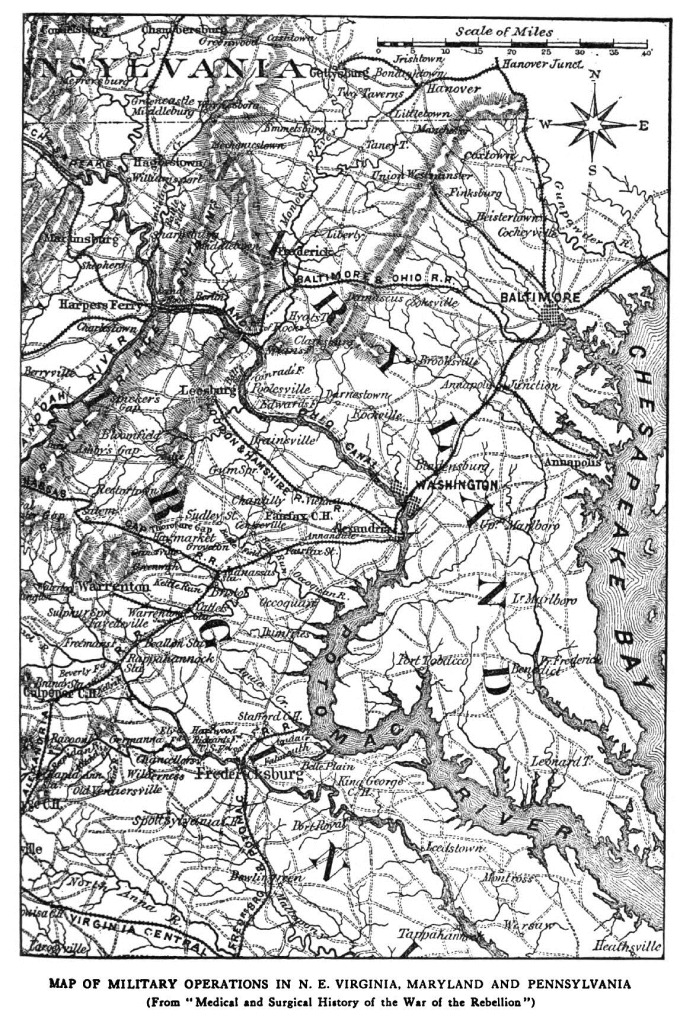
Map of Military Operationsin N.E. Virginia - Maryland and Pennsylvania

Map of Military Operations in N.E. Virginia – Maryland and Pennsylvania (Click on map for larger version)


I will spring over details.however, to say that I am now with Elliott at the Barracks of the 79th Regt. — that I slept last night upon the floor — that I am not yet Lieutenant, though assured of an eventual appointment — so until I write that I am entitled to wear the epaulets, please direct my letters to the care of Lieut. S. R. Elliott, 10th Co., 79th Regt., N. Y. S. M., Washington, D. C. Up to the present I have enjoyed myself much and am delighted with the novelty of the situation. However, I have no catalogue of hardships to complain of, as I have been dining in the best of company at a very good Secessionist Hotel which lies handy to our quarters, so please, dear mother, don’t expose yourself to any privations, for the purpose of better sympathizing with me as regards camp experiences. . . . Elliott you know, and I need not sound his praises. . . . By-the-way, my expenses here to Washington were paid by a grateful country, and in this wise. Young Quartermaster Elliott, meeting me at the Steamboat Landing, introduced me to some officers of a Maine Regt. on its way hither. I was introduced as Lieut. Lusk and in that capacity was invited to occupy the car appropriated for the staff. The officers manifested some curiosity regarding the Regt. I was supposed to represent, so it was with no little difficulty that I resorted to such evasions as would enable me to cover my ignorance. I pronounced the 79th Regt. to be the finest in the field, and was looked upon quite respectfully.

We are now delightfully quartered on Georgetown Heights in the Catholic College, but are going into Camp today. Yesterday a preacher from the Scottish Kirk discoursed to the soldiers in the yard. The Catholic priests must have shuddered at the terrible sacrilege, but even sectarianism must bend to meet the exigencies of war.

Elliott sends kind regards to you, and the sisters, and Hunt. Love to all.

Very affec’y-,

W. T. Lusk.

Post image for A Diary of American Events – July 1, 1861

—General Banks issued a proclamation announcing the arrest of Charles Howard, William Getchell, John Hincks, and John W. Davis, late members of the police board of Baltimore, and giving his reasons therefor.— (Doc. 62.)

—This afternoon Lieutenant Yelverton and eighteen men of the Seventh New York Volunteers, made a reconnoissance from Newport News, Va., up the James River road to within a mile and a half of Great Bethel. At that point they came upon five of the rebel pickets, who precipitately fled, leaving behind, with other trophies, their hats and coats, which showed that the owners were officers. In the pockets of the hitter were several letters just finished, giving a complete account of the late advance of 2,800 men from Yorktown to attack Newport News. One of an amusing character from the pocket of James Steele, bookseller, Richmond, describes the federal troops as a set of baboons, to be speedily driven from the sacred soil of Virginia.—N. Y. Evening Post, July 3.

—Edward Clark, the Governor of Texas, issued a proclamation, in which he said: “It will also be treasonable for any citizen of Texas to pay any debts now owing by him to a citizen of either of the States or Territories now at war with the Confederate States of America.—National Intelligencer, July 3.

—Fifty Home Guards under Captain Cook, from De Soto and Hopewell, Mo., proceeded last night by rail to Irondale, where they arrived this morning at 9 o’clock, and marched towards Farmington in search of contraband arms, &c., reported to be in the neighborhood of that place. They passed through Farmington about three miles eastward towards the river, but finding nothing, were returning home, when about six miles west of Farmington, they were attacked by a body of some 250 to 300 well armed and mounted secessionists, who were in ambush. Their fire was returned by the Homo Guards, mortally wounding Win. Hunter, one of the secession leaders. The Home Guards returned to De Soto without the loss of a man or a gun.

The rebels in that section are in possession of artillery, and gathered their clan by the discharge of their cannon, and were rallying all their forces in anticipation of the return of the Home Guards. The brave 300 were concealed in the brush, and fired upon the Home Guards in an open field.—Missouri Democrat, July 3.

—The marine artillery of the First Rhode Island Regiment left Washington, at night, by rail; destination unknown.—The Third Massachusetts Regiment moved from the encampment within Fortress Monroe, to occupy a position between Hampton and Newmarket Bridge. Col. McChesney’s Regiment (N. Y.) took the place of the Third Massachusetts.—N. Y. World, July 3.

—The Governor of Tennessee stationed an agent at Mitchellsville, on the Louisville and Nashville Railroad, near the northern Tennessee line, to prevent goods declared contraband in the southern confederacy from coming north.—Louisville Journal, July 2.

—James M. Sanderson assumed the control of the culinary department of the army at Washington, under the direction of the Sanitary Commission.—N. Y. World, July 1.

mccullough_ben—Ben. McCulloch, Brigadier-General of the rebel forces, issued a proclamation to the citizens of Arkansas, as follows:—”To defend your frontier, troops of Missouri are falling back upon you. If they are not sustained, your State will be invaded and your homes desolated. All that can arm themselves will rendezvous at Fayetteville, where they will await further orders. All those who have arms of the State, will march to the scene of action, or give their arms to those who will not desert their country in the hour of danger. All organized companies, whether cavalry or infantry, will report at Fayetteville, and will at once be formed into regiments and battalions. The necessary subsistence stores will be forwarded from this post. Rally promptly, then, citizens of Arkansas, and let us drive this Northern horde back from whence they came.”—Memphis Argus, July 1.
—The Fifteenth and Seventeenth Regiments of Indiana volunteers, left Indianapolis this afternoon for Virginia. Each regiment has a corps of fifty sharpshooters, and two pieces of artillery.—N. Y. Tribune, July 2.

—The Fourth Regiment of Michigan volunteers, numbering 1,046 men, under the command of Colonel Dwight A. Woodbury, passed through Baltimore on the route to Washington.—Baltimore American, July 2.

Post image for “There is no outside influence used to induce a man to re-enlist.”–Army Life of an Illinois Soldier, Charles Wright Wills.

Cairo, July 1, 1861.

Writing letters is getting to be harder work than drilling, and is more dreaded by the boys. Lots of people are visiting the camp now, many of them ladies, but I tell you that they use their fans more than their spy-glasses after a very few looks.

I was up to Mound City yesterday with nine others of our company on a United States boat that has three cannons on her. Mound City is a beautiful little place, and takes it name from a mound about 30 feet in diameter and 10 feet high, on which grow a dozen spindling locusts. I have been about 12 miles up each river from the point here. At that distance the river banks are, say 25 feet high, and slope down to the point, and run into a broad wide sandbar that ends Illinois.

Fishing is a principal amusement or time-killer now. I have fished about four days and caught nary a “minner.”

There is no outside influence used to induce a man to re-enlist. Officers tell every man to use his own judgment, and each fellow does his own thinking and—another long dash or words to that effect.

JULY 1st.—My family are gone. We have moved the department to Mechanics’ Hall, which will be known hereafter as the War Department. In an evil hour, I selected a room to write my letters in, quite remote from the Secretary’s office. I thought Mr. Walker resented this. He had likewise been piqued at the effect produced by an article I had written on the subject of the difficulty of getting arms from Georgia with the volunteers from that State. One of the spunky Governor’s organs had replied with acerbity, not only defending the Governor, but striking at the Secretary himself, to whom the authorship was ascribed. My article had been read and approved by the Secretary before its insertion; nevertheless he now regretted it had been written—not that there was anything improper in it, but that it should have been couched in words that suggested the idea to the Southern editor that the Secretary might be its author. I resolved to meddle with edged tools no more; for I remembered that Gil Blas had done the same thing for the Duke of Lerma. Hereafter I shall study Gil Blas for the express purpose of being his antithesis. But I shall never rise until the day of doom brings us all to our feet again.