Following the American Civil War Sesquicentennial with day by day writings of the time, currently 1863.

The American Civil War

—Sergeant Butterworth, of the N. Y. Fire Zouaves, was shot by a sentry at Alexandria,.Va., through his failure to give the word when challenged.—N. Y. News, May 27.

—An attempt to poison the Union forces in Missouri, by means of arsenic in the bread, was betrayed by a negress.

The Missouri troops, organized under the requisition of Governor Jackson, refused to disband, according to the terms of agreement between General Harney and General Price.—St. Louis Democrat, May 24.

—The Steuben Volunteers, 7th Regiment N. Y. S. V., departed from New York for the seat of war.—(Doc. 193.)

—All vessels belonging to the United States, which arrived at New Orleans, La., after the 6th inst., were formally seized by the Confederate States Marshal, in conformity with the act of the Confederate Congress in relation to privateering, which gave thirty days for all vessels in Southern ports to leave, but made no provision for vessels arriving after its passage.—N. O. Picayune, May 25.

—The Senate of Kentucky passed resolutions that that State will not sever her connection with the National Government, nor take up arms for either belligerent party, but arm herself for the protection of peace within her borders, and tender her services as a mediator to effect a just and honorable peace.—Ohio Statesman, May 25.

John Lothrup Motley published an article on the “Causes of the Civil War in America,” in the London Times of this day.—(Doc. 146½.)

—Jefferson Davis issued at Montgomery, Ala., a proclamation appointing Thursday the 18th day of June, 1861, to be observed as a day of fasting and prayer by the people of the seceded States.—(Doc 194.)

—A General movement into Virginia was executed under the command of Gen. Mansfield. The N. Y. Seventh Regiment left their camp in Washington at 1:20 A. M., each man having sixty rounds of ball cartridge. They touched the “sacred soil of Virginia” at 4 A. M., landing at the Alexandria Bridge, near which they encamped. The New York Sixty-ninth and Twenty-eighth Regiments, with Lieut. Drummond’s cavalry and a battery, passed the Chain Bridge, below Georgetown, at about 1 A. M. They first took possession of the Loudon and Hampshire Railroad, seized the train, arrested the passengers, took the cars and engine, and captured one secession soldier, who was on board the train. The 69th then took position on the Orange and Manassas Gap Railroad, which runs out of Alexandria.,

They took up some of the rails, and awaited in ambush the arrival of the train, which they supposed would leave Alexandria with the fugitives. When it came it was surrounded, and the train captured. About seven hundred persons were on board, including 800 men. The entire party were held as prisoners of war, and were kept as hostages for the fair treatment of any loyal citizens that may fall into the hands of the rebels. Two companies of the N. Y. Second, the N. Y. Fifth, Twelfth, Twenty-fifth, three companies of the New York Seventy-first and the N. Y. Fire Zouaves; the Rhode Island First, and the Rhode Island batteries; the Michigan Third; the New Jersey Fourth; three companies of an Ohio Regiment; one company Massachusetts Fifth; three companies of cavalry regular army; and twenty-five hundred District of Columbia troops, also participated in the movement on Virginia—making in all 18,000 men.—N. Y. Times, May 25.

A little before 5 o’clock A. M., the commander of U. S. steamer Pawnee, lying in the Potomac, off Alexandria, Va., sent a flag of truce to the rebel forces, giving them one hour in which to withdraw from the town. At five, the steamers Baltimore and Mount Vernon, with the N. Y. Fire Zouaves, made fast to the wharf. As the steamers approached, the rebel sentinels fired their guns in the air and retreated. The Zouaves landed in good order in double quick time, each company forming on the street facing the river. Company E, Capt. Leveridge, was the first to disembark. It was at once detailed to destroy the railroad track leading to Richmond, which service was promptly performed. After detailing company E, Col. Ellsworth directed the adjutant to form the regiment, and then with his aid, Lieut. Witmer, and a file of men, started for the telegraph office for the purpose of cutting the wires. They marched in double quick time up the street, and had proceeded three blocks, when the attention of Colonel Ellsworth was attracted by a large secession flag flying from the Marshall House kept by J. W. Jackson. Col. Ellsworth entered the hotel, and meeting a man in the hall asked, “Who put that flag up?” The man answered, “I don’t know; I am a boarder here.” Col. Ellsworth, Lieut. Winser, the chaplain of the regiment, Mr. House, a volunteer aid, and the four privates, then went up to the roof; and Col. Ellsworth cut down the flag. The party returned down the stairs, preceded by private Francis E. Brownell of Company A. As they left the attic, the man who had said he was a boarder, but who proved to be the landlord, Jackson, was met in the hall having a double-barrel gun, which he levelled at Brownell. Brownell struck up the gun with his musket, when Jackson pulled both triggers, and the contents lodged in the body of Col. Ellsworth, entering between the third and fifth ribs. Col. Ellsworth was at the time rolling up the flag. He fell forward on the floor of the hall and expired instantly, only exclaiming “My God.”

Private Brownell immediately levelled his musket at Jackson, and fired. The ball struck Jackson on the bridge of the nose, and crashed through his skull, killing him instantly. As he fell Brownell followed his shot by a thrust of his bayonet, which went through Jackson’s body. The companions of Col. Ellsworth, seven in number, immediately posted themselves so as to command the halls of the hotel, and threatened to shoot the first man who showed his head outside of a door. In this way they stood for ten minutes. Their protracted absence alarmed Adjutant Looser, who ordered Company A, Capt. Coyle, to search for the Colonel. The Company found their commander dead, and their comrades in possession of the hotel. They made a litter of muskets, and placing the body of the Colonel on it, returned to the boat, whence it was soon after taken to Washington.

Simultaneously with the landing of the Zouaves the first Michigan Regiment entered Alexandria by the road leading from Long Bridge, and proceeded direct to the railroad depot, of which they took possession, capturing a troop of rebel cavalry numbering one hundred, with their horses and equipments. All the heights which command Washington were occupied in this movement, and the construction of earthworks for batteries was immediately begun. Batteries were placed at each end of the two bridges which cross the Potomac. A portion of the New York troops were ordered towards the Manassas Gap Junction, and the New Jersey regiment was posted at the forks a mile from the Long Bridge. Numerous wagons, with camp equipage, went over about noon to the Federal troops in Virginia, and a great many men commenced work at the intrenchments.

Col. Ellsworth’s body was taken to Washington and placed in the engine-house at the Navy Yard. The house was heavily draped with American flags, crape, and bouquets of flowers. It was guarded by the Zouaves, a company of the Seventy-first N. Y. regiment, and some regulars. Thousands of people assembled there to see the remains during the day, the President’s family among the number. At seven o’clock Alexandria was comparatively quiet. But the Zouaves were anchored at night on a steamer in the river, to prevent them from avenging the death of Ellsworth. They were disposed to burn the town.—(Doc. 195.)
May 23d.—As the mail communication has been suspended between North and South, and the Express Companies are ordered not to carry letters, I sent off my packet of despatches to-day, by Mr. Ewell, of the house of Dennistoun & Co.; and resumed my excursions through New Orleans.

The young artist who is stopping at the St. Charles Hotel, came to me in great agitation to say his life was in danger, in consequence of his former connection with an abolition paper of New York, and that he had been threatened with death by a man with whom he had had a quarrel in Washington. Mr. Mure, to calm his apprehensions, offered to take him to the authorities of the town, who would, no doubt, protect him, as he was merely engaged in making sketches for an English periodical, but the young man declared he was in danger of assassination. He entreated Mr. Mure to give him despatches which would serve to protect him, on his way Northward; and the Consul, moved by his mental distress, promised that if he had any letters of an official character for Washington he would send them by him, in default of other opportunities.

I dined with Major Ranney, the president of one of the railways, with whom Mr. Ward was stopping. Among the company were Mr. Eustis, son-in-law of Mr. Slidell; Mr. Morse, the attorney-general of the State; Mr. Moise, a jew, supposed to have considerable influence with the governor, and a vehement politician; Messrs. Hunt, and others. The table was excellent, and the wines were worthy of the reputation which our host enjoys, in a city where Sallusts and Luculli are said to abound. One of the slave servants who waited at table, an intelligent yellow “boy,” was pointed out to me as a son of General Andrew Jackson.

We had a full account of the attack of the British troops on the city, and their repulse. Mr. Morse denied emphatically that there was any cotton bag fortification in front of the lines, where our troops were defeated; he asserted that there were only a few bales, I think seventy-five, used in the construction of one battery, and that they and some sugar hogsheads, constituted the sole defences of the American trench. Only one citizen applied to the state for compensation, on account of the cotton used by Jackson’s troops, and he owned the whole of the bales so appropriated.

None of the Southern gentlemen have the smallest apprehension of a servile insurrection. They use the universal formula “our negroes are the happiest, most contented, and most comfortable people on the face of the earth.” I admit I have been struck by well-clad and good-humored negroes in the streets, but they are in the minority; many look morose, ill-clad, and discontented. The patrols I know have been strengthened, and I heard a young lady the other night, say, “I shall not be a bit afraid to go back to the plantation, though mamma says the negroes are after mischief.”

CINCINNATI, May 23, 1861.

DEAR UNCLE:—I received yours of the 17th this morning, and am glad to know that your views as to finishing and furnishing the house correspond with our own. If I should not go away during the summer, I will, of course, visit you several times, and we can arrange all these matters. . . .

I suspect you do not like to commit yourself on my warlike designs. We have often observed, that on some questions, advice is never asked until one’s own purpose is fixed; so that the adviser is throwing away breath. Perhaps you think this is such a case, and perhaps you are right; but if the dispatches of this morning are correct, that the Government already has two hundred and twenty thousand men, and will accept no more, the question is settled.

It is raining again—disagreeable times for people in camp. I have not seen any Fremonters, but have written to Haynes¹ to come and see me, with any of the men.

Sincerely,

R.B. HAYES.

S. BIRCHARD.

_______

¹ W. E. Haynes. Later a colonel. Long a prominent citizen of Fremont. Member of Congress, etc.

MAY 23D.—To-day the President took the cars for Pensacola, where it had been said everything was in readiness for an assault on Fort Pickens. Military men said it could be taken, and Toombs, I think, said it ought to be taken. It would cost, perhaps, a thousand lives; but is it not the business of war to consume human life? Napoleon counted men as so much powder to be consumed; and he consumed millions in his career of conquest. But still he conquered, which he could not have done without the consumption of life. And is it not better to consume life rapidly, and attain results quickly, than to await events, when all history shows that a protracted war, of immobile armies, always engulfs more men in the grave from camp fevers than usually fall in battle during the most active operations in the field?

To-day I saw Col. Bartow, who has the bearing and eye of a gallant officer. He was attended by a young man named Lamar, of fine open countenance, whom he desired to have as his aid; but the regulations forbid any one acting in that capacity who was not a lieutenant; and Lamar not being old enough to have a commission, he said he would attend the colonel as a volunteer aid till he attained the prescribed age. I saw Ben McCulloch, also—an unassuming but elastic and brave man. He will make his mark. Also Capt. McIntosh, who goes to the West. I think I saw him in 1846, in Paris, at the table of Mr. King, our Minister; but I had no opportunity to ask him. He is all enthusiasm, and will rise with honor or fall with glory. And here I beheld for the first time Wade Hampton, resolved to abandon all the comforts of his great wealth, and encounter the privations of the tented field in behalf of his menaced country.

Arkansas and Tennessee, as I predicted, have followed the example of Virginia and North Carolina; and I see evidence daily in the mass of correspondence, that Missouri and Kentucky will follow in good time.

—A. H. Stephens arrived at Atlanta, Ga., on his return from Montgomery, and in response to a call of the citizens delivered a strong secession speech.—(Doc. 189.)

—Gen. Butler at Fortress Monroe, in a general order, announced the following staff: Capt. Grier Tallmadge, Assistant Quartermaster and Acting Assistant Adjutant-General, Capt.T. Bailey Myers; Acting Assistant Quartermaster, Capt. Peter Hagerty; and Second Lieut., George H. Butler; Major Richard S. Fay, Military Secretary.—N. Y. Commercial, May 31.

—The Philadelphia Evening Journal of today says: “We have it from good authority that there are, at this time, about five hundred Indians stationed at Harper’s Ferry, with the rebel, or traitor army. If this be the mode of warfare these blood-thirsty, scalping devils are to be brought into the fight, our friends in the South must not consider it all unkind if we accept the proffered services of the ten regiments of free negroes in Canada and the North, and send them down South. Our Governor refused to let one regiment of negroes pass through our State to go South to do battle, but if Indians are to be brought into the field by Jeff. Davis, the South may rely on it they will be met with a corresponding force of negroes, and they will increase their numbers as they pass through the country, by having the slaves join them.”

—The Advance Guard, Fifth Regiment, N. Y. Volunteers, Col. Duryea, embarked on board the steam transport Alabama, from New York, for Fortress Monroe.—(Doc. 190.)

—The Mississippi, which sailed from Boston, Mass., this forenoon, returned to that place and anchored off the Navy Yard. She had proceeded but a few miles down the harbor, when it was discovered that in repairing the engines, about two inches of the delivery pipe, through which the water from the condensers was freed out of the side of the ship, had been cut out, and in its place a joint of gum and canvas substituted, when it should have been a slip joint of iron or other metal. The defective part gave way, pouring a flood of water into the ship, when the engines were immediately stopped and the anchor thrown out. Temporary repairs were made so that she was enabled to return, but she lost a 6,000 lb. anchor by the parting of a cable. Michael Quinn of Virginia, late Chief Engineer in the Navy, superintended the repairs of the Mississippi. He recently resigned, returned to Virginia, and his name was stricken from the Navy roll.—N. Y. Tribune, May 24.

—The First and Second Regiments of the Ohio volunteers, numbering together eighteen hundred men, and under the command respectively of Colonels McCook and Wilson, reached Washington. It has been several weeks since they left home, having been in the mean time encamped in Pennsylvania—first at Lancaster, and afterwards near Philadelphia. They left the latter city early yesterday morning, on the railroad, coming by way of Baltimore.—(Doc. 194)

—An immense dry-dock was anchored at night in the Pensacola channel east of Fort Pickens by the rebels, who had intended, however, to anchor it elsewhere. Gen. Brown, in command at the fort, forbade its further removal. Its anchorage between Forts Pickens and McRae was for some time contemplated.—N. O. Delta, May 24.

—A battery of Whitworth guns, twelve-pounders, with ammunition and carriages complete, arrived in New York city, as a present to the Government from patriotic Americans abroad. The battery is consigned to Henry F. Spaulding, Samuel D. Babcock, and Henry A. Smythe, who have informed Secretary Cameron of its arrival, and that it is at the disposition of the Government. Each one of the guns bears the following inscription:

“From loyal Americans in Europe, to the United States Government, 1861.”

Mr. R. G. Moulton, an American at present residing in Manchester, deserves great credit for his energetic efforts in raising funds for the purchase of this battery.—N. Y. Times, May 24.

—One of the secession flags displayed from the head-quarters of the “Grays,” at Alexandria, Va., and within sight from Washington, was captured by two adventurous Union men—William McSpedon, of New York city, and Samuel Smith, of Queens County, N. Y.

—Gen. Patterson and staff arrived at Fort McHenry, Baltimore. Col. Vosburgh, late of the 71st N. Y. regiment, was buried in Greenwood Cemetery. —N. Y. Times, May 24.

—The Third Connecticut Regiment arrived at Washington. It numbers over eight hundred men, all well drilled, and is commanded by Colonel J. Arnold.—(Doc. 191.)

—The Alexandria (Va.) Sentinel of to-day, says: “The Washington Home Guard, Capt. Powell, took to-day 169 head of fine mutton, three miles above the chain bridge. They were appraised at $2.50 a head, and are impounded near this place. They had been purchased of some Virginia drover by the Georgetown butchers, and were to have been delivered by some party, who had undertaken to swim them across the river at so much a head. It has not been found out who it is in Virginia that is thus furnishing aid and comfort to her enemies. This company deserves great credit for the vigilance they have exercised in protecting the adjoining country from marauding bands of Lincoln’s soldiery, as also to prevent disloyal Virginians from furnishing supplies to the enemy.”

—Jefferson Davis issued instructions to privateers sailing under his letters of marque. —(Doc. 192.)

—Gen. Butler, desiring to know the precise lay of the land about Fortress Monroe, Va., concluded to pay a visit to the neighboring village of Hampton. Col. Phelps’s regiment of Vermonters were detailed for the reconnoissance, and took up the march across the dyke and bridge leading from the Fortress to the Hampton side of the bay. Observing the movement, the rebels rushed down to the bridge, and, with combustibles ready, prepared to set fire to it. At this the advance guard of the Vermonters took the double quick step, and before the fire had made much headway were down on the burning bridge and rebels. The latter fled precipitately, and the former was soon rescued from destruction. A field-piece, which the rebels had planted in the neighborhood, was unceremoniously pitched into the bay. Gen. Butler pushed on and completed the reconnoissance, to the infinite disgust of the rebels, and, probably, of John Tyler in particular, whose villa is not far distant. The ground for the permanent encampment was selected on the farm of Mr. Segor at the end of the bridge, and to-morrow will be the first permanent occupation of the soil of Virginia, made by Capt. Carr’s and Col. Phelps’s Regiments, who will go into encampment there.—N. Y. Tribune, May 27.

—The Wheeling(Va.) Intelligencer of today, says:—That the first belligerent issue between the “Union men” of Western Virginia and the “State troops “ recognizing the authority of the Southern Confederacy, has been joined at the town of Clarksburg, in the county of Harrison. Two companies of the Confederate military having marched into that place on the 20th instant, the court-house bell was rung as a signal for the assemblage of the two “Union military companies” of Clarksburg, under the command of Captains A. C. Moore and J. C. Vance, who demanded that the “Confederate forces” should surrender their arms and disband. After a brief parley the demand was complied with.

May 22nd.—The thermometer to-day marked 95° in the shade. It is not to be wondered at that New Orleans suffers from terrible epidemics. At the side of each street a filthy open sewer flows to and fro with the tide in the blazing sun, and Mr. Mure tells me the city lies so low that he has been obliged to go to his office in a boat along the streets.

I sat for some time listening to the opinions of the various merchants who came in to talk over the news and politics in general. They were all persuaded that Great Britain would speedily recognize the South, but I cannot find that any of them had examined into the effects of such a recognition. One gentleman seemed to think to-day that recognition meant forcing the blockade; whereas it must, as I endeavored to show him, merely lead to the recognition of the rights of the United States to establish a blockade of ports belonging to an independent and hostile nation. There are some who maintain there will be no war after all; that the North will not fight, and that the friends of the Southern cause will recover their courage when this tyranny is over. No one imagines the South will ever go back to the Union voluntarily, or that the North has power to thrust it back at the point of the bayonet.

The South has commenced preparations for the contest by sowing grain instead of planting cotton, to compensate for the loss of supplies from the North. The payment of debts to Northern creditors is declared to be illegal, and “stay laws” have been adopted in most of the seceding states, by which the ordinary laws for the recovery of debts in the States themselves are for the time suspended, which may lead one into the belief that the legislators themselves belong to the debtor instead of the creditor class.

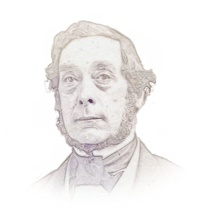
From a photo of an unknown man of the 1800s

MAY 22D.—To-day I had, in our office, a specimen of Mr. Memminger’s oratory. He was pleading for an installment of the claims of South Carolina on the Confederacy; and Mr. Walker, always hesitating, argued the other side, merely for delay. Both are fine speakers, with most distinct enunciation and musical voices. The demand was audited and paid, amounting, I believe, to several hundred thousand dollars.

And I heard and saw Mr. Toombs to-day, the Secretary of State. He is a portly gentleman, but with the pale face of the student and the marks of a deep thinker. To gaze at him in repose, the casual spectator would suppose, from his neglect of dress, that he was a planter in moderate circumstances, and of course not gifted with extraordinary powers of intellect; but let him open his mouth, and the delusion vanishes. At the time alluded to he was surrounded by the rest of the cabinet, in our office, and the topic was the policy of the war. He was for taking the initiative, and carrying the war into the enemy’s country. And as he warmed with the subject, the man seemed to vanish, and the genius alone was visible. He was most emphatic in the advocacy of his policy, and bold almost to rashness in his denunciations of the merely defensive idea. He was opposed to all delays, as fraught with danger; the enemy were in the field, and their purposes were pronounced. Why wait to see what they meant to do? If we did that, they would not only invade us, but get a permanent foothold on our soil. We must invade or be invaded and he was for making the war as terrible as possible from the beginning. It was to be no child’s play; and nothing could be gained by reliance upon the blunders and forbearance of the Yankees. News had been received of the occupation of Alexandria and Arlington Heights, in Virginia; and if we permitted them to build fortifications there, we should not be able to expel them. He denounced with bitterness the neglect of the authorities in Virginia. The enemy should not have been permitted to cross the Potomac. During the month which had elapsed since the passage of the ordinance in Virginia, nothing had been done, nothing attempted. It was true, the vote on ratification had not been taken; and although that fact might shield the provisional government from responsibility, yet the delay to act was fraught with danger and perhaps irreparable injury. Virginia alone could have raised and thrown across the Potomac 25,000 men, and driven the Yankees beyond the Susquehanna. But she, to avoid responsibility, had been telegraphing Davis to come to the rescue; and if he (Toombs) had been in Davis’s place, he would have taken the responsibility.

The Secretary of War well knew how to parry these thrusts; he was not responsible. He was as ultra a man as any; and all he could do was to organize and arm the troops authorized by Congress. Some thirty odd thousand were mustered in already; and at least five thousand volunteers were offering daily. Mr. Toombs said five hundred thousand volunteers ought to be accepted and for the war. We wanted no six or twelve months’ men. To this the Secretary replied that the Executive could not transcend the limits prescribed by Congress.

These little discussions were of frequent occurrence; and it soon became apparent that the Secretary of War was destined to be the most important man among the cabinet ministers. His position afforded the best prospect of future distinction—always provided he should be equal to the position, and his administration attended with success. I felt convinced that Toombs would not be long chafing in the cabinet, but that he would seize the first opportunity to repair to the field.

—The Richmond (Va.) Whig of to-day says: “We are not enough in the secrets of our authorities to specify the day on which Jeff. Davis will dine at the White House, and Ben. McCullough take his siesta in Gen. Sickles’ gilded tent. We should dislike to produce any disappointment by naming too soon or too early a day; but it will save trouble if the gentlemen will keep themselves in readiness to dislodge at a moment’s notice! If they are not smitten, however, with more than judicial blindness, they do not need this warning at our hands. They must know that the measure of their iniquities is full, and the patience of outraged freedom is exhausted. Among all the brave men from the Rio Grande to the Potomac, and stretching over into insulted, indignant and infuriated Maryland, there is but one word on every lip: ‘Washington;’ and one sentiment on every heart: vengeance on the tyrants who pollute the Capital of the Republic!”

—There was an exciting time in Passaic, N. J., on the occasion of raising the Stars and Stripes by the citizens of that locality. A handsome flag, donated by the scholars of the Passaic Academy, was raised upon that edifice, and one of much larger proportions was raised upon Passaic Heights. Eloquent and patriotic addresses were made by Rev. Marshall B. Smith and Thos. D. Hassey, Esq., of Paterson. The Passaic Light Guard turned out in good numbers and saluted the flag with several rounds. —N. Y. Commercial, May 24.

—A correspondent of the Savannah (Ga.) Republican, writing from Montgomery, Alabama, says: “It is feared that the blockade of Lincoln will seriously diminish the revenue, unless speedily raised, and if not, the government will have to resort to direct taxation, in order to provide for its support. The plan will prove acceptable to the people, and will be more effective than a mere dependence upon an uncertain income. Some one has suggested, though not officially, the project of levying a tax of four per cent. upon slaves; but, considering the average value of the slaves at present to be four hundred dollars, the income will not exceed thirty-six millions. The Secretary of War alone estimates for thirty-five millions, and it is probable that at least one hundred will be needed for disbursement this year. We may, therefore, confidently expect a system of direct taxation in case any inconvenience is experienced in collections of the customs revenue. The tariff will be reduced to an exceedingly low figure, and will expose, by its action, the monstrosities of its colleague, the Morrill tariff.”

—Major-General Butler and Staff arrived at Fortress Monroe, and were received with the customary military honors. There was a grand review of the troops in the evening, the parade-line, four thousand men, stretching across the parade-ground of the fortress. The spectacle was magnificent, and there was great enthusiasm among the men.

—A party of Virginians attempted at night to capture a ferry-boat on the Potomac near Clear Spring, Md. Notice was given the Union men of Clear Spring, three miles distant, who turned out to guard the boat. During the night the Virginians seized the boat, and were fired upon by the guard, and when midway across had to abandon the prize and escape in a skiff. Two Virginians were shot. The ferry-boat returned to the Maryland shore.—N. Y. Times; May 24.

—The fortress at Ship Island, Gulf of Mexico, 95 miles from the northern mouth of the Mississippi, was destroyed to prevent it from falling into the hands of the rebels.—Handsboro (Miss.) Democrat, (Extra,) May 22.

—In a speech at Atlanta, Ga., Howell Cobb proposed that the planters should sell half their cotton crop to the Southern Confederacy, and accept its bonds in payment.—(Doc. 186.)

—A circular letter from the Secretary of War was addressed to the governors of all the States, in which he recommends that no person be appointed a lieutenant who is not over 22 years of age; a captaincy, over 30; a major, over 35; a lieutenant-colonel, over 40; or colonel, over 45.—(Doc. 187.)

—The Second Regiment, N. Y. S. V., Col. Carr, left New York for Fortress Monroe.—(Doc. 188.)

—A contingent of 350 men left New York to join the 69th Regiment at Washington. It included Capt. T. F. Meagher’s Company of Zouaves, numbering 110, elegantly equipped and armed with the Minié musket and bayonet. —N. Y. Tribune, May 23.

—Despatches by the Persia state that the agents of the Rebel Government have explored Europe in vain for arms, munitions, or money, to be had in exchange for their bonds. Mr. Dudley Mann had sought an interview with Mr. George Peabody in the hope of negotiating an interview, and had been politely, but firmly repulsed. In no case had they found their securities marketable at the largest discount they could offer as a temptation. —N. Y. Times, May 23.

—The President and Cabinet attended the flag raising at the Post-office Department in Washington. Thousands of spectators were present. As the colors ascended, a lull in the breeze caused them for a moment to hug the staff. In a few seconds, however, the breeze freshened and caused the beautiful Stars and Stripes to float out for full fifty feet. The effect was electric. The host of spectators, the President, the Cabinet—all united in cheers. Mr. Lincoln, amidst the wildest enthusiasm of the mass, made a brief address.

He said that a few months ago the Stars and Stripes hung as listless and still all over the Union as the flag just raised, but in a short time they were caught up by the coming breeze and made to float over the whole loyal nation, and among millions who were now determined to keep the flag flying till the bitter end or until the restoration of peace and unity.

Speeches were also made by Mr. Blair, Mr. Seward, and Mr. Caleb B. Smith. The remarks of Mr. Seward were received with the most intense enthusiasm.—N. Y. Commercial Advertiser, May 22.

—The steamer J. C. Swan was seized at Harlow’s Landing, thirty miles below St. Louis, and brought to the St. Louis arsenal, by order of Gen. Lyon. This is the steamer that brought the arms from Baton Rouge, which were captured by Gen. Lyon, at Camp Jackson. Measures will be taken to effect the legal confiscation of the boat. About 5,000 pounds of lead, en route for the South, were also seized at Ironton, on the Iron Mountain Railroad, by order of Gen. Lyon. Some resistance was offered by a party of citizens, and several shots were fired on both sides, but nobody was hurt.—(Idem.)

—Major-General Sandford was placed in command of the New York troops on duty at Washington.—N. Y. Times, May 24.

—Among the speakers at the annual meeting of the Wesleyan Mission Society in London, was Rev. Dr. McClintock, of New York. He improved the occasion to make a stirring appeal to the audience against the misrepresentations of the London Time., about American affairs, and to set them right on the subject His address was received with very great applause. At one passage, the whole audience rose to their feet, and cheered for the speaker, and for the cause of the Union which he was advocating.—(Doc. 188½.)

(May 21 – The following material is from the diary entry of May 20, which actually appears to have covered two days. This blog entry covers the second day.)

When I woke up at daylight, I found the vessel lying alongside a wharf with a railway train alongside, which is to take us to the city of New Orleans, six miles distant.

A village of restaurants or “restaurats,” as they are called here, and of bathing boxes has grown up around the terminus; all the names of the owners, the notices and sign-boards being French. Outside the settlement the railroad passes through a swamp, like an Indian jungle, through which the overflowings of the Mississippi creep in black currents. The spires of New Orleans rise above the underwood and semitropical vegetation of this swamp. Nearer to the city lies a marshy plain, in which flocks of cattle, up to the belly in the soft earth are floundering among the clumps of vegetation. The nearer approach to New Orleans by rail lies through a suburb of exceedingly broad lanes, lined on each side by rows of miserable mean one-storied houses, inhabited, if I am to judge from the specimens I saw, by a miserable and sickly population.

A great number of the men and women had evident traces of negro blood in their veins, and of the purer blooded whites many had the peculiar look of the fishy-fleshy population of the Levantine towns, and all were pale and lean. The railway terminus is marked by a dirty, barrack-like shed in the city. Selecting one of the numerous tumble-down hackney carriages which crowded the street outside the station, I, directed the man to drive me to the house of Mr. Mure, the British consul, who had been kind enough to invite me as his guest for the period of my stay in New Orleans.

The streets are badly paved, as those of most of the American cities, if not all that I have ever been in, but in other respects they are more worthy of a great city than are those of New York. There is an air thoroughly French about the people—cafes, restaurants, billiard-rooms abound, with oyster and lager-bier saloons interspersed. The shops are all magazins; the people in the streets are speaking French, particularly the negroes, who are going out shopping with their masters and mistresses, exceedingly well dressed, noisy, and not unhappy looking. The extent of the drive gave an imposing idea of the size of New Orleans—the richness of some of the shops, the vehicles in the streets and the multitude of well dressed people on the pavements, an impression of its wealth and the comfort of the inhabitants. The Confederate flag was flying from the public buildings and from many private houses. Military companies paraded through the streets, and a large proportion of men were in uniform.

In the day I drove through the city, delivered letters of introduction, paid visits, and examined the shops and the public places; but there is such a whirl of secession and politics surrounding one it is impossible to discern much of the outer world.

Whatever may be the number of the unionists or of the non-secessionists, a pressure too potent to be resisted has been directed by the popular party against the friends of the Federal government. The agent of Brown Brothers, of Liverpool and New York, has closed their office and is going away in consequence of the intimidation of the mob, or as the phrase is here, the “excitement of the citizens,” on hearing of the subscription made by the firm to the New York fund, after Sumter had been fired upon. Their agent in Mobile has been compelled to adopt the same course. Other houses follow their example, but as most business transactions are over for the season, the mercantile community hope the contest will be ended before the next season, by the recognition of Southern independence.

The streets are full of Turcos, Zouaves, Chasseurs; walls are covered with placards of volunteer companies; there are Pickwick rifles, La Fayette, Beauregard, MacMahon guards, Irish, German, Italian and Spanish and native volunteers, among whom the Meagher rifles, indignant with the gentleman from whom they took their name, because of his adhesion to the North, are going to rebaptize themselves and to seek glory under one more auspicious. In fact, New Orleans looks like a suburb of the camp at Chalons. Tailors are busy night and day making uniforms. I went into a shop with the consul for some shirts—the mistress and all her seamstresses were busy preparing flags as hard as the sewing machine could stitch them, and could attend to no business for the present. The Irish population, finding themselves unable to migrate Northwards, and being without work, have rushed to arms with enthusiasm to support Southern institutions, and Mr. John Mitchell and Mr. Meagher stand opposed to each other in hostile camps.

Abby Howland Woolsey to the Sisters Abroad.

[Robert and his family and Hatty and Carry were still in Europe, but hurrying their return on account of the breaking out of the war.]

New York, May 21, 1861.

Dear Girls: We hope soon to have more particulars about your interview with Mrs. Browning, what she said, and “said he” and “said they.”

I hardly know what to tell you about home. I have been trying to think what questions about public affairs you are longing to have answered, the whys and wherefores of things, but am afraid I might hit on the very wrong ones. We cannot see into details ourselves; we live only on newspaper rumors, and the only peace of mind we get is by mentally consenting to leave everything in the hands of Scott, satisfied of his patriotism, wisdom and skill. The best statesmanship of the country is at work for its good; many knowing heads are contriving and planning; many brave hearts and steady hands are executing the will of government; the monied men, who have so much to save or lose, feel that their only hope of extrication is in the vindication of our laws and constitution; the military men know the true weakness of the South and predict its ultimate ruin; and above all and over all, as Mr. Prentiss preached to us on Sunday, “this continent belongs to Christ. He has a greater stake in it than any of us, who are here only for our little day, can have. If it should be destroyed, where on earth has God such another country so suited to His great providential designs? Be sure He will see to it that America is delivered out of all her troubles in His own time.”

We hear the bugle-call now constantly floating down the streets. It is used as a rallying sound in the field — as in Europe —by the French and the German volunteers, and by some of our own regiments, I think. Going down Broadway you pass a great many “headquarters” or recruiting offices, and the crossed bayonets at the door or the sentry marching up and down have a very foreign look. You should see Charley in his Home Guard martial array. It is a sight to strike awe into feeble sisters— a grey tight-fitting coat, with red cuffs and collar edged with white cord, and a red and grey cap trimmed with white braid.

From Eliza and Joe at Albany we hear as follows: Joe was summoned there to report for duty, as the regiment is quartered in barracks, along with others, four thousand troops in all. The regiment and officers were sworn into United States service last Wednesday, drawn up in a long line, and the sound of their cheers rolling down the field like thunder. Two men refused to swear from some cause or other, and a third, who had hesitated but finally stepped into the ranks, was cheered by his comrades till the tears ran down his cheeks.

They say they are “able to lick their heft in wild cats “ and are pronounced the finest regiment so far accepted—all six feet or more high and experienced riflemen. Joe is well, so far, and busy, and does not for a moment regret the step he has taken. The duties of adjutant are honorable and responsible ones, and purely military.