Following the American Civil War Sesquicentennial with day by day writings of the time, currently 1863.

The American Civil War

Montgomery, Ala., February 19, 1861.—The brand-new Confederacy is making or remodeling its Constitution. Everybody wants Mr. Davis to be General-in-Chief or President. Keitt and Boyce and a party preferred Howell Cobb¹ for President. And the fire-eaters per se wanted Barnwell Rhett.

My brother Stephen brought the officers of the “Montgomery Blues” to dinner. “Very soiled Blues,” they said, apologizing for their rough condition. Poor fellows! they had been a month before Fort Pickens and not allowed to attack it. They said Colonel Chase built it, and so were sure it was impregnable. Colonel Lomax telegraphed to Governor Moore² if he might try to take it, “Chase or no Chase,” and got for his answer, “No.” “And now,” say the Blues, “we have worked like niggers, and when the fun and fighting begin, they send us home and put regulars there.” They have an immense amount of powder. The wheel of the car in which it was carried took fire. There was an escape for you! We are packing a hamper of eatables for them.

I am despondent once more. If I thought them in earnest because at first they put their best in front, what now? We have to meet tremendous odds by pluck, activity, zeal, dash, endurance of the toughest, military instinct. We have had to choose born leaders of men who could attract love and secure trust. Everywhere political intrigue is as rife as in Washington.

Cecil’s saying of Sir Walter Raleigh that he could “toil terribly” was an electric touch. Above all, let the men who are to save South Carolina be young and vigorous. While I was reflecting on what kind of men we ought to choose, I fell on Clarendon, and it was easy to construct my man out of his portraits. What has been may be again, so the men need not be purely ideal types.

Mr. Toombs³ told us a story of General Scott and himself. He said he was dining in Washington with Scott, who seasoned every dish and every glass of wine with the eternal refrain, “Save the Union; the Union must be preserved.” Toombs remarked that he knew why the Union was so dear to the General, and illustrated his point by a steamboat anecdote, an explosion, of course. While the passengers were struggling in the water a woman ran up and down the bank crying, “Oh, save the red-headed man!” The red-headed man was saved, and his preserver, after landing him noticed with surprise how little interest in him the woman who had made such moving appeals seemed to feel. He asked her, ” Why did you make that pathetic outcry? ” She answered, “Oh, he owes me ten thousand dollars.” “Now, General,” said Toombs, “the Union owes you seventeen thousand dollars a year!” I can imagine the scorn on old Scott’s face.

¹ A native of Georgia, Howell Cobb had long served in Congress, and in 1849 was elected Speaker. In 1851 he was elected Governor of Georgia, and in 1857 became Secretary of the Treasury in Buchanan’s Administration. In 1861 he was a delegate from Georgia to the Provisional Congress which adopted the Constitution of the Confederacy, and presided over each of its four sessions.

² Andrew Bary Moore, elected Governor of Alabama in 1859. In 1861, before Alabama seceded, he directed the seizure of United States forts and arsenals and was active afterward in the equipment of State troops.

³ Robert Toombs, a native of Georgia, who early acquired fame as a lawyer, served in the Creek War under General Scott, became known in 1842 as a “State Rights Whig,” being elected to Congress, where he was active in the Compromise measures of 1850. He served in the United States Senate from 1853 to 1861, where he was a pronounced advocate of the sovereignty of States, the extension of slavery, and secession. He was a member of the Confederate Congress at its first session and, by a single vote, failed of election as President of the Confederacy. After the war, he was conspicuous for his hostility to the Union.
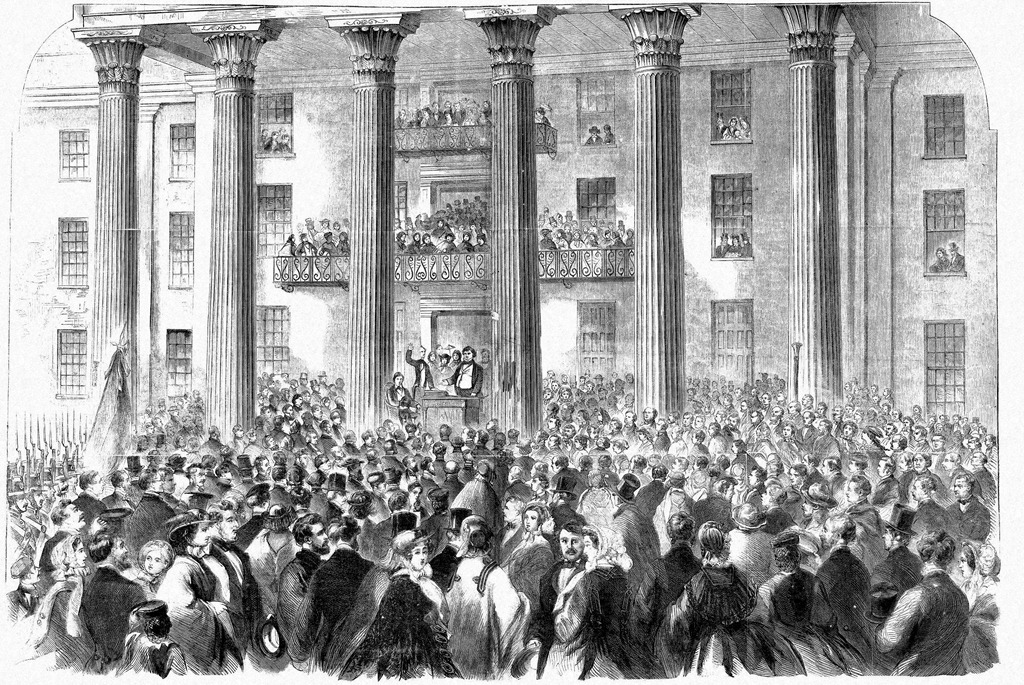
“Inauguration of Jefferson Davis, President of the Southern Confederacy, at Montgomery, Ala., on Monday Feb 18, 1861. – From Sketch by our Special Artist;” (Frank Leslie’s Illustrated Newspaper, March 23, 1861)

inauguration_of_jefferson_davis

—Jefferson Davis was inaugurated President of the Southern Confederacy.—(Doc. 37.)

[FEBRUARY 18(?), 1861.]

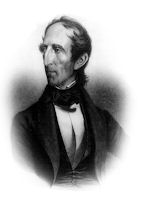
Governor PICKENS, Charleston, S.C.:

Kingman, known as “Ion,” who corresponds with the Baltimore Sun, and is considered reliable in his letter of yesterday, says he has seen and read a letter from a former member of Congress from South Carolina, which assures him that Fort Sumter will be taken on or before the 4th of March, “without reference to what the Montgomery government may advise or order on the subject.”

This startles the President. Will you quiet him by your reply?

The State commissioners will adjourn during the week. No result yet.

JOHN TYLER.

SUNDAY 17

A very pleasant morning. M. 40. Colder the middle of the day and quite a snow storm in the afternoon. Went to Church in the morning with wife & Boys, heard Doct Smith preach. Sunday School performance in the afternoon. Wife & Boys went. Myself and Willie staid at home. Took a walk with the Boys in evening. Tea at 7 o’clock. Spent the evening at home reading and explaining portions of Revolutionary History of U.S. Wife has played on the piano some and the Boys have read aloud & written some.

______

The three diary manuscript volumes, Washington during the Civil War: The Diary of Horatio Nelson Taft, 1861-1865, are available online at The Library of  Congress.

FORT SUMTER, S.C., February 17, 1861.

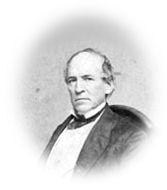
General Jos. G. TOTTEN,
Chief Engineer U. S. Army, Washington, D.C.:

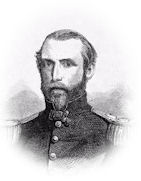
GENERAL: Everything is quiet, and there are no evidences of the presence of many troops around us, nor of military preparation. The assumption of all questions relating to forts, arsenals, &c., by the Congress of the Southern Confederacy appears to have placed a sudden check upon the military enterprise of the South Carolinians. The only operation performed yesterday was the firing of three shots from the iron bomb-proof battery on Cummings Point, apparently for the purpose of trying the embrasure shutters. These shutters appear to be of iron, and are arranged like a trap-door, with a hinge at the upper edge, so that two men can open it—having, probably, a counterpoise in the interior.

I think these batteries can be destroyed by our fire by concentrating it upon one embrasure at a time, and aiming at the embrasure itself.

I cannot yet determine what is being done at Fort Moultrie. In addition to the sand bags, which raises the sole of the exterior about two feet, the whole embrasure is filled with a large bag of wool or cotton.

Very respectfully, your obedient servant,

J. G. FOSTER,

Captain of Engineers.

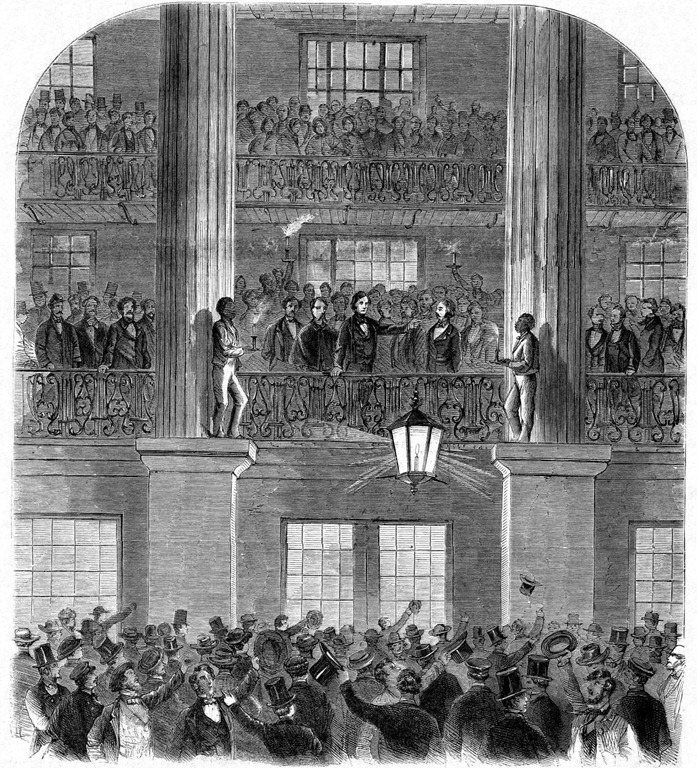
The Hon. Jefferson Davis, President-elect of the new Southern Confederacy, addressing the citizens of Montgomery, Ala., from the balcony of the Exchange Hotel, on the Night of February 16th, 1861, and previous to his inauguration. – from a sketch by our special artist (Frank Leslie’s Illustrated Newspaper)

jefferson_davis-in_montgomery

FRIDAY, FEBRUARY 15, 1861.

This has been a peculiar day as regards the weather. Sunshine and rain alternating all day with high wind and threatening Cloud occasionaly. No particular news. The Peace convention will not I fear amount to much in the end. As it regards the question of Slavery, I think, it & Congress may agree upon terms of settlement. But as regards what the south Claims viz the right of Secession the north will never agree with the south. Hon M Butterfield M.C. from NY, wife & daughter, Doct Everitt, wife & Brother, spent the evening with us. All very pleasant. Bed 11 1/2 o’clock.

______

The three diary manuscript volumes, Washington during the Civil War: The Diary of Horatio Nelson Taft, 1861-1865, are available online at The Library of  Congress.

CINCINNATI, February 15, 1861.

DEAR UNCLE:—. . . The reception given to the President-elect here was most impressive. He rode in an open carriage, standing erect with head uncovered, and bowing his acknowledgments to greetings showered upon him. There was a lack of comfort in the arrangements, but the simplicity, the homely character of all was in keeping with the nobility of this typical American. A six-in-hand with gorgeous trappings, accompanied by outriders and a courtly train, could have added nothing to him; would have detracted from him, would have been wholly out of place. The times are unsuited to show. The people did not wish to be entertained with a display; they did wish to see the man in whose hands is the destiny of our country. You will read the speeches in the papers, and search in vain for anything to find fault with. Mr. Lincoln was wary at all times, wisely so I think, and yet I hear no complaint. Our German Turners, who are radical on the slavery question and who are ready to make that an issue of war, planned to draw from him some expression in sympathy with their own views. They serenaded him and talked at him, but they were baffled.¹ In private conversation he was discreet but frank. He believes in a policy of kindness, of delay to give time for passions to cool, but not in a compromise to extend the power and the deadly influence of the slave system. This gave me great satisfaction. The impression he made was good. He undoubtedly is shrewd, able, and possesses strength in reserve. This will be tested soon. . . .

Sincerely,

R. B. HAYES.

S. BIRCHARD.

_______

¹ Mr. William Henry Smith happened to be present when the Germans serenaded Mr. Lincoln. He made a shorthand report of Mr. Lincoln’s reply. The speech is preserved in print in Francis F. Browne’s “Everyday Life of Lincoln,” p. 385.

From the following brief article the reader can form some idea of the persecution to which Union men had to submit in the town of Fredericksburg as early as the 14th of February, 1861, the date of its publication :—

“Why is it that secessionists talk of compromise with derision? Why is it that they wish to precipitate Virginia out of the Union? Why is it that they call conservative or Union men ‘Submissionists,’ ‘Black Republicans,’ ‘Abolitionists,’ ‘ Traitors and enemies to the South,’ &c. &c.? Are secessionists more intellectual than Union men? In what have they displayed it? Are they more patriotic? What proofs have they given of the fact? Are they more brave? Why then did they vacate their seats in the Senate and Congress halls of the United States, thus virtually surrendering all their rights into the hands of their enemies? Why, in the hour of their country’s peril, did they retreat into the Gulf States, having as a safeguard the Atlantic Ocean on the one side, and the border States between them and danger on the other side? There is no submission in all this, is there? Very brave, is it? In what have Union men compromised their honor or dignity? It is not honorable, not dignified, for a man to stand his ground and fight for his rights on his own soil, and sacredly maintain the trust the people have confided in him! But it is very honorable, quite dignified, for a man to throw down his legal weapons of defence and run away, and belt on the sword, and swear if the enemy comes to him he’ll thrash him out! This is very brave, is it?

“What rights have secessionists to protect that Union men have not? Have Union men no civil, religious, and domestic rights to protect? We think it bad policy for secessionists who would break up the peace and harmony of the Government, and plunge the whole country into civil war, to be accusing their fellow-citizens, who are trying to pour oil upon the troubled waters and are making all possible efforts to bring about peace and harmony, of being ‘Submissionists,’ ‘Black Republicam,’ ‘Abolitionists,’ and ‘ Traitors’ and ‘Enemies to the South'”

_______

“The Conspiracy Unveiled. The South Sacrificed; the Horrors of Secession.” Rev. James W. Hunnicutt (Editor of the Fredericksburg (Va.) Christian Banner); 1863, Philadelphia; J. B. Lippincott & Co.

“The Union, Now and Forever, One and Inseparable.”