Following the American Civil War Sesquicentennial with day by day writings of the time, currently 1863.

The American Civil War

October 13.—A successful reconnoissance was this day made by a force of Union troops under the command of General Stabel, in the vicinity of Paris, Snicker’s Gap, and Leesburgh, Virginia. More than one hundred prisoners were taken and paroled; important information was obtained, and the command returned to its headquarters at Centreville, without losing a man.—New-York Times, October 16.

—The Sixth regiment Missouri State militia, under command of Colonel Catherwood, returned to camp at Sedalia, Missouri, after a successful scouting expedition, in which they broke up and dispersed several bands of rebel guerrillas, killing about fifty of their number. They took prisoner Colonel William H. McCoun, of the rebel army.

—The expedition to Jacksonville, Florida, this day returned to Hilton Head, South-Carolina, when General J. M. Brannan made a report to the Secretary of the Navy, announcing the complete success of the expedition—the capture of the rebel fortification at St. John’s Bluff, with guns and ammunition, and a rebel steamer.— (Doc. 6.)

—The rebel Congress in session at Richmond passed an act authorizing Jefferson Davis to suspend the writ of habeas corpus in certain cases. —The rebel House of Representatives passed a bill making it a death-penalty for Union soldiers to have in their possession, or for endeavoring to pass counterfeit rebel Treasury notes. — The rebel Congress adjourned sine die.

—The ship Tonawanda, from Philadelphia for Liverpool, captured by the rebel steamer Alabama on the ninth, was to-day released and again set sail on her voyage, there being no manner of providing for the considerable number of women and children captured on board of her.

October 12.—This day, the rebel General Stuart’s cavalry, which had passed around the Union army of General McClellan, made good its escape across the Potomac at White’s Ford, near the mouth of the Monocacy River. During the day, General Pleasanton, with five hundred cavalry, harassed the rebel rear, and engaged them in a sharp skirmish, but with no material loss on either side.—(Doc. 5.)

—Considerable excitement was created in Gainsville, Texas, by the discovery of a secret organization of Unionists, whose object was said to be that of killing the secessionists, after which, they were to remove to Missouri, taking with them whatever property they could carry, and burn the remainder. The militia were called out, and arrested twenty-nine persons supposed to belong to the organization, two of whom were immediately hanged.—Houston News.

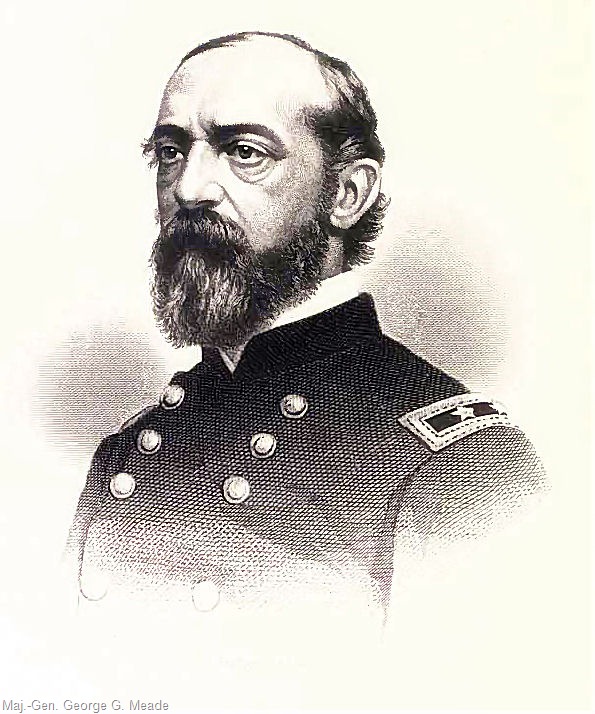
meade_george_g

October 11.—A sharp fight took place a few miles from Helena, Arkansas, between a detachment of the Fourth Iowa cavalry, under the command of Major Rector, and a superior force of Texan Rangers, commanded by Lieutenant-Colonel Giddings, resulting in a rout of the latter, nine of their number, including Lieutenant-Colonel Giddings, being captured. The Unionists had three men killed and nine wounded.—Cincinnati Gazette.

—The ship Manchester, from New-York to Liverpool, laden with grain and cotton, was captured by the rebel steamer Alabama, in lat. 41° 25′, lon. 55° 50′, when her officers and crew were taken off, with such stores as were wanted, and she was burned.—The One Hundred and Fiftieth regiment New-York volunteers, under command of Colonel John H. Ketcham, left Poughkeepsie this day for Washington.

—A force of three hundred Union cavalry, under the command of Colonel McReynolds, made a descent on the rebel Colonel Imboden’s camp, at Cacapon Bridge, about seventeen miles from Winchester, Virginia, and captured a major, lieutenant, twenty-five privates, a large number of horses and mules, one thousand blankets, a quantity of ammunition, brass cannon, wagons, firearms, clothing, and Colonel Imboden’s private papers.—Cumberland (Md.) Union.

—The rebel gunboat Palmetto State, built at Charleston, mainly through the efforts and offerings of the women of South-Carolina, was formally named and dedicated. Colonel Richard Yeadon delivered an oration on the occasion.

—The Seventh regiment Maine volunteers, one hundred and sixty-one in number, under command of Colonel Mason, left Washington this day, by order of General Halleck, on its way home to recruit its decimated ranks.

—The schooner Elmira Cornelius, while trying to run the blockade at Bull’s Bay, S. C, was this day captured by the United States steamer Restless. Her captain ran her ashore, but she was got off by the assistance of the United States steamer Flag.

—Rumors of peace began to be mooted. The Richmond Enquirer of this date says: “There are prospects of an early peace, which conclusion is founded on the results of the battles in Virginia and Maryland, and the campaign now progressing. The battle of Antietam was, to the Federal forces, the most terrible defeat of the war.”

—The United States gunboat Maratanza, Commander Scott, while lying off Cape Fear River, North-Carolina, was fired into by a rebel battery of two Armstrong guns, which the rebels had constructed on the beach during the night. The second shell struck the ship and exploded, killing two and wounding five. After which, the Maratanza immediately got under weigh and stood out to sea.—Com. Scott‘s Despatch.

—Yesterday a body of Union cavalry captured fifty wagons laden with ammunition, on the road between Camp Dick Robinson and Danville, Kentucky, and to-day a portion of General Dumont’s forces captured at Versailles, Kentucky, a train of wagons, two pieces of artillery, and three hundred and fifty rebels, without a fight.

—The preamble and resolution, submitted to the rebel House of Representatives by Mr. Barksdale, of Mississippi, concerning the retaliatory measures to be adopted against the Government of the United States, passed the House by a vote of thirty-five yeas to twenty-two nays.—(Doc. 35.)

—The schooner Revere (British, of Yarmouth, Nova Scotia) was this day captured off Cape Fear, North-Carolina, by the United States gunboats Maratanza and Monticello. Her cargo consisted of military stores.

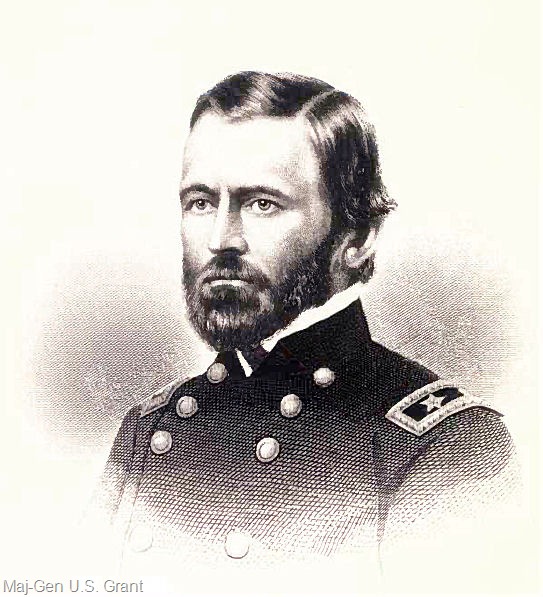
grant_u_sOctober 10, 1862. To-day a force of Union troops, under command of Lieutenant-Colonel John Boyle, of the Ninth Kentucky cavalry, entered Harrodsburgh, Kentucky, completely surprising and taking prisoners one thousand six hundred rebel troops, composed of infantry, artillery, and cavalry, being the rearguard of General Bragg’s army.—Governor Harris, of Tennessee, issued an order requiring the enrolment of all persons between the ages of eighteen and fifty-five, announcing that thirty days would be allowed for volunteering.

—A fight took place on the Upper Missouri River, about a hundred and fifty miles below Fort Berthold, between a party of miners, who were descending the river in a Mackinaw boat, and a large number of the Yancton Sioux tribe of Indians. The firing was kept up on both sides from nine o’clock in the morning until four in the afternoon, when the Indians gave up the chase, a good many of their number having been killed or wounded. Only one of the miners was wounded.—Sioux City Register, November 1.

—General J. E. B. Stuart’s rebel cavalry entered Chambersburgh, Pennsylvania, and destroyed over two hundred and fifty thousand dollars’ worth of government stores and private property.—(Doc. 1.)

—A Party of about one hundred rebel guerrillas entered Hawesville, Indiana, and for a time held possession of the town, but were finally driven out by the Cannelton Home Guard.—Governor Letcher, of Virginia, issued a proclamation putting in force an act of the Rebel Legislature of October first, prohibiting the removal of salt from the limits of the State of Virginia, and making provisions regulating its sale to people within the State.—(Doc. 3.)

—Henry Fairbank, of Colonel Bissell’s Engineer regiment, of the West; Albert Bacon, of the Fourteenth Illinois, and Robert Timmins, of the Thirty-fifth Indiana, who were captured in the battles of Shiloh and Corinth, this day made their escape from Macon, Georgia. After travelling for seventeen nights, and enduring many hardships, they finally reached the Union gunboat Western World, then blockading Doboy Sound, Ga., and were taken on board.

October 9.—The time allowed by Commander Renshaw, of the Union fleet at Galveston, Texas, for the surrender of that city having expired, the Commander proceeded to the city with a portion of the fleet, took possession, and hoisted the Union flag upon the Custom-House, without opposition, the rebels having previously abandoned the city.—Galveston Union, October 10.

—A fight took place in the vicinity of Lawrenceburgh, Ky., between a Union force of three thousand men, under the command of Col. E. A. Parrott, First Ohio volunteers, and the rebel forces under Gen. E. Kirby Smith, resulting, after an engagement of five hours, in the retreat of the latter with considerable loss. The Nationals had six men killed and eight wounded.—(Doc. 216.)

—This morning a small body of Gen. Sigel’s cavalry captured in Aldie, Va., over forty rebel prisoners, several loads of bacon, and an ambulance. The prisoners were paroled.—The Ericsson iron-clad battery, Montauk, was launched from the Continental Works at Greenpoint, L. I.

—In West-Virginia the rebels enforced the conscription act wherever they had the power. In the Kanawha Valley every able-bodied man that could be found was seized and carried to the rebel camp.— Wheeling Intelligencer.

—The Union gunboat Darlington, which left Jacksonville, Fla., on the sixth, on an expedition up St John’s River, returned this day, bringing the rebel steamer Governor Milton, which it had captured two hundred miles up the river.

—A slight skirmish took place near Aldie, Va., between a small party of Union troops and a numerically superior force of rebels, resulting in the retreat of the Nationals without loss.

The rebels had one man killed, Lieut. Mears. —An expedition consisting of about one thousand five hundred cavalry, supported by a battery of artillery, under the command of Colonel Davies, left camp at Upton’s Hill, Va., on the sixth instant, for the purpose of capturing or destroying five or six locomotives on the Orange and Alexandria Railway at Rappahannock Station. It was discovered that the locomotives had been removed to the other side of the Rappahannock River, and the expedition returned to-day to Centreville.

October 8.—The battle of Chaplin Hills, or Perryville, Ky., was this day fought between the Union army under General Buell, and the rebel forces under General Bragg, resulting, after an engagement of several hours’ duration, in the retreat of the rebels across Chaplin River. The loss on both sides was very severe. The Union Generals Jackson and Terrell were killed in this battle.— (Doc. 128.)

—Seventeen National Government wagons, a number of sutlers’ wagons, and about five hundred and fifty men of Gen. Sill’s advance column, under the command of Major Bradford, were this day captured in the vicinity of Frankfort, Ky., by the rebel forces under Gen. E. Kirby Smith.— A force of seventeen Union cavalrymen to-day dashed into Middleburgh, Loudon County, Va., and captured several wagons loaded with bacon belonging to the rebels.

October 6.—The rebel forces in Kentucky were flying in great haste from town to town, closely followed by the Union army under Gen. Buell. Yesterday a reconnoissance in the vicinity of Hardensville disclosed their presence, about twenty thousand strong; but, this morning, on the arrival of the advance column of the Union army, under Gen. Sill, it was discovered that they had fled in confusion toward Frankfort. General Sill followed them up, and arrived at Frankfort this evening, but only in time to see the last of the rebels flying from the opposite side of the town, in the direction of Lexington.

—A number of the citizens of Blackford County, Ind., collected, with arms in their hands, at Hartford, the county-town, for the purpose of resisting the draft They destroyed the ballot-box and enrolling papers, and compelled the commissioners and provost-marshal to resign.— Cincinnati Commercial, October 8.

—The rebels having succeeded in placing a battery at Cockpit Point, Va., on the Potomac, with a view to restore the blockade of that river, one of the Union fleet of gunboats ran into the Point to-day, and shelled it, entirely destroying the battery.—The Thirteenth regiment of New Hampshire volunteers, under the command of Col. A. F. Stevens, left Concord for the seat of war.

—Charles Sumner delivered an elaborate and powerful speech at Boston, Mass., indorsing the Emancipation Proclamation of President Lincoln, and advocating the cause of the African race, who, “slave as well as free,” must help the National Government. At the conclusion of his remarks, George Francis Train, being called for, took the platform, and, refusing to yield it, was carried off by the police.—Boston Transcript, October 7.

—A reconnoitring party of Union troops, consisting of the Sixth United States cavalry, supported by two guns of Robertson’s battery, left Bolivar Heights, near Harper’s Ferry, and proceeded to Halltown, Va., driving the rebel pickets before them. When near Charlestown, the Union advance came upon a force of rebels, and a short skirmish ensued, resulting in the flight of the latter. Soon afterwards the rebels commenced throwing shells, but the Union forces, having positive orders not to bring on a general engagement, withdrew after having obtained the desired information.

—The One Hundred and Forty-second regiment of New-York volunteers, Col. Roscius W. Judson, left Ogdensburgh for the seat of war.— The Eleventh regiment of Rhode Island volunteers, under command of Col. Edwin Metcalf, left Providence for Washington.

October 5.—Colonel Egan, in command of the Fortieth New-York regiment, crossed the Potomac at Nolan’s Ferry, on a reconnoitring expedition, and proceeded to Leesburgh, Va., where he captured a rebel wagon-train containing the personal effects and official papers of the rebel Gen. Longstreet, and a quantity of army supplies. Several fine horses, beef-cattle, and a caisson filled with ammunition, were also captured.

—General Crittenden’s corps left Bardstown, Ky., in pursuit of the retreating rebel army under General Bragg.—Union troops made a landing at Fort Point, near Galveston, Texas, but did not permanently occupy the island.—Richmond Dispatch, October25.

—The rebel forces under General Price, in full retreat from Corinth, pursued and harassed by the National forces under Gens. Ord and Hurlbut, reached the Hatchie River, where they made a stand. The Unionists attacked them, and, after seven hours’ hard fighting, the rebels broke and retreated in disorder, leaving their dead and wounded, and losing four hundred prisoners and two batteries.

—Scott’s rebel cavalry, at Frankfort, Ky., cut one span of the bridge leading to South-Frankfort, took all the paper and ink belonging to the State printer, and left for the South.—A Union force, under the command of Col. Bruce, attacked a party of rebels, six miles north of Glasgow, Ky., killing and capturing a few, and taking a number of horses and cattle.

—Jacksonville, Fla., was occupied by the Union forces under General Brannan.

October 4.—The battle of Corinth, Miss., was this day fought between the Union army, under Gen. Rosecrans, and the rebel forces, under Gens. Price, Van Dorn, and Lovell. The engagement resulted in a rout of the rebels. The loss on both sides was very severe, and particularly in officers. Gen. Hackleman fell mortally wounded while leading his brigade to the charge. General Oglesby was severely wounded. Nearly a thousand prisoners, besides the wounded, were left in the hands of the Nationals.—(Doc. 127.)

—At Frankfort, Kentucky, Richard Howes was inaugurated rebel Governor of that State. Gens. Bragg and Humphrey Marshall were present at the ceremonies, and made vituperative and bitter secession speeches. In the afternoon the railroad bridge leading out of the city was destroyed, and all the rebel infantry departed for the South, leaving Scott’s rebel cavalry in occupation.

—The Military Exemption Act passed the rebel Congress, in session at Richmond, Va. It exempts police for sections of country having dense negro population. Secures the liberty of the press, by exempting editors and such help as they require in their business; exempts employés of transportation and telegraph companies, ministers of the Gospel, physicians, shoemakers, tanners, blacksmiths, wagon-makers, millers, superintendents and employés on Government works, overseers of plantations, and one man to every five hundred head of cattle. The exemption act passed April twenty-first was repealed.—Richmond Examiner, October 6.

—The Secretary of War issued an order, publicly reprimanding Capt George H. Johnston for communicating an official report of a confidential character and for censuring his superior officers. —General Orders, No. 151.

—A large and enthusiastic meeting of citizens was held at the Cooper Institute, New-York City, for the purpose of expressing sympathy with the loyalists of Alabama, Mississippi, and East-Tennessee. Speeches were made by R. N. Havens, who presided, General W. K. Strong, Colonel R. H. Shannon, and Rev. Mr. Carter, of Tennessee.

—A Union gunboat ran past the rebel battery at Fort Point, Galveston, Texas, under a heavy fire, and the authorities of the town were notified that four days would be allowed for the removal of the women and children and the surrender of the town. The rebel battery was destroyed and the troops retreated to Virginia Point.—Richmond Dispatch, October 25.

—A fight occurred near Bardstown, Ky., between the advance-guard of Gen. Wood’s forces, under the command of Major Foster, and the rearguard of the rebel army, under Gen. Polk. The rebels were under cover of the undergrowth, from which they fired two or three volleys into the ranks of the Unionists with such effect that they became panic-stricken and fled back on the main body of the army, which, coming up, threw a few shells among the rebels and scattered them in all directions.—Cincinnati Commercial, Oct. 5.

—A company of the Fifty-fourth Pennsylvania regiment, guarding the Baltimore and Ohio Railroad bridge at Paw Paw, were attacked by a superior rebel force and taken prisoners. At the same time a force of Union cavalry, under the command of Col. McReynolds, captured the encampment of the rebels, with two guns, ten wagons, and sixty horses.

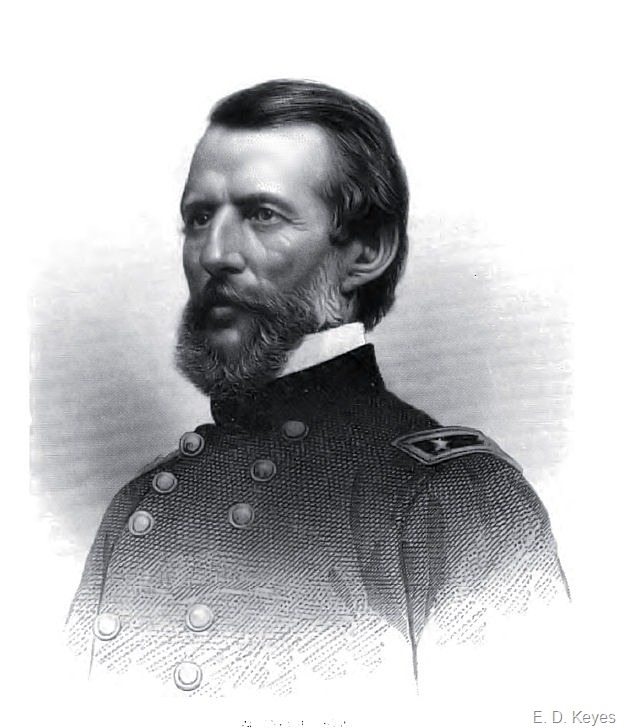
keyes_e_d

October 3.—The rebel General Bragg issued an order from his headquarters at Lexington, Ky., ordering that the paper currency of the confederate States should be taken at its par value in all transactions whatever, public or private. The order also stated that the refusal to take it, or the exaction of exorbitant prices, would be treated as a military offence, and punished accordingly.

—The advance brigade of Gen. Geo. W. Morgan’s command, from Cumberland Gap, reached Greenupsburgh, Ky., after a march of sixteen days. Many of them were “hatless, shoeless, and naked.” They had marched twenty miles a day, skirmishing with the rebels as they advanced.

—Clement C. Clay, Senator from Alabama, submitted the following preamble and resolution in the rebel Congress in session at Richmond, Va,:

Whereas, It is notorious that many and most flagrant acts violative of the usages of war, of the rights of humanity and even of common decency, have been, and still are being, perpetrated by the forces of the United States upon the persons and property of citizens of the confederate States; and, whereas, such outrages cannot be fully known and believed whilst resting only in the oral statements of citizens in different and remote States, and in the hasty paragraphs of newspapers published in the different and remote localities;

Now, therefore, that the evidences of the said outrages may be collected and preserved in a permanent and credible form, and the truth of history thus vindicated, and the perpetrators delivered to the just indignation of present and future generations, •

Resolved, That a Committee of thirteen Senators, or of one from each State, be appointed by the President of the Senate, whose duty it shall be to take, or cause to be taken, in such manner and form as they shall prescribe, the testimony in relation to such outrages, and after making report at such time as they shall deem proper, the report and the testimony shall be deposited in the Department of Justice; and that the objects of this resolution may be attained, the Committee shall have power to send for persons and papers.

—A Union expedition, consisting of one thousand five hundred troops and seven gunboats, from Hilton Head, S. C, under command of Gen. Brannan, which had concentrated at St. John’s River, Fla., attacked and occupied the rebel fortifications on St John’s Bluff, capturing nine guns and a large quantity of munitions, provisions, and camp equipage abandoned by the rebels in their retreat The gunboats afterward ascended the river to Jacksonville, the rebels retreating at their approach.

—From his headquarters near Sharpsburgh, Md, General McClellan issued a congratulatory order to the army under his command, for the victories achieved by their bravery at the battles of South-Mountain and Antietam. Fourteen guns, thirty-nine colors, fifteen thousand five hundred stand of arms, and nearly six thousand prisoners taken from the enemy, were, he said, evidences of the completeness of their triumph.

—A joint resolution was adopted by the Virginia (rebel) Legislature, providing that no person within that State should be tried or imprisoned for driving therefrom or putting to death, by any means, any person, with or without arms, who might be found on that soil aiding or abetting, or in any other way giving effect in that State or its borders to the “lawless and fiendish proclamation”‘ of President Lincoln to liberate the slaves.— Richmond Dispatch, October 4.

—This morning a fight took place along the banks of the Blackwater River, in the vicinity of Franklin, Va., between three Union gunboats, Commodore Perry, Hunchback, and Whitehead, under the command of Capt Flusser, and a force of rebel troops nearly nine thousand strong, resulting, after an engagement of six hours’ duration, in the killing and wounding of a large number of the rebels, when the gunboats retired with a loss of nineteen killed and wounded.

—The ships Brilliant and Emily Farnham were this day captured by the rebel steamer Alabama, in lat 40°, Ion. 50° 30′, the crews taken off, the ships plundered of their provisions and valuables, and burned.

—A reconnoitring expedition, consisting of three regiments of infantry, a regiment of cavalry, and a battery of artillery, under the command of Acting Brig.-Gen. Spear, left Suffolk, Va., and proceeded to the Blackwater River opposite Franklin, where the rebels were discovered in considerable force. An artillery fight ensued, resulting in the retreat of the rebels with a loss of about thirty killed and sixty wounded. The Nationals then returned to camp.—National Intelligencer, October 7.


Erasmus Darwin Keyes (May 29, 1810 – October 14, 1895) was a businessman, banker, and military general, noted for leading the IV Corps of the Union Army of the Potomac during the first half of the American Civil War. (Wikipedia)