Following the American Civil War Sesquicentennial with day by day writings of the time, currently 1863.

The American Civil War

October 2.—Yesterday President Lincoln, accompanied by Major-General McClernand, of the army of the West, and others, visited Harper’s Ferry, Va.

—In the rebel House of Representatives, Mr. Foote reported a set of resolutions, the title of which was as follows: “Joint resolutions recognizing the practical neutrality of the States of California and Oregon, and of the Territories of Washington and Nevada, suggesting the advantages which would result to the people thereof upon an immediate assertion on their part of their independence of the United States; and proposing, upon their so doing, the formation of a league, offensive and defensive, between said States and Territories and the confederate States of America.”

—A fight took place near Olive Hill, Ky., between the home guards of Carter County and a thousand rebels under the guerrilla Morgan. Morgan commenced the attack, but, after several hours’ skirmishing, he was repulsed, losing several of his men. He retreated towards the Licking River, destroying thirty-five houses on his route.

—This day a Union force under command of General Foster, accompanied by gunboats, left Washington, N. C, and advanced upon Hamilton, taking possession of that place and driving the rebels toward Tarboro.

—General Scott’s letter, reviewing the course he pursued relative to the forts and arsenals at different points during the incipient stages of the rebellion, was published in the National Intelligencer.

—A series of skirmishes occurred to-day along the Bardstown turnpike, in the vicinity of Mount Washington, Ky., between the advance-guard of the Union army under General Buell and the rebel forces under General E. Kirby Smith.

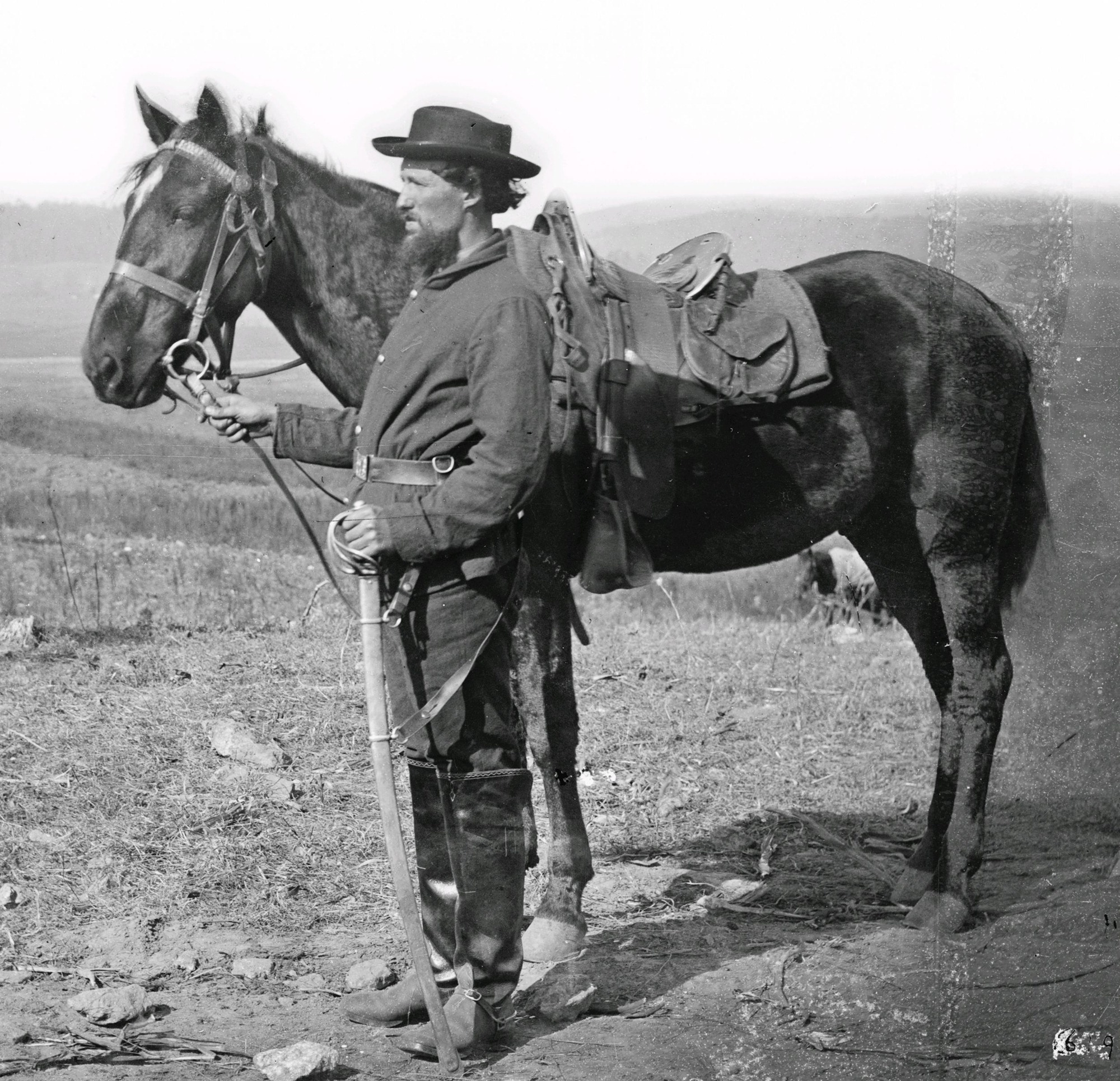
Antietam, Md. A cavalry orderly

Antietam, Md. A cavalry orderly; photograph by Alexander Gardner.

Library of Congress image.

October 1.—The advance of General Sill’s division, including the Fifth brigade, under Col. Edward N. Kirk, had an engagement with a body of rebel cavalry on the east bank of Floyd’s Fork, Ky., where they were heavily posted on the hills. Their pickets were engaged by a squadron of the Fourth Indiana cavalry and driven back upon the main body, where they were held in check until the infantry came up. Detachments of the Thirty-fourth Illinois and Seventy-seventh Pennsylvania were thrown forward as skirmishers, and drove them from their position. No sooner had the firing commenced than Col. Kirk, who had just sufficiently recovered from his wound received at Shiloh to take the field, dashed forward, directing all the movements and ever ready to take advantage of every position. After driving them about three miles, and being unable to overtake the flying enemy, a section of Capt Edgerton’s battery was brought to bear upon them at a distance of about one thousand yards, which only accelerated their retreat. The cavalry then charged and drove them some two miles farther, when, night coming on, the chase was abandoned and the troops went into camp. In their retreat, the rebels left behind a large quantity of small ammunition.—Louisville Journal.

—The rebel Legislature of Virginia, in session at Richmond, passed an act prohibiting the sale and removal of salt out of the State, and regulating its sale and distribution in the State.

—Colonel Barton, with a detachment of the Forty-eighth New-York regiment, under Captain Lent, and of the Third Rhode Island artillery, under Capt Gould, went up the Savannah River, and shelled a battery at Cranston’s Bluff, and a picket at the “Needles.” The rebels replied, but their guns were of so short a range that they were easily silenced.—The rebels evacuated Shelbyville, Ky.

—William E. Hamlin, having been appointed a special provost-marshal for the State of Rhode Island, this day issued a series of regulations, among which is the following: “It is expected that the citizens of the State will cheerfully and from a sense of duty, cooperate with this department in aiding the General Government in suppressing the existing rebellion, by promptly reporting to these headquarters the names of all disloyal persons, and by giving information of any treasonable practices, which shall come to their knowledge, to the end that the instructions of the Government may be fully and efficiently carried out”

—A fight occurred near Gallatin, Tenn., between a force of Union cavalry under the command of Col. Stokes, First Tennessee, and a large body of rebel guerrillas under Col. Bennett, resulting in a complete rout of the latter with a loss of forty killed, a large number wounded, and thirty-nine taken prisoners. Col. Bennett was wounded, and his brother, Robert Bennett, was among the prisoners.—Louisville Journal, Oct. 13.

—A party of nine National pickets captured a rifle-pit near Bachelor’s Creek, about fifteen miles from Newbern, N. C, and dispersed a superior force of rebels.—The Unionists in Camden County, N. C, petitioned President Lincoln for permission to drive all the rebel families out of the county. If granted, they promised two loyal regiments for the Union.

—The United States Western gunboat fleet was this day transferred from the War to the Navy Department.

—The Richmond Whig of this date speaks of President Lincoln’s proclamation as ordaining a servile insurrection in the confederate States, and says it is not misunderstood North or South. “It is a dash of the pen to destroy four thousand millions of our property, and is as much as a bid for the slaves to rise in insurrection, with the assurance of aid from the whole military and naval power of the United States.” It speaks of the cruelty of the Administration, and says Butler is a saint compared with his master. “Our military operations,” it says, “are henceforth to assume a very grave character. The fiend’s new programme will necessarily destroy all terms between us. The next campaign will be a tremendous one, both for the magnitude and character of the operations. Let our authorities prepare the whole strength of our people for the tremendous shock. The enemy is making great preparations, as well as issuing fiendish proclamations. We must respond with equal energy. If we do not, we are lost. But we will do it”

—A Force of Union troops, under the command of General Pleasanton, crossed the Potomac from Maryland into Virginia at Shepherdstown, for the purpose of making a reconnoissance. They advanced to Martinsburgh, which was occupied by Hampton’s brigade of rebel cavalry, and four pieces of artillery, which they engaged, and after a short contest drove them from the town. On their return, and when near Shepherdstown, the rebels attacked them, when a sharp skirmish took place, resulting in a retreat of the rebels, with a loss of about sixty killed, and nine or ten taken prisoners, with their horses and equipments. The Nationals had twelve men wounded, and three were taken prisoners.—(Doc. 214.)

—Majority and minority reports relative to President Lincoln’s emancipation proclamation, were submitted to the rebel Senate at Richmond, Va., by the judiciary committee, to whom the subject was referred.—In the rebel House of Representatives, Mr. Lyons, of Virginia, introduced a series of resolutions proclaiming the character of President Lincoln’s emancipation proclamation; exhorting the people of the rebel States to kill every officer, soldier, or sailor of the United States found within their borders; declaring that after the first January, 1863, no Union officer ought to be captured alive, or if recaptured should be immediately hanged; and offering a bounty of twenty dollars, and an annuity of twenty dollars for life to every slave and free negro who should, after the first of January next, kill a Unionist. The resolutions were referred to the committee on foreign affairs.

—The Union army under Gen. Buell left Louisville, and proceeded towards Bardstown, Ky.
September 30.—A fight took place at Newtonia, Mo., between a force of Union troops under the command of Gen. Salomon, and a body of rebels under Col. Cooper, resulting in the retreat of the Nationals.—(Doc. 213.)

—Commodore Harwood, commanding Potomac flotilla, reported to the Navy Department that the rebel bomb-proof magazines at Lower Shipping Point, Va., had been destroyed, under the superintendence of Lieut. Commander Magaw. They were seven in number, and the work was found heavier than was anticipated. A small body of rebel cavalry made its appearance, but dispersed upon the discharge of a volley of musketry from the Nationals.

—A fight took place at Russellville, Ky., between a force of Union troops under the command of Colonel Harrison, Seventeenth Kentucky, and a body of about three hundred and fifty rebels, resulting in a rout of the latter with a loss of thirty-five of their number killed and ten taken prisoners. — Grayson, Ky., was this day entered and occupied by a force of rebel troops.

—The Twenty-fourth regiment of New-Jersey volunteers, nine months’ men, left Camp Cadwalladcr, at Beverly, this morning in steamers, via Philadelphia, for the seat of war.

—Colonel Barton, of the Forty-eighth New York, with the left wing of his regiment, and with the steamboats Planter and Starlight, having guns aboard, started by order of Major-General Mitchel, to destroy the extensive salt-works at Bluffton, S. C. After a slight delay, occasioned by the Planter’s going aground, he arrived, and his men, under Captain Strickland, landed and drove in the pickets. The boats then ascended the river, and, at sight of them, the rebels, having no batteries, fled, leaving the expedition to accomplish its purpose and return in safety.

September 29.—General Jefferson C. Davis shot General William Nelson at the Gait House, in Louisville, Ky., killing him almost instantly.

— A. W. Bradford, Governor of Maryland, issued an order rendering the thanks of Maryland to General McClellan and the officers and men under his command, and to Governor Curtin and the militia of Pennsylvania, for the prompt expulsion of the rebel army from Maryland; also thanking the Maryland troops engaged in the battles.

— A Brigade of cavalry, under command of Lieutenant-Colonel Karge, made a successful reconnoissance from Centreville, Va;, to Warrenton, capturing and paroling sixteen hundred rebels, a portion of whom were on duty, and the remainder in hospital On their return, Lieutenant York, when between Manassas and Bull Run, took a captain and twenty men of the Seventeenth South Carolina regiment prisoners, and paroled them.

— In the rebel House of Representatives, at Richmond, Va., Mr. Semmes, of Louisiana, submitted a joint resolution declaring President Lincoln’s Emancipation Proclamation to be “a gross violation of the usages of civilized warfare,” as well as “an invitation to an atrocious civil war,” and therefore should be counteracted by such severe retaliatory measures as, in the judgment of Jeff Davis, “may be best calculated to secure its withdrawal or arrest its execution.” A general debate thereupon ensued, in which the opinion was freely expressed that the “black flag” should be raised, and no quarter given during the remainder of the war. The resolution was then referred to the Judiciary Committee.—The Governor of Maryland ordered the draft in that State to be postponed until the fifteenth day of October.

— Brigadier-general Rodman died in a house not far from Hagerstown, Md., of the wound he received at the battle of Antietam.

— Major-General Halleck issued a circular to the Governors of the several States, urging them to fill up the vacancies of commissioned officers who had fallen in battles in such large numbers, by appointing deserving non-commissioned officers and privates who distinguished themselves in battle, and had evinced a capacity to command, to the vacant places.

—S. B. Buckner, Major-General of the rebel army, issued a proclamation at Bardstown, Ky., calling upon the people of the State to arise for the defence of the rights of the Confederacy, and no “longer to submit to make themselves instruments in the hands of New-England to make war upon our own interests, and upon the interests of our brothers of the South.”

—To-day a force of Union troops consisting of Farnsworth’s brigade of cavalry, accompanied by Gibson’s and Tidball’s batteries, crossed the Potomac from Maryland into Virginia below Shepherdstown. They reconnoitred the country for a distance of five or six miles, and discovered that the rebels still held their position in the vicinity of Winchester.

—The Twenty-second regiment of New-Jersey volunteers, nine months’ men, left Trenton for the seat of war. The regiment was fully equipped, and composed principally of young men from the farming districts.—Brig.-Gen. Quincy A. Gillmore, having been assigned by General Wright to the command of the district of Western Virginia, entered upon his duties to-day, establishing his headquarters at Point Pleasant—A spirited cavalry skirmish took place near Sharpsburgh, Md., in which the rebels were dispersed, and a squad of them captured.—Baltimore American, September 30.

—Three hundred and sixty-three disloyal citizens of Carroll County, Mo., were assessed eleven thousand dollars by the Board of Commissioners appointed under General Order No. Three, for killing and wounding loyal soldiers and citizens, and for taking property belonging to said persons. The sums levied ranged from two to one thousand dollars on each person.

September 28.— The rebel steamer Sunbeam was captured off New-Inlet by the United States gunboats State of Georgia and Mystic, while attempting to run the blockade at Wilmington, N. C. She had a cargo of gunpowder and brandy, valued at a quarter of a million dollars.

—Three companies of Union cavalry and a battery of two brass howitzers, under the command of Colonel Charles C. Dodge, made a reconnoissance from Suffolk, Va., to a point on the Blackwater River, twenty-five miles distant, putting a body of rebel infantry to flight after a sharp engagement.

September 27.—The Thirty-first regiment of New-Jersey volunteers, under the command of Colonel A. P. Berthoud, left Flemington to-day for Washington, nine hundred and seventy-seven strong, armed with Enfield rifles.

— Two infantry and one cavalry regiment, under command of Colonel Toland, of the Thirty-fourth Ohio regiment, made an ineffectual attempt to capture Jenkins’s rebel cavalry, in camp at Buffalo, on the Kanawha River, Va. His troops advanced in three directions from Point Pleasant. The centre column surprised Jenkins’s cavalry, five hundred strong, before the other columns arrived, drove the rebels out of their camp, and captured and destroyed all their camp equipage, killing seven, and capturing nine. They pursued them about one and a half miles, when they were reenforced by two regiments of infantry and three pieces of artillery. The National force then fell back without the loss of a man.

— Major John J. Key was dismissed from the service of the United States for having replied to the question propounded to him—”Why was not the rebel army bagged immediately after the battle near Sharpsburgh?” — that it was “not the game; that we should tire the rebels out and ourselves; that that was the only way the Union could be preserved, we come together fraternally, and slavery be saved.”

— Augusta, Ky., was captured by a force of rebel guerrillas, under Captain Basil Duke. The home guard, under the command of Colonel Bradford, vigorously attacked the rebels from the houses; but, being outnumbered, they were compelled to surrender, but not before killing and wounding a large number of their enemies.— (Doc. 212.)

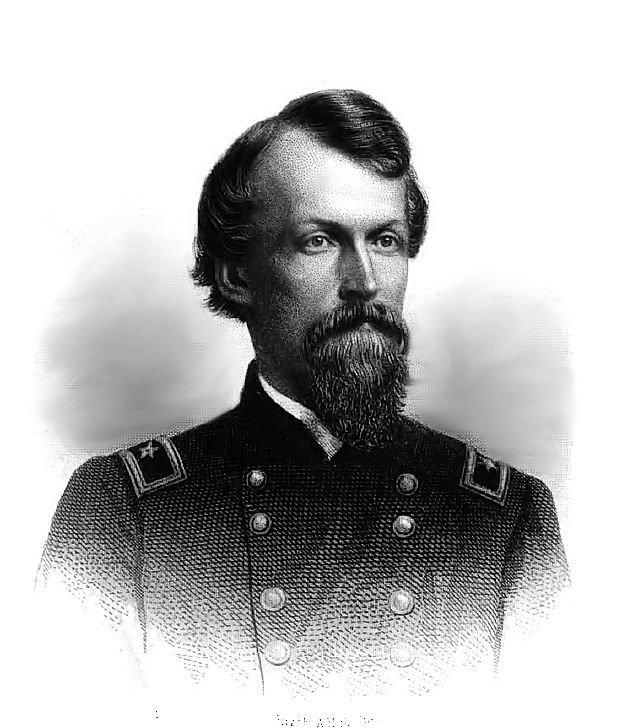
birney_david_b

September 26.—The Fifth and Sixth regulars, with Capt. Robertson’s battery of horse-artillery, went out from Bolivar Heights, Md., on a reconnoissance, under command of Major Whiting of the Second cavalry. At Halltown, five miles off, they encountered the rebel pickets, and drove them in. Approaching within a mile and a half of Charlestown, they met the rebels in force, with infantry, cavalry, and one battery. There was considerable picket-firing, but no casualties on the National side. The expedition, ascertaining that the enemy occupied Charlestown in force, returned, bringing five or six prisoners. Several of them rode horses branded “U. S.,” which they said were captured at the first Bull Run battle.

—The rebel General Bragg issued a proclamation from Bardstown, Ky., addressed to the people of the North-Western States, announcing the motives and purpose of his presence with an army among them. He informed them that the free navigation of the Mississippi River was theirs, and always had been, without striking a blow.

—A skirmish took place near Warrenton Junction, Va., between a reconnoitring force of Union troops, under the command of Col. McLean, and a body of rebel cavalry, resulting in a rout of the latter, leaving in the hands of the Nationals a large quantity of commissary and quartermaster’s stores.

—The Twenty-sixth New-Jersey regiment, one thousand strong, left Newark, N. J., to-day, en route for the seat of war.—The Twenty-third regiment New-Jersey volunteers, Col. Cox, one thousand strong, fully equipped, left Camp Cadwalader this morning, in steamers, for Washington.

—In the rebel House of Representatives majority and minority reports were submitted by the Committee on Foreign Affairs, to whom had been referred certain resolutions relating to the policy of the war, and which recommended to Jeff Davis the issuing of a proclamation offering the free navigation of the Mississippi River and its tributaries, and the opening of the market of the South to the inhabitants of the North-Western States, upon certain terms and conditions.—An unsuccessful attempt to capture the steamer Forest Queen was made at Ashport, Tenn., by a band of rebel guerrillas under Capt Faulkner.— Louisville Journal, September 30.


David Bell Birney (May 29, 1825 – October 18, 1864) was a businessman, lawyer, and a Union General in the American Civil War. Birney entered the Union army just after Fort Sumter as lieutenant colonel of the 23rd Pennsylvania Volunteer Infantry Regiment, a unit he raised largely at his own expense. Just prior to the war he had been studying military texts in preparation for such a role. (Wikipedia)

September 25.—The One Hundred and Sixty-ninth regiment of New-York volunteers, commanded by Col. Clarence Buel, left Camp Corcoran, at Troy, for the seat of war.— The One Hundred and Fifty-seventh regiment New-York State volunteers,. Col. Philip P. Brown, left Hamilton for Washington City.—The Convention of loyal Governors, at Altoona, Pa., adjourned to meet again in Washington, D. C.

—Sabine Pass, Texas, was this day attacked and captured by the United States steamer Kensington, under the command of Acting Master Crocker, assisted by the mortar-boat Henry Janes, and blockading schooner Rachel Seaman. —See Supplement.

—Judge T. W. Thomas, in the Superior Court, Elbert County, Georgia, in the case of James M. Lovinggood, decided that the rebel conscript act was unconstitutional, and that, therefore, the plaintiff was entitled to his liberty.

September 24.—President Lincoln issued a proclamation ordering that during the existing insurrection all persons discouraging enlistments, resisting militia drafts, or guilty of any disloyal practice affording aid and comfort to the rebels, should be subject to martial law and liable to trial and punishment by court-martial or military commission; also suspending the writ of habeas corpus with reference to all persons arrested, who were then, or during the rebellion should be, imprisoned in any camp, arsenal, military prison, or other place of confinement by any military authority, or by the sentence of any court or military commission.—(Doc. 211.)

—Governor Curtin, of Pennsylvania, issued a proclamation dismissing the militia troops that were called into service for the purpose of resisting the invasion of the State by the rebel army under General Lee.

—At Carlisle, Pa., the office of the American Volunteer was destroyed by a party of citizens and the “Anderson Troop,” on account of an editorial reflecting severely upon President Lincoln and his Administration.

—The Convention of the Governors of the loyal States, was held at Altoona, Pa., in accordance with a request of the Governors of Ohio, Pennsylvania, and Western Virginia. An address to the President of the United States was adopted, pledging their cordial support of the Government in the prosecution of the war for the restoration of the Union. The members of the Convention also recommended that a reserve army of one hundred thousand men for one year’s service should be called forth. They also indorsed the emancipation proclamation, and paid a full tribute to the valor of the army in the field.

—General Beauregard assumed command of the department of South-Carolina and Georgia.

—The rebel Senate passed a bill furnishing the Confederacy with a seal, or coat of arms. “In the foreground a confederate soldier, in the position of charge bayonet; in the middle distance, a woman with a child in front of a church, both with hands uplifted in the attitude of prayer; for a background a homestead on the plain with mountains in the distance, beneath the meridian sun; the whole surrounded by a wreath composed of the stalks of the sugar-cane, the rice, the cotton, and the tobacco-plants, the margin inscribed with the words, ‘Seal of the Confederate States of America,’ above, and ‘Our Homes and Constitution’ beneath.”—Richmond Whig, September 25.

—General Butler issued an order from his headquarters at New-Orleans, directing all persons, male or female, within his department, of the age of eighteen years and upwards, who had ever been citizens of the United States, and had not renewed their allegiance to the United States, or who held or pretended any allegiance or sympathy with the rebel States, to report themselves, on or before the first October next, to the nearest provost-marshal, with a descriptive list of all their property, real, personal, and mixed, made out and signed by themselves, with as much particularity as for taxation.—General Orders No. 76.