Following the American Civil War Sesquicentennial with day by day writings of the time, currently 1863.

The American Civil War

September 13.—The military excitement in Philadelphia, Pa., continued. A large number of armed citizens were leaving for Harrisburgh.— The Mayor of Harrisburgh issued a proclamation, forbidding the citizens to leave town under penalty of arrest.

—The rebel chief Porter, with about five hundred guerrillas, made a descent on Palmyra, Mo., this morning and released forty rebel prisoners. He held the town for awhile, but withdrew when he heard an engine from Hannibal whistle. He did no damage whatever.—A force of rebel troops, under the command of Gen. Loring, took possession of the Kanawha salt-works, near Charleston, Va—Richmond Dispatch, Sept. 20.

—The rebels continued the attack upon the Union forces on Maryland Heights, who held the place until three o’clock, when an order was received to spike the guns and remove down the valley to Harper’s Ferry.

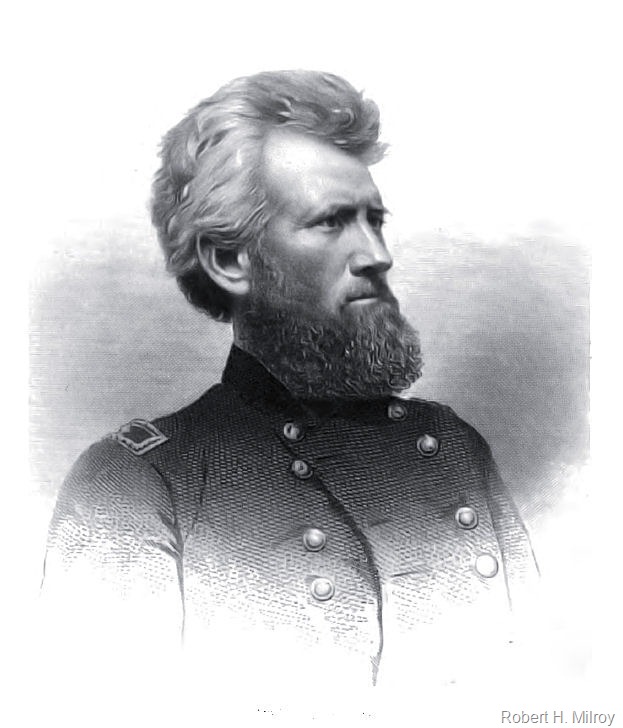
Robert H. Milroy

September 12.—To-day one hundred and eleven rebel prisoners were sent from Fortress Monroe to Aiken’s Landing, Va., for exchange.

—This morning the rebel army under Gen. E. Kirby Smith in full retreat from their position before Cincinnati, Ohio, were pursued by a portion of the Union forces under Gen. Wallace, as far as Florence, Ky.—In view of the invasion of Pennsylvania by the rebel army under General Lee, the City Council of Philadelphia appropriated five hundred thousand dollars for the defence of the city and State, and gave the Mayor of the city full power to act as he might sec fit. The public archives, bonds, and treasure of the State of Pennsylvania and cities of Harrisburgh and Philadelphia were sent to New-York for safe keeping. Many of the capitalists of the State also sent their bonds and treasure.

—A fight took place on the southern bank of Elk River, near Charleston, Va., between a Union force under Col. Lightburn and a large body of rebels, which lasted all day, both parties bivouackng on the field. The Union forces shelled and burned Charleston.

—Capt. Harry Gilmer, of Stuart’s rebel cavalry, with seven other rebel sympathizers, while being “feted by their friends,” were arrested at the house of Dr. T. L. Williamson, seven miles distant from Baltimore, Md., on the Hookerstown road, and carried to Fort McHenry.—The Twenty-first Connecticut, and Eleventh New-Hampshire regiments, under the command of Cols. A . A. Dalton and Walter Harriman, passed through New-York, en route for the seat of war.

—A war meeting of the wholesale grocers was held at New-York City this afternoon, for the purpose of raising an enlistment fund. Mr. Wm. McKenzie called the meeting to order, and nominated G. W. Lane, Esq., for chairman. Dwight Townsend was appointed secretary. Mr. Lane, on taking the chair, made a few appropriate and introductory remarks, after which the following resolution, presented by Mr. Wm. McKenzie, was offered and unanimously adopted: “Whereas, the grocers and the trades connected therewith in the city of New-York desire to aid the Government in suppressing the present rebellion against our Union and Constitution; we do therefore Resolve, that a committee be appointed by the chairman, who shall have full powers to collect money and expend the same in procuring men to enlist as soldiers in the army of the United States, in such a way as shall seem to them most suited to attain the object for which the meeting has been called.” A committee of fourteen was appointed to carry out the object of the resolution.—Bloomfield, Mo., was recaptured by a force of Union troops under the command of Col. Boyd.

—As important debate took place in the rebel House of Representatives at Richmond, Va., upon the propriety of an invasion of the Northern States.—See Supplement.

—The following commands in the army of Virginia were designated by the War Department: First corps, Major-Gen. Hooker; Second corps, Major-Gen. Sumner; Third corps, Major-General Heintzelman; Fourth corps, Major-Gen. Keyes; Fifth corps, Major-Gen. Fitz-John Porter; Sixth corps, Major-Gen. Franklin; Seventh corps, Major-Gen. Dix; Eighth corps, Major-Gen. Wool; Ninth corps, Major-Gen. Burnside; Tenth corps, Major-Gen. Mitchel; Eleventh corps, Major-Gen. Sedgwick; Twelfth corps, Major-Gen. Sigel.

—John Ross, chief of the Cherokee Indians, had an interview with President Lincoln, at Washington, this morning, with regard to the rescue of his nation from the rebels.

—The Union army under General Burnside entered Frederick, Md. A slight skirmish occurred between the Union advance-guard and the rear-guard of the rebel army, in which there were several men killed and wounded on both sides. Great enthusiasm was manifested by the inhabitants, on the appearance of Gen. Burnside and his army.—(Doc. 202.)

—Frankfort, the capital of Kentucky, was occupied by a large force of rebel cavalry under Gen. E. Kirby Smith. He issued a proclamation, informing the citizens that they must fight for him or against him. He also organized a city government and appointed a mayor.—N.Y. Times.

—The attack upon Harper’s Ferry, that position being completely invested by the rebel army, commenced this afternoon in a skirmish with the Union troops upon Maryland Heights, under command of Colonel Ford, lasting until sundown. —(Doc. 120.)


Robert Huston Milroy (June 11, 1816 – March 29, 1890) was a lawyer, judge, and a Union Army general in the American Civil War, most noted for his defeat at the Second Battle of Winchester in 1863. (Wikipedia)

September 11.—This morning a force of rebel cavalry entered Ilagerstown, Md. They immediately seized twelve hundred barrels of flour, and commenced tearing up the railroad in the vicinity of the depot. The United States Marshal, the sheriff, and other officials left the town as soon as the rebels entered, carrying with them the public records and other valuables in their different offices. Hundreds of private citizens also left the place.

—In consequence of the reported approach of the rebel army under General Lee, the greatest excitement existed in Pennsylvania, and especially in the cities of Philadelphia and Harrisburgh. In the latter city, the Governor of the State issued a proclamation, calling for fifty thousand men, “for immediate service to repel the now imminent danger from invasion by the enemies of the country.” He also telegraphed to the Mayor of Philadelphia to send him twenty thousand men. The latter immediately issued an address to the citizens, in which he embodied the Governor’s despatch, and called upon all able-bodied men to assemble next morning at the precinct-houses of the election districts, in readiness to obey the summons to immediate service.

—The New-Hampshire Eleventh regiment left Concord to-day, en route for the seat of war.—A Union meeting was held at Beaufort, N. C, at which an address was made by C. H. Foster, of North-Carolina. The meeting was largely attended, and resolutions of a highly patriotic character were adopted.—A party of rebels made a descent on the National pickets at Ridgeville, Va., and carried off three of them and several of the Union men of the place. Captain Fiery rallied a small force, and, pursuing the rebels, succeeded in capturing three prisoners and a number of horses.— Wheeling Intelligencer, September 13.

—Maysville, Ky., was occupied by the rebel forces under Brig.-Gen. R. M. Gano, of General E. Kirby Smith’s division of the rebel army.— Maysville Eagle, September 13.

—In compliance with orders from the Secretary of War, Gen. Schofield ordered the Provost-Marshal-General for the district of Missouri to proceed without delay to carry into effect the confiscation act, so far as the provisions of said act were subject to be carried into effect by the miltary authorities of the United States in the district. The property liable to confiscation in the district was estimated at fifty millions.

—Westminster, Md., was taken possession of by five hundred rebel cavalry, under the command of Col. Rosser. They came dashing into the town at a rapid rate, and immediately proceeded to place pickets around the town, to prevent the citizens from leaving. A gentleman named Crothers, in endeavoring to make his escape, was fired upon and killed. The rebels seized the post-office and the depot; ascertaining that there was a locomotive and two passenger and four freight-cars a short distance from the town, they also despatched a force and brought them in. Upon being established in the town, the rebels proceeded to lay hands upon all the boots, shoes, and clothing that they could find in the stores, for which they tendered in payment confederate money. Secession sympathizers suffered in common with the Union residents, the rebels stating that they had been deceived relative to the secession feeling in Maryland.—Baltimore Clipper, September 13.

—New-Market, Md., was occupied by the National forces.

—The Union forces stationed at Gauley, Va., under the command of Colonel Lightburn, having been threatened by an overwhelming rebel force in front, flank, and rear, were compelled to evacuate that place, after destroying all the Government stores they were unable to carry away.

—To-day the rebel army under Gen. E. Kirby Smith had reached Latonia Springs, Ky., within seven miles of Cincinnati, Ohio, and skirmishing between the rebel and Union pickets commenced on the banks of the West-Licking River, in the vicinity of that city. At night the rebels began to throw up breastworks in front of Fort Wallace. The Union forces in Cincinnati were being largely reenforced from all parts of the State, and also from Gen. Grant’s army, several regiments of which having arrived there to day. Considerable excitement existed in the city, although it was considered perfectly safe.

—Bloomfield, Mo., was captured by a large body of rebel guerrillas, after a fight of two hours. The town was defended by fifteen hundred State militia, who, being outnumbered, retired.—The Twentieth regiment of Connecticut, commanded by Col. Samuel Ross, left New-Haven for Washington.

—The Union army under Gen. Buell was on the march to the support of Nashville, Tenn., which was menaced by the rebel army under General Bragg, and eight thousand men from the army of General Rosecrans, under command of General Jefferson C. Davis, arrived there to-day for the purpose of reenforcing General Buell.

September 10.—Frederick, Md., was this day evacuated by the rebel army under General Lee. — (Doc. 202.)

—The Seventh regiment of Rhode Island volunteers, under the command of Colonel Zenas C. Bliss, left Providence, for the seat of war in Virginia.— The Sixth regiment of Massachusetts militia, under the command of Colonel Albert S. Follansbee, passed through New-York, on their way to Washington.

— Day before yesterday Colonel Grierson, with three hundred and seventy men, came up with the enemy beyond Coldwater, near Cochran’s Cross-Roads, Miss. They were a portion of Jackson’s and Pierson’s cavalry and a number of infantry, amounting to about one thousand men. They were posted and commenced the attack, but were driven two and a half miles through heavy timber. In the affair four of the rebels were killed and seventy or eighty wounded.

At night Colonel Grierson camped between the cross-road and Hernando, remaining Wednesday in the latter place, and this morning he moved in the direction of Coldwater, and came upon the enemy’s pickets at Coldwater Bridge, behind which they lay in force. They fired the bridge, but moved off, and the bridge was so far saved that, after some repairs, the Union forces crossed, the enemy retiring as they advanced, and Grierson entered Senatobia, where he burned the railroad depot and its contents.

— A public meeting was held in Susquehanna, Pa., and in accordance with the orders of the Governor of the State, a company was formed for immediate service. Over ninety men signed the roll and held themselves in readiness to march at an hour’s notice.—The draft in Pennsylvania, was postponed until the twentieth of September.

— A severe fight took place at Fayette, Va., between a force of rebels five thousand strong, under General Loring, and the Thirty-fourth and Thirty-seventh Ohio, under the command of Col. Siber, numbering about one thousand two hundred men, resulting in a defeat of the Unionists, with a loss of over one hundred killed and wounded.—(Doc. 206.)

— The excitement in Cincinnati, O., consequent on the near approach of the rebel army under General E. Kirby Smith, still continued. Martial law was enforced. The military authorities were actively employed in fortifying and preparing the city for a vigorous defence. Over one thousand squirrel-hunters from the neighboring counties came in and volunteered their services.

— A force of Union cavalry, supported by two pieces of artillery, under the command of Captain Saunders, acting Colonel of the Sixth United States cavalry, left Barnesville, Md., on a reconnoitring expedition to Sugar-Loaf Mountain. When half-way up the mountain, the Unionists encountered a force of rebel infantry supported by artillery, and a skirmish ensued in which the Unionists were defeated and compelled to retire. At night they returned to Barnesville.

September 9.—The greatest excitement existed throughout York and Adams County, Pennsylvania, as well as at Harrisburgh and throughout the Susquehanna region and the Cleveland Valley. The farmers sent their women and children, as well as their cattle, away, and armed for the defence of their homes against cavalry raids.

At Wilkesbarre all places of business were closed. All the church and court-house bells rang for the people to assemble for drill, at which time nearly all the able-bodied men in the town, amounting to some hundreds, assembled in the public square, formed into companies, marched to the river bank and drilled. Men over sixty years of age fell into the ranks. — Wilhesbarre Record.

— This afternoon, in latitude 28°, longitude 94° 10′, the United States steamer Connecticut captured the English schooner Rambler. She had run the blockade at Sabine Pass, Texas, and was bound to Havana heavily laden with cotton. Among the papers found on board was a memorandum in writing, directing the captain of the Rambler to sell the cotton at Havana, and with the proceeds of the sale to purchase powder, medicines, army shoes and other contraband articles, and without delay to return to Sabine Pass.

—Colonel Brums, sent in pursuit of the guerrillas under Quantrel, after their attack upon Olathe, Mo., overtook them five miles north of Pleasant Hill, Mo., and after a short skirmish compelled them to retreat, leaving in the hands of the Nationals all their transportation and subsistence, one thousand rounds of ammunition, one hundred horses, five wagons, a number of tents and other camp equipage, and a large quantity of dry goods, and other articles stolen from the citizens of Olathe.—Official Report.

—Major-general Banks, in compliance with an order issued on the seventh instant from the headquarters of Major-General McClellan, assumed command of the defences of the capital during the absence of the General Commanding from Washington.—Col. T. L. Kane, of the Pennsylvania Bucktail Rifles, was appointed a Brigadier-General for gallant and meritorious conduct in the field.

— This morning, the Third Indiana and the Eighth Illinois cavalry, the entire force under command of Col. Farnsworth, of the latter troop, left Poolesville, Md., and proceeded toward Barnesville. Upon approaching Monocacy Church, the cavalry discovered the rebel videttes guarding the cross-roads. Col. Farnsworth distributed his force, sending companies A and B, of the Third Indiana, on the road leading toward Nolansville, and other companies in other directions. Companies A and B, under command of Major Chapman, pursued the rebel videttes for some distance on the road to Nolansville, and succeeded in taking the regimental flag of the Twelfth Virginia cavalry, and eight prisoners. During the flight, the rebels lost three men killed. The companies then joined their squadron, and the entire force pushed forward into the town of Barnesville. Before reaching the town, however, they met with another small force of rebel cavalry, and after a few shots had been exchanged, the rebels fled, leaving seven more of their men prisoners. The rebels also sustained an additional loss of five men killed. In the whole affair, the Nationals had none killed, and only one man wounded.

To-night, the Eighth Illinois and the Third Indiana occupy the town—N. Y. Times, Sept. 12.

— Middletown, Md., was occupied by the rebels this morning, about two hundred taking formal possession and declaring martial law. In anticipation of such an event, many of the Union residents, whose names had been forwarded by their secession neighbors to Frederick, left last evening and early this morning, thus escaping the draft the rebels enforced from the enrolled lists taken from the National officer.

— Great excitement existed in Baltimore, Md., in consequence of the apprehended approach of the rebel army under General Lee. The authorities made the most ample preparations to intercept any movement in the direction of their city; and should the rebels succeed in entering it, to receive them in a manner different from that expected by them.

— Colonel Shingles with a force of rebel cavalry, and three pieces of artillery, made an attack on Williamsburgh, Va., this morning. After having captured the National pickets, they marched into town, taking the troops by surprise. An engagement ensued, which lasted about thirty minutes. The National force consisted of the Fifth Pennsylvania cavalry, Colonel Campbell, who was taken prisoner, together with five captains, four lieutenants, and a few privates. The rebel commander, Colonel Shingles, and eight of his officers and men were killed.

— The U. S. bark Braziliero, Acting Master M. V. Gillespie, commanding, captured the schooner Defiance, of Nassau, N. P.

September 8.—L. C. Turner, Judge Advocate of the War Department, issued the following instructions to United States marshals, military commandants, and their officers in the several States:

“The quota of volunteers and enrolment of militia having been completed in the several States, the necessity for stringent enforcement of the orders of the War Department in respect to volunteering and drafting no longer exists. Arrests for violation of these orders, and for disloyal practices, will hereafter be made only upon my express warrant, or by direction of the military commander or governor of the State in which such arrests may be made; and restrictions upon travel imposed by those orders are rescinded.”

—Boyd’s Station, Ky., was taken possession of by a large force of rebel troops.

—A meeting took place at London, England, between the American and British Sunday-school delegates, relative to the civil war in the United States. The opinion seemed to prevail that the end of the war would be also the virtual end of slavery. One or two of the English delegates declared that the North, in attempting to preserve the Union and destroy slavery, had the sympathy of all Christian men in England.—London News, September 9.

—A meeting of several hundred women of various denominations was held at the Park-street Church, Boston, at which a circular was adopted to the women of the United States, suggesting to them to form circles of prayer throughout the land, and to pray for the outpouring of the Holy Spirit on the entire nation; for the President and his councillors; for the officers of the army and navy; for the soldiers and seamen; for their families; for ministers of the Gospel, and for the oppressed of the land; and agreeing to observe Monday of every week as a day of special prayer, assembling at ten A.m. and at three P.M.; each service to occupy two hours.—The Fortieth regiment of Massachusetts volunteers, under the command of Lieutenant-Colonel Joseph A. Dalton, left the encampment at Boxboro’ for the seat of war.

—This afternoon two companies of the Third Indiana cavalry, under command of Major Chapman, went to Poolesville, Md., which they found in possession of a rebel cavalry regiment, who had planted on a hill to the right of the town one field-piece, which was opened on the Nationals as they approached. The command did not stop, but made a charge through the town. The enemy were then forming a line of battle near their gun. In a few moments reinforcements came up, consisting of two pieces of artillery and several companies of the Eighth Illinois cavalry, who, after a few shots, succeeded in silencing the enemy’s piece, when another charge was made by Major Chapman’s command, and the rebels broke and ran, leaving seven dead on the field. The National loss was one man killed, Sergeant David A. Fallis, of company B, and eight men wounded, Lieutenants Ladue and Davis, of company B, and six men of company A.—Washington Star, September 9.

—The water stations at Benson and Bagdad, Ky., on the Louisville and Frankfort Railroad, were destroyed and the road at the latter place torn up by a party of rebels.—Louisville Journal.

—A fight took place at a point on the right bank of the Mississippi River, twenty-five miles above New-Orleans, La., between the Twenty-first regiment of Indiana volunteers, and five hundred mounted Texan Rangers, resulting in the dispersion of the latter, and the capture of a greater part of their horses.—(Doc. 205.)

—Colonel Bradley T. Johnson, having been appointed by Gen. Lee, Provost-Marshal of Frederick, Md., on his entrance into that city, issued a proclamation addressed to the people of Maryland, in which he told them that after sixteen months of oppression, more galling than the Austrian tyranny, the victorious army of the South brought freedom to their doors; that its standard waved from the Potomac to Mason and Dixon’s line; that the men of Maryland had then the opportunity of working out their own redemption; and he called upon them to do their part, and to rise at once. He asked them to remember the cells of Fort McHcnry, the dungeons of Forts La Fayette and Warren; the insults to their wives and daughters; the arrests, the midnight searches of their houses, and to rise at once in arms and strike for liberty and rights.

—General Lee, commanding the rebel army in Virginia, issued a proclamation from his headquarters at Frederick, Maryland, addressed to the people of that State, in which he informed them that the people of the confederate States had long watched with the deepest sympathy the wrongs and outrages that had been inflicted upon them by the Government of the United States; that, believing they possessed a spirit too lofty to submit to such a Government, the people of the South had long wished to aid them in throwing off the foreign yoke, to enable them again to enjoy the inalienable rights of freemen, and restore the independence and sovereignty of their State. In obedience to this wish the Southern army had come among them, and was prepared to assist them with the power of its arms in regaining the rights of which they had been so unjustly despoiled. This was the mission of the Southern army. No restraint upon their free will was intended, no intimidation would be allowed, at least within the limits of his army. But it was for the people of Maryland to decide their own destiny, freely and without constraint. The army would respect their choice, whatever it might be; and while the Southern people would rejoice to welcome them to their natural position among them, they would do so only when they came of their own free will.

—Governor Bradford, of Maryland, in view of the fact that the rebel army under General Lee had entered the State and menaced the city of Baltimore and other places with a hostile attack, issued a proclamation calling upon the citizens to enroll themselves at once in volunteer military organizations; that no possible power at command might be overlooked in preparing to meet every emergency. Arms and accoutrements would be distributed to all military organizations, whether infantry or cavalry.

—The excitement among the people of Pennsylvania, consequent upon the invasion of the neighboring State of Maryland by the rebel army under General Lee, threatening an advance upon their own State, was most intense. Yesterday the citizens of Lancaster County held a great meeting, at which they appointed a committee of safety, who, to-day, issued an address appealing to the inhabitants of every township and borough in the county to organize committees of safety; to make out lists of all able-bodied men capable of bearing arms; to organize them into companies, and drill them daily; to put in order and have ready for immediate service every rifle and shot-gun; to provide themselves with ammunition; to form squads of cavalry in every district; to arrest every man who uttered a traitorous sentiment against the Government, and to watch every suspicious character whom they might find prowling about their neighborhoods.
September 7.—Harrisburgh, the capital of Pennsylvania, was the scene of tremendous excitement. The streets were thronged all the evening with excited citizens; and the women were excessively alarmed. The report had been scattered that the women and children were to be sent away on Wednesday; and preparations were actually made for departure. It was also rumored that the money and archives of the State had been packed, ready to be sent away in case of an emergency.

The arrival of a special train from Hagerstown, Maryland, added fuel to the excitement The passengers stated that the rebels were at Frederick, Maryland; that rebel scouts were in and about Hagerstown, and that an advance on that place by the rebels was regarded as imminent There was also a report from Chambersburgh that a rebel spy had been arrested there, with maps and plans of the Cumberland valley in his possession. Men then began earnestly to discuss means of defence for Harrisburgh.— The Thirty-seventh regiment of Massachusetts volunteers, under the command of Colonel Oliver Edwards, left Pittsfield for the seat of war.

— A party of rebels under the command of Captain Bowles, a son of J. B. Bowles, President of the Bank of Louisville, Ky., made a raid upon Shepherdsville, Ky., and burned the bridge over Salt River. A guard of eighty-five of the Fifty-fourth regiment, stationed at that place, were compelled to surrender, but were soon after paroled.—Louisville Democrat, September. 8.

— Major-general Pope, at his own request, was relieved from the command of the army of Virginia, and was assigned to the command of the Department of the North-West— The Tenth regiment of Vermont volunteers, under the command of Colonel A. B. Jewett, passed through New-York, en route for the seat of war.

— Clarksville, Tenn., was recaptured by the National forces under Colonel W. W. Lowe, composed of the Seventy-first Ohio, Eleventh Illinois infantry, and the Fifth Iowa cavalry.—(Doc. 204.)

— Governor Robinson, of Kansas, in view of the threatening attitude of the Indians on the western, north-western, and southern borders of the State, and the numerous bands of rebel guerrillas liable at any time to invade the State on the east, issued a proclamation calling upon all able-bodied citizens not connected with a volunteer company, to organize immediately in accordance with the militia law, and report to the Adjutant-General of the State without delay.

— General George W. Morgan sent the following, from his headquarters at Cumberland Gap, to the editors of Kentucky and the neighboring States. “Gentlemen: Please to say to the relatives and friends of the soldiers of this command that we have good health and good spirits, and that our condition in every respect is better than that of the enemy who surround us. Let our friends do their duty to our country, and we will try and take care of ourselves.”

September 6.—Olathe, the county-seat of Johnson County, Kansas, was sacked by Quantrel. The marauding band entered the town about midnight, took all the men, including the recent volunteers, prisoners, and marched them to the public square. Two men were killed, and one, a young man, mortally wounded while asleep. Two brothers, who had enlisted, living about two miles from the town, were taken out of their house into a corn-field and shot down in cold blood. The stores and private houses were plundered. The press of the Olathe Mirror was broken up. The post-office was entered and rifled of its contents, and county papers, etc., destroyed. Some government arms and stores were also taken. No resistance was made, because the citizens and volunteers were completely taken by surprise and overpowered. Quantrel had about three hundred well-armed and well-mounted men with him. Twenty-nine of the volunteers were taken out near the border and released on parole.—Leavenworth Conservative.

— A fight took place near Cacapon Bridge, about seventeen miles from Winchester, Va., between a body of Union troops under the command of Colonel McReynolds, and a portion of the rebel forces under Colonel Imboden, resulting in a rout of the rebels and the capture by the Unionists of all their camp equipage, ammunition, guns, horses, mules, etc

— The One Hundred and Twenty-third and the One Hundred and Twenty-fourth regiments N.Y.S.V., under the command of Colonels A. L. McDougall and A. Van Horn Ellis, passed through New-York for the seat of war.

— A party of rebel cavalry, numbering four hundred, attacked the outposts of the command of Gen. Julius White, in the vicinity of Martinsburgh, Va., and after a short engagement, were defeated, with a loss of about fifty prisoners, horses, and arms. The National loss was two killed and ten wounded, among the number Capt. Grosvenor and Lieut Logan, of the Twelfth Illinois cavalry, the members of which distinguished themselves by their bravery and daring.— General White’s Despatch.

— The funeral of Major-General Kearny, who was killed at the battle of Chantilly, on the first of September, took place to-day. The remains had been conveyed to his home, at Bellegrove, near Newark, N. J., from which place they were carried to New-York, escorted by a numerous procession of friends and admirers, preceded by a band of music and military, both infantry and cavalry. On arriving at New-York the cortege was met by the Fifth N.Y.S.M. regiment, and escorted to Trinity Church, where the burial service took place. The body was interred in the family vault, near the south-west corner of Trinity church-yard.

— The city of Frederick, Maryland, was entered and occupied by the rebel army under General Lee. The inhabitants manifested no enthusiasm on their arrival.—(Doc. 202.)

— Fort Abercrombie was attacked by a party of three hundred Indians, who were driven off after killing one of the National troops and wounding three others. —St. Paul Pioneer, Sept. 9.

— Washington, N. C, was attacked by a large body of rebels, who were repulsed with a loss of thirty killed and thirty-six taken prisoners, after a severe fight of nearly two hours. During the engagement, the National gunboat Picket, exploded her magazine, killing and wounding eighteen men.—(Doc. 203.)

— About forty men of the Fourth Virginia regiment, under command of Major Hall, were attacked and surrounded near Chapmansvillc, Va., by three hundred rebel guerrillas under Colonel Stratton. After a sharp fight, in which Major Hall was wounded and Colonel Stratton killed, the Nationals succeeded in cutting their way out.

— Pikeville, Va., was this day captured by a strong force of rebel cavalry, and plundered of a large amount of private property. The home guard endeavored to resist the rebels, but they were too few in number to do so with effect.

September 5.—The One Hundred and Sixteenth regiment of New York volunteers under the command of Colonel Chapin, left Buffalo for the seat of war.—The rebel schooner Rising Sun, was captured by the boats of the United States steamer Wyandotte, in Brittan’s Bay, near the mouth of the Potomac River, Va.—Poolesville, Md., was taken possession of, and a detachment of Massachusetts cavalry stationed there was captured, by the rebel forces under Gen. Stuart. He crossed the Potomac River at Conrad’s Ferry without opposition, and was received with exultant demonstrations of favor, nearly all the population turning out to welcome him.—Philadelphia Press.

—The One Hundred and Twenty-eighth regiment of New York volunteers, under the command of Colonel David S. Cowles, left Hudson for the seat of war.—The ship Ocmulgee, of Edgartown, Mass., was burned at sea by the rebel privateer “290,” commanded by Capt. Semmes.

—Braxton Bragg, the rebel General at Sparta, Alabama, issued the following congratulatory order to his army:—

“Comrades: Our campaign opens auspiciously. The enemy is in full retreat, with consternation and demoralization devastating his ranks. To secure the fruits of this condition, we must press on vigorously and unceasingly.

“Alabamians! your State is redeemed. Tennesseeans! your capital and State are almost restored without firing a gun. You return conquerors. Kentuckians! the first great blow has been struck for your freedom. Soldiers from other States share the happiness of our more fortunate brothers, and will press on with them for the redemption of their homes and women.”

—Governor Morton, of Indiana, issued a proclamation calling upon the inhabitants of the counties bordering upon the Ohio River to meet at their respective places of holding elections, and form themselves into companies for military duty, and report to the Colonel of the Indiana Legion in their respective districts.

—General J. S. Morgan, commanding Union forces at Key West, Fla., issued an order directing that persons of African descent, including those held to service or labor under State laws, coming within the lines of his command, should be employed in the quartermaster’s department. The order also declared that all persons so employed should receive permanent protection against any compulsory return to a condition of servitude.

—Governor Tod, of Ohio, issued a proclamation informing the inhabitants of the State that no more volunteers were required for the protection of the city of Cincinnati.

September 4.—On Monday last, September first, a detachment of Dodge’s New-York Mounted Rifles were despatched from Suffolk Va., upon a scout, under the command of Major Wheelen. The party proceeded nearly thirty-five miles, and when about twelve miles west of South-Mills they came across a company of rebels, on their way toward Richmond. Major Wheelen made such a disposition of his force that he succeeded in capturing the whole command, consisting of two commissioned officers and one hundred and eleven privates. The rebel company had gathered along the route thirty-eight negroes, who were tied, and destined for Richmond. This morning the prisoners were marched into Suffolk, and placed under a guard from the Third regiment New-York volunteers. They were conscripts, intended to fill up old regiments.

—The rebels burned three bridges over Benson Creek, on the Louisville and Frankfort Railroad, about sixty miles east of Louisville, Ky.

—A war meeting was held at the halfway house, on the Philadelphia and Trenton turnpike, between the villages of Andalusia and Eddington, Pa., for the special purpose of encouraging recruiting “to a company of loyal Virginians.” Patriotic resolutions were adopted and speeches made urging the necessity of “immediately putting forth all our energies to sustain our dearbought liberties.”

—The Governors of Maine, New-Hampshire, Massachusetts and Rhode Island held a session at Providence, R. I., with a delegation of the New-York National War Committee.

—Jeff Davis issued a proclamation setting apart Thursday, the eighteenth inst., “as a day of prayer and thanksgiving to Almighty God for the great mercies vouchsafed to our people, and more especially for the triumph of our arms at Richmond and Mannassas.”

—The rebel war steamer Oreto ran the blockade into the harbor of Mobile, this day. The correspondent of the Charleston Mercury gives the following account of the steamer:

“The vessel is the steam corvette Oreto, now called the Florida, and is not an iron-clad. Our readers are aware of the difficulties which the commander of this ship encountered at Nassau, owing to the rigor of the British neutrality regulations. Having finally escaped from the clutches of the Court of Admiralty, Capt Maffitt steamed away to the Gulf and boldly ran the gauntlet of the blockaders at the mouth of Mobile Bay, in broad daylight The Captain was at the time sick with fever, as were most of her small crew of thirteen men. The Florida ran within sixty yards of the Yankee vessels, and her sides are peppered all over with shrapnel and grape-shot. One eleven-inch shell went through her side a foot above the water-line, and lodged in the “coal-bunkers.” The Florida is a beautiful and well-armed corvette of great speed. Her armament consists of eight guns. Her dash through the blockaders, with a sick crew of only thirteen men, in broad daylight, is one of the most daring naval exploits of the war. The Florida did not fire a shot, as her crew were unable to man even a single gun. She had one killed and two wounded.”

—A skirmish took place near Cumberland Gap, between a foraging party of National troops and a body of rebels, in which the latter were routed with considerable loss.—Louisville Journal.

—Governor Curtin, of Pennsylvania, issued a proclamation earnestly recommending the immediate formation, throughout the State, of volunteer companies and regiments, in conformity with the Militia Act of 1858. Arms would be distributed to such organizations agreeably to the provisions of the act. It was further recommended that, in order to give due opportunities for drill and instruction, all places of business should be closed daily at three o’clock.

—Frederick City, Md., was evacuated by the National troops, after they had burned the hospital and commissary stores, and removed the sick and wounded.

—Major-general George B. McClellan, pursuant to general orders from the War Department, of the second of September, assumed command of the fortifications of Washington and of all the troops for the defence of the capital.— Joseph Holt, of Kentucky, was appointed Judge Advocate General of the army of the United States, with the rank of Colonel.

—Ravenswood, Va., was entered and occupied by a force of rebel guerrillas, who destroyed a large quantity of wheat and other private property.

—The Peace Society of London, England, issued an address to the people of the United States, urging that the time had come when an attempt should be made to arrest the destructive conflict that had been carried on. It deprecated any interference with American affairs, but such as would prove acceptable to Americans, but said: “Surely the idea of friendly mediation may be entertained without any derogation of national dignity. It argues that there are only two alternatives to issue out of the war—either the utter extermination of one of the parties to it, or some form of accommodation and compromise between the contending sides. Is it not better to have recourse to the latter at once, before the feelings of the North and South become hopelessly inflamed with the most bitter animosity and vengeance?”

—The bark Fannie Laurie, was captured while attempting to run the blockade of South-Edisto, S. C.—Commodore Du Ponts Report.