Following the American Civil War Sesquicentennial with day by day writings of the time, currently 1863.

The American Civil War

July 25.—At St Louis, Mo., great excitement existed on account of the order of Governor Gamble, authorizing the enrolment of the State militia.—An engagement took place on the Hatchie River, near Brownsville, Tenn., between a body of rebels, under the command of Capt. Faulkner, and a party of National cavalry, led by Major Wallace.

— Major-Gen. Pope, at Washington, issued the following order:

“Hereafter no guards will be placed over private houses or private property of any description whatever. Commanding officers are responsible for the conduct of the troops under their command, and the articles of war and regulations of the army provide ample means for restraining them to the full extent required for discipline and efficiency. Soldiers were called into the field to do battle against the enemy, and it is not expected that their force and energy shall be wasted in the protection of the private property of those most hostile to the government. No soldier serving in this army shall hereafter be employed in such service.”

—The Philadelphia and Reading, Pa., Railroad Company, subscribed twenty-five thousand dollars to aid in raising volunteers.—The rebel steamer Cuba arrived at Mobile, Ala., “from Havana, after an exciting chase by the blockaders.” — Richmond Examiner, July 26.

— President Lincoln, in accordance with the sixth section of the act of Congress entitled, “An act to suppress insurrection, to punish treason and rebellion, to seize and confiscate the property of rebels, and for other purposes,” issued a proclamation warning all persons to cease participating in aiding, countenancing or abetting the existing rebellion, or any rebellion, against the government of the United States, and to return to their proper allegiance to the United States, on pain of the forfeitures and seizures as by said sixth section provided.—(Doc. 158.)

— Two companies of Union troops, under the command of Captain Davidson, while guarding the bridge at Courtland, Ala., were completely surprised and captured by a force of rebel cavalry.— (Doc. 159.)

— A meeting of Irish citizens and residents of St. Louis, Mo., was held in that city for the purpose of denouncing the conduct of such of their countrymen as had attempted to avoid the operation of the Governor’s proclamation for troops to serve the State, by appealing to the British Consul for protection, as cowardly, base, and infamous.

— A skirmish took place near Orange Court-House, Va., between a reconnoitring party of Union troops under the command of General Gibson, and a body of rebels, resulting in the retreat of the latter with a loss of five men killed, several wounded and some prisoners.—Large meetings were held at Corning and Ithaca, N. Y., to promote enlistments into the army under the call of the President for additional troops.

porter_w_d

July 24.—The steamer Tubal Cain was seized as a prize by the United States gunboat Octarora this day, having on board a cargo of small arms, salt, saltpetre, military buttons, shells and various other goods suitable for a Southern market.—The schooner Emma was captured by the United States steamer Adirondack, commander Gansevoort.—Skirmishes took place at Malvern Hill, Va., and Coldwater, Miss.

— At St. Louis, Mo., the Union Merchants’ Exchange unanimously adopted a stirring and patriotic address to the people of Missouri. Unfaltering and unconditional fidelity to the Union was the sentiment, and liberal aid to the volunteer fund was pledged. — The City Council of Philadelphia appropriated five hundred thousand dollars for the payment of bounty of fifty dollars to each volunteer to supply the quota for the city under the recent call of the President

—A skirmish took place at Trinity, near Decatur, Ala., between a small party of Union troops under the command of Captain Harman, Thirty-first Ohio, and a much superior force of rebels, resulting in the retreat of the latter with a loss of ten or twelve killed and thirty wounded.— (Doc. 157.)

—In consequence of the fear entertained by the Irish and other foreign residents of St. Louis of being forced into the militia service of the State, General Schofield issued an order informing them that the subjects of foreign powers, lawfully pursuing their avocations, were exempt from such service.—The Union forces stationed at Grand Junction, Miss., were withdrawn from that place to Bolivar, Tenn. All the public property and cotton were removed prior to the withdrawal

— Lieutenant-Colonel W. C. Starr, Ninth Virginia infantry, and about eighty of his command were surprised and captured at Summcrville, Va., by a superior force of rebel cavalry under the command of Major Bailey.

—Large and enthusiastic meetings were this day held at Pittsburgh, Pa., Oswego, N.Y., Stamford and Middletown, Conn., to promote enlistments into the army under the call of President Lincoln for additional troops. At the meeting at Stamford two thousand five hundred dollars were collected for the families of volunteers, and in that of Oswego resolutions were unanimously adopted in favor of a more vigorous prosecution of the war; the confiscation of rebel property; the employment of the slaves of fugitive and rebel masters in the military and naval forces of the Union, and pledging united and determined resistance against foreign intervention in the affairs of America. The Board of Supervisors added fifty dollars to the bounty of each recruit, and a number were obtained on the spot

—A company of rebel cavalry entered Gloucester Point, Va., and captured a number of contraband negroes accumulated there; set fire to a lot of ship-timber, and impressed into the rebel army nearly every man capable of bearing arms. Parties of rebel cavalry were to be seen in the vicinities of Gloucester Point and Williamsburgh in quest of plunder, and impressing into the rebel service every man who could be of any use to them.

— The Union fleet of gunboats under the command of Commodore Farragut, embarked the Union army under General Williams at Vicksburgh, and proceeded down the Mississippi to Baton Rouge, La. The flotilla of mortar vessels, under command of Commodore Davis, left its position before Vicksburgh, and proceeded up the Mississippi to the mouth of the Yazoo River, where it came to anchor.


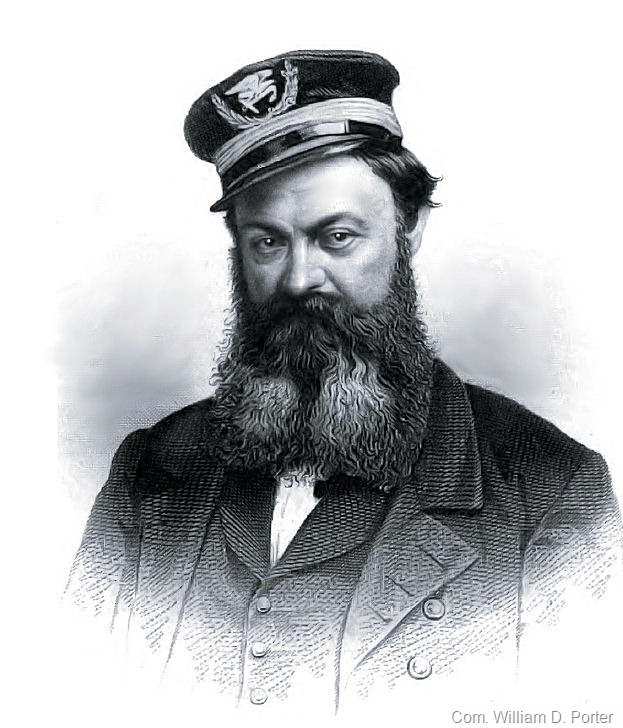
William D. Porter (10 March 1808 – 1 May 1864) was a flag officer of the United States Navy. He was the son of Commodore David Porter (1780–1843) and brother of Admiral David Dixon Porter (1813–1891) as well as foster brother of Admiral David Farragut (1801–1870). (Wikipedia)

July 23.—General Pope issued an order directing the generals in his command to seize all the horses, mules and stores within their lines, except such as were absolutely needed by the inhabitants, especially in Culpeper County, Va. He also issued an order for the arrest of all disloyal male citizens within the lines of his command. Those who were willing to take the oath of allegiance and provide security for its observance were permitted to remain at their homes. Those refusing to be so sworn would be sent South beyond the National pickets.—(Doc. 104.)

—A fight took place near Florida, Mo., between a company of Union cavalry under the command of Major Caldwell and Porter’s band of rebel guerrillas, numbering three hundred, which resulted in the retreat of the Nationals with a loss of twenty-six killed, wounded and missing.

—A fight took place near the North Anna River, Va., between a body of Union troops under the command of Colonel Kilpatrick, and a force of the rebels, resulting in the complete rout of the latter. After the defeat of the rebels the Nationals cut the telegraph-wire, burned a railroad train loaded with grain, wagons, tents, baggage, commissary and medical stores, and other valuable property, and returned to Fredericksburg)), whence they started two days previous.—(Doc 156.)

—A large and enthusiastic meeting was held in Trenton, N. J., to promote enlistments into the army under the call of the President for three hundred thousand more troops. Resolutions strongly supporting the Government in the prosecution of the war, and recommending the raising of money for the purpose of paying bounties, was unanimously adopted. About five thousand dollars were subscribed at the meeting. Several persons were arrested in Fredericksburgh, Va., by order of Major-General Pope, and held as hostages for certain Union men seized by the rebels some months previous.

July 22.—Major-General Sherman assumed command at Memphis, Tenn. Four hundred citizens took the oath of allegiance, and one hundred and thirty were provided with passes to go to the South.—General Dix, on the part of the United States, and Gen. D. H. Hill, for the rebel government, made an arrangement for an immediate and general exchange of prisoners.—(Doc. 103.)

—President Lincoln issued an order in reference to foreign residents in the United States. The ministers of foreign powers having complained to the government that subjects of such powers were forced into taking the oath of allegiance, the President ordered that military commanders abstain from imposing such obligations in future, but in lieu adopt such other restraints as they might deem necessary for the public safety.

—The steamer Ceres was fired into by the rebels at a point on the Mississippi, below Vicksburgh, Miss., killing Capt Brooks, of the Seventh Vermont regiment, besides inflicting other injuries.

—Governor Gamble, of Missouri, in view of the existence of numerous bands of guerrillas in different parts of that State, who were engaged in robbing and murdering peaceable citizens for no other cause than that such citizens were loyal to the Government under which they had always lived, authorized Brig.-Gen. Schofield to organize the entire militia of the State into companies, regiments, and brigades, and to order into active service such portions of the force thus organized as he might judge necessary for the purpose of putting down all marauders, and defending peaceable citizens of the State.

—The effect on the Yankee soldiers of General Pope’s recent orders to the “Army of the Rappahannock” is already being felt by the citizens of Culpeper. The party who burned the bridge over the Rapidan on the thirteenth took breakfast that morning at the house of Alexander G. Taliaferro, Colonel of the Twenty-first Virginia regiment. On their approach the Colonel was at home, and was very near being captured; but, by good management, contrived to escape. After they had breakfasted, the Yankee ruffians searched the house, took possession of the family silver, broke up the table-ware and knives and forks, eta, and actually wrenched from Mrs. Taliaferro’s finger a splendid diamond ring of great value.— Richmond Examiner, July 23.

—President Lincoln issued an order directing military commanders within the States of Virginia, North-Carolina, Georgia, Florida, Alabama, Mississippi, Louisiana, Texas, and Arkansas, to seize and use any property, real or personal, which might be necessary or convenient for their several commands, for supplies or for other military purposes.—(Doc. 155.)

—A band of rebel guerrillas entered Florence, Ala., and burned the warehouses containing commissary and quartermaster’s stores, and all the cotton in the vicinity. They also seized the United States steamer Colonna; and after taking all the money belonging to the vessel and passengers, they burned her. They next proceeded down the Tennessee River to Chickasaw, then to Waterloo and the vicinity of Eastport, and burned all the warehouses that contained cotton.— A band of about forty rebel guerrillas attacked a Union wagon-train near Pittsburgh Landing, Tenn., and captured sixty wagons laden with commissary and quartermaster’s stores.

—An unsuccessful effort to sink the rebel ram Arkansas, lying before Vicksburgh, was made by the Union ram Queen of the West, under the command of Lieutenant-Colonel A. W. Ellet. The Arkansas was hit by the Union ram, but with very little injurious effect The fire of the rebel shore batteries was to be diverted by the gunboats under Commodore Farragut, but by some mistake they failed to do so, and the Queen of the West in making the attack was completely riddled by shot and shell from the shore batteries and the Arkansas.—(Doc. 152.)

—A party of rebel troops, who were acting as escort to the United States post surgeon at Murfreesboro, Tenn., who was returning under a flag of truce to the lines of the Union army, were fired upon when near Tazewell, Tenn., by a body of National troops belonging to General Carter’s brigade, killing and wounding several of their number.

July 21st.

It is impossible to discover the true story of last night’s alarm. Some say it was a gang of negroes who attacked the pickets in revenge for having been turned out of the Garrison; others say it was a number of our soldiers who fired from the bushes; and the most amusing story is that they took alarm at an old white horse, which they killed, mistaking him for the Confederates. One regiment has refused to do picket duty; and the story runs among these poor soldiers that our army, which is within a mile, is perfectly overwhelming. The excitement still continues.

I have been writing to the Brunots the news confirming the death of McClellan, the surrender of his army, and the good tidings of our Ram’s recent exploits above Vicksburg, and her arriving safely under the guns there. If we could keep all the dispatches that have passed between us since the battle of the forts, what a collection of absurdity and contradiction it would be! “Forts have been taken.” “Their ships have passed; forts safe; Yankees at our mercy.” “Ships at New Orleans. City to be bombarded in twelve hours.” “Forts surrendered.” “City under British protection.” “No, it is n’t.” “City surrendered.” “Mistake.” “Baton Rouge to be burned when Yankee ships come.” And so on, sometimes three times a day, each dispatch contradicting the other, and all equally ridiculous.

The crowd here seems to increase. The streets are thronged with the military, and it will soon be impossible to go even to Mrs. Brunot’s, which will be a great privation to me. . . . Five thousand are to come next week, and then it will really be impossible to go in the streets.

July 21. Monday. — We are target firing now. The Enfields are a little better sighted than the muskets; the muskets have most power and the longest range. Company C does rather the best shooting, Companies E and A coming next.

A zouave at the Flat Top camp found tied to a tree with five bullet holes through him! Naked too! An enemy’s cavalry patrol seen two miles outside of our pickets. Secesh, ten or twelve in number.

July 21.—A party of National pickets were captured on the Lebanon road, five miles from Nashville, Tenn., by a body of rebel guerrillas.— Three bridges were burned on the Chattanooga road, within eight miles of Nashville.

—The first anniversary of the battle of Manassas was celebrated at Dill’s farm, at Gen. Whiting’s headquarters, near Richmond, Va., by the Bee Lodge of Masons. A procession was formed at Dill’s and marched thence, preceded by a brass band, to the farm of Mrs. Schermerhorn. Arrived there, proceedings were initiated by prayer by Rev. Dr. Duncan. An oration, an eulogy on the death of the gallant and lamented brother Barnard E. Bee, Brigadier-General, C.S.A., who fell at Manassas, was then delivered in feeling and appropriate language by Rev. Dr. Stewart, an Episcopalian clergyman, of Alexandria, Va., who, it will be remembered, was driven from his pulpit by the hirelings of Lincoln for declining to pray for that individual. The procession returned to Dill’s farm, where the exercises of the day were concluded.—Richmond Dispatch, July 24.

—General Boyle, commanding United States forces in Kentucky, issued an order from his headquarters at Louisville, informing the inhabitants of the State that no person hostile in opinion to the Government, and desiring its overthrow, would be allowed to run as a candidate for any office in the military district of Kentucky. The attempt of such a person to stand for office would be regarded as in itself sufficient evidence of his treasonable intent to warrant his arrest.—General Order No. 5.

—The work of recruiting for the Union army, under the call of President Lincoln for three hundred thousand men, issued on the first instant, was rapidly progressing in all the loyal States of the Union.

— Brigadier-General Ross, of the Union army, issued an order from his headquarters at Bolivar, Tenn., to all owners of slaves living within ten miles of his military post, to forward to his headquarters three fourths of their male slaves, from the age of sixteen to forty-five years, to aid him in erecting fortifications.—A large and enthusiastic meeting was held in Hornellsville, N. Y., for the purpose of promoting enlistments into the army under the call of President Lincoln for more troops. Forty volunteers came forward and enrolled their names.

—The rebel steamer Reliance, commanded by Lieut. Gladding, from Dobay Bar, Ga., with a cargo of cotton, was captured by the United States steamer Huntsville.—Official Reports.

July 20.—A body of cavalry belonging to Gen. King’s command, left Fredericksburgh, Va,, last night at seven o’clock, and, after a forced march, made a descent this morning at daylight upon the Virginia Central Railroad, at Beaver Dam Creek, destroying the railroad and telegraph lines for several miles, and burning the depot which contained forty thousand rounds of musket-ammunition, one hundred barrels of flour, and much other valuable material, besides capturing the rebel captain who had charge of the property. —(Doc. 154.)

—This morning a slight skirmish occurred at Orange Court-House, Va., between a force of Union troops under the command of Col. Brodhead, First Michigan cavalry, and a body of rebels, resulting in the retreat of the latter, and the occupation of the town by the Nationals. In the evening, the rebels having been strongly re-enforced, Col. Brodhead retired, swimming the Rapidan River with his command without losing a man, and encamped on the bank of that stream in full sight of the rebels.

—Major-General Halleck left St Louis, Mo., this evening for Washington.—A skirmish took place at Turkey Island Bridge, near Haxall Landing, James River, Va., between a body of rebel pickets and a squadron of the Eighth Pennsylvania cavalry, under the command of Capt. P. Keenan.—Philadelphia Press.

July 19.—An agreement was made this day between the Government of Denmark and the Government of the United States, wherein the former is to “receive all negroes delivered from on board vessels seized in the prosecution of the slave-trade, by commanders of United States vessels, and to provide them with suitable instruction, clothing, and shelter, and to employ them at wages, under such regulations as shall be agreed upon, for a period not exceeding five years from the date of their being landed at St Croix, West-Indies.”

—Many persons in the city of New-Orleans, La., and its vicinity, having ordered their slaves “to go to the Yankees,” thereby causing much annoyance to the National authorities, General Butler ordered that all such declarations would be taken and deemed acts of voluntary emancipation, and slaves sent away by their masters with such declarations, would be regarded and treated as manumitted and emancipated.—Fifty-three men of the Third Michigan cavalry were captured by the rebels near Booneville, Miss.

—Large and enthusiastic meetings were held in Chicago, Ill., Louisville, Ky., Fishkill, N. Y., and Towanda, Penn., for the purpose of promoting enlistments into the army, under the call of the President. At the Louisville meeting a resolution was adopted requesting the City Council to appropriate one hundred thousand dollars for the support of the families of volunteers.

July 18.—Great excitement and terror existed among the citizens of Cincinnati, in consequence of the vicinity of the force of rebel guerrillas under John Morgan. Colonel Burbank, Thirteenth United States infantry, assumed military command of the city, and issued orders directing all officers in the volunteer service to report to him. The Governor of the State also issued an order calling for volunteers to serve for thirty days. The excitement of Cincinnati pervaded the adjoining towns in Kentucky.

—At Kingston, North-Carolina, two negroes were executed, by order of Colonel Sol Williams, C.S.A., having been found guilty of drumming up recruits for Burnside’s army.—Richmond Examiner, July 24.

—Col. Salomon, of the Ninth Wisconsin volunteers, at his encampment on Grand River, Ark., arrested Col. Weer, commander of the Indian expedition, and assumed command.

—A desperate fight took place near Memphis, Mo., between a detachment of Union troops, numbering about four hundred, under the command of Major John Y. Clopper, and a force of rebel guerrillas six hundred strong, resulting in a complete rout of the rebels, who left a large number of their dead and wounded.—(Doc. 153.)

—The Richmond (Va.) Despatch of this date, speaking of the proposition of employing negroes on the Union fortifications, said: “It appears from statements in the Northern newspapers that McClellan proposes to employ negroes to perform the hard labor on his fortifications, with a view to save his troops from the perils of sunstroke. This is the sort of freedom the deluded slaves enjoy when they get into the clutches of the abolitionists. They are worked to death, in order to save the lives of a proportionate number of miserable Yankees, not one half of whom can lay as much claim to respectability as the blackest cornfield negro in Virginia. We hope our authorities, in negotiating for an exchange of prisoners, will make the invaders account for at least a portion of the ‘contrabands’ they have stolen, though in making up their relative value it should appear that one nigger was equal to two Yankees.”

—The town of Newburg, Ind., was this day entered by a band of rebel guerrillas, under Capt. Johnson, and robbed of a large amount of property.—Evansville Journal, July 21.

—Large and enthusiastic meetings were held in Memphis, Tenn., Milwaukee, Wis., Danbury, Ct, and Troy, N. Y., for the purpose of promoting enlistments into the army, under the call of President Lincoln.

—In the British House of Commons a debate took place on the following motion submitted by Mr. Lindsay:

“That, in the opinion of this House, the States which have seceded from the Union of the republic of the United States have so long maintained themselves under a separate and established government, and have given such proof of their determination and ability to support their independence, that the propriety of offering mediation with the view of terminating hostilities between the contending parties, is worthy of the serious and immediate attention of her Majesty’s government”

In making this motion Mr. Lindsay said he felt assured that an expression of opinion on the part of the House on the subject would have an effect contrary to that which some persons seemed to apprehend. He thought the confederate States had shown their determination and ability to support their independence. There could be no difference of opinion on that point: but there might be a difference of opinion as to the propriety of British mediation. He then addressed the House on the origin and causes of the war; next he spoke of its effects; then he showed that, as he conceived, the end of the war must be separation; and, lastly, he endeavored to show that humanity and British interests demanded that a stop should be put to the war. It appeared strange and unaccountable to him that her Majesty’s government had taken no steps in that direction. It was clear that the South could not be conquered, and it was still more clear it could never be brought back again into the Union. He therefore submitted that the time had arrived when the Southern States ought to be received into the family of nations, and begged to make the above motion.

Mr. Taylor, who had given notice of an amendment to Mr. Lindsay’s motion, to leave out all the words after the words “House,” in order to insert the words, “it is desirable that this country should continue to maintain the strictest neutrality in the civil war unhappily existing in the republic of the United States,” said he thought Mr. Lindsay had not acted prudently in disregarding the suggestion of an honorable member, to forbear to move his resolution. It meant the recognition of the Southern States and intervention by force, which was another word for war with America. He had never heard, he said, such tremendous issues so raised; he, therefore, implored the House not to adopt the resolution.

Lord A. V. Tempest, who had given notice of a resolution, “that it is the duty of her Majesty’s government to endeavor, either by itself or in combination with other European Powers, by mediation or otherwise, to bring to a termination the existing contest in America,” said he thought the House should not separate without expressing an opinion on the subject of the war. He justified the interference of Great Britain on the grounds of humanity and of its responsibilities and duties. Mediation, however, he thought would be worthless unless backed by ulterior measures.

Mr. W. Foster said that, in his opinion, the motion was not calculated to put an end to the war, but was more likely to prolong it, and even to drag Great Britain into it. Was the object of the resolution, he asked, mediation or forcible interference? If the former, the less that was publicly said about it the better, and the mediator should be considered a friend to both parties; whereas Mr. Lindsay had avowed his partiality for the South. Then, if the offer of mediation was to be accompanied by a threat, it would be justly regarded as an insult, and would aggravate the evil. If the North were let alone it was not improbable it would find out that the subjugation of the South was too hard a task. He insisted that the civil strife was a great revolution, that tariffs had nothing to do with it, that slavery was the real cause of the war, and that it would put an end to slavery. He, therefore, advocated the principle and policy of non-intervention.

Mr. Whiteside observed, that although this question was difficult and delicate, that was no reason why the House of Commons should not express an opinion upon it; to shrink from doing it would be a cowardly proceeding on their part, and he thought Mr. Lindsay deserved well of the country in giving the government an opportunity of making known their sentiments on the subject. In his opinion the time had come when, upon the principles of international law, the Southern States, which had so long maintained their independence, might be recognized, without giving just ground of war or umbrage to the North. Mr. Gregory contended that though the war was for independence on one side, it was not for empire but for revenge on the other, in pursuit of which object every other consideration had been lost sight of by the North, and he insisted that Great Britain had a perfect right to endeavor to put a stop to such a state of things.

Mr. S. Fitzgerald moved the adjournment of the debate, when—

Lord Palmerston rose and said he hoped, after the length to which the debate had gone, that the House would be disposed to come to a decision to-night on the motion of the honorable member for Sunderland. The subject they had been debating was one of the highest importance, and one also of the most delicate character—and he could not think that the postponement of the conclusion of the debate could be attended with any beneficial result, either one way or the other. There could be but one wish on the part of every man in the country with respect to the war in America, and that was that it should end. He might doubt whether any end which could be satisfactory, or which could lead to an amicable settlement between the two parties was likely to be accelerated by angry debates in that House. He confessed, therefore, that he regretted that the discussion had been brought on, and he should earnestly hope that the House would not agree to the motion of his honorable friend, but would leave it in the hands of the government to deal with the future, content as he believed the country was with the manner in which the past had been conducted by them.

Mr. Hopwood said a few words concerning the distress of the operatives of Lancashire and Cheshire, which, he said, was entirely caused by the war in America, and implored the government to take some steps to put an end to the misery which the struggle was creating not only in America but in Europe.

Mr. Lindsay then asked the permission of the House to withdraw his motion, observing that he would rest satisfied with the statement of the noble lord at the head of the government, and the hope which it held out that he would take the earliest opportunity to bring about a termination of the war.

The motion was then withdrawn.