Following the American Civil War Sesquicentennial with day by day writings of the time, currently 1863.

The American Civil War

July 17.—A detachment of the Union army, under Gen. Pope, this day entered the town of Gordonsville, Va., unopposed, and destroyed the railroad at that place, being the junction of the Orange and Alexandria and Virginia Central Railroads, together with a great quantity of rebel army supplies gathered at that point

—Cynthiana, Ky., was captured by a party of rebel troops, under Col. John H. Morgan, after a severe engagement with the National forces occupying the town, under the command of Lieut. Col. Landrum.—(Doc. 89.)

—The British schooner William, captured off the coast of Texas by the National steamer De Soto, arrived at Key West, Fla.—Major-General Halleck, having relinquished the command of the department of the Mississippi, left Corinth for Washington, D. C, accompanied by General Cullum, Col. Kelton, and an aid-de-camp.—The bill authorizing the issue of postage and other government stamps as currency, and prohibiting banks and other corporations or individuals from issuing notes below the denomination of one dollar for circulation, was passed by the House of Representatives and signed by the President.

—President Lincoln sent a special message to Congress, informing it that as he had considered the bill for an act to suppress insurrection, to punish treason and rebellion, to seize and confiscate the property of rebels, and the joint resolution explanatory of the act, as being substantially one, he had approved and signed both. Before the President was informed of the passage of the resolution, he had prepared the draft of a message stating objections to the bill becoming a law, a copy of which draft he transmitted to Congress with the special message.

—The Congress of the United States adjourned sine die.—At Louisville, Ky., both branches of the Common Council of that city adopted an ordinance compelling the Board of School Trustees to require all professors and teachers of the public schools, before entering on their duties, to appear before the Mayor and take oath to support the Constitutions of the United States and Kentucky, and to be true and loyal citizens thereof.—Gen. Nelson arrived at Nashville, Tenn., with large reenforcements, and assumed command there.

—A scouting-party of ten men, under Lieut. Roberts, of the First Kentucky (Wolford’s) cavalry, when about fifteen miles from Columbia, Tenn., were attacked by a body of sixty rebels. The Union party retired to a house in the neighborhood, from which they fought the rebels six hours, when they finally retreated. Several of the rebels fell. The Union party lost none.

—Enthusiastic meetings were this day held at Bangor, Me., Bridgeport, Ct, and Auburn, N. Y., for the purpose of promoting enlistments into the army, under the call of the President for more troops.

JULY 16TH.—Gen. Lee is hurrying up reinforcements from the South, old regiments and conscripts, and pays very little attention to McClellan on the Peninsula, knowing no further enterprises will be attempted by the enemy in that quarter for some time to come.

July 16.—The United States War Department received from William H. Aspinwall, of New York, a present of his check for twenty-five thousand two hundred and ninety dollars and sixty cents, as his share of profit on a contract for arms purchased by Howland & Aspinwall, and sold to the Government. The Secretary of War ordered “that the check be transferred to the Secretary of the Treasury, and that the thanks of the Department be rendered to Mr. Aspinwall for the proof he has furnished of the disinterested and patriotic spirit that animates the citizens of the United States in the present contest against treason and rebellion, giving assurance that a government supported by citizens who thus prefer the public welfare to their private gain, must overcome its enemies.”

—Gen. Halleck, on retiring from the command of the army of the Mississippi, issued an address to the troops, expressing his high appreciation of the endurance, bravery, and soldierly conduct which they had exhibited on all occasions during the campaign.

—The British schooner Agnes was captured off Abaco Island, by the United States steamer Huntsville, commanded by Lieut. Rogers.—Official Report.

—Governor Pierpont, of Virginia, issued a proclamation calling upon the people to furnish the State’s quota of troops, under the call of President Lincoln for three hundred thousand men. To aid the work, he desired the Senators and members of the House of Delegates to act as agents in procuring volunteers in their respective districts.

—Yesterday John B. Clarke, of the rebel Senate, addressed a letter to G. W. Randolph, the rebel Secretary of War, inquiring whether the “Partisan Rangers” were to be considered as belonging to the rebel army, and whether the rebel government would not claim for them the same treatment as prisoners which was exacted for prisoners of war; and to-day the Secretary replied that partisan rangers were a part of the provisional army of the States in rebellion, and were subject to all the regulations adopted for its government, and entitled to the same protection as prisoners of war.—(See Supplement.)

July 15.—A body of Union troops, numbering about six hundred men, under the command of Major Miller, Second Wisconsin cavalry, attacked the combined rebel forces of Rains, Coffee, Hunter, Hawthorne, and Tracy, numbering about sixteen hundred, at a point eight miles beyond Fayetteville, Arkansas, and routed them with great loss.—David E. Twiggs, who was dismissed from the United States army for treason, died at Augusta, Ga.

—This morning the rebel iron-clad ram Arkansas passed down the Yazoo River into the Mississippi, and landed under the batteries at Vicksburgh, passing through and receiving the fire of the Union fleet of gunboats and mortars. The ram returned the fire, but, except killing and wounding a number of men on several of the gunboats, without material damage to the fleet. The ram, though struck by a great number of shot, was not much injured.—At about six o’clock in the evening, the whole Union fleet got under way, and while the mortars attacked the land batteries, the gunboats, in the hope of sinking the Arkansas, poured their broadsides into her, but without effect. The bombardment lasted for an hour, when the fleet dropped below the city, and came to anchor.—(Doc. 152.)

—The town of Henderson, Ky., was entered by a band of rebel guerrillas, who broke into the soldiers’ hospital, (whose inmates had been removed to Evansville, Ind.,) robbing it of its blankets, sheets, etc., and then left, without doing any further mischief.

—In consequence of the difficulty of procuring small change, caused by the premium on specie, postage-stamps were now first spoken of as a substitute.—New-York World, July 15.

—The rebel Colonel Morgan visited Midway, Ky., at noon to-day, and cut the telegraph wires and tore up the railroad. He took away with him every thing he could convert to his use. He had four twelve-pound howitzers. In the evening he left for Georgetown, and encamped there on Gano’s farm.

—At Cleveland, Ohio, the City Council appropriated thirty-five thousand dollars to aid in recruiting for the new regiments.—At Detroit, Michigan, a meeting was held to facilitate the raising of new regiments. Patriotic resolutions were passed.

—A very large gathering of citizens was held in the Capitol Park, at Albany, N. Y. Great enthusiasm was manifested. Governor Morgan presided, and among the Vice-Presidents were Mayor Perry, Senator John V. L. Pruyn, John Tracy, General Cooper, and other prominent citizens. Strong resolutions in favor of the new levy, and recommending an extra session of the Legislature, to authorize the giving of a State bounty to volunteers, were introduced by George Dawson, chairman of the committee, and unanimously adopted. Speeches were made by Lyman Tremain and others.

—The Ninth regiment of Vermont volunteers, under the command of Col. George I. Stannard, left Brattleboro this morning at nine o’clock, en route for the seat of war. This was the first regiment recruited under the call of July first, for three hundred thousand additional troops.

—A large and enthusiastic public meeting was held this day in Union Square, New-York, in behalf of the Union and in support of the Government in its efforts to suppress the rebellion. Speeches were made by Mayor Opdyke, General Fremont, General Walbridge, President King, Professor Lieber, Rev. Dr. Vinton, Rev. Dr. Hitchcock, Rev. Dr. Clarke, E. D. Smith, William Allen Butler, and others. — New York Tribune, July 16-17.

July 14.—General Pope issued an address “to the officers and soldiers of the army of Virginia, “informing them that by special assignment of the President of the United States, he had assumed command of the army.—(Doc 160.)

—A band of rebel guerrillas, under John Morgan, destroyed the long bridge on the Kentucky Central Railroad, between Cynthiana and Paris, Kentucky.—In the United States Senate, a resolution of thanks to Flag-Officer Foote, for his gallant services at the West, was adopted.

—An enthusiastic meeting of the citizens of Utica, N. Y., was held in that town for the purpose of promoting enlistments into the army under the call of President Lincoln for more men. Speeches were made by Ex-Governor Seymour, Judges Denio and Bacon, Francis Kiernan, E. H. Roberts, Charles W. Doolittle, and others. Resolutions offering extra bounties to volunteers were adopted.

—President Lincoln sent to Congress a message embodying the draft of a bill to compensate any State which should abolish slavery within its limits, the passage of which, substantially as presented, he earnestly recommended.—(Doc. 151.)


July 13.—The railroad bridge over the Rapidan River, at Rapidan Station, Va., was destroyed by a party of Union troops under the command of Major James M. Deems. On proceeding towards the bridge, and when about six miles from Fairfax, they were fired upon by a force of the enemy, and a sharp skirmish ensued, resulting in the defeat of the rebels, who were driven for a distance of ten miles. On arriving at the bridge, another party of rebels were encountered, who, after a short fight, were dispersed. Besides destroying the bridge, the Unionists cut the telegraph wire and destroyed the battery at the station.—(Doc. 149.)

—A party of rebel guerrillas entered Memphis, Mo., captured the militia troops stationed there, drove out the Union men, and robbed the stores.

—Great excitement existed in Louisville, Lexington, Bowling Green, Danville, Frankfort, Covington, and other towns in Kentucky, in anticipation of a visit from the rebel guerrillas under John Morgan. In order to be prepared for such an event, General Boyle, commanding the Union forces at Louisville, issued the following order: “It is ordered that every able-bodied man take arms and aid in repelling the marauders. Every man who does not join will remain in his house forty-eight hours, and be shot down if he leaves it.” General Ward, commanding at Lexington, issued an order directing that “all able-bodied citizens of Lexington and Fayette County are to report themselves at the Court-House Square, in Lexington, forthwith. Those having arms will bring them; those having none will be armed.”

—Mukfreesboro, Ky., was captured by the rebel forces under the command of Brig.-General Forrest—(Doc. 88.)

July 12.—The Senate of the United States adopted the Confiscation Bill as it passed in the House of Representatives yesterday, by a vote of twenty-seven to thirteen.—The advance of Gen. Curtis’s army under General Washburn reached Helena, Ark., at nine o’clock this morning, having left Clarendon, on the White River, yesterday, at six A.M., and made a forced march of sixty-five miles in a day and a night.

Gen. Curtis left Batesville on the twenty-fourth ult. with twenty days’ rations, and after a halt of five days at Jacksonport, to concentrate the forces on his outposts, he took up his line of march, and his entire command are now en route for Helena.

From eight to twelve hundred rebels, under Matlock, who were on his front, fired on forage trains from canebrakes, and barricaded all the roads leading southward with trees felled by negroes, and placed every conceivable obstacle in the way of his men, but he overcame them all.

Gen. Washburn had a number of skirmishes on the route, in all of which the rebels were whipped, and with considerable loss to them, though with few casualties to the National troops.

—A fight took place at Lebanon, Ky., between a small body of Union troops, under the command of Colonel Johnson, and a force of rebel cavalry under John Morgan, resulting in the defeat of the Unionists and the capture of the town by the rebels.—(Doc. 87.)

—Large and enthusiastic meetings, for the purpose of promoting enlistments into the army under the call of President Lincoln for three hundred thousand additional troops, were this day held at Boston, Cambridge, Roxbury, Brookline, Somerville, Maiden, Springfield, and West-Cambridge, Mass., and at Portland, Maine. Speeches by distinguished and prominent citizens were made in each place. In several of the towns large sums of money were collected for the purpose of paying extra bounties to the volunteers.

—President Lincoln received the Senators and Representatives of the slaveholding Border States at the Presidential mansion, and addressed them on the subject of emancipation.

—General Smith, of the rebel army, issued an address to the forces under his command at Vicksburgh, Miss., thanking them for their bravery in resisting the attack made by the Union forces on the city.—The rebel General Albert Pike, in command of Fort McCulloch, Indian Territory, forwarded his “unconditional and absolute” resignation to Jeff Davis.

—The British schooner Julia, of Digby, N. S., captured by the National gunboat Kittatinny in Barrataria Creek, La., and the schooner Uncle Mose, captured by the gunboat Tahoma on the coast of Campeachy, arrived at Key West, Fla.— Colonel Thomas Cass, of the Ninth Massachusetts regiment, died at Boston from the effects of wounds received before Richmond.

—Fairmont, Missouri, was this day surprised by a band of bushwhackers, who plundered the town and carried off several of its inhabitants.

—The New-Orleans (La.) Delta, of this date, speaking of the sanitary condition of that city, said:

In the memory of the “oldest inhabitant,” our city was never more healthy at this season of the year. For this great blessing we are greatly indebted to Gen. Butler’s idea of relieving the poor, and at the same time getting said poor to clean up the streets. The order was intrusted to Gen. Shepley, who very judiciously selected Col. T. B. Thorpe to superintend the distribution of the charity of the Government, and see that the thousand laborers, the recipients, did their duty. The result is, that our city is a model of cleanliness.

—A fight took place at Culpepcr, Va., between a body of Union troops, under the command of Gen. Hatch, and a force of rebel cavalry, in which the rebels were routed, having had one killed, five wounded, and leaving eleven prisoners in the hands of the Unionists.

—The Unionists of North-Alabama having been much abused and persecuted by the rebels in that region, a body of Union troops, under the command of Colonel Streight, Fifty-first Indiana, were sent to relieve and protect them.—(Doc. 86.)

—The Union ram Switzerland, under the command of Lieut.-Col. Ellet, made a reconnoissance up the Yazoo River, for the purpose of ascertaining if the rebels had erected any breastworks along its banks.

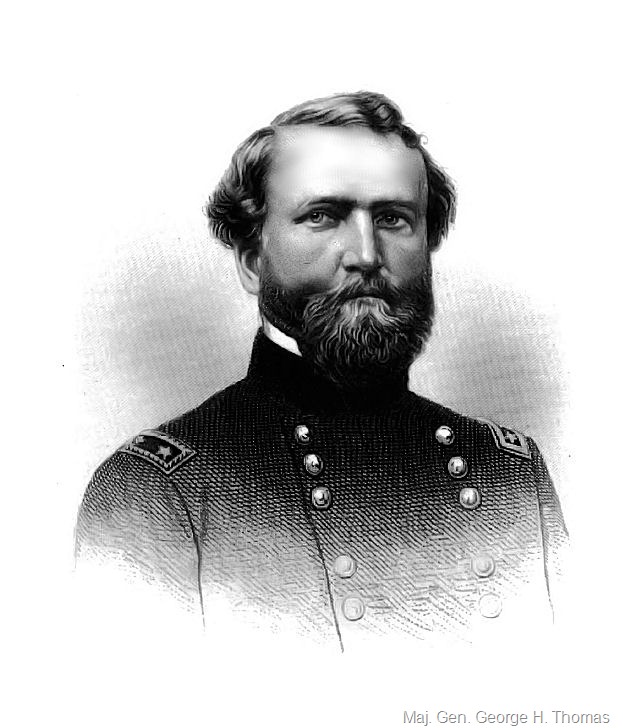
thomas_george_h


July 11.—A skirmish took place at Williamsburgh, Virginia, between the National and rebel pickets, in which the latter were defeated with a loss of three killed and seven taken prisoners.

—Governor Yates, of Illinois, published a letter to the President of the United States, urging the employment of all available means to crush the rebellion.—At New-Orleans, La., all acts of sale by auctioneers who had not taken the oath of allegiance to the United States were declared null and void by the Military Commandant, Gen. Shepley.

—A skirmish occurred near Pleasant Hill, Mo., between a company of State militia and a band of rebel guerrillas, resulting in a rout of the rebels, with a loss of six killed and five mortally wounded.

—A despatch from Gen. McClellan, at Harrison’s Landing, on the James River, of this date, said:

“All quiet. We are rested. Enemy has retreated.”

—By order of President Lincoln, Major-General Henry W. Halleck was this day assigned to the command of the whole land forces of the United States, as General-in-Chief.

—The rebel Gen. Ruggles refused to grant the petition of the inhabitants of Saint Tammany Parish, La., to permit them to exchange their wood, bricks, lumber, etc., for food, with the citizens of New-Orleans.—A skirmish took place near New-Hope, Ky., between a body of Union troops, under the command of Lieut.-Col. Moore, and a force of rebel guerrilla cavalry, resulting in the complete rout of the rebels.

July 10.—A meeting was held in Huttonville, Randolph County, Va., at which the following resolution was adopted:

Resolved, That we, as citizens, are willing to live under the Federal Government and its laws, and that we will give any information to the Federal commanders in relation to the operation of certain bands of men known as Guerrillas or Mountain Rangers.

—At New-Orleans John H. Larue, “being by his own confession a vagrant,” was committed to the parish prison, and “Anna Larue, his wife, having been found in the public streets wearing a confederate flag upon her person, in order to incite riot, “was sent to Ship Island, by the command of Gen. Butler.—Special Order, No. 179.

—The Provost-Marshal of Memphis, Tennessee, issued an order requiring all persons connected with the rebel army or government to leave the city with their families within five days.—A company of guerrillas, ninety in number, engaged in drilling in a field between Gallatin and Hartsville, Tenn., were captured by a body of Nationals belonging to Col. Boone’s regiment and carried into Nashville.—Nashville Union, July 12.

—John Morgan, the rebel guerrilla leader, issued an appeal to the citizens of Kentucky, calling upon them to “rise and arm, and drive the Hessian invaders from their soil.”—A fight took place two miles south of Scatterville, Ark., between a detachment of the First Wisconsin cavalry and a rebel force of ninety men under Capt Allen.

—General Saxton, at Beaufort, S. C, reported to the War Department as follows:

“I have the honor to report that every thing pertaining to the special service for which I am sent to this department is in a favorable condition. The negroes are working industriously. We have some fifteen thousand acres of corn and cotton under cultivation. It looks well. The system of voluntary labor works admirably. The people are contented and happy. When the new crop is harvested they will cease to be a burden upon the Government.

“By adopting a judicious system of reward for labor, almost any amount can be obtained. Its proceeds will pay the expense.”

—The gunboat Monongahela was this day launched at Philadelphia, Pa. — Enthusiastic meetings were held at Lockport, N. Y., and Hartford, Ct, for the purpose of devising means to meet the call of President Lincoln for three hundred thousand additional troops.

July 9.—The National transport steamer Canonicus was fired into by the rebels, a few miles below Harrison’s Landing, on the James River, Va. —In the New-Hampshire Legislature resolutions were unanimously passed, pledging the State to furnish her full quota of soldiers under the call of President Lincoln.

—Public meetings were held in England, praying the government to use its influence to bring about a reconciliation between the Northern and Southern States of America, as it was from America alone that an immediate supply of cotton could be expected; and if need there should be, that the British government should not hesitate to acknowledge the independence of the Southern States.

—A fight occurred near Tompkinsville, Ky., between a body of one thousand five hundred guerrillas, under Morgan, and the Third battalion of Pennsylvania cavalry, numbering about two hundred and fifty men, under the command of Major Jordan, in which the Nationals were routed, with a loss of four killed, six wounded, and nineteen taken prisoners.

—Hamilton, N. C, was occupied by the National forces under the command of Capt. Hammel, of Hawkins’s N. Y. Zouaves.—(Doc. 148.)