Following the American Civil War Sesquicentennial with day by day writings of the time, currently 1863.

The American Civil War

April 30.—The schooner Maria was captured near Charleston, S. C., by the U. S. steamer Santiago de Cuba.—N. Y. Tribune, May 6.

—A Reconnoissance in force was made this morning from the right wing of the National army, near Pittsburgh, Tenn., four miles north of Purdy, on the Memphis and Ohio Railroad. The National troops met a force of rebel cavalry, who fled, and were pursued to Purdy. On taking possession of the town, the Union troops burned two bridges and threw a locomotive into the river. Three prisoners were taken, and the Unionists retired, having cut off all railroad communication between Corinth and the North.—Baltimore American, May 2.

—A. G. Curtin, Governor of Pennsylvania, has issued a general order in acknowledgment of the gallantry of the Seventy-seventh regiment of infantry, Pennsylvania volunteers, Col. F. S. Stambaugh commanding, at Shiloh, Tennessee, and of the First regiment of cavalry, Pennsylvania volunteers, Col. George D. Bayard commanding, at Falmouth, Virginia. He orders that “Shiloh, April 7th, 1862,” be inscribed on the flag of the Seventy-seventh regiment of infantry, and that “Falmouth, April 18th, 1862,” be inscribed on the flag of the First regiment of cavalry, and that this order be read at the head of all the regiments of Pennsylvania volunteers.

—In the United States House of Representatives, the following resolution was passed by a vote of seventy-five yeas against forty-five nays:

Resolved, That Simon Cameron, late Secretary of War, by investing Alexander Cummings with the control of large sums of the public money, and authority to purchase military supplies without restriction, without requiring from him any guarantee for the faithful performance of his duties, when the services of competent public officers were available, and by involving the Government in a vast number of contracts with persons not legitimately engaged in the business pertaining to the subject matter of such contracts— especially in the purchase of arms for future delivery—has adopted a policy highly injurious to the public service, and deserving the censure of this House.

—The report of the Joint Committee on the Conduct of the War, in reference to the treatment by the rebels at Manassas of the remains of officers and soldiers of the United States killed in battle there, was made public.—(Doc. 155.)
April 29.—At Harrisonburgh, Va., to-day, a National salute was fired from an eminence near the town by the troops under General Banks, in honor of recent Union victories. The regimental bands assembled in the Court-House square and played “Hail Columbia.” The soldiers gave nine cheers, when the band followed with the “Red, White, and Blue,” “Dixie,” and the “Star-Spangled Banner.” After a recess the bands consolidated and marched through the streets, much to the disgust of certain prominent inhabitants. The day was pleasant, and the bright new uniforms presented a striking contrast to the sombre hues of those of the former occupants of the town.—Boston Transcript, May 1.

—Monterey, Tenn., was visited by the National forces under Gen. Pope. The rebels fled on the appearance of the Union forces before the town, leaving a quantity of baggage and supplies. Fifteen prisoners were taken by the Nationals, who returned to their camp near Pittsburgh, Tenn., having destroyed the rebel camp.—Sec’y T. A. Scott’s Despatch.

—Timothy Webster was executed as a spy at Richmond, Va. Webster is said to be the first spy executed by the rebel government—Richmond Despatch, April 30.

—President Lincoln sent a Message to the Senate to-day in answer to a resolution of inquiry as to who authorized the arrest of Gen. Charles P. Stone, the ground upon which he was arrested, and the reasons why he had not been tried by court-martial. The President said the arrest was made by his order, upon good and sufficient evidence; and that the only reason why he had not had a trial was because the public interests would not permit it. The officers required to hold the court, and who would be called as witnesses, perhaps on both sides, were in the field, in the midst of active operations. The President stated, in conclusion, that it was his purpose to give the General a fair trial as soon as it could be done in justice to the service.

—Col. Davidson, of the Third Mississippi regiment, who was captured at Fort Donclson, died at Fort Warren this day.—Boston Post, May 3.

—An expedition with the gunboat Hale was made this day, to capture a battery on Grim ball’s plantation, near the junction of Dawho-pow-pow and South-Edisto River, S. C. The rebels opened on the Hale when within one thousand eight hundred yards, and continued their fire as she wound her way to engage them at close quarters; but when the Hale reached the last bend, and was making a straight course for the battery, the rebels fled in haste. Lieut. Gillis landed with a party of men to destroy it. The work was about three hundred and fifty yards from the river-bank, and mounted two long fine twenty-four-pounders on excellent field-carriages. So rapid was the flight of the rebels that one of the guns was left loaded and primed. The Hale returned to her anchorage without having a man injured.—Report of Com. Du Pont.

—A battle took place this day at Bridgeport, Ala., between the National forces under Gen. O. M. Mitchel and the confederates under Gen. E. Kirby Smith, in which the latter was defeated with a loss of seventy-two killed and wounded and three hundred and fifty taken prisoners.— (Doc. 154.)

—The Montgomery (Ala) Advertiser of this date contains the following on the cotton question: We have understood that an agent of the French government is in this city, authorized to purchase an indefinite amount of cotton.

The designs are evidently these. The agent is to purchase a large supply of cotton, and then in case of a threatened Yankee occupation of the city, he would hoist the French flag over it to prevent it from being destroyed by our authorities and the citizens. With Montgomery and the Alabama River in the hands of the Yankees, and the cotton in the hands of the French agent, it could be at once shipped to Europe, and the necessities of the manufacturers there relieved; the Yankees would not, of course, object to such a cute scheme, seeing at once, that with a supply of cotton sufficient to meet their requirements, England and France would lose all their interest in the American question, and Lincoln would no longer be troubled with fears of a foreign intervention.

It is doubtless a very nice arrangement on the part of those who wish to relieve themselves from a very disagreeable dilemma, but we can assure the French agent and all others that the scheme won’t work. The question concerning the protection of foreign flags has already been decided. The President having authorized Gen. Lovell, at New-Orleans, to destroy all cotton and tobacco belonging to citizens or foreign residents, indiscriminately, where it was in danger of falling into the hands of the enemy. The same course will be pursued here, and the French flag or any other, will not save the cotton from destruction in case the enemy threatens to land at this point.

April 28.—To-day a detachment of the First New-Jersey cavalry carried into Washington, D. C, ten prisoners captured at a courier station, six miles beyond the Rappahannock River, Va. They were surprised in their beds. The information which led to their capture was volunteered by a loyal black, who guided the Jerseymen through the rebel picket line. The prisoners declared that they were of the party who killed Lieut. Decker, near Falmouth. They were intelligent men of a company formed in John Brown times, to which “none but gentlemen were elected.”—N. Y. Tribune, April 29.

—The United States war steamer Sacramento was launched at the Portsmouth, (N. H.) Navy Yard to-day. She is the finest and largest war vessel ever built at Portsmouth.—Boston Transcript, April 29.

—Five companies of National cavalry had a skirmish with the enemy’s cavalry two miles in advance of Monterey, Tenn.[1] The rebels retreated. Five of them were killed—one a major. Eighteen prisoners, with horses and arms, were captured. One of the prisoners, named Vaughan, was formerly foreman in the office of the Louisville Democrat. The Unionists had one man wounded and none killed. The prisoners say that the enemy has upward of eighty thousand men at Corinth, and will fight and that they are intrenching and mounting large guns.—Official War Despatch.

—Near Yorktown, Va., Gen. Hancock went out with a portion of his brigade for the purpose of driving the rebels from a piece of timber which they occupied in close proximity to the National works. The troops advanced through an open fire on their hands and knees until they came within close musket-range. The rebels, who were secreted behind stumps and trees, were anxious to get the men on their feet, and to accomplish this the captain in command of the enemy shouted at the height of his voice to charge bayonets, supposing that the Union troops would instantly jump to their feet and run. But they were mistaken. The command being given the second time, the rebels arose, when the Union troops poured into them a well-directed fire, causing them to retreat, leaving their dead and wounded.

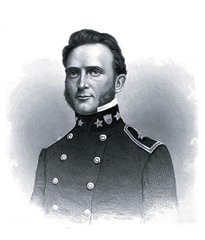
Thomas J. (Stonewall) Jackson

Thomas J. (Stonewall) Jackson

During the skirmish a new battery which the rebels had erected during Sunday night, and which interfered with the working party of the Nationals, was most effectually silenced and the guns dismantled.

—The Santa Fe, New-Mexico mail, arrived at Kansas City, Mo., with dates to the twelfth inst. Col. Slough and Gen. Canby formed a junction at Galisteo on the eleventh. Major Duncan, who was in command of Gen. Canby’s advance-guard, encountered a large party of Texans and routed them. Major Duncan was slightly wounded. The Texans were thirty miles south of Galisteo, in full flight from the territory.—Official Despatch.

—The rebel steamer Ella Warley (Isabel) arrived at Port Royal, S. C, in charge of Lieut. Gibson and a prize crew, she having been captured by the Santiago de Cuba, one hundred miles north of Abaco.

—Forts Jackson and St Philip on the Mississippi River, below New-Orleans, surrendered to the National fleet under Flag-Officer Farragut.— (Doc. 149.)


[1] Monterey is a small post-village of McNairy County, situated near the boundary line of Mississippi but a short distance from Corinth. The county has an area estimated at five hundred and seventy square miles, and occupies part of the table-land I between the Tennessee and Hatchie Rivers.

April 27.—The people of Franklin County, Mo., met and passed resolutions in support of the Emancipation Message of President Lincoln, and sustaining the measures of the National Government adopted for the prosecution of the war.—(Doc. 152.)

Mansfield Lovell, General late in command of the rebel forces at New-Orleans, La., telegraphed to Richmond as follows from Camp Moore, La.: — “Forts Jackson and St Philip are still in good condition, and in our hands. The steamers Louisiana and McRae are safe. The enemy’s fleet are at the city, (New-Orleans), but they have not forces enough to occupy it. The inhabitants are stanchly loyal.”

—Fort Livingston, La., was this day evacuated by the rebel forces.—National Intelligencer, May 10.

—Gen. Beauregard, at Memphis, Tennessee, issued the following address to the planters of the South:—”The casualties of war have opened the Mississippi to our enemies. The time has therefore come to test the earnestness of all classes, and I call upon all patriotic planters owning cotton in the possible reach of our enemies to apply the torch to it without delay or hesitation.”—Missouri Democrat.

—Purdy, Tennessee, was evacuated by the confederates.—Memphis Argus, April 29.

April 26.—The United States steamer Flambeau, under the command of Lieut. Commanding Upshur, captured the schooner Arctic, under English colors, about seven miles below Stono, S. C—N. Y. Tribune, May 6.

—This afternoon, the pickets of colonel Donnelly’s brigade, stationed eight miles from Harrisonburgh, Va., on the Gordonsville road, were attacked by a large force of Ashby’s rear-guard, and driven back. One man, named Isaac Zelly, of the Forty-sixth Pennsylvania regiment, was killed, and three others wounded. The reserve of the Forty-sixth, and a section of Hampton’s battery then advanced and repulsed the rebels. They retreated to a wood, where several of the Union shells burst in their very midst, and a wagon was seen gathering up and carrying off their dead and wounded. — New – York Times, April 29.

—The rebel General, Albert Pike, issued a proclamation complimenting the Indian allies for their bravery at the battle at Pea Ridge, Ark. N. Y. Tribune, May 2.

—President Lincoln, at Washington, visited the French frigate Gassendi to-day—it being the first time a President of the United States ever went aboard a foreign man-of-war. He was received with the honors paid to crowned heads, the same as usually shown the Emperor. The yards were manned by the crew, who shouted; “Vive le President”

The Secretary of State and Captain Dahlgren accompanied the President. The French Minister was on board to receive the party.—National Intelligencer, April 28.

—Gen. McClellan sent the following to the War Department, at Washington:

“Early this morning an advanced lunette of the rebels, on this side of the Warwick, near its head, was carried by company H, First Massachusetts regiment. The work had a ditch six feet deep, with a strong parapet, and was manned by two companies of infantry, no artillery. Our men moved over open, soft ground, some six hundred yards, received the fire of the rebels at fifty yards, did not return it, but rushed over the ditch and parapet in the most gallant manner. The rebels broke and ran as soon as they saw that our men intended to cross the parapet. Our loss was three killed, and one mortally, and twelve otherwise wounded. We took fourteen prisoners, destroyed the work sufficiently to render it useless, and retired. The operation was conducted by Gen. C. Grover, who managed the affair most handsomely. Nothing could have been better than the conduct of all the men under fire. The supports, who were also under artillery fire of other works, were companies of the First and Eleventh Massachusetts. In spite of the rain our work progresses well.”

The following is the list of killed and wounded, all belonging to company H, First Massachusetts regiment. Killed: George P. Noyes, Wm. D. Smith, and Walter B. Andrews. Wounded: Allen A. Kingsbury, company H, mortally; George L. Stoddart George H. Campbell, Wm. H. Montague, Thos. Crittick, Horace A. Sommers, Geo. H. Stone, Wm. H. Lane, O. C. Cooper, Wm. T. Wright, James W. Spooner, William P. Hallowe, Thomas Archer.—(Doc. 150.)

—The schooner Belle was captured about thirty miles off Charleston, S. C, by the U. S. steamer Uncas.—The schooner Mersey was captured off the coast of Georgia by the U. S. steamer Santiago de Cuba.—N. Y. Tribune, May 6.

—A Battle was fought at Neosho, Mo., between one hundred and forty-six men of the First regiment of Missouri cavalry, under the command of Major Hubbard, and six hundred Indians, commanded by Cols. Coffee and Stainwright, resulting in the defeat of the latter party. Major Hubbard killed and wounded thirty of the savages, besides capturing sixty-two prisoners, seventy horses, and a large quantity of arms.—(Doc. 151.)

April 25.—The bombardment of Fort Macon, N. C, by the combined forces of Gen. Burnside and Com. Goldsborough, terminated in the reduction and capture of the garrison.—(Doc. 135.)

—The Forts on Lake Ponchartrain, La., were this day evacuated by the rebel forces, and all their gunboats on the lake were burnt or otherwise destroyed.—Richmond Despatch, April 29.

—New-Orleans, La., surrendered to the naval forces of the United States, under the command of Flag-Officer D. G. Farragut.—(Doc. 149.)

—Major-Gen. C. F. Smith died at Savannah, Tenn., at four o’clock this afternoon, of dysentery. He was taken sick shortly after the occupation of Savannah by the forces under him.

—Major Von Steinhaus, Capt Botticher, and Capt Camp, of the Sixty-eighth regiment of New York volunteers; Lieut. Lombard, Battalion Adjutant Eighth Illinois cavalry, and Assist. Surg. Williams, First New-York artillery, were, by the order of President Lincoln, struck from the roll of the’ army, for being captured while straggling, without authority, beyond the National lines.

—Com. Paulding published a letter giving an account of the destruction of the Norfolk Navy Yard, in April, 1861.— (Doc. 148.)

—Henry Kuhl, Hamilton W. Windon, and Conrad Kuhl, having been tried by court-martial, in Western Virginia, and found guilty of murdering a Union soldier, the two first named were sentenced to be hung, and the third to wear a ball and chain, and perform hard labor during the war. Major-Gen. Fremont, in an order issued this day, confirmed the findings and sentence of the court. The hanging is to take place at Suttonville, on the ninth of May, and the ball and chain individual is ordered to Camp Chase, to satisfy the violated law in that locality.— Cincinnati Gazette, April 29.

April 24.—Yorktown, Va., was shelled by one of the United States gunboats. She moved up to the mouth of Wormley’s Creek during the morning, opening a well-directed fire on the rebel works, which was promptly answered. The boat then fell back a distance of three miles from Yorktown, when she again opened fire, the shells exploding each time within the enemy’s works, but obtaining no response. A few shots were fired during the day along the whole line, to keep the rebels from strengthening their works. No one was injured.

—The United States Government steamer Eunice was run into last night by the Commodore Perry, off Ashland, Ky., and sunk. No lives were lost.—New- York Tribune, April 26.

—A reconnoitring party, under General A. J. Smith, left Pittsburgh this morning and attacked the rebel pickets, one hundred and fifty strong, who fled in great haste, leaving knapsacks, blankets, and everything else. The party proceeded on foot to Pea Ridge, and there found three or four thousand drawn up in line of battle, who, at the first fire of artillery, also decamped, leaving tents, equipage, private baggage, half-written letters, and other things, indicating a great surprise. Enough tents were left to accommodate a division. Everything was burned. The Nationals captured twelve prisoners, none of whom expressed regret at being taken.—Chicago Tribune.

—The United States Senate passed the bill for the appointment of diplomatic representatives to Hayti and Liberia.

—Col,. Crocker and Major Cassidy, belonging to the Ninety-third regiment of New-York volunteers, were this morning taken prisoners by the rebels near Yorktown, Va.—Phila. Inquirer.

—Gen. Banks’s advance-guard, Col. Donnelly commanding, took three prisoners to-day, at a point nine miles beyond Harrisonburgh,Va. One of them says he belongs to company B of the Tenth Virginia regiment of infantry. This regiment had been on the Rappahannock, according to previous information.—Gen. Banks’s Despatch.

—A body of National cavalry from Forsyth, Mo., destroyed the rebel saltpetre manufactory near Yellville, Ark., this day. Lieut. Heacock. of the Fourth regiment of Iowa cavalry, was killed and one private wounded, in the fight with the rebels.— (Doc. 146.)

— The Dismal Swamp Canal, N. C, was destroyed by the naval forces under Commander Rowan.—(Doc. 147.)

—The National fleet, under the command of Flag-Officer Farragut, after bombarding Forts Jackson and St Philip, on the Mississippi River, passed by the forts to reduce New-Orleans.— Gen. Butler’s Report.

April 23.—A party of National infantry despatched from Romney, Va., to look after guerrillas, was attacked by a squad of rebels, on Grass Lick, near Wash River. The National troops lost three killed, but drove the rebels, who took refuge in the house of a confederate. A reenforcement of cavalry was then sent out, under the command of Lieut.-Col. Downey, but the rebels fled at his approach, carrying off several dead and wounded. Col. Downey burned the house, and in pursuit captured five prisoners.—(Doc. 145.)

—The resolution adopted by the Maryland Legislature, signed by Governor Bradford, appropriating seven thousand dollars for the relief of the families of the killed and disabled men of the Massachusetts Sixth regiment by the secession mob in Baltimore, on the nineteenth of April, 1861, was read this afternoon in the Massachusetts House of Representatives, and referred to the Committee on Federal Relations. The resolution caused a marked sensation, and its reading was followed by hearty applause.—Boston Post, April 24.

April 22.—The special committee of the United States Senate made a report to-day on the resolution instructing them to inquire into the allegations of disloyalty made against Senator Starke, of Oregon, whose case had occupied the Senate some time, but resulted in his admission as Senator. The special committee considered the same evidence that was before the Committee on the Judiciary, and also heard Mr. Starke at great length in reply. In this he assumed that he was loyal, and intimated that the committee had better inquire into the character and allegations of his assailants in Oregon. The committee arrived at the following conclusions:

First. That for many months, prior to the twenty-first of November, 1861, and up to that time, Mr. Starke was an ardent advocate of the cause of the rebellious States.

Second. That after the formation of the Constitution of the confederate States, he openly declared his admiration for it, and desired the absorption of the loyal States of the Union into the Southern Confederacy under that Constitution, as the only means of peace, and warmly avowing his sympathy with that cause.

Third. That the Senator from Oregon is disloyal to the Government of the United States.

—The first boat-load of cotton and tobacco from the Tennessee River since the commencement of the rebellion arrived at Pittsburgh, Pa., having left Nashville last week, and will pass over the Pennsylvania Railroad to-day.—N. Y. Evening Post, April 22.

—This day the rebels came out from their rifle-pits in front of Lee’s Mills, Va., killing one of the National pickets. After he was dead about thirty of them fired their pieces into his head, completely riddling it with bullets. The officer then commanding the reserve ordered his men to charge on the rebels, which was willingly responded to, resulting in several of them being killed and one taken prisoner. Two men were killed on the National side and one mortally wounded.—Ohio Statesman, April 25.

—The rebel Congress at Richmond adjourned, to meet again in August. The Richmond Whig says: For fear of accidents on the railroad, the stampeded Congress left in a number of the strongest and newest canal-boats. These boats are drawn by mules of approved sweetness of temper. To protect the stampeders from the snakes and bull-frogs that abound along the line of the canal, Gen. Winder has detailed a regiment of ladies to march in advance of the mules and clear the tow-path of the pirates. The regiment is armed with pop-guns of the longest range. The ladies will accompany the stampeders to a secluded cave in the mountains of Hepsidam, and leave them there in charge of the children of the vicinage, until McClellan thinks proper to lot them come forth. The ladies return to the defence of their country.

—The National steamer Yankee ascended the Rappahannock River this day to Fredericksburgh, Va., having passed the obstructions placed in the river seven miles below the town in safety.—The Potomac flotilla captured seven rebel schooners — one with a valuable cargo of dry goods, medicines, and saltpetre—and also two small steamers. —Baltimore American, April 23.

—This afternoon the National gunboat Anacostia, on her way down the Potomac River, when near Lowry’s Point was fired into by a party of rebel infantry, who were dispersed by a couple of shells from the gunboat — N. Y. Tribune, April 26.

—Col. Donnelly, of Gen. Banks’s forces, made a reconnoissance this day toward Harrisonburgh, Va. When approaching he was fired on by the rebel cavalry scouts. Two companies of the Ohio cavalry were deployed on the left, toward Gordonsville turnpike, the same number of the Vermont cavalry on the right, and the Michigan cavalry on the centre; Hampton’s battery and the Connecticut Fifth formed the reserve.

The rebel cavalry, after the first fire, retreated to the town, where they joined their command, and when escaping by the Gordonsville route, were passed by the Ohio cavalry. Seven men and eleven horses were captured — the rest escaped. The town was then entered and occupied by Col. Donnelly and the cavalry. Jackson’s Winchester hostages, whom he released near Shenandoah, on their parole of honor, were found in the town. Two had died of fatigue and want of attention.—N. Y. Commercial, April 24.

April 21.—The United States Circuit Court, for the middle district of Tennessee, held its first (preliminary) session, since the secession of the State, in the court-room of the capital at Nashville, Judge John Catron presiding.—Chicago Times.

—The Provost-Marshal’s force at Richmond, Va., arrested three citizens of that place, named Jas. Humphreys, Benj. Humphreys, watchmakers, and J. T. Pritchard, formerly a clerk of G. R. Peake, all for disloyalty. The prisoners were defiant in their remarks, saying that they owed allegiance to the United States alone, etc All three of them are Virginians by birth.—Richmond Despatch, April 22.

—Gen. Milroy, at the head of a reconnoitring force, overtook the rear-guard of the rebel cavalry six miles west of the railroad, near Buffalo Gap, Augusta County, Western Virginia. They fled, rapidly pursued by the Nationals. Milroy learned that their main body stopped the previous night six miles beyond Buffalo Gap, but finding they were cut off at Staunton by Gen. Banks, they bore south-west, through both Bath and Alleghany Counties, toward the James River.

A company that was sent by General Milroy down the north fork of the Potomac, in Pendleton County, captured eight rebels, including Barnett, a notorious guerrilla.—New – York Commercial, April 25.

—The ship R. C. Files was captured by the National fleet, while attempting to run the blockade of Mobile, Ala.—New-York Tribune, May 9.