April 20.—The flight of the rebel Gen. Jackson from the Shenandoah Valley, by way of the mountains, from Harrisonburgh towards Stannardsvillc and Orange Court-House, on Gordonsville, was confirmed this morning by the scouts and prisoners at Gen. Banks’s headquarters, at New-Market, Va,—Gen. Banks’s Despatch.
The American Civil War
April 19.—The battle of Camden, North-Carolina, was fought this day. Day before yesterday Gen. Reno left Newborn and proceeded to Roanoke Island, from which place he took about two thousand men and proceeded to Elizabeth City, where a strong rebel force was reported to be intrenching themselves.
To-day, an advance was made upon the rebels, who opened fire with their artillery as soon as the Union troops made their appearance. The troops immediately formed in line of battle, and charged on the enemy, who ran at the first fire. The Nationals then immediately took possession of the town, and after remaining there for a few hours, retired to the main army.
The force was about two thousand men, under Gen. Reno, and three boat-howitzers, under Col. Howard. The force of the rebels consisted of a Georgia regiment, numbering eleven hundred men, a portion of Wise’s Legion, and two batteries of artillery. The enemy was totally routed, with a loss of about sixty men. The National loss was about twelve killed and forty-eight wounded. Col. Hawkins, of the New-York Zouaves, received a slight flesh-wound in the arm. The adjutant of Col. Hawkins’s regiment was killed.— (Doc. 134.)
—General Banks at Newmarket, Va., sent the following to the War Department:
“To-day I have been to the bridges on the south fork of the Shenandoah, in the Massanutton valley, with a force of cavalry, infantry, and artillery, to protect the two important bridges that cross the river. We were within sight of Luray, at the south bridge. A sharp skirmish occurred with the rebels, in which they lost several men taken prisoners. Their object was the destruction of the bridges. One of the prisoners left the camp on the bank of the Rappahannock Tuesday morning. There were no fortifications there up to that time. Other reports indicate a stronger force at Gordonsville and a contest there, the whole resulting in a belief that they are concentrating at Yorktown. I believe Jackson left this valley yesterday. He is reported to have left Harrisonburgh yesterday for Gordonsville by the mountain road. He encamped last night at McGaugeytown, eleven miles from Harrisonburgh.”
—The anniversary of the attack upon and massacre of Massachusetts troops in Baltimore was noticed in Boston by a grand Promenade Concert given in Music Hall in the evening, for the benefit of the soldiers.
In Worcester, the day was noticed as a commemoration of the marching of the Minute Men for Lexington on the nineteenth of April, 1775, under command of Capts. Bigelow and Flagg, of the passing of the Worcester Light Infantry through Baltimore on the nineteenth of April, 1861, and also of the dedication of the Bigelow Monument. The Tatnuck “Fremont” Guards, and other volunteers, paraded as the Minute Men of 1775, and the McClellan Guards and Highland Cadets as the Minute Men of 1862.
At Baltimore, the anniversary was also commemorated in an appropriate manner by the loyal citizens of that place.—Boston Traveller.
—The rebel schooner Wave was captured this day, by the pilot-boat G. W. Blunt, off the coast of South-Carolina.—New-York Tribune, May 6.
—The “Independent Battalion Enfants Perdus, N. Y. S. V.,” under the command of Col. Felix Confort, left New-York for the seat of war. Previous to their departure, a handsome national standard of silk, regulation size, was presented, in an eloquent speech, by the Rev. Samuel Osgood, on behalf of the daughter of Gen. Tyler.— New-York Tribune, April 21.
—A party of rebels concealed on Edisto Island, having fired upon a national party, sent out from the United States steamer Crusader, to assist the Government agent in raising cotton, Lieut. Rhind of the steamer planned an expedition to capture the rebels. Late last night the expedition, composed of sixty men from the Third New-Hampshire and Fifty-fifth Pennsylvania regiments, landed and marching through the swamps, this morning discovered the enemy, who fled on receiving the fire of a platoon of the Pennsylvanians. At daylight a force of rebel mounted riflemen made their appearance, and opened fire; but after a skirmish of twenty minutes they retreated. Their loss was unknown. The Nationals had three wounded.— (Doc. 144.)
—The Petersburgh, Va., Express, of this date, has the following: “Another requisition, we understand, has just been made on the slaveholders of Prince George and Surry Counties, for one half the negroes between the ages of sixteen and fifty years, to go to Williamsburgh to work on the fortifications in that vicinity. Not knowing the exigencies of the public service, we presume the demand is all right; but we have serious apprehensions that these fertile counties will contribute but a very small quota of the staff of life for the support of the country another year. The abstraction of so great an amount of labor could not have occurred at a more critical moment”
—The advanced guard of Gen. Banks’s army occupied this morning the village of Sparta, eight miles in front of New-Market, Va. For the first time in their retreat the rebels burned the small bridges on the road, obstructing by the smallest possible means the pursuit of the National troops. Some dozen or more bridges were thus destroyed, but immediately reconstructed.— Gen. Banks’s Despatch.
—The United States gunboat Huron captured, off Charleston, the schooner Glide, of Charleston, while attempting to run the blockade. She was bound to Nassau, and was loaded with one thousand bales of cotton and five tierces of rice. Her papers and log-book were thrown overboard during the chase.
—Major-gen. David Hunter, U.S.A., commanding the Department of the South, this day issued the following proclamation:
“It having been proven to the entire satisfaction of the General Commanding the Department of the South that the bearer, named William Jenkins, heretofore held in involuntary servitude, has been directly employed to aid and assist those in rebellion against the United States of America.
“Now be it known to all that, agreeably to the laws, I declare the said person free, and forever absolved from all claims to his services. Both he and his wife and his children have full right to go North, South, East, or West, as they may decide.”—Baltimore American.
—The city council of Fredericksburgh, Va., waited upon Gen. Augur, of the National forces, stating that the confederate forces had evacuated that place, etc., that no resistance would be made to its occupation by the National troops.
April 18.—The United States gunboat Tioga was successfully launched at the Navy-Yard at Charlestown, Mass., this afternoon.—N. Y. Tribune, April 19.
—At Philadelphia, Pa., Parson Brownlow was received at Independence Hall by the city authorities this morning —Mr. Tregg, President of the Common Council, receiving him with words of the heartiest welcome. Mr. Brownlow replied in a characteristic address of some length, delivered from a stand erected in front of the Hall, to an immense audience. He recited the tribulations East-Tennessee Unionists had undergone. —Philadelphia Press, April 19.
—Wm. Gilchrist, arrested some months ago on the charge of furnishing “aid and comfort to the enemy,” and sent to Fort Warren, and afterward upon his release, by order of the Government, arrested by Detective Franklin, on the charge of “treason,” has now been discharged unconditionally, after months’ imprisonment, without trial.—K Y. Commercial, April 19.
—Gen. McClellan, before Yorktown, Va., telegraphed as follows to the War Department: “At about one half-hour after midnight, the enemy attacked Smith’s position, and attempted to carry his guns. Smith repulsed them handsomely, and took some prisoners. I have no details. Will forward them as soon as my aids return. The firing was very heavy. All is now quiet.
“Second Despatch.—My position occupied yesterday by Smith was intrenched last night, so that we have been able to prevent the enemy from working to-day, and kept his guns silent Same result at the batteries at Hyam’s Mills.
“Yorktown was shelled by our gunboats and some of our barges to-day, without effect
“There has been a good deal of firing from the Yorktown land batteries.”
—Falmouth, opposite Fredericksburgh, Va:, was occupied by the forces of the United States. Their progress was disputed by a rebel force of one regiment of infantry, one of cavalry, and a battery of artillery, which attempted to make two distinct stands. They wore, however, driven across the Rappahannock, after inflicting upon the Unionists a loss of five killed and sixteen wounded, all of them cavalry, including Lieut. Decker, of the Harris cavalry, killed; Col. Fitzpatrick, wounded, and a valuable scout, named Britten, badly wounded. Col. Bayard’s horse was badly wounded under him. Immediately after making their escape across the Rappahannock bridge, opposite Fredericksburgh, the rebels applied the torch to it, and thus temporarily delayed progress into the town.—(Doc. 143.)
In the afternoon, Lieut. Wood, of Gen. King’s staff, Lieut. Campbell, Fourth artillery, and Major Duffle, of the Harris light cavalry, crossed the Rappahannock under a flag of truce, and communicated with the municipal authorities of the city.
The City Councils had called a meeting immediately after the appearance of the forces, and appointed a committee consisting of the Mayor, Mr. Slaughter, three members from each Board, and three citizens, to confer with Gen. Augur relative to the occupation of Fredericksburgh and the protection of property. The Councils at the same time adopted a series of resolutions declaring that the city, since the adoption of the ordinance of secession, had been unanimously in favor of disunion, and was still firmly attached to the Southern cause, surrendering only upon conditions of protection to private property.
—Martial law was declared in Eastern Tennessee, by the rebel government.—(Doc. 141.)
—Henry T. Clark, the rebel Governor of North Carolina, issued the following notice to the people of that State:
“By an advertisement in the public papers, signed W. S. Ashe, you are informed that he will appoint, and send agents through every county in the State to borrow, purchase, and, if necessary, to impress, all the arms now in the hands of private citizens.
“Any attempt to seize the arms of our citizens is directly at variance with the Constitution, and in opposition to the declared policy of the government, which makes it the duty of every citizen to keep and bear arms, and protects the arms of the militia even from execution for debt
“But while I notify you that these agents have no lawful authority to seize your private arms, and you will be protected in preserving the means of self-defence, I must enjoin upon you in this emergency, as an act of the highest patriotism and duty, that you should discover to the proper State authorities all public arms, muskets or rifles, within your knowledge, and of selling to the State all the arms, the property of individuals, which can be spared.
“The colonels of the several regiments of militia will act as agents for the State, and will notify me whenever any such arms are delivered or offered to them. Their prompt and earnest attention is called to the execution of this order.— Raleigh Standard, April 26.
—The bombardment of Forts Jackson and St Philip, on the Mississippi River below New-Orleans, was this day commenced by the National fleet under the command of Flag-Officer Farragut.
April 17.—The National forces under General Banks this morning occupied Mount Jackson, Va. The rebels resisted the Union advance in order to gain time for the destruction of bridges, railway cars, engines, and other material which had accumulated at the terminus of the road, but the movement of the National troops was so sudden that they made a precipitate retreat, and much of the property already prepared for conflagration was captured. In this movement Col. Carroll’s brigade of Gen Shields’s division led the advance on the back road to the rear of Mount Jackson, and Gen. McCall on the turnpike. Gen. Williams, with his main division, brought up the reserved column.
— In the confederate House of Representatives, at Richmond, Va., a committee appointed to investigate the Roanoke Island disaster, presented a voluminous report which concludes by saying that: “Whatever blame or responsibility is justly attributable to any one for the defeat of our troops at Roanoke Island on the eighth of February last, should attach to Major-General Huger and Mr. Benjamin, the late Secretary of War.”—Charleston Mercury, April 18.
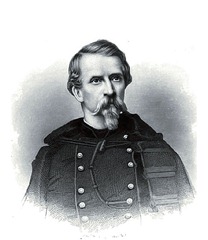
Major General Philip Kearney
— This morning, in pursuance of orders received during the night, a heavy mounted force, consisting of the Second Indiana, two Illinois, two Kentucky, and two Ohio cavalry regiments, making together about four thousand, assembled upon the upper road from Pittsburgh Landing to Corinth, Miss., in the vicinity of Gen. Sherman’s headquarters, with two days’ rations for men and animals. Shortly after nine o’clock Brig.-Gen. Smith, Chief of cavalry, upon Gen. Halleck’s staff, appeared with his Aids, and after a brief inspection, the mounted column was set in motion with the Second Indiana cavalry, Lieut.-Col. McCook commanding, in the advance. Having followed the upper road past the outmost pickets, and within two miles of Monterey, the Second Indiana and the Eleventh Illinois were dismounted and deployed as skirmishers on the right and left of the roads, and ordered to advance. The line of skirmishers had moved forward about half a mile when it came upon the pickets of the rebels, and a lively exchange of shots at once commenced. The National skirmishers steadily advanced, driving the rebels before them, until they came within range of a strong body of infantry supposed to number about two thousand, when they were ordered to fall back upon the main body, which wheeled about and returned. The only casualties on the Union side were: First Sergeant Richardson of company D, Second Indiana cavalry, killed, and a private of the same regiment, and a lieutenant in the Eleventh Illinois, slightly wounded. Half-a-dozen horses were also disabled. Sergeant Richardson was a man of unusual intelligence and good standing at home, who had enlisted from purely patriotic motives. For some unexplained reason his body was abandoned to the enemy.—N. Y. Tribune, April 30.
— New-market, Va.,[1] was occupied by the troops under the command of Gen. Banks. The rebels attempted to make a stand on their retreat, but were compelled to fly. Major Copeland, with a small party of cavalry, charged through the town in pursuit of the rebels. Lieut. O’Brien, of Ashby’s rebel cavalry, was captured, together with a large body of prisoners.—General Banks’s Despatch.—Philadelphia Press, April 18.
—At Providence, R. I., one hundred guns were fired in honor of Emancipation in the District of Columbia.—New-York Tribune, April 18.
—A skirmish took place on the dry fork of the Holly River, in Western Virginia, in which two guerrillas were killed and three of the National troops, under Lieut.-Col. Harris, of the Tenth regiment of Virginia, were wounded.—New-York Times, April 19.
— Yesterday morning the rebels, with one thousand men, commenced to strengthen a battery located about three miles to the left of Yorktown, when a battery was brought to bear, causing them to beat a hasty retreat. The rebels opened with their heavy guns, when a second battery was brought forward. A brisk fire was kept up for about four hours, during which three of the rebels’ guns were dismounted, when both parties ceased for a while, but was resumed by the Nationals late in the afternoon, and continued till daylight this morning, effectually preventing the rebels from repairing the damage they had sustained. The Union loss was Sergeant Baker, Second Michigan, killed; and F. Page, company K, Third Michigan regiment, both feet shot off —New-York Tribune, April 18.
— The Richmond Whig of this date says: “Congress has already declared that every military officer must give up his commission or his seat in Congress. But we hear of but one resignation. Why is this? If individual members choose to disregard the expected judgment of the body, it is time that the Houses should practically assert their authority, and compel the recusants to do one thing or the other.
“There is something very revolting to our notions of propriety in any man’s drawing two large salaries from the Treasury in this hour of our country’s need. A colonel, we believe, draws about two thousand seven hundred dollars per annum for his military services; and as a member of Congress he draws two thousand seven hundred and sixty dollars more! He is thus drawing about five thousand four hundred dollars per annum from the public treasury! The difference between ancient and modern patriotism seems to be this: Washington drew no salary— our modern Washingtons draw two!
“The country needs every dollar it can raise for defence, and this system of double salaries should be stopped. The law of the United States forbade any man from drawing two salaries. Did not our Congress adopt the law when it adopted all the laws of the United States which were applicable to our condition? This should be looked into, and this leak should be closed.”
—Tins day is the first anniversary of the passage of the Ordinance of Secession by the Virginia Convention. It may be that we can’t afford to burn powder in firing a salute in commemoration of the occasion, but, as suggested the other day, the flags of the State and Confederacy can be displayed by way of observance of the anniversary.—Richmond Whig, April 17.
—The steamers Minnehaha and Patton were fired into by the rebels, while ascending the Tennessee River with United States troops. One man was killed on the Minnehaha, and one wounded. No one was injured on the other vessel. The troops from the Minnehaha landed, and burned a row of wooden buildings on the bluffs near which the firing originated.—Chicago Tribune, April 19.
—In the Union lines, at Yorktown, Va., at three o’clock this afternoon, as Lieut. O. G. Wagoner, of the Topographical corps, and four others, were making sketches of the rebels’ works opposite Weed’s Mills, a shell was thrown at them from one of the enemy’s guns. It struck just in front of the table, around which they were seated, killing one man outright, fatally injuring another, and wounding the other two.
—The Memphis Appeal, of this date, says that the confederate losses at the battle of Shiloh do not exceed one thousand killed, five thousand wounded, and nine hundred taken prisoners, and ascribes the defeat on the second day to the whiskey found in the Federal encampments on the previous night.
[1] New-Market is a post-village of Shenandoah County, In Virginia, and is situated near the borders or Rockingham County, about eight miles from Mount Jackson, nearly twenty miles from Woodstock, over thirty miles from Strasburg, about ninety-three miles from Manassas Junction, about one hundred and twenty miles from Alexandria, and one hundred and fifty miles to the north-west of Richmond.
April 16.—Abraham Lincoln, President of the United States, signed the bill for the emancipation of the slaves in the District of Columbia, and it became a law.—(Doc. 133.)
—A boat containing a party of the officers and men of the Seventy-fifth regiment of Pennsylvania volunteers, sank at Castleman’s Ferry, on the Shenandoah River, Va., drowning a large portion of the men and officers.—N. Y. Tribune, April 18.
—John H. Winder, Brigadier-General C.S.A., in command of the Department of Henrico, at Richmond, Va., issued the following general order: “From and after this date, the issuance and circulation of individual notes are strictly prohibited. Notes of this character are to be redeemed in bankable funds upon presentation, and must at once be withdrawn from circulation.
“Persons violating this order in any particular, will be considered guilty of a grave offence, and will be subject to arrest and such punishment as may be imposed by a court-martial.”
—The confirmation of the battle of Apache Pass, N. M., was received. The Union loss is one hundred and fifty killed, wounded and missing. The rebels acknowledge their loss to be from three hundred to four hundred killed and wounded. Ninety-three rebels were taken prisoners, thirteen of whom are officers. The National forces captured and burned sixty-four wagons, laden with provisions and ammunition, and killed two hundred mules. The Texans attacked the Union battery four times, the last time coming within forty feet of the guns, but were repulsed with heavy loss.—(Official Despatch.)
—In the United States Senate the resolution calling for information relative to the arrest of Gen. Stone, was taken up, and Mr. McDougall, of California, made a speech on the subject The Confiscation bill was subsequently considered, and Mr. Powell, of Kentucky, addressed the Senate in opposition to its passage.
—A skirmish took place at Savannah, Tenn., between a detachment of Union cavalry and a rebel picket-guard, resulting in the defeat of the rebels, with a loss of five killed and sixty-five wounded.—Chicago Tribune, April 19.
—This day a fight occurred on Wilmington Island, N. C, between a reconnoitring and surveying party of National troops, and a superior force of rebels. A party consisting of about two hundred men, principally from the Eighth Michigan regiment, was despatched from the Federal headquarters, for the purpose of reconnoitring on Wilmington Island, and taking surveys and soundings. One of the companies was under command of Lieut. Wilson. The force landed in the morning from boats, and in the forenoon was surprised by a rebel force, numbering six to eight hundred men, who had come from their batteries on the mainland, with the apparent design of entirely cutting off the National force.
The attack of the rebels was unexpected. They showered upon the Union troops an effective fire, which killed and wounded several, and followed up the advantage, given them by the confusion into which that part of the force nearest them were thrown by the suddenness of the attack, by an immediate advance. The Federal soldiers at once returned the fire, and went gallantly into the fight The advance of the rebels was checked, and after a short stand they retreated, though slowly and in order. No pursuit was attempted, and the rebels recrossed to their batteries. During the engagement the Adjutant of the Eighth Maine regiment was killed, and twelve or thirteen others. The killed and wounded numbered twenty-nine.—(Doc. 140.)
—At London, England, a deputation from the British and Foreign Anti-Slavery Society waited upon Mr. Adams, the American Minister, and presented an address, in which the hope was expressed that the restoration of the Union would be founded upon the abolition of the true cause of the strife.—London Times, April 18.
—Sixty-one of Ashby’s cavalry, including three officers, were captured this morning, and carried into Woodstock, Va. They were at their breakfast, just at daybreak, in a church, and were surrounded by a body of Ringgold’s cavalry, and four companies of infantry, of the Forty-sixth Pennsylvania volunteers, of Gen. Williams’s division, and surrendered without resistance. The affair occurred several miles beyond Columbia Furnace, and within seven miles of Mount Jackson.—N. Y. World, April 17.
A fight occurred at Lee’s Mills, Va., between four companies of the Third regiment of Vermont volunteers and a party of rebel troops under the command of Gen. Howell Cobb. —(Doc. 142.)
April 15.—The Norfolk Day-Book of to-day contains the following: “A party of gentlemen left this city on Saturday last, in the steamer S. S. Anderson, and proceeded down the river.
“In the course of the day they went well over to the enemy’s lines, in the direction of Newport News, and went alongside Her Britannic Majesty’s steamer Rinaldo.
“They were not permitted to go on board the Rinaldo, as Her Britannic Majesty’s gallant subjects informed them that they could hold no communication with us. (Query—Would they have said the same to a Yankee?) Her officers and crew, however, evinced great pleasure at the visit, and testified their delight by the waving of hands and hats, and responding to the cheers given them by those on board the Anderson as they were about leaving.
“After leaving her, our boys thought they had not sufficiently teased the Yankees, and in order to vex them as much as possible, they waved the ‘rebel’ colors directly in their teeth and courted a shot, but to no purpose. The ‘rebels’ ruled the Roads, and the Yankees manifested no disposition to dispute the ground with them.
“The above narrative we obtained from a gentleman on board the Anderson at the time, and as he related it to us, we were struck very forcibly with one expression, and the reader has doubtless been equally as much surprised as we. We refer to the refusal of the officers of the English steamer to permit our men to tread her deck. We confess we do not altogether understand their assertion that they had instructions to hold no communication with us; and if it be that such instructions were really given, we think it high time we had taken the hint, and thrown ourselves back upon our dignity.
“As we derive no real benefit from a friendly relation with England, we can afford to abstain from communication with her, without detriment to ourselves or our country; and if she is equally independent of us — an assertion which she will be slow to make — then no harm will accrue to either party by an agreement to disagree.”
—The United States steamer Yankee, Capt Eastman, arrived at the Navy-Yard at Washington to-day, having left York River at six o’clock yesterday morning. The Yankee went about eight miles up the York River on Sunday night, and anchored off Gloucester Point, where the steamers Penobscot, Marblehead, and Wachusett were already lying. The rebel batteries at the Point tried the range of their guns on the steamers at about three o’clock yesterday afternoon, the shot falling very little short of the Marblehead. The vessels then dropped down the river, and about three miles below the Point discovered a party of rebels building a battery on the north bank, on whom the Yankee opened fire at a distance of three fourths of a mile.
The rebels seemed loth to abandon their works, and although the shells of the Yankee fell in their midst, they did not- leave the vicinity, but took refuge in the woods and behind some neighboring log-houses. The Yankee, after firing some sixty or seventy shot and shell during an hour and a half, left the scene. As she was leaving, the boats of the Marblehead were on the way to the shore to burn the houses behind which the rebels had taken refuge. During the engagement, a battery up the river fired some eight or ten shots, but they fell far short of them.— Philadelphia Bulletin, April 16.
—Simon Cameron, late Secretary of War, was arrested at Philadelphia, Pa., at the suit of Pierce Butler, for alleged false imprisonment in Fort Lafayette, last summer.—N. Y. Tribune, April 16.
—To-day was the date appointed by the rebels for convening the court of Berkeley County, at Martinsburgh, Va. At the appointed hour the sheriff under the rebel regime entered the courthouse, and was about to ring the bell, summoning the late confederate judge, John B. Nedenbush, to his seat, when Thomas Noakes, a well-known loyal citizen, seized the sheriff by the arm and emphatically notified him that “no rebel court should hereafter convene in Berkeley County, without passing over his dead body.” The sheriff desisted and the rebel court did not meet.
Subsequently by permission and under the direction of Major C. M. Walker, of the Tenth Maine volunteers and Provost-Marshal of the town, three Union magistrates were selected by the loyal citizens and held the court.
Some official business was transacted, court and county officers appointed, and the court adjourned until the next term, without ordering any election, but awaiting the action of the constitutional State authorities in the premises.—NewYork Commercial, April 18.
—The rebels have been for several days building large fortifications on the Gloucester side of York River, about two miles from Yorktown, Va., and within sight of the national gunboats, but their guns were of too long a range to allow of the approach of the gunboats to shell the works. About one thousand men were at work on the fortifications, and the mortars were not of sufficient range to check the operations. This morning, however, the gunboat Sebago arrived, having a heavy hundred-pound rifled Parrott gun, and at once opened upon them with shell, which were; so well aimed, that they could be seen falling in their midst and exploding with fatal effect. The rebels could be distinctly seen carrying off their killed and wounded, and in the course of two hours the work was entirely suspended, the men retiring out of range. At every attempt to renew the work they were driven back up to night.—Baltimore Sun, April 17.
—The fine weather is very favorable to the operations at Yorktown, and it is probable that Gen. McClellan will soon be able to open his batteries on the fortifications of the enemy.
The preparations for the assault are diversified by occasional skirmishing between pickets. On Friday evening the enemy made a demonstration with a force of two or three thousand men, who drove in our pickets. Two or three regiments were sent to their support, which induced a hasty retrograde movement on the part of the enemy. Their object was probably a reconnoissance. They fired a good many shells and round shot, but with very little effect. On Monday morning, about two o’clock, a section of Union artillery was posted within half a mile of the rebel works, near the river, supported by sufficient infantry to prevent their being captured. Fifteen shots were fired into the rebel earthworks before the enemy were able to bring their guns to bear upon the Union forces, when they withdrew without damage.—General Wool’s Despatch.
April 14.—This day the Potomac flotilla visited the town of Urbana, Va. A boat’s crew was sent ashore there, but when within a few yards of the beach, they were fired upon from the rifle-pits. No one was injured. The boat received several bullets in her hull. The Jacob Bell being the nearest in, immediately opened fire upon the rebels, which scattered them in every direction. After this, the flotilla proceeded on its voyage toward Fredericksburgh. Arriving opposite Lowry’s Point batteries, they commenced from the whole fleet to shell the works and fortifications, driving out the pickets who had occupied it since its evacuation.
After the shelling, the boats’ crews landed and proceeded to burn some one hundred and fifty plank and log houses, used by the rebels as quarters, which were entirely consumed. After which, the boats returned to their ships, loaded with blankets, quilts, medicines, and muskets, left by the rebels in their flight.
The fleet thence proceeded to the town of Tappahannock, about two miles above Fort Lowry, arriving off which, a blank cartridge was fired and a flag of truce hoisted, which was responded to by the people of the town, by displaying a number of white flags. The commander of the flotilla landed, where he was met at the beach by a large concourse of persons of all colors, and received with great demonstrations by the colored population.
The American flag was run up over one of the largest houses in the town, when it was hailed with enthusiastic cheering by the crews of the National gunboats. Subsequently the commander was informed that some of the people of the place had said that as soon as the National fleet left, it would be torn down. He then politely told them if it was he would give them six hours to leave the town before he burnt it
Information was given by the contrabands that four large schooners and other obstructions had been placed in the narrow channel of the river five miles below Fredericksburgh, to prevent approach to that place, where lie the steamers St Nicholas, Eureka, and Logan, the former mounted with two guns.—(Doc. 132.)
—This day, below Pollocksville, near Kingston, N. C, a skirmish took place between a detachment of the Second North-Carolina cavalry regiment and the Yankee pickets. Lieut.-Col. Robinson, who commanded, is probably a prisoner. Capt. Turner was hurt by a fall from his horse. Two privates were seriously injured, and five wounded with gun – shots. — Richmond Whig, April 17.
—The issue at Yorktown is tremendous. When the battle does come off it will be a fearful one, for the stake is enormous, being nothing less than the fate of Virginia. Having taken months to prepare, having assembled such a force as the world has not seen since Napoleon advanced into Russia, McClellan feels that to him defeat would be ruin, while confederate soldiers and leaders feel that not only their fate, but the fate of their country, is staked upon the issue, and they cannot afford to be defeated. The contest cannot long be deferred. The news of a terrible battle may startle us at any moment. We trust that our people arc prepared, not only to call upon God to defend the right, but, under God, to defend it themselves, with brave hearts, strong arms, and sufficient numbers.
.
Wave, Richmond! all thy banners wave,
And charge with all thy chivalry!
.
For not only the fate of the temporary seat of Government, but of Eastern Virginia, and even more than that, trembles in the balance. We presume that President Davis himself will be on the field, as he has intimated. He will share the fate of his soldiers in life or in death, in victory or defeat.— Wilmington Journal, April 14.
—The bombardment of Fort Pillow, on the Mississippi, was this day begun by the mortar-boats of Flag-Officer Foote.—Official Despatch.
April 13.—The United States steamer Hercules, under the command of Lieut. Thomas S. Dungan, captured the rebel sloop Velma, this day. On searching the vessel there was found a large mail, many of which were addressed to persons in Baltimore, and a larger number to persons in various parts of Maryland. On searching the crew there was also found two thousand dollars in old Virginia Bank notes. The Velma had some time previously been cleared from Baltimore for Pokomoke Sound, Va., with a cargo consisting of provisions of various kinds. This cargo, instead of being discharged in a Maryland port, was taken over to Great Wicomico River and there discharged within the boundaries of Virginia. The sloop in ballast was coming back to get a new cargo. The rebel captain, Samuel D. Lankford, previous to being captured, burned his commission in the fire, the remnants of which being found among the ashes, he acknowledged the fact, and also that he had been engaged in the battle of Manassas, and before he would take the oath of allegiance he would rot in prison.— Baltimore American, April 14.
—In general orders Gen. Halleck thanked the officers and men of the United States army for the heroism displayed in the two days’ battles at Pittsburgh Landing, Tenn.— (Doc. 139.)
—A force of four thousand men on five transports left Pittsburgh Landing, Tenn., last night, accompanied by the gunboats Tyler and Lexington, and proceeded up the Tennessee River to a point near Eastport, Miss., where they landed this morning, and proceeded inland to Bear Creek Bridge, and destroyed the two bridges on the Mobile and Ohio Railroad, one measuring one hundred and twenty-one and the other two hundred and ten feet in length. A cavalry force of one hundred and fifty men was found there, who, after having four killed, made good their retreat The expedition returned to-night, without having lost a man.—National Intelligencer, April 17.
—In Baltimore, Md., at all the Roman Catholic churches, special prayers were recited by order of the Most Reverend Archbishop Kenrick, in accordance with the request of the President of the United States, and were responded to with very general unanimity.—Balt. American, April 14.
—A Gunboat fight took place this day at Needham’s Cut Off, on the Mississippi River, forty-five miles below New-Madrid, Mo., between the National flotilla, under the command of Commodore Foote, and five rebel gunboats, in which the latter were compelled to retire.—Louisville Journal.
—Lieut. Shoemaker, of company H, Fourth Ohio cavalry, on an reconnoitring expedition, this day, with a small body of men, about fifteen miles west of Decatur, Ala., came upon sixteen rebel cavalry, who immediately fled to a swamp and, dismounting, left their horses and plunged into the thicket Ordering his men to dismount, Lieut. Shoemaker followed the rebels on foot, killing one, capturing five, and returning to camp with his prisoners and a dozen extra horses.— Cincinnati Gazette.
—Major-General Halleck, in a despatch to Secretary Stanton, dated Pittsburgh, Tenn., said: “It is the unanimous opinion here that Brig.-Gen. W. T. Sherman saved the fortune of the day on the sixth, and contributed largely to the glorious victory of the seventh. He was in the thickest of the fight on both days, having three horses killed under him, and being wounded twice. I respectfully request that he be made a Major General of volunteers, to date from the sixth instant”
April 12.—The Nineteenth Regiment of South Carolina volunteer State troops, reached Augusta, Ga., to-day, on their way to the West. After reaching the Georgia Railroad depot, a large number of them—variously stated at one to three hundred—refused to proceed further, alleging that they were enlisted to serve the State of South Carolina, and were willing to fight in her defence, but that they would not go out of the State. Some declared that they would have gone if they had been consulted before starting, but that their officers had not notified them that they were to leave the State. Others had furloughs, and desired to see their families. The officers urged in vain the stigma that would rest upon them for refusing to go where their country most needed their services, and the reproach they would bring upon the State of South-Carolina, which had been foremost in the work of resistance. Their appeals were unavailing, and the malcontents returned to the Carolina depot Some of the officers telegraphed to Adjt-Gen. Gist for instructions, and that his reply was: “Arrest them— they are deserters of the worst character.” Gen. Ripley sent similar instructions. About thirty of the mutinists belonged to the command of Capt Gregg, Graniteville. He was proceeding to execute the order of Gen. Gist, when many of his men and others that refused to go on in the morning, took the evening train which conveyed the Tenth regiment, Col. Manigault.
“We deem it proper to make this statement of the facts of this unfortunate affair,” says the Constitutionalist, “leaving the press and public sentiment of South-Carolina to assign the proper position to all parties concerned. It was at best a melancholy spectacle to see the sons of our gallant sister State turning their backs upon the region threatened by the invader’s tread, and if there is any circumstance to palliate their conduct which we have not stated, we shall be glad to make it public.”—Augusta Constitutionalist, April 13.
—Lowry’s Point batteries on the Rappahannock River, Va., were evacuated by the rebels this day.—New-York Commercial, April 18.
—The Nassau (N. P.) Guardian of this day contains a “complete list” of all the arrivals at that place from confederate ports since the commencement of the National blockade. “It is not with the view of expatiating on the effectiveness of the blockade,” says the Guardian, “that we have compiled this table, but to show to our merchants the importance of the trade that has recently grown up, and which, if properly fostered, may attain much wider proportions. The majority of the vessels mentioned have again run the blockade into confederate ports, but of these we need not present a record.
“It is a notable circumstance that the arrivals from the Southern States are far more numerous than those from the North, with which our intercourse is free and unrestrained.”—(Doc. 131.)
—At Fort Pulaski, Ga., this day, the following general order was issued by command of Major-Gen. David Hunter, U.S.A.:
“All persons of color lately held to involuntary service by enemies of the United States, in Fort Pulaski and on Cockspur Island, Ga., are hereby confiscated and declared free, in conformity with law, and shall hereafter receive the fruits of their own labor. Such of said persons of color as are able-bodied, and may be required, shall be employed in the Quartermaster’s Department, at the rate heretofore established by Brig.-Gen. W. T. Sherman.”
Gen. Hunter also addressed to Mr. Pierce, the Treasury Agent in charge of the Sea Island plantations, a letter asking for “the names of the former owners, and the number of persons formerly held to involuntary service,” in charge of the Government agents. On receiving this information, it is the intention of Gen. Hunter to afford said owners a reasonable time to prove their fealty to the Government, and then in case of their failure to do so, and upon sufficient proof of their treason, he will at once restore these slaves to freedom.—Cincinnati Gazette, April 23.
—Pocahontas, Ark., was taken possession of by a body of Indiana cavalry, under the command of Capt. G. P. Deweese.— (Doc. 137.)
—This morning two expeditions were started from Huntsville, Ala., in the cars captured by Gen. Mitchel yesterday. One under Col. Sill, of the Thirty-third Ohio, went east to Stevens, the junction of the Chattanooga with the Memphis and Charleston Railroads, at which point they seized two thousand of the enemy, who were retreating, without firing a shot, and captured five locomotives and a large amount of rolling stock.
The other expedition, under Col. Turchin, of the Nineteenth Illinois regiment, went west, and arrived at Decatur in time to save the railroad bridge, which was in flames. General Mitchell now holds a hundred miles of the Memphis and Charleston Railroad.—Philadelphia Press, April 15.
—Commodore Foote, with the Western flotilla and mortar-boats, en route for Fort Pillow, left New-Madrid, Mo., accompanied by a large body of National troops.—New-York World, April 16.
—Four companies of the Connecticut Eighth Regiment had a skirmish this day with a force of rebels of one hundred and fifty men that made a sortie from Fort Macon, the rebels driving in the Union pickets. After a sharp engagement the rebels were driven back to the Fort. Capt. Schaffer and one private of company II, of the Eighth Connecticut, were severely wounded.
The rebels were seen to take four of their men into the Fort, one of them supposed dead. During the engagement Fort Macon fired seventy shots at the engaging forces.—New- York Herald.
—This day a party of Union soldiers sent from Kansas City in search of Quantrel’s band of outlaws, came upon them near the Little Blue River, in Jackson County, Mo., and after a hard fight, succeeded in killing five, and capturing seventeen of them. Quantrel had his horse shot from under him, and made his escape by swimming the Missouri River.—St. Louis News, April 17.
—Brig.-Gen. Shields, at Woodstock, Va., issued the following general order: “The General commanding the division directs that the special thanks of himself and command be tendered to Capt Ambrose Thompson, Division Quartermaster, for the energy, industry, and efficiency with which he has conducted the affairs of his Department previous to and during the battle of Winchester, and in his untiring and successful efforts since to employ every means which judgment and activity could devise to furnish this division with every thing required to render it efficient in the field. This order will be published to the command as an assurance of our appreciation of his ability, and a copy of the same will be furnished Capt. Ambrose Thompson.”
—The United States revenue steamer Reliance arrived at Baltimore, Md., this morning, with four prize vessels — the schooners Hartford, Bride, Whig and Two Brothers—all captured in Wicomico River, between the mouths of the Potomac and Rappahannock Rivers, Va. They had all been landing coffee, salt, flour, flannel and whiskey for the rebels.—New-York Herald, April 13.
—Near Monterey, Va., the rebels about one thousand strong, with cavalry companies and two pieces of artillery, attacked the National pickets this morning about ten o’clock, and drove them some two miles. Gen. Milroy sent out reenforcements consisting of two companies of the Seventy-fifth Ohio, two companies of the Second Virginia, two companies of the Thirty-second Ohio, one gun of Capt. Hyman’s battery, and one company of cavalry, all under Major Webster. The skirmishing was brisk for a short time, but the rebels were put to flight with considerable loss. The casualties on the National side were three men of the Seventy-fifth badly wounded. The men behaved nobly.—Gen. Milroy’s Despatch.
April 11.—Fort Pulaski surrendered to the National arms. Yesterday morning the preparations for its bombardment, under Brig.-Gen. Gilmore, were completed, and a communication under a flag of truce was forwarded to Col. Olmstead, the commander of Fort Pulaski, demanding the unconditional surrender of the place. To this Col. Olmstead replied in a very gentlemanly and witty note, stating that he was placed there “to defend, not to surrender the Fort.” Upon receipt of this, the batteries on Tybee opened fire. After firing a few rounds from the several batteries, a chance shot carried away the halliards on Pulaski, and the confederate flag fell to the earth. At this point the fire slackened, the Nationals not knowing but that the occupants of the Fort had concluded to succumb. Presently, instead of the white flag, the stars and bars were once more seen waving from a temporary flag-staff on the parapet. The batteries on Tybee recommenced with redoubled vigor, and the firing continued without cessation during the remainder of the day. Toward night, Gen. Gilmore being satisfied, from the effects of the Parrott guns and James’s projectiles during the day, of the practicability of breaching the Fort, again slackened the firing, in order to make arrangements for the planting of more guns at the Goat Point batteries, that point being the nearest to Pulaski, distance one thousand six hundred and eighty-five yards. From sunset till twelve o’clock, midnight, no firing was heard; from then until daylight an occasional shot was fired, and this morning two small breaches were visible at the distance of two miles, on the south-east face of the Fort. By twelve o’clock M., these, under the heavy and well-directed firing from the Goat Point batteries, had assumed most wonderful proportions, and at eighteen minutes past two P.m., the confederate flag was hauled down and a white flag displayed. A boat was then sent to Pulaski, and a surrender of the Fort was made. Col. Olmstead stated that it was impossible to hold out any longer, as the rifle shots were fast working their way into the magazines, and a goodly number of his guns were disabled, and ha was therefore compelled to comply with General Hunter’s demand; accordingly, the Seventh Connecticut, colonel Terry, was thrown into the Fort, and the munitions of war, provisions, etc., were turned over to the credit of the Union. Union loss—one killed and one wounded slightly. Confederate loss—three wounded. Amputation necessary, and performed in each case. Prisoners, three hundred and eighty-five, including officers. —(Doc. 126.)
—The Bill to emancipate slaves in the District of Columbia was passed by the House of Representatives of the United States. During the debate upon it, John J. Crittenden, of Kentucky, made a powerful speech, entering, in the name of his constituents, a protest not only against the bill, but against any measure calculated to agitate the question of slavery.
—Lieut. J. G. Baker, U.S.N., with an armed crew, on board the rebel prize schooner Bride, captured the rebel sloop Wren, at Shark’s Point, Va., after a chase of over two hours. The crew escaped.—Baltimore American, April 14.
—Huntsville,[1] Alabama, was this day occupied by the National forces under the command of Gen. Mitchel, without much resistance. Gen. Mitchcl’s official despatch says: “After a forced march of incredible difficulty, leaving Fayetteville yesterday at twelve, noon, my advanced guard, consisting of Turchin’s Brigade, Kennett’s cavalry, and Simonson’s battery, entered Huntsville this morning at six o’clock. The city was completely taken by surprise, no one having considered the march practicable in the time. We have captured about two hundred prisoners, fifteen locomotives, a large amount of passenger and box-platform cars, the telegraph apparatus and office, and two Southern mails. We have, at last, succeeded in cutting the great artery of railway communication between the Southern States.”—(Doc. 129.)
—The Adams Army Express carried away from Newbern, N. C, four hundred and thirty thousand dollars, the contributions of Burnside’s soldiers to their families at the North.—Newbern Progress, April 11.
—The Nashville (Tenn.) Union of this date has the following: “For several days the office of Governor Johnson, in the capital, has been thronged with secession men and women from the city and adjacent country, earnestly interceding for their sons who have been or are now in the rebel army, and expressing the utmost willingness and even anxiety to take the oath of allegiance to the good old Government, and faithfully discharge the duties of law-abiding and loyal citizens. Some of these distressed parents, for whom we feel the deepest sympathy, say that their sons were virtually forced into the rebel service by taunts and menaces, others that their pride led them to volunteer lest they should be subjected to the degradation of the draft, and others from various malign influences so hard to be resisted by the thoughtless adventurers and ambitious young men. Many instances of the most affecting nature could be adduced, but we forbear to intrude upon the sanctity of private grief
“The improvement in the state of the public mind is most gratifying, and will be hailed with rapture by every patriotic heart. The work of restoration progresses most cheeringly. The spell of treason is broken, and the demon of enchantment lies powerless at the feet of our country’s genius.”
—The rebel iron-clad steamer Merrimac made her second appearance in Hampton Roads, Va., this day, in company with six smaller vessels, two of which were the Jamestown and Yorktown. After manœuvring in the Roads, and capturing three small vessels belonging to Unionists, the rebel fleet returned to Elizabeth River.—(Doc. 130.)
—The Secretary of War makes public acknowledgment to the Governors of Massachusetts, Indiana, and Ohio, and the Board of Trade of Pittsburgh, Pa., for their prompt offers of assistance for the relief of the officers and soldiers wounded in the late great battle on Tennessee River. Their offers have been accepted. It is understood that similarly humane and patriotic service has been rendered by other city and State authorities, and which have not been reported to the department, but are thankfully acknowledged. — War Order.
—To-day, while the Twelfth New-York volunteers, in command of Major Barnum, were on picket-duty in front of the enemy’s works near York River, Va., a regiment of rebels came out from under cover and advanced in line of battle. The Major rallied about three hundred of his men to receive them at musket-range, pouring in a deadly fire of Minie-balls, when the enemy retired, leaving behind their dead and wounded, which they afterwards removed in ambulances. Later in the day the rebels advanced in considerable force from another point, drove in the National pickets, and burnt a dwelling used by the Federal troops. During both these skirmishes the Unionists had three men slightly wounded.
The Fifty-seventh and Sixty-third Pennsylvania regiments had also a brisk skirmish with the rebels near Yorktown, Va., in which we had two men killed and four wounded. The killed were E. Cross and James Thompson, company A, Sixty-third Pennsylvania regiment The wounded are Thomas Brooks, company C, Sixty-third regiment; D. R Lynch, company E, Sixty-third regiment; Sergt. Samuel Merunie, company E, Fifty-seventh regiment, and John Cochrane, company F, same regiment—Baltimore American, April 14.
—Grave complaints against Assistant-Surgeons Hewitt and Skipp having reached the War Department, they were suspended from duty, and ordered to report themselves. A negligent or inhuman surgeon is regarded by the department as an enemy of his country and of his race, and will be dealt with according to the utmost rigor of military law.—Secretary Stanton’s Order.
[1] Huntsville is the shire town of Madison County, Alabama. It is on the Memphis and Charleston Railroad, one hundred and fifty miles north north-east from Tuscaloosa, and one hundred and sixteen miles in a southerly direction from Nashville. The town contains many handsome buildings, and a court-house which cost forty-five thousand dollars, and a bank building which, cost eighty thousand dollars. The town contains six churches, a federal land office, three newspaper offices, and two female seminaries. It is in the midst of a fine farming region, and among the south-western spurs of the Alleghany range.


