Following the American Civil War Sesquicentennial with day by day writings of the time, currently 1863.

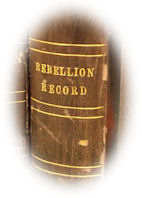
The Rebellion Record—A Diary of American Events; by Frank Moore

.—The Confederate Secretary of War invested R. E. Lee with the control of the rebel forces of Va., by the following order:

Mongomery, May 10, 1861.

To Major-Gen. R. E. Lee:
To prevent confusion, you will assume the control of the forces of the Confederate States in Virginia, and assign them to such duties as you may indicate, until further orders; for which this will be your authority.
…………..I. P. Walker, Secretary of War.
National Intelligencer, May 15.

—The Charleston News of this day contains the prayer of the Rev. James Bardwell, at the opening of the Tennessee Legislature on the 25th of April.—(Doc. 149.)

—In addition to the new Military Departments of Washington, Annapolis, and Pennsylvania, the States of Ohio, Indiana, and Illinois will constitute a fourth, subdivided into several others, to be called the Department of the Ohio. Major-General McClellan, Ohio Volunteers, is assigned to its command; headquarters, Cincinnati.

The President, by general orders, directs that all officers of the army, except those who have entered service since 1st April, take and subscribe anew the oath of allegiance to the United States, as set forth in the 10th article of war.—N. Y. Evening Post, May 11.

—The First Regiment of Vermont Volunteers, commanded by Colonel J. Wolcott Phelps, arrived at New York, and took up their quarters in the Park Barracks. This regiment consists of ten companies—77 men each—of hardy Green Mountain boys, whose stalwart frames and broad shoulders are the envy of all beholders. These ten companies were selected from four different regiments. The uniform of the regiment is of gray cloth, each man being supplied with a heavy overcoat of the same material. One or two companies have a blue uniform instead of the gray. Each man wears a hemlock sprig in his hat. They are all supplied with new Minié muskets, but have no ammunition.

The men are nearly all Vermonters, there being scarcely a dozen foreigners in the regiment. They are all esteemed citizens at home, and nearly every one abandoned a profitable business to give his strong arm to his country. They have been encamped at Rutland, Vt., for the past eight days, completing their outfit, and when they came to strike their tents and take up the line of march, not a man was on the sick list. Their destination is Fort Monroe.

The character of the Green Mountain boys may be illustrated by the following incident: As the cars were leaving their camp-ground in Rutland, on the morning of the 9th instant, a private, in response to the cheers of the people, said: “The Vermont Regiment, citizens in peace, soldiers in war, give you the sentiment embodied in the charge of the Grecian matron to her son—We will bring back our shields or be brought back upon them.”—(Doc. 150.)

—The Protestant Episcopal Diocese of Alabama adopted the following ordinance:

“Whereas, the Constitution of the Diocese of Alabama was adopted when the said Diocese actually was, on the presumption of its continuing to be, a part of the Protestant Episcopal Church in the United States;’

“And whereas, the State of Alabama is no longer a part of the United States:

“Therefore, it is hereby declared by this convention that the first article of the constitution of the Diocese, with all those canons, or portion of canons, dependent upon it, are null and void.

“It is furthermore declared that all canons, or portions of canons, both diocesan and general, not necessarily dependent upon the recognition of the authority of the Church in the United States, are hereby retained in force.

“This declaration is not to be construed as affecting faith, doctrine or communion.”—N. O. Picayune, May 12.

—President Lincoln issued a proclamation directing the commander of the forces of the United States on the Florida coast to permit no person to exercise any office or authority upon the islands of Key West, the Tortugas, and Santa Rosa, which may be inconsistent with the laws and Constitution of the United States, authorizing him at the same time, if he shall find it necessary, to suspend there the writ of habeas corpus, and to remove from the vicinity of the United States fortresses all dangerous or suspected persons.—(Doc. 151.)

—Captain Tyler, of the Second Dragoons, commanding at Fort Kearney, fearing that a mob might take and turn against the garrison the ten twelve-pounder howitzers in his possession, spiked them. He had received orders to remove the pieces to Fort Leavenworth, but thought it unsafe to do so in the distracted state of the country. Threats had been made to take them from him—N. Y. Sun, May 14.

—The Second Regiment of Connecticut Volunteers, Colonel Terry, embarked from New Haven for Washington, on the steamer Cahawba. They marched down Chapel street, escorted by a large body of citizens, cavalry, a body of old New Haven Grays, and by the Emmot Guard—making a very fine appearance. The whole city was alive with people, and the route of the procession was a grand array of flags.—N. Y. Evening Post, May 11.

—The London News publishes an interesting article on the difficulties in the United States, and endeavors to indicate the position which the States under Jefferson Davis now occupy with relation to those under President Lincoln, and the status which both portions of the country now hold with relation to Great Britain and the rest of the world.—(Doc. 152.)

—The steamer Pembroke sailed from Boston, Mass., for Fort Monroe, with reinforcements, including Capt. Tyler’s Boston Volunteers, and a company from Lynn, under Capt. Chamber  —N. Y. World, May 11.

—The Winans steam-gun was captured this morning. A wagon, containing a suspicious-looking box and three men, was observed going out on the Frederick road from Baltimore, and the fact being communicated to General Butler, at the Relay House, he despatched a scouting party in pursuit, who overtook the wagon six miles beyond the Relay House, at Ilchester. On examination it was found that the box contained the steam-gun. It was being taken to Harper’s Ferry. The soldiers brought the gun and the three men back to the Relay House. The prisoners, one of whom was Dickenson, the inventor of the gun, were sent to Annapolis.— Baltimore American, May 11.

—The Diocesan Convention of Massachusetts passed resolutions in regard to the present state of affairs. One of them is as follows:—

Resolved, That the convention of clerical and lay delegates of the Protestant Episcopal Church in the diocese of Massachusetts do hereby express their heartfelt sympathy with the National Government in all right efforts to vindicate the authority of the Federal Union against “all sedition, privy conspiracy, and rebellion.”—Boston Advertiser, May 11.

—The Maryland Legislature passed a resolution, imploring the President of the United States to cease the present war.—(Doc. 153.)

—At about 2 P. M., a sudden movement was made by the U. S. forces in St. Louis under Capt. Lyon, upon Camp Jackson, near that city, by which the camp was entirely surrounded in less than half an hour, and compelled to an unconditional surrender. A great mob followed the U. S. troops to the camp, and began a noisy demonstration against them, and to throw stones. One company received the order to fire, and did so. Twenty-two persons were killed, and many were wounded. The mob then dispersed. A large quantity of arms and munitions were taken in the camp, together with 689 prisoners.—(Doc. 154.)

—At 8 o’clock this afternoon the steamer Maryland, with other transports, arrived at Baltimore with 1,800 troops from Perryville. They consist of five companies of the 3d Infantry, regulars, Major Shepherd, 420 men; one company of Sherman’s Battery of Light Artillery, with 6 pieces of cannon and 70 horses, under Major Sherman; and the 1st Regiment, ten companies, of Pennsylvania Artillery, Col. Patterson, armed with muskets, and numbering 800 men. They were landed at Locust Point, one of the termini of the Baltimore and Ohio Railroad, within half a mile of Fort McHenry, and there transferred on board of two trains of car; which departed immediately.

Two hundred men were left to take charge of the horses, provisions and baggage, and these were to be forwarded at a later hour. The Mayor and Police Commissioners, with two hundred police, crossed in a ferry-boat to Locust Point, and were present at the debarkation.

The Harriet Lane stood off the point with her ports open. The transfer to the cars was accomplished without much difficulty, and there was no excitement other than that which proceeded from the curiosity of the people to witness the proceedings.

The track from Locust Point skirts the lower part of the city, and joins the main stem near Camden Station.—N. Y. Tribune, May 10.

—The Richmond Whig says: “We beg to sanest to all Southern papers the propriety of omitting all mention of the movement of troops within our borders. A word to the wise.”

“The caution is a good one, and might well be extended to correspondents, both private and public, by telegraph and by mail. The caution is the more necessary, because of our large daily correspondence with the people of the North, with whom we are unfortunately at war.”—N. O. Picayune, May 10.

—The Confederate Congress passed an act authorizing the President of the Southern Confederacy to raise such a force for the war as he may deem expedient.—(Doc. 147.)

—The Palmetto Guard left Charleston, S. C., for Virginia. The company numbers eighty-five privates, and is commanded as follows:

Geo. B. Cuthbert, Captain; C. R. Holmes, First Lieutenant; T. S. Brownfield, Second Lieutenant; L. S. Webb, Third Lieutenant; Samuel Robinson, First Sergeant; J. E. Wright, Second Sergeant; G. M. Lalane, Third Ser-geant; H. D. Manahan, Fourth Sergeant; M. J. Darly, Fifth Sergeant; J. B. Boyd, First Corporal; J. E. Gaillard, Second Corporal; A. M. Brailsford, Third Corporal; DeSaussure Edwards, Fourth Corporal; J. E. Dutart, Fifth Corporal; E. W. Bellinger, Sixth Corporal; O. D. Mathews, Quartermaster; R. S. Miller, jr., Commissary.—Charleston Mercury, May 10.

—The Cumberland, Pawnee, Monticello, and Yankee are enforcing the blockade off Fortress Monroe. The Yankee pursued an armed schooner up York River, but after proceeding a short distance was fired upon from a concealed battery, and compelled to return.

The steamers Philadelphia, Baltimore, Powhattan, and Mount Vernon, of the Aquia Creek line, recently taken possession of by the Federal Government, are cruising on the Potomac, all heavily armed. Southern troops are concentrating in the vicinity of Norfolk. An Alabama regiment of 1,100 men, and eighty cadets of the same State, have arrived, and encamped in the vicinity of Fort Norfolk.

The Virginians have five batteries erected in Norfolk harbor; one on Craney Island; one at Sandy Point; one at the Hospital; one near Fort Norfolk, and one on the Bluffs three miles from the Hospital. —N. Y. Evening Post, May 11.

—J. Lawrence Keese, a private in the 8th Company of the 7th Regiment of New York, was accidentally shot at Washington. He was standing in front of his tent washing his hands, when a musket fell from a stack of arms within a few feet of him, and went off, the ball entering his side, passing through his lungs, and killing him almost instantly. He was a young man of fine talents, and greatly esteemed by his comrades.—N. Y. Commercial, May 10.

—Today was strictly observed as a fast-day at Wheeling, Va. Patriotic sermons were delivered in nine out of the twelve churches. The Methodist Church pulpit was decorated with the Stars and Stripes. Rev. Mr. Smith delivered an eloquent address. He said he would hold no fellowship with traitors. If there was a secessionist in his congregation he wanted him to leave. Other ministers prayed that the rebels might be subdued or wiped from the face of the earth.—N. Y. Herald, May 10.

—The steamship Africa arrived at New York from England, bringing the first news of the impression produced in Europe by the reduction of Fort Sumter. The earliest feeling was one of the profoundest gloom and discouragement, but subsequent reflection suggested a probability, eagerly accepted, that hostilities would terminate with the opening act; and that, startled by the shock of arms, the Government and the separated States would have fresh dispositions for an amicable arrangement The notion, founded on the fact that no lives had been lost, also became current; that the affair was merely a sham fight, arranged entirely to cover the evacuation from discredit, and save the reputation of Major Anderson. These ideas were indorsed generally by the journals, who, however, regarded the business as extremely enigmatic, and as needing further enlightenment before final judgment could be passed.— (Doc. 148.)

—Two companies of Southern volunteers from Baltimore, numbering sixty-five men, passed through Frederick, Md., on their way to Virginia. They were under the command of Capts. Wetmore and Price, and unarmed. They marched through the city protected by Gen. Shriver and the sheriff, and their appearance created deep excitement, but no outbreak. A company of about thirty-four volunteers left Frederick early this morning for Harper’s Ferry, under the command of Captain Bradley T. Johnson.—National Intelligencer, May 11.

—The First Regiment of Connecticut Volunteers left New Haven this morning for the seat of war.—N. Y. Tribune, May 10.

—The Salem, Mass., Zouaves arrived at Washington. They number 66 men, and are officered as follows: Captain, A. F. Devereux; 1st Lieutenant, G. F. Austin; 2d Lieutenant, E. A. P. Brewster; 3d Lieutenant, G. D. Putnam. They are armed with the Miniè musket, and uniformed in dark blue jackets and pants, trimmed with scarlet braid, and red fatigue caps. —National Intelligencer, May 11.

—A privateer was captured at the mouth of the Chesapeake, by the steamer Harriet Lane. The officers and crew, with the exception of two seamen, escaped.—Philadelphia Press, May 9.

—The Richmond Examiner of to-day demands a Dictator; it says: “No power in executive hands can be too great, no discretion too absolute, at such moments as these. We need a Dictator. Let lawyers talk when the world has time to hear them. Now let the sword do its work. Usurpations of power by the chief, for the preservation of the people from robbers and murderers, will be reckoned as genius and patriotism by all sensible men in the world now, and by every historian that will judge the deed hereafter.”

—The Fourth Pennsylvania Regiment from the county of Montgomery, arrived at Washington from Annapolis. It is commanded by the following officers:

Colonel, John F. Hartranft; Lieut. Col, Edward Schall; Major, Edwin Schall; Adjutant, Chas. Hunsicker; Quartermaster, Yerkes; Surgeon, Dunlop; Assistant-Surgeons, Christ and Rogers; Captains, Bolton, Schall, Chamberlain, Dunn, Snyder, Allabaugh, Amey, Brooke, Cooke, and Taylor.

The regiment numbers about 900, and comprises a fine body of hardy yeomanry and artisans, who left their fields and shops to rally in defence of the National Capital—National Intelligencer, May 9.

—The steam frigate Minnesota, the flag-ship of the blockading squadron, sailed from Boston, Mass.—Boston Transcript, May 8.

—A meeting in aid of the volunteers from Roxbury, Mass., was held in that city. Speeches were made by Rev. J. E. Bartholomew, Edward Everett, and Alexander H. Rice.—(Doc. 145.)

—General Butler, at the Relay House, Md., promulgated special brigade orders concerning the several events that have occurred at the camp at that place since its formation.—(Doc. 146.)

—A serious riot occurred at Knoxville, Tenn., caused by hoisting a Union flag and the delivery of inflammatory speeches. About twenty shots were fired in all. A man named Douglas, a ringleader in the fight, was wounded, having received several shots. An outsider, named Bull, was mortally wounded.—National Intelligencer, May 11.

—Judge Ogden  of the County Court of Oyer and Terminer of Hudson County, N. J., delivered a charge to the Grand Jury, in which he defined the crime of treason as giving aid, comfort, and information to the enemy.

The Massachusetts First Regiment, which has been for several days at Boston waiting marching orders, on learning that the War Department would hereafter accept no troops for a less period than three years, unanimously offered their services to the Governor for the full term.

The New Jersey House of Assembly ordered to a third reading the bill to raise a war loan of $1,000,000. Resolutions of thanks to Governor Olden for his activity in raising troops, to President Lincoln for his energetic defence of the Union, and pledging New Jersey to stand by the Union with all her power, were introduced into the Senate by a democrat, and passed by a unanimous vote.—N. Y. Tribune, May 8.

—The contributions of the people of the North for the war, during the last three weeks amount to the sum of $23,277,000. Pennsylvania leads the column with a free gift of $3, 500,000. New York and Ohio have each given $3,000,000; Connecticut and Illinois each $2,000,000; Maine, $1,300,000; Vermont and New Jersey, each $1,000,000; Wisconsin and Rhode Island, $500,000; Iowa, $100,000. The contributions of the principal cities are: New York, $2,173,000; Philadelphia, $330,000; Boston, $186,000; Brooklyn, $75,000; Buffalo, $110,000; Cincinnati, $280,000; Detroit, $50,000; Hartford, $64,000.—(Doc. 141.)

—The Twentieth Regiment of N. Y. S. M. from Ulster County, under the command of Colonel George W. Pratt, left New York for the seat of war.—(Doc. 142.)

—Reverdy Johnson addressed the Home Guard of Frederick, Md., upon the occasion of the presentation to them of a National flag from the ladies of that place. The population of the city was swelled by the addition of upwards of two thousand persons, who poured in from the surrounding towns and villages, sometimes in lengthy cavalcades of horses and vehicles, and again in companies of tens and fifties. Union cockades and badges were displayed in profusion upon the coats of the jubilant Union men, numbers of whom were decidedly ambitious in their ideas of patriotic personal adornment, wearing cockades as large as sun-flowers. The Stars and Stripes fluttered gaily from about forty different points, and, altogether, Frederick may be said to have donned her holiday suit for the occasion.

The scene of the presentation formalities was the Court-house yard, where a stand, draped with the national colors, had been erected, and at the hour designated for the commencement of the ceremonies, was surrounded by two or three thousand persons, including the Brengle Guard, a body of about three hundred respectable citizens, principally aged and middle-aged men, organized for the purpose of home protection and defence.—(Doc. 148.)

—Four hundred Pennsylvania volunteers, escorted by three hundred regular United States troops from Carlisle barrack; arrived at Washington at 10 o’clock, on the evening of Thursday, April 18th, and bivouacked at the capitol—N. Y. Times, April 19.

—Isham G. Harris, Governor, sent a message to the General Assembly of Tennessee, announcing the formation of a military league between that State and the Confederate States; submitting the plan of the league, the joint resolution ratifying it, and a “declaration of independence and ordinance dissolving the Federal relations between the State of Tennessee and the United States of America.”—(Doc. 144.)

—Governor Hicks, in response to an order of the Maryland Senate, inquiring if he consented to or authorized the burning of the bridges on the Northern Central, and the Baltimore, Wilmington, and Philadelphia railroad, said: “I have to say that I neither authorized nor consented to the destruction of said bridges, but left the whole matter in the hands of the Mayor of the city of Baltimore, with the declaration that I had no authority in the premises; that I was a lover of law and order, and could not participate in such proceedings.”—National Intelligencer, May 10.

—The six regiments demanded by the Federal Government of Indiana were raised and mustered into service and ready to march in a week after the call was made. They are now in camp, drilling daily, and living the regular soldier life. They would have been on the way to the post assigned them long ago if they had been armed. But up to this time, though the guns have come, the accoutrements are still behind.—Indiana State Journal, May 7.

—Virginia was admitted into the Southern Confederacy in Secret Session of the Confederate Congress.—N. Y. Times, May 14.

—The Committee appointed by the General Assembly of Maryland to visit President Lincoln and present him with a copy of the joint resolutions adopted by that body on the 24 of May, presented their report.—(Doc. 135.)

—The town of Dorchester, Mass., voted $20,000 for the war, besides appropriating $20 per month to every married volunteer, and $15 to every single volunteer. This applies not only to citizens of Dorchester who enlist in the town or out, but to citizens of other towns who may enlist in Dorchester, provided their own towns . do not make any provision for them.—N. Y. Express, May 9.

—General John A. Dix, late Secretary of the Treasury, was appointed one of the four major-generals from the State of New York. General Dix is a native of New Hampshire, and is a son of the late Lieut.-Colonel Timothy Dix. He entered the United States Military Academy at West Point in 1812; was promoted ensign in 1814, and was subsequently promoted to a third lieutenancy in the twenty-first regiment of infantry. His subsequent rank of promotion is as follows:

Second lieutenant, March, 1814; transferred August 14, 1814, to artillery arm; returned same year in the re-organization of the army; adjutant, 1816; first lieutenant, March 18; aide-de-camp to Major-General Brown, 1816; transferred to First artillery, May, 1821; Third artillery, August, 1821; captain, August 25; resigned his commission in the army, December 11, 1828. He afterward filled the post of Adjutant-General of the State of New York, Secretary of State, and United States Senator from January, 1845 to 1849; Postmaster of New York in 1860-61; and was called to the post of Secretary of the Treasury, under James Buchanan, January 11, 1861.— Commercial Advertiser, May 7.

—The First, Second, and Third regiments of New Jersey State Militia arrived at Washington. They constitute, with the Fourth, previously arrived, a brigade of 3,200 men, under the command of Gen. Theodore Runyon. His staff consists of Capt. J. B. Mulligan, Aid; Brigade-Major, A. V. Bonnell; Private Secretary and Special aid, C. W. Tollis.—(Doc. 136)

—The Arkansas Convention, by a vote of sixty-nine to one, passed an ordinance of secession from the Federal Union. The ordinance was unanimously ratified by the State.—N. O. Picayune, May 7.

—The correspondence between Mr. Faulkner, late American Minister at Paris, and Secretary Seward, in relation to the recognition of the Southern Confederacy by the government of France, is published. — (Doc. 137.)

—The Washington Star of this morning, speaking of the intended attack on Washington by the secessionists, says, “The scheme of the oligarchy was to have attacked this city sometime between daybreak of the 18th and daybreak of the 21st of April ultimo. They had been led to believe that the Virginia ordinance of secession would have been pushed through the Convention a few days before that was accomplished, (on the 17th,) and that the troops of that State would have been able to take Washington by surprise between the dates we have named above. The secret outside Convention that was assembled by the disunion Convention in Richmond on the 17th ultimo, was called to aid the scheme, and the raid on Harper’s Ferry was to the end of aiding it also. That was contrived and carried out wholly by disunion revolutionary means; the Governor (Letcher) having declined to order it, or the raid on the Government property (the Navy Yard, &c.) in and near Norfolk. John Bell was doubtless in the conspiracy, we apprehend, as his change of front took place just in time to admit of his getting on what he foolishly supposed would be the winning side. The resignation of the large number of army and navy officers between the 18th and 21st of April, in a body, was doubtless also planned to embarrass the Government just previous to the contemplated attack upon the Federal Metropolis. The conspirators had no idea that the Government would prove more prompt and efficient in their measures of defence, than they in theirs of attack.”

—President Lincoln’s letter to Governor Hicks of Maryland and Mayor Brown of Baltimore, dated on the day after the attack upon the Massachusetts troops, (April 19,) is published in full in the newspapers of to-day.—(Doc. 138.)

—The Police Commissioners of St. Louis, Mo., formally demanded of Capt. Lyon, the officer in command at the Arsenal, the removal of United States troops from all places and buildings occupied by them outside the Arsenal grounds. The Captain, as was doubtless expected, declined compliance with the demand, and the Commissioners have referred the matter to the Governor and Legislature. The Commissioners allege that such occupancy is in derogation of the Constitution and laws of the United States, and in rejoinder Capt. Lyon replies, inquiring what provisions of the Constitution and laws were thus violated. The Commissioners, in support of their position, say that originally “Missouri had sovereign and exclusive jurisdiction over her whole territory,” and had delegated a portion of her sovereignty to the United States over certain tracts of land for military purposes, such as arsenals, parks, &c., and the conclusion implied, but not stated, is, that this is the extreme limit of the right of the United States Government to occupy or touch the soil of the sovereign State of Missouri.—St. Louis Democrat, May 7.

—An important interview took place at Camp Defiance, Cairo, Ill., between Colonel Tilghman, commander of the Kentucky forces, and Colonel Prentiss in command at Cairo.—(Doc. 139.)

—The act recognizing the existence of war between the United States and the seceding States, and concerning letters of marque prizes and prize goods, which had passed the Southern congress at Montgomery, was made public, the injunction of secrecy having been removed therefrom.—(Doc. 140.)

—A meeting of the principal shipowners and commercial men of Maine was held at Augusta. It was summoned by Governor Washburn to take into consideration the state of the country, and the expediency of procuring a guard for the coast. Resolutions were adopted tendering the services of the shipowners to the Government, and pledging their ability to furnish thirty steam vessels within from 60 to 90 days, if required.

George F. Patten, of Bath, John B. Brown, of Portland, and George W. Lawrence, of Warren, were appointed a committee to proceed to Washington and communicate to the Government the views of the merchants and shopkeepers of the State, and to urge the most vigorous action in the premises. The meeting embraced the leading shipowners of all parties, and the sentiment in favor of executing the laws was not only unanimous, but enthusiastic.—Boston Transcript, May 8.

—Raleigh, North Carolina, is alive with soldiers, who have been pouring in at the call of the Governor. Sixteen companies, comprising twelve hundred men, rank and file, are encamped at the Fair Grounds, and there are several more quartered in other parts of the city. They are all fine looking, and in their eagerness to acquire military knowledge frequently have voluntary drills, not being satisfied with the three regularly appointed ones for each day.

Ten companies have been selected by the Governor to constitute the “First Regiment of North Carolina Volunteers,” and an election of field officers has taken place, resulting in the selection of D. H Hill, O. C. Lee, and J. H. Lane, respectively, to the offices of Colonel, Lieutenant-Colonel, and Major.—Charleston Mercury, May 11.

—The Twenty-eighth New York Regiment (from Brooklyn) arrived at Washington by the steamer Star of the South. In the absence of Col. Bennett, detained at home by sickness, Lieut.-Col. E. Burns is in command. The other officers are Acting Lieut.-Col. W. R. Brewster; Adjutant, D. A. Bokee; Surgeon, P. B. Rice; Surgeon’s Mates, Drs. Rappold and Prentice; Captain of Engineer Corps, Von Kumeke; Quartermaster, F. Steigier; Assistant Quartermaster, O. Menseh; Acting Paymaster, W. Mavelle; Chaplain, Mr. Zapt. They number about six hundred men, divided into ten companies, commanded by Captains Brewer, Baker, Campbell, Brandenberry, Beadle, Seeper, Ruegor, Wills, Kuhl, and Weaver. —National Intelligencer, May 7.

—Brigadier-General Philip St. George Cocke commanding the “Potomac Department” of the State of Virginia, in orders issued to-day, says:

“The capital of the United States has never been threatened, and it is not now threatened. It is beyond and outside the limits of the free and sovereign State of Virginia.”

If Gen. Cocke means to say that the “capital of the United States” has never been threatened by him, all credence will be given to his declarations under this head; but if it is intended to suggest that there have been no threats of attack from other quarters, sufficient to justify the precautionary measures taken by the Federal Government, his assurances cannot be received without casting discredit on men high in the confidence of the Confederate States, and on able and influential journals, heretofore understood to be the authentic exponents of Southern wishes and purposes.—(Doc. 134.)

—A body of, Federal troops, under command of Gen. B. F. Butler, arrived at the Relay House, nine miles from Baltimore, took possession of the telegraph wires, planted eight howitzers on the viaduct, and invested the entire neighborhood. They encamped on the grounds of William Talbot, adjoining those of George W. Dobbin, on the west side of the Patapsco. This point is the junction of the Baltimore and Ohio road, and the Washington branch, and gives full command of the road to and from the West.—The World, May 6.

—The women of Mobile organized themselves into a society to make sand bags for defence, lint and bandages for the wounded, clothes for the soldiers of the Confederate Army, to nurse the sick and wounded, and to seek out the families of those volunteers upon whose exertions their families are dependent for daily support.—N. O. Picayune, May 5.

—A large Union meeting was held at Kingwood, Preston county, Va., when resolutions were adopted expressing unalterable opposition to the ordinance of secession, favoring a division of the State, and resolving to vote for a delegate to the next session of Congress.—National Intelligencer, May 11.

—Commodore Charles Stewart, of the United States Navy, addressed a letter to George W. Childs of Philadelphia, furnishing him with the reminiscences of a conversation which passed between Com. Stewart and John C. Calhoun, in the year 1812, after the declaration of war against Great Britain by the Congress of the United States.—(Doc. 132.)

—The artists of New York met at the rooms of Messrs. Kensett and Lang in that city. Mr. D. Huntingdon was called to the chair. Messrs. Kensett, Gray, and Lang embodied resolutions which were adopted by those present, expressing their desire to contribute to the relief of families of volunteers of the city of New York who are now serving in defence of government and law, and resolving that a committee be appointed to solicit contributions of pictures or other works of art, to be disposed of at public auction; said committee to have power, also, to receive moneys presented in aid of the fund. Messrs. Gray, Lang, Hubbard, Huntington, Stone, and Baker were named the committee, with full power to forward the plan proposed. —N. Y. Evening Post, May 7.

—The Ithaca (N. Y.) volunteers arrived in New York on their way to the seat of war. They number one hundred and fifteen men, and are commanded by the following officers:—Captain, Jerome Rowe; First Lieutenant, James Tischner; Ensign, William O. Wyckoff; Orderly Sergeant, William Godley; Second Sergeant, Edwin C. Fulkenson; Third do., Edward Atwater; Fourth do., Dr. Tolbo; First Corporal, Leonard Atwater; Second do., Clinton McGill; Third do., James A. Dickinson; Fourth do., George Shepherd.—N. Y. Herald, May 5.

—The Onondaga Regiment left Syracuse, N. Y., for Elmira. This is the first regiment organized under the new Volunteer bill of the State of New York. Ten full companies presented their muster-rolls to the Adjutant-General, not merely full, but with an excess of nearly one hundred men.—N. Y. Tribune, May 5.

—The New Orleans Delta of to-day contains a full account of the numbers and condition of the rebel troops and defences in the vicinity of Fort Pickens; from which it appears that Gen. Bragg has under his command an army of over six thousand fighting men, besides a large force of laborers, sailors, and marines.—(Doc. 133.)

—The Buena Vista Volunteers, from Philadelphia, Captain Powers, arrived at New York. They are to join Col D. E. Sickles’s regiment. These are men who went unarmed to Baltimore, and fought the Gorillas with their fists.— N. Y. Tribune, May 5.

—The Phoenix Ironworks at Gretna, opposite Lafayette, New Orleans, cast the first gun for the Confederate Navy. It is an eight-inch Dahlgren shell, and has eight feet six inches bore.

The steamship Star of the West was put in commission as the receiving ship of the Confederate States Navy at New Orleans. She is stationed at the navy yard at Algiers, under the temporary command of Midshipman Comstock, for receiving sailors and marines now being enlisted for the navy.—N. O. Picayune, May 5.

—A committee of the Maryland Legislature held an interview with President Lincoln. They admitted both the right and the power of the government to bring troops through Baltimore or the State, and to take any measures for the public safety which, in the discretion of the President, might be demanded either by actual or reasonably apprehended exigencies. They expressed their belief that no immediate effort at secession or resistance of the federal authority would be attempted by the Legislature or State authorities, and asked that, in this view, the State should, as long as possible, be spared the evils of a military occupation or a mere revengeful chastisement for former transgressions. The President replied that their suggestions and representations should be considered, but that he should now say no more than that the public interests, and not any spirit of revenge, would actuate his measures—N. Y. Herald, May 5.

—A Union meeting was held at Wheeling, Va, Hon. Frank Pierpont, of Mason county, and George M. Porter, late member of the convention, addressed the people in able speeches, urging resistance to the secession ordinance, ad favoring the division of the State. Resolutions were adopted approving the action of the merchants in refusing to pay taxes to the authorities at Richmond, denunciatory of the secession ordinance, and declaring adhesion to the stars and stripes.—Boston Transcript, May 8.

—The American flag was displayed from the tower of the First Baptist Church in Broome street, New York, with appropriate ceremonies. A large concourse of people listened to stirring speeches by President Eaton, of Madison University, Rev. Dr. Armitage, Rev. Mr. Webber, of Rochester, and Hon. W. D. Murphy, of the Oliver street church.

Dr. Armitage referred to the fact that the pastors of this First Baptist Church (a church which has existed more than a century) had all been noted for their zealous patriotism. One of the most eminent of them—Spencer H. Cone—had, in the war of 1812, himself gallantly defended that emblem of civil and religious liberty, the stars and stripes, at Fort McHenry; and at this moment members of this church are in the camp, equally ready to defend it against all aggression. No free government or constitutional liberty have ever been secured or perpetuated by any nation without the seal of its own blood. If the liberties thus purchased for us by our fathers, and the government which they founded—the best the world has ever seen—are to be insulted and trampled upon, shall we not strike down the traitor, even though he be one of the family—even though he be our own brother?

“I too,” said Dr. Eaton, “am emphatically a man of peace, for I am a minister of the gospel of the Prince of Peace; but in this crisis, my friends, it is my firm conviction that the best and surest way to perpetuate the blessing is promptly to send down, if need be, half a million of men to those seditious brethren of ours, and compel them to keep the peace. We cherish no malice against them—God forbid. But their traitorous hands are now clutching the very life of our body politic, and we must use prompt and vigorous action in defence of our very national existence.”—N. Y. Evening Post, May 7.

—The American flag was elevated above the roof of the University at New York, by Captain Jones, late of Harper’s Ferry, amid the enthusiastic cheers of a large collection of people.

Dr. Bethune made some remarks, taking occasion to make a fitting allusion to Major Anderson and Fort Sumter, which were received with repeated and enthusiastic cheering. He had looked over ancient history for a parallel to this deed of valor, but found none. The bravery shown by the three hundred Spartans at the Pass of Thermopylae was well known; but there still was one coward among them. There was no coward among the men at Sumter. He had been present at a conversation with the gallant defender of the fort, when a gentleman remarked he regretted that the major had not blown up the fort, to which Major Anderson replied that it was better as it was. The ruined battlements and battle-scarred walls of Fort Sumter would be an everlasting shame and disgrace to the South Carolinians. At the conclusion of Dr. Bethune’s remarks the “Star-spangled Banner” was sung, all the audience rising to their feet and joining in the chorus. Col. Baker and Capt. Jones also made short addresses.—The World, May 4.

—Governor Letcher published a proclamation, saying that the sovereignty of the Commonwealth of Virginia having been denied, her territorial rights assailed, her soil threatened with invasion by the authorities of Washington, and every artifice employed which could inflame the people of the Northern States against her, it therefore becomes the solemn duty of every citizen of Virginia to prepare for the impending conflict.

To this end, and for these purposes, and with a determination to repel invasion, Governor Letcher authorizes the Commanding General of the military forces to call out, and cause to be mustered into service from time to time, as the public exigencies may require, such additional number of volunteers as he may deem necessary.—(Doc. 129.)

—The First Regiment, Colonel Johnson; the Second, Col Baker; the Third, Col. Napton; the Fourth, Col. Miller, of New Jersey Troops, with Brigadier-General Runyon and staff, left Bordentown for the seat of war, proceeding down the Delaware, via the Delaware and Chesapeake canal. The troops and stores are in a fleet of fourteen steam propellers, the W. Woodward, Henry Cadwalader, Octorora, Delaware, Raritan, Trenton, Patroon, F. W. Brune, Elizabeth, Franklin, Farmer, J. B. Molleson, Eureka, and Fanny Gardner.— World, May 4.

—Union Ward meetings were held to-night throughout Baltimore, Md., and resolutions were adopted to the following purport:—

That we cherish the Constitution and laws of the United States, and will devote our fortunes and lives to defend their integrity against all revolutionary or violent assaults; that we regret the violent attacks on the troops of the United States while peacefully marching through the city to protect the seat of Government, and indignantly repudiate making it a pretext to organize an armed mob, under the guise of a special police, to place the city in a hostile attitude to the General Government; declaring abhorrence at the attempt of the Legislature to inaugurate a military despotism by the bill for the creation of a Board of Public Safety; that the persons named for said Board have not the confidence of the people, and we protest against the whole measure as an invasion on the prerogatives of the Governor and a usurpation of the Executive power by the Legislature.—N. Y. Tribune, May 4.

—The following notice was issued at Pittsburg, Pa., to-day: Shippers of goods in New York are hereby notified that all packages found to contain guns, pistols, powder, and other articles contraband of war, destined for the Southern States, will not be permitted to pass the city of Pittsburg.
………..By order of the Committee,
………………..E. D. Gazzani, Chairman.
N. Y. Tribune, May 4.

—A letter was received at New York giving information of a design to burn that city, the supply of water to be cut off at the time the city was fired. Philadelphia and Boston were also to be burned.—(Doc. 130.)

—Fourteen companies of Kentuckians from the border counties tendered their services to the Secretary of War through Colonel T. V. Guthrie. Ten were accepted with orders to encamp on the Ohio side of the river.—Boston Transcript, May 4.

—The Connecticut legislature unanimously passed a bill appropriating $2,000,000 for the organization and equipment of a volunteer militia, and to provide for the public defence.—N. Y. Tribune, May 4.

—Governor Jackson of Missouri, in a message to the legislature of that State, says the President of the United States in calling out the troops to subdue the seceded States, has threatened civil war, and his act is unconstitutional and illegal, and tending towards consolidated despotism. While he evidently justifies the action of the Confederate States in seceding, he does not recommend immediate secession, but holds the following language:

“Our interest and sympathies are identical with those of the slaveholding States, and necessarily unite our destiny with theirs. The similarity of our social and political institutions, our industrial interests, our sympathies, habits, and tastes, our common origin, territorial contiguity, all concur in pointing out our duty in regard to the separation now taking place between the States of the old federal Union.” He further adds that “Missouri has at this time no war to prosecute. It is not her policy to make an aggression; but, in the present state of the country, she would be faithless to her honor, recreant to her duty, were she to hesitate a moment in making the most ample preparation for the protection of her people against the aggression of all assailants. I therefore recommend an appropriation of a sufficient sum of money to place the State at the earliest practicable moment in a complete state of defence.”

In conclusion he says: “Permit me to appeal to you and through you to the whole people of the State, to whom we are all responsible, to do nothing imprudent or precipitate. We have a most solemn duty to perform. Let us then calmly reason one with another, avoid all passion and tendency to tumult and disorder, obey implicitly the constituted authorities, and endeavor ultimately to unite all our citizens in a cordial cooperation for the preservation of our honor, the security of our property, and the performance of all those high duties imposed upon us by our obligations to our families, our country, and our God.”—Louisville Journal, May 4

—President Lincoln issued a proclamation calling into the service of the United States 42,000 volunteers for three years’ service, and directing the increase of the regular army and navy of the United States.—(Doc. 131.)

—Four companies of volunteers left Buffalo, N. Y., for the rendezvous at Elmira. They were escorted to the depot by the Home Guard. Major Millard Fillmore, Ex-President, commanding in person. The Home Guard is composed of retired commissioned officers of the State Militia, and is being thoroughly drilled by Major Fillmore. About 150 members are already enrolled.—N. Y. Tribune, May 4.

—Two associations of ladies of New Orleans were formed for aiding and equipping volunteers, and for making lint and bandages, and nursing the sick and wounded. The meetings were very large and enthusiastic.—Baltimore Sun, May 7th.

—The Sixty-ninth New York Regiment, (altogether composed of Irishmen,) under the command of Col. Corcoran, arrived at Washington, from the Annapolis Junction, Md., where, with the exception of one company which preceded them on Tuesday, they have been on duty for several days past.—National Intelligencer, May 8.

—Governor Andrew, the Mayors of Lowell and Lawrence, and others, met at the State House, in Boston, Mass., for the purpose of identifying the bodies of the Massachusetts soldiers killed in Baltimore. Several articles which were the property of the deceased were exhibited, but failing to identify the bodies by these, the company proceeded to the vault beneath King’s Chapel, where the coffins were opened. The first corpse was at once recognized as Sumner H. Needham of Lawrence, by two of his brothers. The second was recognized as that of Addison O. Whitney of the Lowell City Guards, by three of his intimate friends. He was reported as among the missing when the regiment reached Washington. He died from a shot in the left breast. He was a spinner in the Middlesex Mills, and has a sister at Lowell. The third body proved to be that of Luther C. Ladd of Lowell, also of the Lowell City Guards. He had not been heard from since the fight, but a letter was received from his brother in the regiment at Washington stating that he was missing. The body was identified by a brother-in-law of Ladd. He was about eighteen years of age, a machinist, and was born at Alexandria, N. H. Ho was shot in the thigh, and probably bled to death at once. His face was somewhat swollen, and gave evidence of rough usage.—Boston Traveller, May 8.

—The mouth of James River, and Hampton roads are under strict blockade. The blockading vessels are the frigate Cumberland, steamships Monticello and Yankee, and three or four steam tugs.—The World, May 4.

—Ellsworth’s Regiment of Fire Zouaves arrived at Washington. Their march through the city was a complete ovation. They were greeted with great cheering and other demonstrations of enthusiasm. The splendid appearance of the regiment, both as to numbers and equipments, caused great surprise, and elicited universal praise.—N. Y. Tribune, May 8.

—The adjourned meeting of merchants to take into consideration the action necessary in regard to the state license, was held at Wheeling, Va. The Committee made a report setting forth the law in reference to the matter, submitted a resolve to the effect that we are good citizens of the State of Virginia, and at the same time hold ourselves loyal citizens of the United States, and will maintain allegiance to the same as heretofore; that we are willing to pay a license tax so long as Virginia is in the United States, but we are not willing to pay revenue to the present usurped government at Richmond, which, without the consent of the people of Virginia, has assumed to absolve us from allegiance to the United States, recommending the merchants of Wheeling and Ohio county to withhold the payment of taxes for the present. The resolutions were unanimously adopted. A German announced that the commissioner of the revenue resigned to forward the patriotic undertaking.—The World, May 3.

—Judge Campbell of the United States Supreme Court, who resides in Alabama, sent in his resignation. He is a Unionist, but feels bound to adhere to the fortunes of his State.— N. Y. Tribune, May 8.

The Marine Artillery of Rhode Island (flying artillery) arrived in Washington having a battery of six pieces, apparently perfect, like all we have thus far seen from that gallant little State, in every appointment of military art that can give efficiency to this most effective arm of modern warfare. The battery is served by about one hundred and sixty men, who are experienced cannoneers, and who, we learn, have left behind them an equal number, ready at a moment’s notice to tender their services to the Government. The Rhode Island regiment of infantry, twelve hundred strong, appeared also in the streets on parade, attracting universal admiration for the military precision of their movements and the fine soldiery bearing of both officers and men.

The Artillery made a visit to the President of the United States about five o’clock in the afternoon. He received them in front of the mansion, and was complimented in return by three hearty cheers as they passed in review. —National Intelligencer, May 8.

—The New Orleans Picayune, of to-day, says: “We heard but recently of a united North to defend and preserve the Union—now we hear of a united North to subjugate the South. The change is rapid. It shows the increasing strength of those whose permanent success would be destructive of liberty. These are the enemies the South has to combat. A Southern victory at Washington would not only strike terror into their ranks, but go far towards releasing the good and estimable people of the North from a thralldom which has become as terrible as it is degrading. We hope to have the pleasure, ere many days, of chronicling the glorious achievement.”

—The national flag was hoisted over the Interior Department at Washington. It was enthusiastically greeted by the dense mass of spectators and by the Rhode Island regiment, whose appearance and drill, together with their music, elicited general praise. They were accompanied by Governor Sprague and suite in full uniform.

The President and Secretaries Seward and Smith were near the staff when the flag was raised, and having saluted it, they were in turn cheered.

The regiment, having re-entered the building where they are quartered, sung “Our Flag still Waves.”—N. Y. Evening Post, May 8.

—The religious press presents a singular and varied view of the political affairs of the United States.—(Doc. 128.)

—The story of an armistice having been requested by Secretary Cameron was denied as follows:

Wilmington, Wednesday, May 1.
Simeon Draper, Esq., Chairman Union Defence Committee:

There is not a word of truth in any of the newspaper reports of the armistice made or proposed. That sort of business ended on the 4th of March.

………F. W. Seward.

N: Y. Times, May 2.

—A large and enthusiastic meeting of the citizens of Wiscasset, Maine, was held, Wilmot Wood, Esq., presiding. Some spirited resolutions were unanimously passed; and it was recommended to the town to raise $5,000 for the support of families of volunteers who, under the command of Edwin M. Smith, Esq., were enrolled in a company for the defence of the Union.—Boston Transcript, May 7.

—The Baptist State Convention of Georgia, submitted a communication to the Congress of the seceded States at Montgomery, endorsing, approving, and avowing support to, the Confederate Government, and requesting the said Government to proclaim a day of fasting and prayer, “that God will deliver us from the power of our enemies, and restore peace to the country.”—(Doc. 124.)

—The governor of Connecticut sent a message to the legislature of that State, containing the following:— “Col Samuel Colt, of Hartford, on the 25th of April last, offered to the executive his services in promoting the enlistment of a regiment of able-bodied men from the State for the war, and to furnish a sufficient number of his revolving breech rifles for their equipment. To this noble proposition I have replied, expressing my high appreciation of the patriotic offer, and assuring him that the tender of ten companies would at once be accepted, the troops organized into a regiment, the field officers appointed in harmony with the wishes of the regiment and the dignity of the State, and their services placed at the disposal of the General Government. These arms, which are the very latest improvements, with the saber bayonets, would sell in market to-day for over $50,000 in cash. Col. Colt is now actively engaged in enlisting a full regiment for the war, and also furnishing officers to drill and perfect the men in the use of the weapons at his own expense.”—The World, May 3.

—General Harney, in a letter to Col. Fallon of St. Louis, gives an account of his arrest and subsequent release by the authorities of Virginia; declares that he will serve under no other banner than the one he has followed for forty years; denies the right of secession, and implores his fellow-citizens of Missouri not to be seduced by designing men to become the instruments of their mad ambition, and plunge the State into revolution.—(Doc. 125.)

—The Albany (N. Y.) Burgesses Corps arrived at New York, and proceed to Washington to-morrow to join the Twenty-fifth regiment, N. Y. S. M.—(Doc. 126.)

—An attempt was made to blow up the State Powder House, on Brarnhall Hill, at Portland, Me., containing 1,000 kegs of powder, by building a fire at an air-hole outside. It was discovered, and extinguished.—N. Y. Tribune, May 2.

—Gov. Black of Nebraska, issued a proclamation, recommending a thorough volunteer organization throughout the Territory. He has supplied companies with arms and equipments, and seems determined to place Nebraska in the best possible condition of defence.—Idem.

—The remains of the three Massachusetts soldiers who were killed in Baltimore, arrived at Boston in charge of private D. S. Wright, of the Sixth regiment, who was detailed by Col. Jones for the duty. The bodies were taken from the receiving tomb in Baltimore, under the supervision of Mayor Brown, and left Tuesday morning last. The fact was not generally known, but a large crowd gathered at the depot.

Gov. Andrew and staff, the executive council, with the divisionary corps of cadets as an escort, were present to receive the bodies. The coffins were covered with national flags, as were the hearses which bore them to Stone Chapel, under which they were deposited to await final and more public obsequies. On the route to the chapel the band played dirges, and the rapidly-gathered crowds uncovered as the procession moved past.—Boston Transcript, May 2.

—The Montgomery (Ala.) Weekly Post of this day, says:— “There is no longer any doubt as to the position of General Scott. His general order of April 19 will satisfy the most skeptical. He will prove false to the mother which gave him birth.”—(See Doc. 68, p. 78.)

—Collier, of the United States marines, attached to the Minnesota, raised the American flag to-day on the steeple of the Old South Church at Boston, Mass.

At noon the star-spangled banner was raised with great demonstration of enthusiasm from the post-office and customhouse at Baltimore, Mel, by order of the newly-appointed officials. A large crowd assembled in front of the custom-house to witness the flag-raising. A new flag-staff was erected over the portico, and at precisely quarter to twelve, Captain Frazier, a veteran sea-captain of Fells Point, who was assigned the honor, drew up the flag, which, as it spread to the breeze, was greeted with tremendous applause, waving of hats, cheers for the Union and the old flag. The crowd then joined in singing the “Star-spangled Banner.”—N. Y. Commercial Advertiser, May 1.

—William Gray, of Boston, Mass., gave ten thousand dollars for the benefit of the volunteers’ families.—N. Y. Times, May 2.

—The South Carolina College Cadets and the Washington Artillery returned to Charleston, S. C., from duty at the forts in the harbor of that place.—(Doc. 127.)