Following the American Civil War Sesquicentennial with day by day writings of the time, currently 1863.

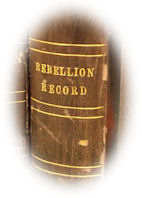
The Rebellion Record—A Diary of American Events; by Frank Moore

—The steamship Coatzacoalcos arrived at New York this morning, bringing home the Federal troops who were left in Texas without a commander, after the treason of General Twiggs.

—The Government at Washington is acting on positive information in taking all possible precautionary measures for the defence of, and the maintenance of peace at, that point.

A company of military were marched inside the capitol to-night, and a picket of guards is stationed on each of the roads leading into the city. This was done on no new information, but is among the signs of the revolution. A military company has not been within the walls of the capitol before since the war of 1812.

The oath of fidelity was administered to several companies of volunteers to-day.— World, April 12.

—Unusual activity now prevails in military circles in Pennsylvania. New companies are forming, and the old organizations are drilling frequently. The prospect of active service in the event of the breaking out of actual hostilities in the South, is exciting much discussion among the volunteer companies, and it is understood that several have already tendered their services to the Secretary of War, in case the Government should need their aid. It is also understood that in the event of an attack on the Government, the latter will make an early call upon Pennsylvania for men. Our volunteers labor under great disadvantages in respect to arms, and in a case of emergency many more men would be forthcoming than there are arms to place in their hands.—Phila. Press.

—This morning the Commissioners of the Confederate States left Washington. They are satisfied that no recognition of the Southern Confederacy will ever take place under the administration of President Lincoln. In their final communication they reflect severely on the Administration, taking the ground they have exhausted every resource for a peaceful solution of the existing difficulties, and that if civil war results, on the head of the Federal Government will rest the responsibility. They charge the Administration with gross perfidy, insisting that under the shelter of the pretext and assertion that Fort Sumter was to be evacuated, an immense armada has been despatched to provision and reinforce that fort. They repeat they had almost daily indirect assurances from the Administration that Fort Sumter was positively to be abandoned, and that all the Government’s efforts were to be directed toward peace. The commissioners allege that the Government at Montgomery was earnestly desirous of peace; and that, in accordance with its instructions, as well as their own feelings, they left no means unexhansted to secure that much-desired end; but all their efforts having failed, they were now forced to return to an outraged people with the object of their mission unaccomplished; and they express the firm conviction that war is inevitable.—(Doc. 51.)—World, April 12.

—At 2 P. M. Colonel Chesnut and Major Lee, aids to General Beauregard, conveyed to Fort Sumter the demand that Major Anderson should evacuate that fort. Major Anderson replied at 6 P. M. that his “sense of honor and his obligations to his Government would prevent his compliance” with the demand. He informed the gentlemen verbally that he would be “starved out in a few days.”

It was stated that there were at this time 7,000 men around Fort Sumter under arms, and 140 pieces of ordnance of heavy calibre in position and ready for use.—Charleston Mercury.

—The floating battery, finished, mounted, and manned at Charleston, was taken out of the dock last evening, and anchored in the cove, near Sullivan’s Island.

The people are not excited, but there is a fixed determination to meet the issue. The Convention has just adjourned, subject to the call of the president. Before adjourning, it passed resolutions approving the conduct of General Twiggs in resigning his commission and turning over the public property under his control to the authorities.

Governor Pickens was in secret session with the Convention. About 1,000 troops were sent to the fortifications to-day; 1,800 more go down to-morrow.

Messrs. Wigfall, Chesnut, Means, Manning, McGowan, and Boyleston, have received appointments in General Beauregard’s staff. A large number of the members of the Convention, after adjournment, volunteered as privates. About 7,000 troops are now at the fortifications. The beginning of the end is coming to a final closing. Fort Sumter will be attacked without waiting for the fleet. Every thing is prepared against a land attack. The enthusiasm is intense, and the eagerness for the conflict, if it must come, unbounded.—N. Y. Day Book.

—The officers of the District of Columbia militia were ordered to meet at 10 o’clock A. M., in consequence of information relative to a contemplated movement for the seizure of the city of Washington by the secessionists under Ben McCullough. Orders were issued for the militia to assemble at their armories.

Seven militia companies reported to General Scott, and between six and eight hundred of them volunteered for any service in which the President might desire them to act.—Times, April 11.

—Governor Curtin, of Pennsylvania, sent a special message to the Legislature to-day, urging the necessity of purchasing arms and reorganizing the military system of that State.—Times, April 10.

—Jefferson Davis made a requisition on the Governor of Alabama for 8,000 soldiers.—Tribune, April 10.

—The Charleston Mercury of to-day announces war as declared. “Our authorities,” it says, “yesterday evening received notice from Lincoln’s Government, through a special messenger from Washington, that an effort will be made to supply Fort Sumter with provisions and that if this were permitted, no attempt would be made to reinforce it with men! This message comes simultaneously with a fleet, which we understand is now off our bar, waiting for daylight and tide to make the effort threatened.

“We have patiently submitted to the insolent military domination of a handful of men in our bay for over three months after the declaration of our independence of the United States. The object of that self humiliation has been to avoid the effusion of blood, while such preparation was made as to render it causeless and useless.

“It seems we have been unable, by discretion, forbearance, and preparation, to effect the desired object, and that now the issue of battle is to be forced upon us. The gage is thrown down, and we accept the challenge. We will meet the invader, and the God of Battles must decide the issue between the hostile hirelings of Abolition hate and Northern tyranny, and the people of South Carolina defending their freedom and their homes. We hope such a blow will be struck in behalf of the South, that Sumter and Charleston harbor will be remembered at the North as long as they exist as a people.”

—Steamers Illinois and Baltic, in commission for United States Government, got to sea from New York. They discharged their pilots at 7.30 A. M., and sailed southwardly.—(Doc. 50)

—United States sloop-of-war Pawnee sailed from Norfolk at 6 P. M., with sealed orders.—Times, April 11.

—Information having been given by the United States authorities to the authorities at Charleston that they desired to send supplies to Fort Sumter by an unarmed vessel, they were informed that the vessel would be fired upon and not permitted to enter the port. Official notification was then given by the United States Government that supplies would be sent to Major Anderson, peaceably if possible, otherwise by force. Lieutenant Talbot, attached to the garrison of Fort Sumter, and who accompanied the bearer of this despatch, was not permitted to proceed to his post.

—Orders were issued to the entire military force of Charleston, held in reserve, to proceed to their stations without delay. Four regiments of a thousand men each were telegraphed for from the country.

Dr. Gibbs, surgeon-general, was ordered to prepare ambulances, and make every provision for the wounded.

—At midnight Charleston was thrown into great excitement by the discharge of seven guns from Citadel square, the signal for all the reserves to assemble ten minutes afterwards.

Hundreds of men left their beds, hurrying to and fro towards their respective destinations.

In the absence of sufficient armories, at the corners of the streets, publics squares, and other convenient points, meetings were formed, and all night the long roll of the drum and the steady tramp of the military, and the gallop of the cavalry resounding through the city, betokened the close proximity of the long-anticipated hostilities. The Home Guard corps of old gentlemen, who occupy the position of military exempts, rode through the city, arousing the soldiers, and doing other duty required by the moment.

United States vessels were reported off the bar. Major Anderson displayed signal lights during the night from the walls of Fort Sumter.—Times, April 10.

—The State Department at Washington replied to-day to the Confederate State Commissioners, declining to receive them in their official capacity, but expressing deference for them as gentlemen. The Secretary expressed a peaceful policy on the part of the Government, declaring a purpose to defend only when assailed. Tribune, April 9.

—General Beauregard issued an order, and sent a special messenger to Major Anderson, to give him an official notification that no further intercourse between Fort Sumter and the city would be permitted. — Times, April 9.

—The steam transport Atlantic sailed under sealed orders from New York, laden with troops and provisions. Among the troops is Captain Barry’s celebrated company of United States Flying Artillery. — Commercial Advertiser, April 8.

—The Virginia Convention adopted, in committee of the whole, several of the series of resolutions reported by the majority of the Committee on Federal Relations, and rejected, by the decisive vote of 89 to 45, a motion to substitute for one of the resolutions an ordinance of secession, to be submitted to the popular vote.— World, April 5.

—Many rumors are in circulation to-day. They appear to have originated from movements on the part of the United States troops, the reasons for which have not been communicated to the reporters at Washington as freely as the late Administration was in the habit of imparting Cabinet secrets. There can be no doubt that serious movements are on foot. The tone of the southern press for the last week, and the concentration of troops at Pensacola, indicate a determination to precipitate a conflict at Fort Pickens, probably with a view to hasten the secession movement in Virginia.—Tribune, April 5.

—Despatches were received in Washington to-day, confirming the reported reinforcement of Fort Pickens; and the Cabinet held a long session, without coming to any definite conclusion in regard to the long-mooted evacuation of Fort Sumter. One company of artillery left Washington for Fort Hamilton, and two more are to follow to-morrow. Unwonted activity also prevails in the navy, several vessels being rapidly fitted for service.—World, April 4.

—The mortar batteries on Morris’ Island, Charleston harbor, fired into an unknown schooner. She displayed the stars and stripes, and put to sea. A boat from Sumter with a white flag went out to her; nobody hurt. A shot had gone through her.—(Doc. 49.)

—All officers of the Southern Confederate army, on leave of absence, were ordered to their respective commands.—Times, April 5.

—The South Carolina Convention ratified the Constitution of the Confederate States, by a vote of 114 to 16.—Tribune, April 6.

—The Charleston correspondent writes: “By the by, let us never surrender to the North the noble song, the ‘Star-Spangled Banner.’ It is southern in its origin; in sentiments, poetry and song; in its association with chivalrous deeds, it is ours; and the time, I trust, is not remote, when the broad stripes and brilliant stars of the confederate flag of the South will wave triumphantly over our capitol, Fortress Monroe, and every fort within our borders.”—Richmond Examiner.

—It is asserted for the hundredth time, in apparently authoritative circles, that Fort Sumter will be evacuated on or before Wednesday next, April 8d.— World, April 1.

—The Mississippi State Convention, at Jackson, ratified the Constitution of the Confederate States, by a vote of 78 to 7.—Tribune, April 1.

—Governor Pickens, of South Carolina, sent a message to the convention of that State, informing it that six hundred men would be required to garrison the forts in Charleston harbor; besides giving other important details respecting the financial condition of the State. (This message is printed complete in the New York Tribune of April 2, 1861.)

—The actual vote of the State of Louisiana on secession is given by the New Orleans papers of to-day as follows: For secession, 20,448; against it, 17,296.— World, April 4.