Following the American Civil War Sesquicentennial with day by day writings of the time, currently 1863.

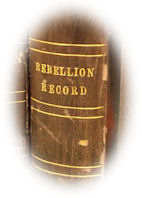
The Rebellion Record—A Diary of American Events; by Frank Moore

—Colonel Lamon, a Government messenger, had an interview at Charleston with Governor Pickens and General Beauregard.—Times, March 26.

—The rumors from Charleston are very conflicting concerning the evacuation of Fort Sumter. One report states that Major Anderson is strengthening his position; another, that he has received orders to evacuate the fort and report himself for duty at Newport barracks, and that the officers are packing their goods in expectation of immediate departure. The truth of the matter will probably be known in a day or two.—Evening Post.

—Governor Pettus, of Mississippi, in accordance with the order of the President of the Confederate States, issued a proclamation calling upon the organized military of the State for fifteen hundred infantry.—Georgia Republic, March 25.

—Dr. Fox, of the United States navy, a special messenger from the Government to Major Anderson, reached Charleston and visited Fort Sumter by permission, in company with Captain Hartstein.

“Intercepted despatches”—by which we are to understand “stolen letters”—subsequently disclosed to the authorities in Charleston, it is said, that Mr. Fox employed this opportunity to devise and concert with Major Anderson a plan to supply the fort by force; and that this plan was adopted by the United States Government.—Times, March 28 and April 18.

—A meeting was held at Frankfort, Ala., at which the following resolutions, among others of a similar character, were passed:

Resolved, That we approve the course pursued by our delegates, Messrs. Watkins and Steele, in convention at Montgomery, in not signing the so-called secession ordinance.

That secession is inexpedient and unnecessary, and we are opposed to it in any form, and the more so since a majority of the slave States have refused to go out, either by what is called “southern cooperation,” or “precipitate secession;” and that the refusal to submit the so-called secession ordinance to the decision of the people is an outrage upon our right and liberty, and manifests a spirit of assumption, unfairness, and dictatorship.

Resolved, That our congressional nominee, if elected, is to represent us in the United States Congress, and not in the Congress of this so-called “Southern Confederacy.”—Tuscumbia North Alabamian.

—The Montgomery Mail protests against the word stripes: “We protest against the word ‘stripes,’ as applied to the broad bars of the flag of our confederacy. The word is quite appropriate as applied to the Yankee ensign or a barber’s pole; but it does not correctly describe the red and white divisions of the flag of the Confederate States. The word is bars—we have removed from under the stripes.”— World, April 2.
—A. H. Stephens, Vice-President of the “Confederate States” of the South, delivered a speech at Savannah, Ga. It is intended to be a vindication of the new features in the constitution, which has been adopted for their government.—(Doc. 48.)

—At about 7 o’clock this evening, Lieutenant Homer, in command of the Continentals, at drill was informed that there was a sloop lying at the wharf at the foot of Spanish alley in Mobile, which was laden with supplies for the United States fleet outside, between that place and Pensacola. A detachment of the company was on drill at the time, and Lieutenant Homer immediately ordered them down to the point mentioned, and then and there took charge of the little sloop Isabel. She was laden with beef, pork, barrels of eggs, etc. The person in charge acknowledged that these supplies were intended for the fleet outside.—Mobile Tribune, March 21.

—Correspondence between Mr. Secretary Seward and the Commissioners from the Confederate States is published.—(Doc. 47.)

—Supplies were cut off from Fort Pickens and the fleet in the Gulf of Mexico.— (Doc. 46.)

—The act, passed by the Florida Legislature, defining treason, became a law by the approval and signature of the Governor. It declares that in the event of any actual collision between the troops of the late Federal Union and those in the employ of the State of Florida, it shall be the duty of the Governor of the State to make public proclamation of the fact; and thereafter the act of holding office under the Federal Government shall be declared treason, and the person convicted shall suffer death.—Evening Post, March 26.

—The London News of to-day publishes a strong protest against a recognition of the Southern Confederacy by the British Government.—(Doc. 45.)

—The Southern Confederacy Congress passed an act for the establishment and organization of the army of the Confederate States.—(Doc. 44.) —Times, March 16.

—Fort Brown, Texas, was finally surrendered by arrangement between Captain Hill and the Texas Commissioners.—Galveston Civilian, March 11.

—General Peter G. T. Beauregard, lately a major in the United States Engineer Corps, was ordered by Jefferson Davis, President of the Southern Confederacy, to proceed to Charleston and take command of the forces there assembled, and to be assembled for the investment of Fort Sumter.—Herald, March 7.

—In the Texas State Convention, a letter was received from General Wanl, enclosing a letter from the Secretary of War of the Confederate States, in relation to the military complications in Texas. President Davis instructs the Secretary of War to say that he is disposed to assume every responsibility compatible with the relations of the Federal Government to Texas. Davis considers it due to international courtesy that the Government of the Confederate States (Texas included, after her withdrawal from the United States) should accord to the troops belonging to the Federal Government a reasonable time within which to depart from her territory. Should the Federal Government refuse to withdraw them, President Davis does not hesitate to say, that all the powers of the Southern Confederacy shall be promptly employed to expel them. General Waul says that the possibility of settling difficulties by a reconstruction of the old Union is never alluded to in the Congress, and that the proposal would receive about the same encouragement as a proposition to reannex Texas to the States of Mexico.—Evening Post, March 20.

—The President’s inaugural meets with a varied reception throughout the country. The South pronounces it warlike, while a greater portion of the North considers it conservative. —(Doc. 43.)