—Jefferson Davis was inaugurated President of the Southern Confederacy.—(Doc. 37.)
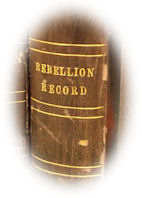
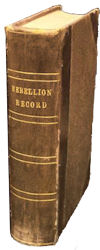
The Rebellion Record—A Diary of American Events; by Frank Moore
Feb. 13.—Abraham Lincoln, of Illinois, and Hannibal Hamlin, of Maine, were declared by Vice-President Breckenridge, elected President and Vice-President of the United States for the four years from March 4, 1861.—(Doc. 36.)—Tribune, Feb. 14.
—Eight thousand Sharp’s rifle cartridges and 10,000 Sharp’s rifle primers, were seized by the police in New York city on a Charleston steamer.—Idem.
—The New York vessels seized by the State of Georgia were released.—Courier & Enquirer.
—At Montgomery, Mr. Memminger presented a flag sent by some of the young ladies of South Carolina to the Convention.—(Doc. 35.)—National Intelligencer.
—The Congress at Montgomery this evening unanimously agreed to a constitution and provisional government. They will go into immediate operation.—(Doc. 33.)—No propositions for compromise or reconstruction. After the vote on the constitution was taken, Jefferson Davis was elected President, and Alexander H. Stevens Vice-President of the Southern Confederacy, by the Congress.—(Doc. 34.)—Commercial Advertiser.
—Brigs W. R. Kibby and Golden Lead; barks Adjuster and C. Colden Murray; and schooner Julia A. Hallock, all owned in New York, were seized in the harbor of Savannah, by order of the Governor of Georgia, in reprisal for the seizure, in New York, of arms consigned to Georgia.—Baltimore American.
—The Little Rock arsenal, Arkansas, with 9,000 stands of arms, 40 cannon, and a large amount of ammunition, was surrendered to the State of Arkansas.—N. Y. Times, Feb. 11.
—The Peace Convention, at Washington, organized permanently, with Ex-president John Tyler in the chair; J O. Wright, of Ohio, secretary.—Herald, Feb. 6.
—The Montgomery convention organized with Howell Cobb, president, and Johnson L Hooper, secretary.—(Doc. 32.)
—The North Carolina House of Representatives passed unanimously a declaration that if reconciliation fails, North Carolina will go with the other slave States.—Times, Feb. 6.
—The United States revenue cutter Lewis Cass, Capt. Morrison, a Georgian, was surrendered by the officer at Mobile to the State of Louisiana.—(Doc. 31.)—N Y. Times, Feb. 6.
—The Texas State Convention, at Galveston, passed an ordinance of secession, to be voted on by the people on the 28d of February, and if adopted, to take effect March 2.—(Doc. 30.)—New Orleans Picayune, Feb. 7.
—The State of South Carolina, by her attorney-general, I. W. Hayne, offered to buy Fort Sumter, and declared that, “if not permitted to purchase, she would seize the fort by force of arms.” The United States, in reply, asserted political rights superior to the proprietary right, and not subject to the right of “eminent domain.”—Times, Feb. 9.
—The United States branch mint, and the custom-house at New Orleans, seized by the State authorities. In the mint were government funds to the amount of $389,000, and in the sub-treasury, $122,000—(Doc. 29.)—Louisville Journal, Feb. 2.


