Following the American Civil War Sesquicentennial with day by day writings of the time, currently 1863.

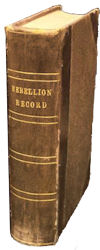
The Rebellion Record—A Diary of American Events; by Frank Moore

—The United States revenue cutter Robert McClelland, Captain Breshwood (a Virginian), was surrendered at New Orleans to the State of Louisiana.—Times, Feb. 8.

—Secretary Dix’s dispatch to Hemphill Jones, to “shoot on the spot” any one who attempts to “haul down the American flag” caused great enthusiasm.—(Doc. 28.)

—The Grand Jury at Washington made three presentments of Ex-Secretary Floyd, first, for maladministration in office; second, for complicity in the abstraction of the bonds; and third, for conspiracy against the Government.—N. Y. Tribune.

—The Louisiana State Convention passed the ordinance of secession to-day, by a vote of one hundred and thirteen to seventeen. A delay ordinance was proposed yesterday, but was voted down by a large majority. A gold pen was given each member, with which to sign the ordinance of secession.—(Doc. 27.)— Buffalo Courier.

—A large Union mass meeting was held at Portland, Me., this evening; Chief Justice Shepley presided, and the meeting was addressed by many of the ablest speakers of all parties. Union resolutions were passed.

—A correspondence between Senator Toombs, of Georgia, and Fernando Wood, mayor of New York, relative to the seizure of arms by the police of that city, creates comment and surprise.—(Doc. 26.)

—The Charleston Mercury continues the publication of anonymous incendiary appeals, intended to stir up the people to an attack on Fort Sumter. One, headed “Fort Sumter, the Bastion of the Federal Union,” concludes with these words:

“No longer hoping for concessions, let us be ready for war, and when we have driven every foreign soldier from our shores, then let us take our place in the glorious Republic the future promises us. Border southern States will never join us until we have indicated our power to free ourselves—until we have proven that a garrison of seventy men cannot hold the portal of our commerce. The fate of the Southern Confederacy hangs by the ensign halliards of Fort Sumter.”

—The Toronto Leader, the Government paper of Canada, this morning says it is in a position to announce in the most positive terms that it is the intention of the English Government to acknowledge the independence of the Southern Confederacy as soon as it is formed.

—The London Times, in an article on the disunion movement in America, asserts that the United States cannot “for many years be to the world what they have been.”—(Doc. 25.)

—An effort was made by the New York police to seize a quantity of fire-arms which were known to be shipped on board the steamer Montgomery. While the officers were searching on board for the arms, the captain ordered the vessel’s fasts to be cut, and she steamed away from the pier, scarcely giving the policemen time to jump ashore. The five hundred muskets found on board the schooner Caspian were returned to the captain, the authorities being satisfied that the vessel was bound to Carthagena.—Chicago Tribune.

—The United States arsenal at Augusta, Ga., was surrendered to the State authorities, upon the demand of Governor Brown.—Baltimore Sun, Jan. 25.

—The Catawba Indians of South Carolina offered their services to Governor Pickens, and were accepted.—Times, Jan. 25.

—Sherrard Clemens of Va. made a strong Union speech in the House of Representatives to-day.—(Doc. 24.)

—Jefferson Davis, of Mississippi, withdrew from the Senate at Washington to-day. The ordinance of secession having passed the Convention of his State, he felt obliged to obey the summons, and retire from all official connection with the Federal Government.—(Doc. 23.)

At the Brooklyn, N. Y., navy yard, the entire force was put under arms, and held in readiness to act immediately, through some apprehension of an attack by an organized force of persons in sympathy with secession. The guns of the North Carolina were shotted, and a portion of the Brooklyn city military was mustered to cooperate.—Herald, Jan. 22.

—The Georgia State Convention resolved, unanimously:

“As a response to the resolutions of the Legislature of the State of New York, that this Convention highly approves of the energetic and patriotic conduct of the Governor of Georgia in taking possession of Fort Pulaski by the Georgia troops; that this Convention request him to hold possession of said fort until the relations of Georgia with the Federal Government shall be determined, and that a copy of this resolution be transmitted to the Governor of the State of New York.—Times, Jan. 22.

—Wendell Phillips addressed the Twenty-eighth Congregational Society in Boston this afternoon on the “Political Lessons of the Hour.” He declared himself to be a disunion man, and was glad to see South Carolina and other southern slave States had practically initiated a disunion movement. He hoped that all the slave States would leave the Union, and not stand upon the order of their going, but go at once. He denounced the compromise spirit manifested by Mr. Seward and Charles Francis Adams with much severity of language; and there was an occasional stamping of feet and hissing, but no outbreak. Mr. Phillips was escorted home by a few policemen, and a great crowd pushing about him.—Springfield Republican.

—A Union meeting was held to-night at Trenton, N. J., Thomas J. Stryker, Cashier of the Trenton Bank, in the chair.

The Committee on Resolutions reported, deploring the state of the country; recommending, as a means of settling differences, the adoption by the people of the Crittenden resolutions, or some other pacific measure; with such modifications as may be deemed expedient; recommending the Legislature of New Jersey to pass a law to take a vote of the people, yes or no, on the Crittenden resolutions; approving of the course of Virginia in appointing a Commission to go to Washington, and recommending the New Jersey Legislature to do the same.

Speeches were made by Judge Naar, C. W. Jay, and others.
—The State Convention of Georgia has adopted the secession ordinance by a vote of two hundred and eight against eighty-nine. —(Doc. 22.)

A motion to postpone the operation of the ordinance until the 3d of March was lost by about thirty majority.

Alexander H. Stephens and Herschel V. Johnson are among those who voted against the ordinance.

The ordinance of secession is ordered to be éngrossed on parchment, and to be signed on Monday at noon.

Judge Linton Stephens says that, while he approves of the ordinance, he sees no reason for its adoption now. He therefore will not vote for or sign it.

Unusual demonstrations of approbation are being made at Milledgeville to-night in honor of the adoption of the ordinance, including the firing of cannon, the letting off of sky-rockets, the burning of torches, and music and speeches. —Richmond Enquirer.

—In the Massachusetts State Legislature to-day, a series of resolutions was passed by a unanimous vote, tendering to the President of the United States such aid in men and money as he may request, to maintain the authority of the general Government. The preamble to the resolution declares that the State of South Carolina, in seizing the fortifications of the Federal Government, the Post Office, Custom Home, money; arms, munitions of war, and by firing upon a vessel in the service of the United States, has committed an act of war. The Senate passed a bill authorizing the increase of the volunteer military of the State.—Boston Journal, Jan. 19.

—The names of William L. Yancey of Alabama, and James H. Hammond of South Carolina, appear in the Apalachicola Times of this day, as candidates for the presidency and vice-presidency of the Southern Confederacy.