Following the American Civil War Sesquicentennial with day by day writings of the time, currently 1863.

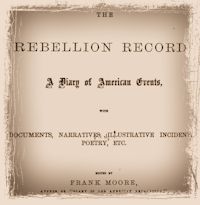
The Rebellion Record—A Diary of American Events; by Frank Moore

March 11.—In the rebel Congress, in session at Richmond, Va., Mr. Conrad, of Louisiana, offered the following peace preamble and resolution:

Whereas, The present administration of the United States, by its reckless disregard of all constitutional restraints, by its persistent efforts to subvert the institutions of these States, and the ferocious war which it is waging for that purpose, has more than realized the worst apprehensions of our people, and fully justified their wisdom and foresight in averting, by timely separation from the Union, the calamities which a longer continuance in it would have rendered inevitable; and

Whereas, A portion of the people of the United States have recently manifested their disapproval of the war, of the objects for which and the manner in which it is conducted, and their desire for its speedy termination, and several foreign Powers, notably the government of France, have expressed a similar desire;

“Now, therefore the Congress of the confederate States, deeply impressed with the conviction that it is their duty to leave no means untried to put an end to a contest injurious to the civilized world and disastrous to the parties engaged, believing that its prolongation can only tend to embitter and perpetuate feelings of hostility between States which, however politically disunited, must ever be intimately connected by identity of language and of religion, and by the immutable laws of geographical amity and of mutual demand and supply, deem the present time, when there is a momentary pause in conflict, a suitable one to utter the words of peace. The Senate and House of Representatives of the confederate States do therefore resolve that they will cordially cooperate with the Executive in any measures it may adopt, consistent with the honor, the dignity and independence of these States, tending to a speedy restoration of peace with all or with any of the States of the Federal Union.” The resolution was referred without debate to the Committee on Foreign Affairs.

—Governor Cannon, of Delaware, issued a proclamation enjoining upon the people of that State that they should hold true allegiance to the Government of the United States as paramount to that of the State of Delaware, and that they should obey the constituted authorities thereof before the Legislature of the State of Delaware, or any other human authority whatsoever.—(Doc. 134.)

—The National Union Club, of Philadelphia, Pa., was inaugurated at that place this evening.— A brief skirmish took place at a point twelve miles east of Paris, Ky., between a party of rebel guerrillas and the guard of a National forage train, resulting in a repulse of the guerrillas.—Major-General Schenck, at Baltimore, Md., issued an order prohibiting the sale within his command of pictures of rebel soldiers and statesmen.

March 10.—Jacksonville, Florida, was captured by the First South-Carolina colored regiment, under the command of Colonel T. W. Higginson, and a portion of the Second South-Carolina colored regiment, under Colonel Montgomery. The people were in great fear of an indiscriminate massacre; but the negroes behaved with propriety, and no one was harmed.—(Doc. 132.)

—The sloop Peter, of Savannah, Ga., while attempting to run the blockade at Indian River Inlet, Fla., was this day captured by the gunboat Gem of the Sea.—General Granger came up with the rebels at Rutherford’s Creek, Tenn., and captured several of their number.

—President Lincoln issued a proclamation, ordering all soldiers, whether enlisted or drafted, who were absent from their regiments without leave, to return to their respective regiments before the first day of April, on pain of being arrested as deserters, and punished as the law provided.—(Doc. 133.)

—A detachment of National troops, consisting of the Sixth and Seventh regiments of Illinois cavalry, under the command of Colonel Grierson, attacked a body of rebel guerrillas, numbering four hundred men, under Colonel Richardson, encamped near Covington, Tenn., killing twenty-five, capturing a large number, and utterly routing and dispersing the rest. The camp and its contents were destroyed.

March 9.—A small rebel force was this day captured six miles below Port Hudson, together with the signal book containing the signals used in the rebel army.—A large number of vagrant negroes were arrested in New-Orleans, La.

—The schooner Lightning, from Nassau, N. P., laden with dry goods, sugar and coffee, was this day captured by the United States steamer Bienville, thirty miles south of Hilton Head, S. C.

—The British iron-screw steamer Douro, of Liverpool, laden with cotton, turpentine, and tobacco, from Wilmington, N. C, was this day captured in latitude 33° 41′ N., longitude 77° 2′ W., by the United States gunboat Quaker City.

—To-day a skirmish took place near Bolivar, Tenn., between a detachment of National troops and a band of guerrillas, in which the latter were routed and eighteen of their number captured.

—James Louis Petigru died at Charleston, S. C, in the seventy-fourth year of his age. Mr. Petigru was an avowed and active opponent of the nullification movement of 1830-32, a consistent and persistent Whig through successive Democratic administrations, and a bold, open, and loyal Union man in the critical winter of 1860-61. He sacrificed popularity without losing esteem. He was for many years the leader of the South-Carolina bar, and one of the latest acts of his life was a masterly argument made by him before the rebel States District Court, against the confiscation and sequestration laws passed by the rebel Congress at Richmond. Although living amongst the most bitter and vindictive people of the rebel population, Mr. Petigru died a lover of his country, and loyal to the government of the United States.

—Colonel C. C. Dodge returned to Norfolk, Va., after making a successful reconnoissance to Southfield, Chuckatuck, and Blackwater Bridge. At the latter place he had a fight with a party of rebels, but at the expiration of twenty minutes, they hastily withdrew. In this affair, several rebel prisoners were captured with their horses and arms.

— A Detachment of National troops under the command of Colonel Chickering, left Baton Rouge, La., for the purpose of reconnoitring the surrounding country and burning the bridges on the Comite River. They destroyed Bogler, the Strickland, and the Roberts bridges over that river, dispersed a large force of rebel guerrillas, and returned to camp without losing a man.

—To-night, a second “Quaker gunboat,” or sham monitor, constructed of logs, with pork barrels for funnels, was sent adrift by the National fleet above Vicksburgh, for the purpose of drawing the fire of the rebel batteries. It showed that the rebels were always on the alert, for, although the night was very dark, ninety-four shots were fired at the mock vessel as she passed along the various batteries.

March 8.—Early this morning, Captain John S. Mosby, commanding a company of rebel guerrilla cavalry, made a dash into Fairfax Court-House, Va., and captured Brigadier-General Stoughton, and over thirty other officers and privates, together with their arms, equipments, and fifty-eight horses.—(Doc. 131.)

—The sloop Enterprise, having run out of Mosquito Inlet, was captured off Hillsborough, Fla., by the gunboat Sagamore.—The Forty-third regiment of Massachusetts, under the command of Colonel Holbrook, surrounded and captured a company of rebel cavalry, with all their officers, on the Trent road, some distance from Newbern, N, C.

March 7.—Major-General Schenck, commanding the Middle Department of the army of the United States, issued an order at Baltimore, Md., prohibiting the sale of secession music in his department, and commanding the publishers of the game to send to his office any such music as they had on hand at that time.

—The Mobile Register published the following: “Let every man, woman, and child at home, with a yard square of ground, scratch it and put in corn. Every grain carefully intrusted to the fruitful earth is a mite of contribution to the nation’s liberty. Every acre of cotton planted is a comfort to our enemies and a nail in the coffin of confederate independence.”—At New-Orleans a meeting was held to discuss the propriety of establishing a provisional State government in Louisiana.—New Orleans Era.

— This day the expedition, under Colonel Phelps, which left Belle Plain, Va., in steamers on Tuesday for Northumberland County, Va., returned to headquarters. The troops visited Heathsville, which they found deserted by the rebels. Then, throwing out large foraging parties from that base into Lancaster County and in other directions, they succeeded in capturing one thousand bushels of corn, fifty horses and mules, a large number of beef cattle and quite an amount of medical stores. Two post-offices and several stores were visited, and two important rebel mails captured. The cavalry also seized a large number of horses and mules. Some prisoners were also taken, among them Colonel Claybrook, a prominent rebel officer, and two clerks of the departments at Richmond, with a quantity of correspondence for citizens of Baltimore, and official papers addressed to parties in London, to the care of Baring Brothers.—New-York Tribune.

March 6.—The ship Star of Peace was captured and burned by the rebel privateer Florida, under the command of Captain J. N. Maffit.—General Hunter in command of the Department of the South, from his headquarters at Port Royal, S. C, issued an order drafting for garrison duty all the able-bodied negroes in his department, not otherwise employed in the service of the National government.—General Orders, No. 17.

March 5.—A fight occurred at Thompson’s Station, a few miles south of Franklin, Tenn., between a considerable body of Union troops under the command of Colonel John Coburn, and a large rebel force under General Van Dorn, resulting, after a desperate conflict of four hours’ duration, in the rout or capture of the whole Union force.—(Doc. 130.)

—The editorial office of the Crisis at Columbus, Ohio, was visited by a body of soldiers who destroyed every thing they could find in it.— Gold sold in Richmond, Va., at three hundred per cent advance.—The rebels at Vicksburgh during the day threw shells occasionally at the National forces engaged in digging the canal opposite that place, doing no damage.

March 4.—The First East-Tennessee cavalry, Colonel Johnson, had a fight with a party of rebels led by Colonel Rogers, at a point on Harpeth River, near Chapel Hill, Tenn.; killed twelve, and captured seventy-two of the rebels, with all their horses and accoutrements. Majors Burkhart and Macy were in command of the National cavalry, all of whom passed through the engagement without injury.—The Thirty-seventh Congress of the United States terminated.—The sloop Ida was captured near Charlotte Harbor, Fla., by the blockading schooner James S. Chambers.—The Second New-Hampshire regiment returned to Concord.

—A skirmish took place at Skeet, N. C, between a scouting detachment of National troops under the command of Captain Richardson, of the Third New-York cavalry, and a party of rebel guerrillas, in which the latter were routed and dispersed. The Union party then advanced to Swan Quarter, where they encountered a superior body of rebels, but after a sharp fight of twenty minutes, they completely routed them, killing and wounding twenty-eight of their number. In this skirmish the Unionists had three men killed and fifteen wounded.—Newbern Progress.

—The office of the Volksblatt, a German antiwar Democratic paper, published at Belleville, Mo., was visited by some persons unknown and thrown into disorder.

March 3.—Fort McAllister, on the Great Ogeechee River, Ga., was this day bombarded by a fleet of iron-clad monitors and mortar-schooners, under the command of Captain Drayton; but, after an almost incessant fire of eight hours’ duration, they failed to reduce it—(Doc. 129.)

—John Maginnis, late editor of the New-Orleans True Delta, died this day.—A grand review of the rebel forces at Mobile, Ala., took place this day, by Major-Generals Withers and Buckner, and Brigadier-Generals Slaughter and Cummins. After the review, four pieces of artillery captured at Murfreesboro, were presented by General Withers, on behalf of the Alabamians and Tennesseeans in the army of the Tennessee, to the army of Mobile. Each piece was inscribed with the names of Alabamians who fell in that battle.—Mobile Advertiser.

—First Lieutenant Gilbert S. Lawrence was dismissed the service of the United States for saying in the presence of officers and civilians, “I have no confidence in General Hooker. Burnside was stuck in the mud, and he will be stuck worse;” and also for publicly declaring: “I want to get out of the service. I don’t believe we will succeed. I am dissatisfied generally. Nobody but McClellan can command this army.”—New- York Tribune.

—The schooner Kingfisher was captured and burned by the rebel privateer Alabama in latitude 1° 20′, longitude 26° 20′.—The Spanish sloop Relampago was captured at Charlotte Harbor, Fla., by the National blockading schooner, James S. Chambers.—The Southern Union, a journal published in Georgia, having proposed to reconstruct the old Union of the States, was reprimanded by the Atlanta Confederacy, which asserted that “there are fewer abolitionists in Massachusetts than reconstructionists in Georgia.”

March 2.—The brigade of regulars from General Rosecrans’s division went out on a foraging expedition from Murfreesboro, Tenn., this morning, and encountered the rebels posted in force, about sixteen miles distant on the Salem Pike. The Union forces consisted of one battalion of the Fifteenth infantry, Captain Keteltas; one battalion of the Sixteenth, Captain Crofton; two battalions of the Eighteenth, Captains Douglas and Fetterman; and one battalion of the Nineteenth— the whole under command of Colonel Shepherd, Fifteenth United States infantry. A section of Guenther’s battery accompanied the infantry. The expedition moved out from Murfreesboro at seven A.M., and proceeded without interruption to the vicinity of Eagleville. Here it was ascertained that a strong body of the rebel cavalry were awaiting the National approach. Colonel Shepherd instantly ordered his force to take the proper positions, and, with a strong line of skirmishers thrown to front and flank, advanced steadily and cautiously upon the rebel position. In a few moments the National skirmishers engaged the enemy’s outposts, and immediately thereafter the rebels moved quickly to the front and advanced across the front line of the skirmishers. A hot engagement ensued, and lasted for about ten minutes, when the enemy, unable to endure the galling fire of the regulars, broke and fled. They were shortly afterward got into a second line of battle, and, with heavy reinforcements, ventured a movement on the Union right, with the evident intention of assailing them by flank and rear. This design also failed, and the National forces repulsed the assailants a second time. They did not again make a stand, but made a hurried retreat, even leaving behind their dead, of whom there were several. The Unionists took no prisoners, but the enemy’s loss in killed and wounded was considerable.—Chicago Times.

— A Union Club was organized in Boston, Mass., and Edward Everett was elected to its presidency.—A slight cavalry fight took place near Petersburgh, Tenn., between a party of rebels and bushwhackers, and two hundred loyal Tennesseeans, under the command of Lieutenant-Colonel Brownlow, in which the rebels were routed, with twelve killed and twenty wounded.— Captain Schultze, with a company of Union cavalry, surprised Mosby’s rebel guerrillas at a point near Aldie, Va., and succeeded in capturing thirty of them, without any loss on the National side.

— Thirty-three commissioned officers of the United States army having been found guilty of various charges by general Court-Martial, the details of the several cases being contained in General Orders No. 13, dated February eighteenth, 1S63, and the sentence having been approved by the Commanding General, were this day dismissed the service.—Four guerrillas were captured at the house of one Lisle, on the Nashville turnpike, three miles from Russellville, Ky.—Union meetings were held at Harrodsburgh, Lebanon, and Taylorsville, Ky.—Louisville Journal.