Following the American Civil War Sesquicentennial with day by day writings of the time, currently 1863.

The Rebellion Record—A Diary of American Events; by Frank Moore

March 1.—A scouting-party of Union troops, under the command of Adjutant Poole, made a dash into Bloomfield, Mo., early this morning, and killed the rebel recruiting officer, Lieutenant Brazeau, captured the Provost-Marshal, with all his papers, twenty rebel guerrilla prisoners, a number of fire-arms, and a quantity of ammunition.—Missouri Democrat.

—The English steamer Queen of the Wave stranded while endeavoring to run into Georgetown, S. C, and soon after was taken possession of by the crew of the United States gunboat Conemaugh.—Fifty men of the First Vermont cavalry, under Captains Wood and Huntoon, were surprised by a party of rebels at Aldie, Va.

—To-day a fight took place in the vicinity of Bradyville, Tenn., between an expeditionary force of Union troops under General Stanley, and a body of rebel guerrillas under Colonel Duke, in which, after a stubborn resistance of twenty minutes, the latter were routed with great loss.— (Doc. 128.)

February 28.—General R. E. Lee, commanding the rebel army in Virginia, issued an order reviewing its operations for the year 1862.—(Doc. 126.)

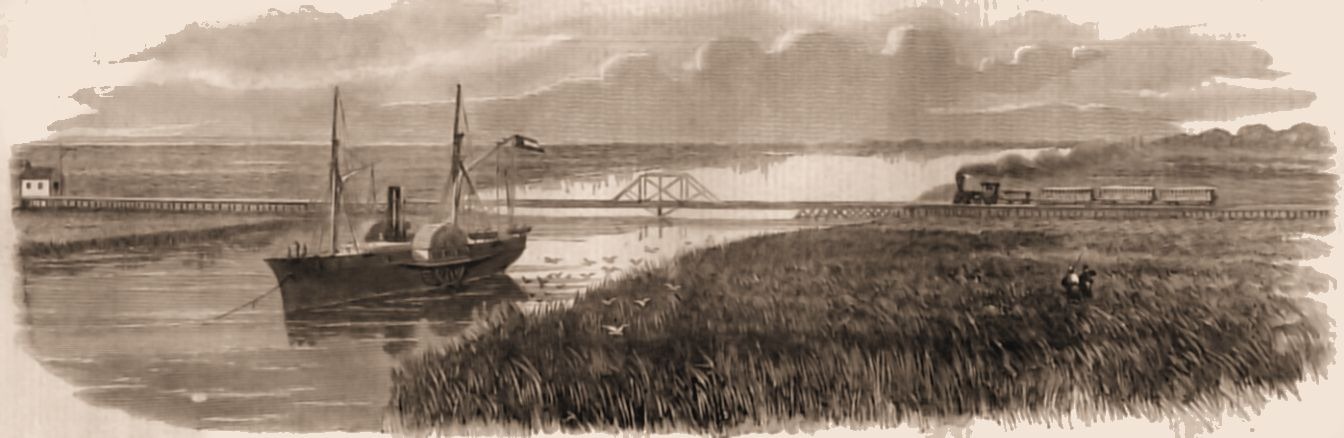
—The armed rebel steamer Nashville, while aground under the guns of Fort McAllister, on the Great Ogeechee River, Ga., was this day destroyed by the United States gunboat Montauk, under the command of Captain J. L. Worden.— (Doc. 127.)

The Rebel Steamer, Nashville, Lying At the Railway Bridge, On the Ogeechee River.—From a Sketch by a Naval Officer

The Rebel Steamer “Nashville”  Lying At the Railway Bridge, On the Ogeechee River.—From a Sketch by a Naval Officer.

From March 14, 1863 Harper’s Weekly.

February 27.—Jefferson Davis issued a proclamation to the people of the States in rebellion, appointing the twenty-seventh of March as a day of fasting and prayer.—General John Cochrane resigned his command in the United States army of the Potomac, and issued a farewell address to the soldiers of his late brigade.

—A skirmish took place at a point fifteen miles from Newbern, N. C, between a detachment of Mix’s New-York cavalry, under the command of Captain Jacobs, and a strong scouting-party of rebel infantry, in which the latter were routed after the first fire, with a loss of three of their number killed and forty-eight taken prisoners, including a commissioned officer. The National party had none killed, and only one man wounded.

February 26.— Yesterday, a rebel cavalry scout, eighty strong, came inside the National pickets on the Strasburgh road, Va. After a skirmish with infantry pickets, in which two were wounded on each side, they retired, capturing a cavalry picket of twelve men. This morning, five hundred of the Thirteenth Pennsylvania and First New-York cavalry sent in pursuit, recaptured, beyond Strasburgh, most of the prisoners and horses, and also took a number of prisoners. The commander of the Union detachment, exceeding his orders, pursued them beyond Woodstock. After driving in the rebel pickets, he stood parleying in the road, without guarding against surprise. The enemy returned in force, charged upon and threw them into confusion, killing and capturing two hundred.—See Supplement.

—The National Council of the Cherokee Indians adjourned this day, having repealed the ordinance of secession passed in 1861. They also passed an act depriving of office in the nation, and disqualifying all who continued disloyal to the Government of the United States; and also an act abolishing slavery.—The yacht Anna was captured in the Suwanee River, Ga., by the National steamer Fort Henry.—New-York Journal of Commerce.

—A very large and enthusiastic meeting of the people of Indiana was this day held at Indianapolis, the capital of the State. Loyal and patriotic resolutions were adopted, and speeches were made by Governor Wright, Governor Andrew Johnson, of Tennessee, General S. F. Carey, of Ohio, T. Buchanan Read, of Pennsylvania, Charles W. Cathcart, Charles Case, and others.

—A freight train on the Louisville and Nashville Railroad, laden with merchandise belonging to private individuals, and a quantity of Government stores, and two hundred and forty mules, were this day captured near Woodburn, Tenn., by a party of rebel guerrillas. After driving off the mules and rifling the cars of their contents, they set fire to and totally destroyed them; they then raised steam upon the locomotive to its fullest height, and started it along the road at the top of its speed, hoping that it would encounter the passenger train coming from Nashville. The locomotive drove along the track through Franklin, and passed other stations at a fearful rate of speed, but the supply of steam was finally exhausted, and the machine came to a full stop, without doing any harm.

February 25.—The act for “enrolling and calling out the National forces, and for other purposes,” passed the United States House of Representatives by a vote of one hundred and fifteen yeas to fifty-nine nays.—About noon to-day, Stuart’s rebel cavalry made an attack on a portion of General Averill’s division of cavalry, near Hartwood Church, Va., when a fight ensued, which terminated in the repulse and rout of tho rebels with a loss of one captain, a lieutenant and several privates. General Averill pursued them to Kelly’s Ford, but they succeeded in crossing the river before he arrived.— Philadelphia Inquirer.

—An expedition, consisting of a force of Union troops, under the command of General Rose, left Moon Lake on board several steamers, under Lieutenant Commanding Smith, and proceeded up Yazoo Pass.

—The rebels under Cluke, in their raid through Kentucky, were overtaken at Licktown, twelve miles east of Mount Sterling, and dispersed.—The British steamer Peterhoff, was captured off St. Thomas, W. I., by the United States gunboat Vanderbilt, and sent to Key West, Fla., for adjudication.—The bakers in Charleston, S. C, advanced the price of bread to twenty-five cents for a half-pound loaf. Flour sold at sixty-five dollars a barrel.— Charleston Courier.

February 24.— The United States steamer Indianola, under the command of Lieutenant George Brown, was this day captured in the Mississippi River, near Grand Gulf, after an engagement lasting one hour and a half, by the rebel iron-clad steamers Queen of the West and William n. Webb, and the armed steamers Doctor Batey and Grand Duke.— (Doc. 124.)

—The steamer Hetty Gilmore, was captured and destroyed by the rebels under the command of W. C. P. Breckenridge, at Woodbury, Tenn.— The Savannah News of this date said: “There seems to be now a great rage for investing in confederate bonds. Every body is buying bonds— that is, every body who has treasury notes wherewith to buy. How great the contrast! Here, our people are seeking confederate government paper. In Lincolndom every body is avoiding government paper, and paying enormous prices for every article which will enable them to get rid of Yankee promises to pay! This is one of the best signs of the times.”

—At Richmond, Va., Judge Meredith of the Circuit Court, decided in a habeas corpus case, that every citizen of Maryland, and every foreigner who had enlisted in the rebel army, no matter for how short a period, had acquired a domicile, and therefore was liable to conscription between the ages of eighteen and forty-five.—Richmond Examiner.

February 23.—Union meetings were held at Cincinnati, Ohio, Russellville, Ky., and Nashville, Tenn., at which the action of the National Government was sustained, and pledges to perpetuate the authority of the Constitution were renewed.— A fight took place near Greenville, Miss., between the rebel forces under General Ferguson, and the Nationals, commanded by General Burbridge. In the action, Major Mudd, of the Twenty-second Illinois cavalry, was killed. —New-York Tribune.

—A skirmish took place near Athens, Ky., between a party of National troops and a body of Morgan’s guerrillas, who were making a raid through that State. In the fight, Dr. Theophilus Steele, a rebel, was severely wounded, and Charlton Morgan, a brother to the rebel General John H. Morgan, with others, was taken prisoner.

—The One Hundred and Thirty-third New-York regiment, accompanied by a company of cavalry, went from Plaquemine to Rosedale, La., a distance of nearly thirty miles, to break up a rebel camp, supposed to be situated there. They found the rebels had gone, but some medicines, nineteen bales of cotton, and several horses were taken, together with four prisoners. A portion of the party went three miles above Port Hudson, on the opposite side of the river.—Louisville Journal.

—A body of seven hundred rebel guerrilla cavalry, under the leadership of Colonel Leroy Cluke, made a thieving expedition into Kentucky. They first went to Winchester, thence to Mount Sterling, Straw Hill, and Hazel Green, robbing and destroying property of every description. A huge amount of government property was destroyed at Paris, in order to prevent it from falling into the hands of the rebels. They were pursued by a detachment of National troops, under the command of Colonel B. P. Runkle, but the rebels, though superior in numbers to the Union force, preferred the business of robbing to that of fighting, and continued to retreat from place to place, until they finally got away with a large amount of property, and a great number of horses.

—Governor Brown, of Georgia, issued an order compelling all the militia officers of that State, except those already tendered and accepted by General Beauregard, “to repair forthwith, without hesitation or delay, to the city of Savannah, and report to General Beauregard, to be organized under his direction into companies, for duty in the defence of that city.”

—The steamer Belle, of Memphis, while lying at Cottonwood Landing, Tenn., was boarded by a party of rebel guerrillas who attempted to capture her, but they were beaten off by the passengers and crew, and the boat escaped. In the fight, one Union man was wounded, and one of the guerrillas was killed.—Philadelphia Inquirer.
February 22.—Colonel F. M. Cornyn, Tenth Missouri cavalry, in command of a detachment of Union troops, made a successful scouting expedition to Florence and Tuscumbia, Ala. He assessed the wealthy slaveholders in sums of five hundred dollars and upwards, carried off fifty bales of cotton, a large number of horses and mules, sixty negroes, and a number of prisoners.—(Doc. 123.)

—A captain and eight privates belonging to the Fifty-seventh rebel regiment of Virginia, were captured near Gatesville, Va., by a small force of Union troops.—The expedition through the Yazoo Pass reached Moon Lake this day.— See Supplement.

February 21.—The ships Golden Eagle and Olive Jane, in lat. 29° 17′, lon. 45° 15′, were captured and burned by the rebel privateer Alabama.—An enthusiastic Union meeting was held at Bloomfield, Indiana.—The National gunboats Freeborn and Dragon made a reconnoissance up the Rappahannock River, Va., a distance of sixty-five miles. Just below Fort Lowry they were fired on by a rebel battery, and an engagement of an hour’s duration occurred, in which the batteries were silenced. The Freeborn received unimportant injuries and had three men slightly wounded. The expedition was conducted by Lieut. Commander Samuel Magaw, and was a perfect success.—Official Report.

—A party of guerrillas, dressed as Union soldiers, made a descent upon South-Union, or Shakertown, Ky., this day, and destroyed a number of cars belonging to the Louisville and Nashville Railroad, besides a large quantity of property belonging to the National Government. After having finished their depredations they left the place, taking the road toward Greenville, when Colonel Benjamin H. Bristow of the Eighth Kentucky cavalry, sent a portion of his regiment in pursuit, and succeeded in capturing four of the guerrillas.—Cincinnati Gazette.