[At this point my diary begins again.]
Headquarters Army of the Potomac,
Camp near Falmouth, Virginia.
March 20, 1863. — General Benham relieved General Woodbury,’ to-day. Snowed hard.
[At this point my diary begins again.]
Headquarters Army of the Potomac,
Camp near Falmouth, Virginia.
March 20, 1863. — General Benham relieved General Woodbury,’ to-day. Snowed hard.
Headquarters Army Potomac,
Camp near Falmouth, March 16, 1863.
Dear Father, — . . . I was very glad to hear General Sedgwick speak so highly of General Benham as he did. He said that he considered him the smartest man in the army, although he thought he did not possess so much general information as some others. General S., General Hooker, and General Benham were classmates at West Point. I think General B. may have a corps, although I do not want you to say anything about this. I see no chance of any move for some time.
I tried to get Henry Ropes on General B.’s staff, but he did not wish to leave his regiment. I do not know whom to get now. Almost all my friends are captains. . . .
I have very little to do at present, except read and write, and ride about to see my friends. I am reading a French book, among other things.
I have got a cook and everything in regard to our mess fixed. We take two meals a day, breakfast at eight, and dinner at five. . . .
I hear that General Porter is to be made Street Commissioner in New York. I hope it is true.
I called on General Barnes the other day, and also on my regiment. I am glad I did not get on Meade’s staff. From what I can learn, I do not think he is a very pleasant man to be with. . .
Headquarters Army of the Potomac, March 15, 1863.
Dear Mother, — We are having at this moment, 9 P.M., a delightful hail-storm, but as I am in a nice comfortable tent, I do not mind it much more than you do in the parlor at home.
General Benham went to Washington yesterday, and left me here to see that things went straight, although I really don’t see much to look after or attend to. James went to Washington this morning to get me a horse and a few mess stores.
The general told me to find him an aide, and so I went over to the 20th Massachusetts yesterday to try and get Ropes. He is a fine fellow, and would have been a great acquisition, but I am sorry to say that he did not like to leave his regiment. He is a very conscientious person, and felt that as there were so few officers left in his regiment, and so many of them permanently absent from loss of limbs, etc., he did not think it right to leave. I am very sorry indeed to lose him. I hardly know where to find any one who would suit me and the general, or rather the general and me. I shall keep my eyes open, however. I dined with the fellows at the 20th, and had quite a nice time there. I met Major Macy, Captains Abbott and Holmes, and Lieutenant Ropes, all of them well.
To-day I went to General Sedgwick’s headquarters and dined with Captain Whittier, a classmate of mine. I saw General S. there, and he told me that he considered General Benham the smartest man in our army, which, coming from General Sedgwick, is a great deal of praise. . . .
Headquarters Army of the Potomac, March 7, 1863.
Dear Father, — I am very comfortably settled here at headquarters, and feel quite at home.
The first day I got here I dined with General Hooker. He has certainly one good quality and that is self-confidence, and a sure feeling that he will be successful. I feel pretty confident from what I heard said at his table that he will not have any interference from Washington, and that he will not stand anything of that kind. He is going to work in such a way that he will make himself popular in the army, and I think will gain the confidence of the soldiers. He will make a spoon or spoil the horn. It is uncertain what command General Benham [1] will have, although I think it may be a division, with the Engineer Brigade under Woodbury as a part. This private, of course.
We are messing together, but as we have no cook or cooking stove as yet, it is pretty hard scratching. I hope by Tuesday to have everything in shape, and ready to go ahead. I have a nice new wall tent, with a board floor and stove, and feel quite comfortable.
I met some of my old friends here. Among them was Lieutenant Perkins of Butterfield’s staff; I messed with him until we got our mess going.
General Benham went down the river on a reconnoissance the other day as far as Port Royal. To-morrow he will probably go up the river. I like him very much, and find him very pleasant and kind. I think I shall find my position very pleasant.
I am on the lookout for another aide for the general. He asked me if I knew of any officer. I think I can find one in the 2d or 10th Massachusetts. Captain Motley has gone on to General Gordon’s staff. To-morrow I shall try and go down to my regiment, and see whether I can get a place for George.[2]
I find I can have my own way on the staff here, and on that account it is, of course, much better than my former position. Then, too, General Benham seems to be a favorite of General Hooker’s, and will stand a very fair chance of promotion.
That letter in New York was from General Butterfield, advising me to return or resign. I saw him last night and explained the whole matter to him. He was quite kind.
[1] General Henry W. Benham.
[2] My cousin, George W. Weld, who was trying to get a commission. He was a son of William F. Weld, and a classmate of mine in College.
Headquarters 5th Army Corps,
Camp near Shepardstown, Sept. 23, 1862.
Dear Hannah, – I have cut out a map from the Philadelphia Inquirer, which gives a fair view of the battlefield of September 17. With the aid of this map and what I have marked upon it, I think, aided by this letter, that you will be able to form a good idea of the battle. Except when carrying messages, I was on the hill marked “Gen. McClellan’s Headquarters,” and had a fine view of the whole affair.
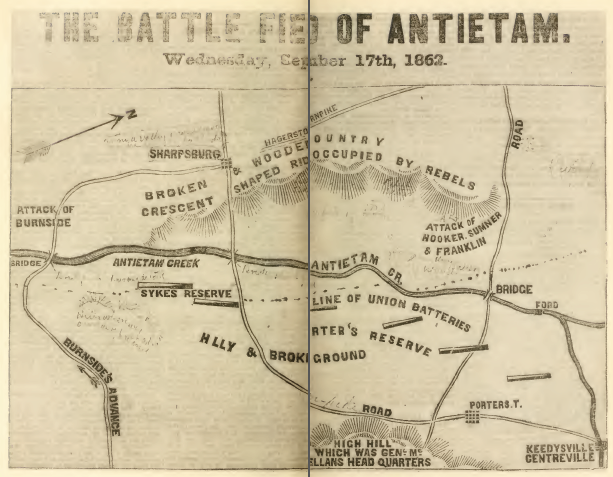
On the map you will see the crescent-shaped ridge occupied by the rebels. Now imagine this long ridge overlooking a hilly and open country in front, which country is full of ravines and cornfields, but free from woods, and lower, mind, than the ridge. The ridge itself is wooded on its summit on the right of Sharpsburg, the Hagerstown pike running parallel and in front of the woods. On the left of Sharpsburg the ridge is mostly free from woods. All that we could see of Sharpsburg was two steeples, the rest of the town being hidden in the valley beyond the ridge. All along this ridge the rebels had batteries placed, both on the right and left of the road. Their infantry, according to their custom, was hidden in the woods. Our batteries were, except on the extreme right, placed on a line of hills parallel to the Antietam, and on the south of it. Our infantry held about the line I have marked in ink. The attack began early in the morning, the artillery on both sides firing rapidly at each other. Soon the musketry on the right grew loud and furious, and we could see our whole line advancing slowly but surely. You see A. That is a school-house in the edge of the wood held by the rebels. Our line advanced nearly up to that, and crept through the cornfield C until they came onto the crest of the hill, where a furious fire from infantry and artillery opened on them, which after a few minutes drove our men back in disorder. It was a dreadful sight, and it made me feel badly, I can tell you. All along the hillside black specks could be seen which we well knew were the dead and wounded on our side. Soon our men rallied, and fresh troops came up and deployed more to the left of the cornfield C. Again we advanced, and this time I could see the rebels run from the cornfield D. Meanwhile Burnside tried to cross the bridge on the left of the map, and after great loss charged across the bridge and took it. He advanced about a mile, but was driven back about half the distance. So it was throughout the whole day. We would advance and get driven back, but would again advance, and the rebels run. Our men on the right broke four times, but were four times rallied, and finally kept the ground they had gained. Very little firing was done in the centre, except artillery. There was one mighty plucky battery on the right. It kept pushing forward, whenever it could get a chance, and banging away at the enemy. Finally it got near D, and there it had three batteries firing on it, with a cross fire. They stood it some time, but finally had to give way, leaving two caissons. As soon as they had got their guns in a safe place, back they went for their caissons and got them away safely. It was a plucky thing and well done.
Headquarters 5th Army Corps,
Camp near Shepardstown, Sept. 22.
Dear Father, — . . . The enemy are still on the opposite side of the river and I do not know what measures will be taken to drive them off. Meanwhile we are getting a day’s rest, which every one needs badly enough. I am in the saddle almost all the time, and have very few chances to write. I feel so tired after coming in at night, that I go to bed instantly.
We have four guns here at headquarters which were taken the other evening from the other side of the Potomac. One of them is a gun taken from Griffin’s Battery at Bull Run No. 1. Griffin, who is now a general in the corps, is well pleased at getting the gun back, and is going to have it placed with his old battery.
I went over the river this afternoon with a message to Colonel Webb, who was over there with a flag of truce. We sent over some paroled prisoners and also applied for leave to bury our dead, who were killed in the skirmish on that side. I saw Colonel Lee,[1] who was in College with me, being in the class of ’58. He now commands the 9th Virginia Cavalry. He said that their men behaved disgracefully in the fight of September 17 and ran like sheep. He gave as the reason, that they were starved and had nothing to eat. When the 4th Michigan crossed the river the other evening, he said, they drove a whole brigade of rebels, who ran shamefully. These are Colonel Lee’s own words. He also said that the rebels deserted 27 guns that evening, of which we got four, not knowing where the rest were. There is no doubt that the rebels are mighty hard up for food and clothing. There were some forty of our dead there, and all of them had their shoes taken and pockets rifled. The faces of the dead were horrible. Some could hardly be distinguished from negroes, their faces were so black. I had charge of burying a good many of them. There are some 1200 rebels wounded, in the barns and hospitals around here, most of whom will be paroled. . . .
I have every reason to think General Porter is satisfied with me, from the messages he intrusts to me, many of which are very important.
Headquarters 5th Army Corps,
Camp near Sharpsburg, Sept. 18
Dear Father, – I just write you a few lines to let you
know that I am all right so far. Yesterday we had a terrible battle[1] in which we drove the enemy along the whole line. The severe fighting was on the right and left. The centre was slightly engaged. We were in the centre and in the reserve and were not actively engaged. From a hill where we were the whole day we had a fine view of the right and most of the centre. I carried several dispatches during the day. To-day we have been getting up ammunition, etc., and also some 10,000 fresh troops. The enemy greatly outnumber us, but the men are confident and in good spirits. To-morrow a great battle will probably come off, and I hope we shall be successful. . . .
Frank Balch was in the fight yesterday, I suppose. I have not been able to see him yet. . . .
We lost 8 generals yesterday, killed and wounded. . .
[1] The battle of Antietam, or Sharpsburg as it is called in the South.
Leesborough, Sept. 12, 1862.
Headquarters 5th Army Corps.
Dear Father, — . . . We received orders this morning to join General McClellan, and set out on our way about nine o’clock. Our destination is Brookville.
I suppose you have seen General Pope’s report of the battle. He wrote it apparently for the purpose of laying the blame of his own incompetency and mismanagement on General Porter. General Porter luckily has the written orders from Pope, which will completely use him up. . .
Sept. 10.
Pope, I think, must have given up all idea of bringing any charges against General Porter, for I hear no more said about them. . . .
General Porter has charge of all the forts from Fort Bennett to Fort Ellsworth, inclusive. I have had a great deal of riding to do, between the forts, picking out encampments, etc. We moved here to Arlington House from Fort Corcoran yesterday, and shall probably stay here for some time. I think I shall have a commission as first lieutenant in my regiment soon. . . .
We have a very pleasant officer here as chief of staff, Lieutenant Colonel Webb of the regular army, — a very gentlemanly officer. . . .
Headquarters 5th Army Corps,
Camp at Hall’s Hill, Sept. 6, 1862.
Dear Father, — The report is that Generals Porter and Franklin are relieved of the command of their respective corps, until charges are tried which are preferred against them by General Pope. Pope will probably try to blame Porter, and lay the blame of the whole matter on him, on the ground of disobedience of orders. General Porter disobeyed no orders, and if these stories are true, in regard to his being relieved of command, why I have no fear of the result of any court-martial. It will only turn out to the disadvantage of Pope. You cannot conceive of the intense feeling against Pope, McDowell and Stanton.
Meanwhile the enemy are advancing into Maryland, and there will soon be a bloody struggle there, I suppose.
They annoy us very little in front, and are waiting, I suppose, for the force in Maryland to operate.
I am in perfectly good health, and find that out-door life agrees with me.
 Follow on facebook
 RSS
RSS email
email