Following the American Civil War Sesquicentennial with day by day writings of the time, currently 1863.

War diary and letters of Stephen Minot Weld

Headquarters 5th Army Corps,
Camp at Hall’s Hill, Va., Sept. 4, 1862.

Dear Father, — We have at length, after fighting over a year, reached Washington, and are as badly off as we were a. year ago. Here we are encamped in the identical spot we were last March when we started off on our way to Richmond. And now what is this owing to? Simply to the interference of the Abolitionists and politicians with McClellan. They bothered him, and interfered with him until they compelled him to retreat from his near position to Richmond, and finally made him come up here, when he offered to take Richmond with 25,000 more men. He, however, pushed his troops on to Pope’s assistance with all the rapidity he could. Pope marched us and countermarched us, and wore us out by his marches, then let the enemy get between us and Washington and capture three new and complete batteries from off the cars at Manassas, in addition to any number of things which they wanted. They also cut off our supplies. Pope then goes hunting in the wrong direction for the enemy, and finally finds him at Bull Run. Here he pushes our corps from a strong position into the woods, where we are butchered and fall back, protected alone by our artillery. The left is turned, and were it not for the assistance of Sykes’s division of Regulars in Porter’s corps, the whole army would have been cut to pieces. We are compelled to leave the field with a loss of some thousands, and retire to Centreville. Pope waits here while all the generals tell him that the enemy will surround him. He wanted to get all McClellan’s troops and be in complete command of them. He gets them and retreats for Washington, being nearly cut off on his way. When near Chain Bridge McClellan comes out to meet the weary discouraged soldiers. Such cheers I never heard before, and were never heard in Pope’s army. Way off in the distance as he passed the different corps we could hear them cheer him. Every one felt happy and jolly. We felt there was some chance for Washington. The President and Halleck, after taking away his army and leaving him two thousand men and a battery, and after he had sent in his resignation, were compelled to go and see him and ask him to take command, as he was the only man who could then save the country. Two days before, when he heard his own troops engaged in battle and he wished to go out and see them, as a spectator, leave was refused him. Pope deceived the President and General Halleck by his lying dispatches. I only hope that they did not find it out too late.

I am perfectly well. . . .

[The beginning of the next letter is lost, but I remember the circumstances which occasioned it. Colonel Webb, of McClellan’s staff, came up to see the Army, and he was invited to breakfast by Ruggles, who was on Pope’s staff. The rest explains itself.]

. . . Webb was quite hungry. Pretty soon he saw Pope call Ruggles aside and begin to scold at him. He thought from Pope’s manner that he was displeased at Ruggles asking him to breakfast, and so he took up his hat and bid them good morning. Ruggles came up to him and said: “The truth is, Webb, that General Pope don’t like my asking you to breakfast. He says that he won’t have any of General McClellan’s staff at his table.”Pretty small for Pope.

There is a rumor that General Porter is to take command of the Army of the Potomac. I hope it is so.

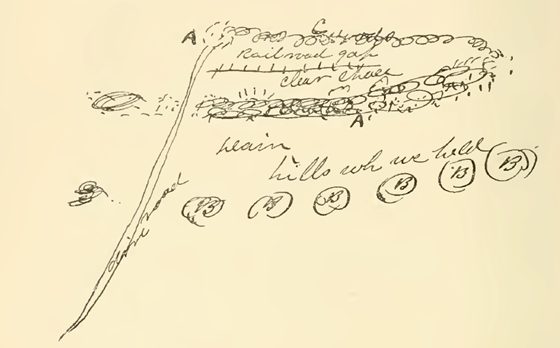
In regard to my being rash in going out so far that day, I wish to say a few words. I have always made it my intention to do everything the general has told me to do, and not come back and tell him that I could not find any one I was sent for or do anything I was sent to do. So this time I did not want to come back and tell him that I could not find the rear guard. The position of some of our troops and of the enemies’ batteries confused me, and made me go out too far. I will try and give you the position of our forces on the 2nd Bull Run field.

A was where the enemy had a battery placed during the day, that fired at us and finally withdrew, leaving only two pieces there. We advanced from the hills, B , and went across the plain into the woods A’. The enemy had a strong force in the woods C, and in the railroad gap in which they were posted. We tried to advance from the woods A’ across to C, and were repulsed by a terrible fire of grape, canister and musketry which mowed down the men like sheep. They had their batteries posted along the edge of woods C, and got a cross fire on us. The railroad gap served as a breastwork for them. Our left was turned by them and we were compelled to retreat to another range of hills behind the first, where towards night they were held in check by the Regulars, and time given us to retreat to Centreville, which was done in good order.

image

Some of the troops straggled dreadfully, but were all picked up by Franklin’s division. I will get a map of the country and show it to you as soon as I can. The general and staff were in the skirt of woods A; and when the enemy began shelling, it was a hot place. Their case-shot would burst and come whizzing around us, knocking the dust up under our horses and on all sides of us. Then would come the sharp zip of the bullet, and the fearful screech of the shot and shell. I saw at least a dozen round shot and pieces of shell, come flying towards us, and then only could one get an idea of the fearful force with which they were propelled. To see this dark object come by like a flash, strike the ground, and go ricochetting along with enormous bounds was fearful. Then our artillery on the hills B would open and the noise of the cannon, the whizzing of the shot and the sharp buzz of the bullets seemed to make the place a perfect hell. I saw more than a half a dozen men knocked down by these round shot but not injured, the ball knocking the ground from under them or covering [them] with dirt. After a while the wounded men who could walk came straggling out, and others were carried by their comrades. Soon well ones came running out by squads, and the general sent me to General Bayard of the cavalry to order him to form a line and stop them. We soon, however, had to abandon our position and fall back to the hills. Two batteries were lost during the fight, none of them from our corps. . . .

Centreville, Aug. 31, 1862.

Dear Father, — We had a severe battle at Bull Run yesterday, and were obliged to retire to this place. The retreat was conducted in good order, and without the loss of wagons, etc. General Porter’s corps did most of the fighting. Pope made a complete muddle of the whole affair and ordered us into a place where we were hit hard. I can only thank God that I got out safe. We were under a very severe fire of musketry, round shot, shell and case-shot. My horse was slightly wounded in the leg by a musket shot. If we ever reach Washington in safety, it will be more than I expect.

Pope has blundered terribly. He let Jackson get between him and Washington, destroy any number of cars and the railroad track at Manassas Junction and the telegraph. Jackson then went to Centreville, then to Bull Run. Ewell[1] is killed on the rebel side. Lee commanded the rebel centre where we attacked. Pope knows he is dead if he retreats to Washington and so he keeps us here, where the enemy may cut off our supplies. The place itself is very strong and we occupy the enemy’s old works. . . .


[1] This was a mistake. Ewell lost a leg on August 28, but was not killed.

Warrenton Junction, Aug. 27.

Dear Father, — We arrived here this morning and find that the enemy are at Manassas Gap, between us and Washington. General Pope, in my opinion, is a complete failure. He can handle 10,000 men, but no more. We still have communication with Washington via Aquia Creek. I hope we shall see a successful issue to this trouble.

Headquarters 5th Army Corps, Aug. 26,1862.
Camp five miles from Bealeton.

Dear Mother, — . . . We are continually on the go now, and are guarding several of the fords through the Rappahannock. Griffin’s brigade is at Barrett’s Ford some eleven miles from here. Butterfield and Martindale are at Kelly’s Ford six miles from here, and Sykes’s division is with us on the way to Rappahannock Station, where the Orange and Alexandria R.R. crosses the Rappahannock River. The first three brigades (Griffin’s, Butterfield’s, and Martindale’s) compose More11’s (Porter’s old) division. The corps has quite a long line to guard. Sumner, however, is landing his corps to-day at Aquia Creek and will soon join us. Heinzelman went to Alexandria and part of his force is 5 miles from us. Franklin lands at Alexandria and marches up to join Pope. Keyes stops to guard the Peninsula. You now know where McClellan’s army is. Burnside came to Aquia Creek with 7000 men; 5000 of them are with Pope and the remainder with General Burnside at Falmouth. To-day I was in the saddle at seven o’clock A.M. and out at 4 o’clock P.M., having ridden all over the country with the general. As a general thing the country is barren, stony, and unproductive. There arc some five or six gold mines round here, which were worked by New York companies but which do not amount to much.

I am remarkably well, and grow stronger every day. . . .

Headquarters 5th Army Corps, Camp near Falmouth, Aug. 23.

Dearest Family, Father, Mother, Sisters, Brothers, Etc. —

We arrived here from Fortress Monroe day before yesterday, and our whole command has gone to Barrett’s Ford some ten miles from here up the Rappahannock. We follow this afternoon or evening.

We are encamped on Major Lynch’s grounds right opposite Fredericksburg. The house is a splendid brick mansion beautifully situated on the banks of the Rappahannock. Terraces slope down to the river, and beautiful trees keep off the burning rays of the sun. The proprietor, of course, is in the Secesh army, and has left his place deserted. Our troops are encamped all over his grounds, and Major General Burnside and Major General Porter have pitched their tents close to the house. I was introduced to General Burnside yesterday, and found him very pleasant.

We have a very pretty view of Fredericksburg from here. It seems to be the picture of peace and quietness, and is a very pretty little town.

I was sent by General Porter down to Fortress Monroe, and was to meet him there, but by some mistake missed him, and was obliged to follow after him in another steamer. I came from Aquia Creek here by railroad,— a distance of 13 miles. . . .

Heavy firing was heard from Pope yesterday and this morning. We have not heard the result as yet.’[1] . .


[1] The fighting was practically continuous along the line of the Rappahannock during the last half of August.

Headquarters 5th Army Corps, Camp at Newport News, August 19.

Dear Hannah, — I have had no chance to write since my first letter to Father as the army has been in motion since that time. We left Harrison’s Landing on Thursday, 8 P.M., and reached Barrett’s Ford on the Chickahominy, a distance of twenty miles, by 7 o’clock the next morning. We crossed the Chickahominy on the pontoon bridge just constructed, 2000 feet in length, and camped on this side. Saturday at 4 A.M. we started for Williamsburg, about 12 miles distant, and made our headquarters in the President’s house at William and Mary’s College. Williamsburg is an old-fashioned city of 4000 inhabitants, although now mostly deserted. Sunday at 6 P.M. we started for Yorktown, 14 miles off, and from there pushed on to Newport News, 28 miles, reaching here at 8 o’clock yesterday morning. The whole army is now across the Chickahominy and the bridge taken up. I am somewhat tired, but in other respects perfectly well.

Prison life did not leave any bad effects upon me, except the natural one of weakness. I was well all the time, with the exception of some slight eruption, which broke out on my body, probably a mild form of scurvy. My chief annoyance was from the lice. Every morning for over six weeks I looked over my clothes carefully, and as regularly found two or three of the disgusting old fellows, besides any amount of nits and young ones. The building was full of them and whenever any one hammered on the floor above, down came the lice. I have always had a great horror of them, and found them rather hard to bear. All the officers were in the same condition. Our life was the same from one day’s end to another. Our mess (No. 2) took breakfast at 7.30. We had sour bread, coffee made from rye and bought (75 cts. lb.) by ourselves. Then we would read or play cards or go to sleep during the forenoon until 1 o’clock, when we dined on bread and greasy soup. The afternoon was spent in much the same way as the morning. Supper we took at 6, and at 9 went to bed.

I don’t want Father to send my horse on. I shall buy one on here. As soon as I can get a chance I shall have my things sent on to me, but at present I don’t know where to have them sent to. I think we shall go to Aquia Creek. We probably go on board to-night.

I have not heard from home yet and do not know why letters do not come. I hope you are all well. I was very anxious while in prison until I heard from the general that Father was well and relieved of all anxiety about me. . . .

Headquarters Porter’s Corps,
Camp near Harrison’s Landing [Aug., ’62].

Dear Father, — Here I am, thank Heaven, under the Stars and Stripes again, ready and willing to go at my duty. I reached here this morning at 7.30 o’clock, having left Aiken’s Landing on the James River at 4 o’clock A.M., coming down on board the steamer Ariel.

After many disappointments and delays we left the Libby Prison at Richmond yesterday at 12 o’clock. Though the sun was at its hottest heat, and pouring down its literally burning rays, and although we had to march fifteen miles on foot, I doubt if there was one officer among the one hundred and fifty who was not glad and willing to start at that precise moment in preference to any other, and undergo the fatigue and labor of the march for the sake of getting away from that vile prison. We started off at a smart pace, too much so indeed, but every one was anxious to get away as soon as possible. We marched steadily for three miles and then made a halt at a bridge. Almost every one was tired out by that time, and several were even in danger of being sun-struck. After going a quarter of a mile farther, the officer in charge found it necessary to halt at a house surrounded by trees, the officers being completely used up. He determined luckily to wait until five o’clock before starting again, by which time the sun would be less powerful. The field officers and the sick, who were in wagons, soon caught up with us, and got out to enjoy the shade. We waited till 3.30, when the sun became clouded, and the air cooler. I was completely used up, the skin being worn off my foot by the chafing of my boot. I got into one of the wagons and off we started again. Soon a strong wind came up, completely enveloping us in a cloud of dust, of a thicker and dirtier nature than I have ever known before. Soon, however, rain came, and made the travelling quite pleasant. We went by the Drewry’s Bluff road, and passed by some dozen works on that road alone, besides seeing as many more on the other side of the river. Our route lay along the river part of the way, although we were led some four miles away from our course, in order that we might not see some new works they were making. The country was rich and fertile, and was planted entirely with corn, which was in very good condition. By eight o’clock we reached Aiken’s Landing, and were transferred to the steamer without giving any parole, and without any conditions. Our exchange is complete at 12 o’clock to-day. We slept on board the steamer and started early this morning. I walked up to headquarters and was very kindly welcomed by the general and staff. The general has been very kind to me, having written me that you were all well, and relieved of all anxiety for me. He also sent me $25.50, which was very acceptable. $12.50 was in gold, worth about $25.00 in Confederate notes.

In regard to my treatment in Richmond, I met with very kind treatment from the officer in charge, Lieutenant Trabue. The first officer who had charge of us, Captain William Read, was as conceited a puppy as ever lived. He was impudent to the officers, and was consequently removed. Trabue then had charge of us and was very kind and obliging. He was removed, however, on account of the escape of five officers, three of whom made good their escape, and two were recaptured. We then were more strictly guarded and the privilege of getting spring water refused us, although this was partially restored to us again. Most of the officers who had anything to do with us, treated us personally in a very kind manner, but their government treated us quite harshly. The only food furnished us was sour bread, meat, and salt, and at times a little vinegar. The meat was made into greasy soup, entirely unfit for a human being’s stomach. If we had not had some money, we should have starved. I had only one dollar when I reached Richmond, but I met with an officer who lent me twenty-two dollars, and when that was used up, I sold my rubber coat, which cost me $6, for $15. Then I also received $25 from the general, $9.50 of which I gave to Harry Russell,[1] who was taken prisoner by Ewell or Jackson last Saturday. All Pope’s officers, 30 in number, taken on Saturday, were treated shamefully. They live in a room with the privates and are allowed nothing but bread and meat, and are not permitted to buy anything outside. No blankets are given them, but when I went away I sent Harry Russell my bed and blanket. I was not allowed to see him, but received a short note from him, in which he said he was well, and I also heard that he was well and uninjured from officers who saw him. I shall write Mr. Shaw about his being captured. Harry R. said in his note to me that Major Savage was wounded in arm and leg and taken prisoner. When I went away I sent Russell all the money I had. I will enclose the note, which I received from him. His order on Mr. Shaw was his own idea, of course, and not mine. I shall write Mr. Shaw and let him know that Harry is well.

I send you a list of the prices of articles of food in Richmond. Butter, $1 per lb. Apples, $.50 to $1.00 a doz. Eggs, $1.00 per doz. Molasses, $.75 per pint. Sugar, $.75 per lb. Cherries, 50 cts. per quart. Potatoes, 30 cts. per quart. Coffee, $2.50 per lb.; and rye coffee, $.75 per lb. Tea, $16.00 per lb.

On my way from Richmond I saw Merrimac No. 2, lying at the Rockets just below. She must be very nearly finished. She was covered like the roof of a house and will be a formidable antagonist if she ever succeeds in getting out. We were kept in the Libby Prison for a week, and were then moved to a building on 18th St., where there were splendid opportunities for escaping. I bought me a Secesh uniform and should have tried it if we had not received the news of the exchange. There were five or six Union families within a stone’s throw of our prison, and we used to converse with them by the dumb alphabet and by writing on boards, etc. The officers frequently went out nights through a hole made in a fence separating another building from ours, and came back again after walking about the city. I will give you an account of my imprisonment at greater length, in a few days.

General Porter has been away all the day and will not return till morning. Even if he should offer me a furlough I should not take it while there was any chance of a move. I think we shall move in a few days, but I think it will be towards Fortress Monroe. . . .


[1] The late Col. Henry S. Russell, for many years Fire Commissioner of Boston.
Richmond, July 31, 1862. Prison on 18th St.

Dear Father, — Time goes rather slowly here, as we expect to be released soon, and find the waiting for the lucky day tedious. However, we manage to do pretty well, and with the help of books and cards, make the hours pass more quickly than they would if we did not have the above-mentioned articles.

In the evening we have lectures delivered by some of the officers here, which are very interesting. Morning and evening religious exercises are held.

We have the papers every day, and find quotations from Northern papers, which give us some information of what is going on in the world.

I received a letter from General Porter in which he very kindly offered to send me money or clothing. He relieved my mind very much by telling me that all were well at home, and free from anxiety on my account. I am perfectly well. Love to all.

Libby’s Prison, July 1, 1862.

Dear Father, — I was taken by the skirmishers of the 3th Virginia regiment on the morning of last Friday.

I got right in their midst while looking for General Reynolds’s brigade. I am well treated and in good health. There are about 100 of us officers in a room about 70 by 50 feet. Colonels Corcoran and Ely were confined here at one time.

You need not feel at all anxious about me. If you get a good chance, send me $50 in gold and silver, half of each. I have but three cents left, having but a dollar on me when taken.