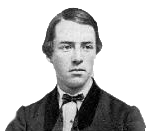
Saturday, November 2. — The storm continued all day, but it reached its height last night between 12 and 3, so that to-day towards evening it moderated a little. Many of the people were seasick, and I myself barely escaped being so. In the afternoon we steered west, in the direction of Brunswick, Georgia. We lay to most of the night. We left the Gulf Stream to-day, and the change from the warm air to the colder was very marked. The fleet is all scattered, and but four are now in sight. Our sealed orders were opened to-day.
War diary and letters of Stephen Minot Weld
Friday, November 1 . — There was a rainbow early this morning, and the old adage that “a rainbow in the morning is the sailor’s warning” was well carried out; for about ten o’clock it clouded up, and in an hour we had a strong breeze blowing, which soon turned into a gale. It blew hard all night, and I surely thought we were going to the bottom. One sea which broke over the ship killed one of Captain Hascall’s horses. I did not go below during the whole night. I am afraid the Governor and some other vessels are lost. We parted with our tow this evening. I never passed such a horrible night in my life. I had fully made up my mind to be drowned, but suspense was dreadful. The wind would blow and shriek through the rigging till it seemed as if it could blow no harder; and when I thought it was at its height, it would scream and whistle more than ever. There was something terrible to me in the waves, which were enormously high, and only rendered visible by the phosphorescent light on the tops of them. At times it would rain so that one could not see, and the gangways would be full of water dashing hither and thither with the motion of the ship, until it seemed as if we were full of water and were going to sink immediately. The drum-major of the regiment exhibited such cowardice that it was disgusting to see him. I was glad to see daylight as the sea grew calmer. We were in Long, 77° 53′ and Lat. 33° 01′ at noon.
Thursday, October 31. — This morning about 2.30 o’clock I was waked up by the ship’s shaking, jarring, groaning, and screeching generally. I at first thought we had been struck by a heavy sea, but a second shock, following soon after the first, convinced me that I was wrong. At the second shock I called Saxton and asked him what the matter was, and we both jumped out of bed, I running into the saloon to see what had happened, and Saxton lighting the candle. The saloon was full of people, excited and running around, but still not noisy. I found out from the hospital steward that the ship was aground. All the while we were bumping heavily, causing the ship to groan and creak in every timber. I must confess that a dreadful shudder ran through me at the idea of being drowned, for so it seemed to me must be the fate of every one on board, as the night was dark and the sea rough. I thought, however, that it would do no good to be frightened, so I put on my trousers, shoes, and coat, then took my watch and ring from under my pillow, and finally took the cork life-preserver from under the bed, and fixed it so that I could slip it on at a minute’s notice, I then left it on my bed, and went up on deck to see how we were getting on. When I reached the deck, the bumping had ceased, and the ship had backed off safely. The pumps were sounded, and everything found snug and tight, much to my delight as well as that of others.
When we struck, the concussion was so severe as to throw several people out of their berths, and those on deck were thrown several feet. We sent up rockets as signals of distress, and as a warning to other vessels of the fleet. Pretty soon the Coatzacoalcos came along, and asked us if we wanted any assistance. We told her we were all right, and she then informed us that the Illinois had also grounded, but had got off without injury. She had been obliged to cut loose the ship which she was towing, which we also had to do, our ship barely grazing our starboard wheelhouse. We backed for some distance, and then steered due East. I went to bed at four and slept till six, when I got up and dressed myself. I saw our ship, the Ocean Express, on our port bow, and about ten o’clock we fastened our tow line to her.
In regard to the behavior of the passengers of the ship, I think it should be praised as a general thing. Most of them were calm and quiet, although some of them made fools of themselves. Captain Comstock says we had a very narrow escape indeed, one of the most wonderful on record. The wind luckily had subsided, and the sea was, compared with the evening before, quite calm. No one seemed to know what shoal we struck, although it afterwards turned out to be the Outer Hatteras Shoal. There must have been some gross negligence, to say the least, in our getting on the shoal, and from all I can learn, the Wabash was to blame, as she at ten last evening gave us the course to steer, which we followed strictly, and consequently ran aground. Hubbell and the second mate, Hallet, saw breakers ahead about three minutes before we struck and told the captain of it. He said it was impossible, and was just going forward when she struck. The captain says the waves were as high as the yards, and that the shoal must have been steep and precipitous on its sides as otherwise we should have struck amidships, and been “hogged.” Lieutenant Richardson, the officer of the day, behaved nobly. He told all the sentinels to do their duty, and stick the first man who came up, while he stood at the head of the stairs with a loaded pistol, and told them he would shoot the first man who tried to pass him. The captain was thus enabled to work the ship easily, which would have been impossible with all the soldiers on deck.
We saw the Illinois with one smoke-stack broken off by her ship running into her, but she has now repaired it. The fleet is either all scattered or else we are away from it, and the latter proves to be the case. I should think that more than two vessels must have struck the shoal. The war-steamer Bienville, blockading off Hatteras Inlet, chased us this morning to ask if we had seen the Wabash. The Bienville also said she went ashore last night on the same shoal. In the afternoon the Atlantic spoke us, steaming back to hurry up the rest of the fleet. She said the Wabash was ahead of us, much to our gratification as we were afraid that a great part of the fleet had been lost on the shoal. A soldier who died of brain fever was buried this evening, and services were held on deck.
Wednesday, October 30. — The day was beautiful and pleasant. The air was soft and balmy, as we had just struck the Gulf Stream, and the temperature of the water was 74 degrees. We had to go as slowly as possible, as we did yesterday, in order to keep with the rest of the fleet. The fleet kept nearer each other, and in better order than yesterday. According to the pilot we were off Cape Hatteras at 2 p.m. We found out however, as events showed, that we did not take sufficient account of our slow rate of speed, and of the Gulf Stream. Nothing of any particular interest occurred during the day. I saw nothing of the ferry-boats. It was so rough that some of them must have gone in nearer to the shore.
Tuesday, October 29. — Off at last. Last night we steamed out towards the sea about four miles, and then anchored. This morning I was waked up about 6 o’clock by the moving of the paddle-wheels. By the time I was up and dressed, which was about 8 o’clock, I found that we had at last fastened our tow-line to the Ocean Express, and about ten we started slowly on our way, with the most delightful weather imaginable, the air being warmer than it had been for some days previous, and the sea being moderately calm. When we passed Cape Henry we could see the lighthouse standing up boldly on a barren sand-hill, and no signs of civilization visible except two small huts, situated at the foot of the light- house. To make the place seem still more desolate than nature had made it, a wrecked schooner could be plainly seen about half a mile from the lighthouse, a monument of the wickedness of these rebels who destroy lighthouses as well as try to destroy their government. The cape is a barren, desolate spot, with high sand-hills rising up in the background, and gradually decreasing in size until they terminate in a narrow sand-spit. We passed within two miles, and might easily have been disabled by a battery placed there. The sight of so many vessels leaving the port at once, with different colored flags on their masts as signals or to denote their names, was a most beautiful one. When we had passed the cape, our tow-line parted, repairing which delayed us about an hour. We finally got off at two o’clock, proceeding as slowly as possible all the afternoon, in order to keep with the rest of the fleet.
The sea was pretty rough all the day, but most of the ships stood it well except the ferry-boats. In the evening different signals were displayed from the war-ships, of red, white, blue, and green lights, which looked very prettily, flashing up as they did on all sides of us. I spoke to Captain Hascall about getting me a place on General Wright’s staff as volunteer aide. A society was formed for the “confusion of useless knowledge” the other evening, and we had a meeting this evening.
Monday, October 21. — We again started this morning for Fortress Monroe, and as we proceeded had a calmer sea. When I got up this morning, I had my first taste of seasickness, owing to the closeness of my state-room. My chum refuses to have the window open, and the consequence is we have more foul air in the room than is pleasant for me. I was soon well, however, after getting on deck, although I carefully and secretly looked over the railing into the sea, and gave Davy Jones a scanty offering. It was amusing to see the soldiers sick and vomiting, especially after I was well. We arrived at the fort about 10 a.m., and anchored near the Atlantic. As nothing particularly interesting happened while we were here, I shall just jot down a few events interesting to myself only. I went ashore and walked all over the fortress, and all around the walls. There is a ditch all around the fort, and on some sides a water battery on the outside of it. There is one tier of guns in casemates, and one en barbette. On the sea side, outside of the walls, is the Floyd gun mounted, and the Union gun ready to mount, both of them remarkable only on account of their size. The fort is connected with the mainland by two sandy necks of land, between which is a large body of water which has access to the ocean by a channel running through one of these necks, and over which a new bridge has lately been built. This last-named neck is the one by which they go to Hampton and the mainland. The interior of the fort is quite pretty, trees growing there, and walks being laid out very much like a park. There are several houses here, and also a church. A man might make himself very comfortable here, in my opinion.
I walked over to the place where most of our troops are encamped, which lies between Hampton and the fort, and which is approached by the neck before referred to. I went to the camp of the 16th Massachusetts, and saw Waldo Merriam, the adjutant, and Bill Amory of Jamaica Plain. I had a very pleasant time, and was delighted to see old faces again. I saw a very good dress-parade, and returned to the fort again, passing through the camp of the Naval Brigade, Colonel Wardrop. I spent the night at the Hygeia Hotel, most of which is used as a hospital for our troops. Just as I had gone to sleep I was waked up by the most fearful succession of screams I ever heard in my life. It turned out to be a sick soldier in the hospital who was having his wounds dressed. The next morning I met Harry Fisher, captain’s clerk on board the Minnesota, and went with him on board of her. I was well paid, too, for a more beautiful and clean-looking ship I never saw. The decks looked clean enough to eat one’s meal off of, and the long line of guns on each side, all polished and in perfect order, seemed eager to bestow a few compliments on any rebel or enemy who might make his appearance. Hubbell went with me, and was also much pleased with the ship. I saw Captain Van Brunt[1] on board, looking as well as ever.
We waited here at Hampton Roads for a week, anxiously expecting orders to sail, and growing at times despondent and gloomy about the success of the expedition. Then, to make us still more gloomy, reports were flying about of the desertion of the commodore’s private secretary, with important papers, containing the secret naval signals, our place of destination, etc. To crown the whole, and plunge us still deeper into despair, we heard of the battle of Ball’s Bluff, and of the defeat of our forces. The news of Putnam’s death, of Holmes[2] being wounded, etc., made me feel the reality of the war, which is a hard thing to bring home to one’s self until one loses a friend, or meets with some such mishap. However, as the ships began to get up steam, and as various other little matters showed that we were going to start soon, our fears and despondent feelings began to give way to a more cheerful state of mind, and when we were actually under way every one felt buoyant and hopeful. While waiting here, one of the 7th Connecticut soldiers was drowned by jumping overboard for a plate which we had dropped. Major Pangborn, formerly editor of the Boston Bee, came on board. He is paymaster for our brigade.
Sunday, October 20. — This day passed like any other, except perhaps it was a more busy one. The baggage of the regiment was put on board, and we started on our way for Fortress Monroe at noon. We steamed down the Chesapeake, and came in sight of the Capes, when we had to anchor owing to a fog and a storm, I received a letter from John Perry, much to my delight, as he is the only one I have heard from.
Saturday, October 19. — Nothing of any interest occurred to-day. We expected our regiment to come on board and waited all day in vain. Finally, about eight o’clock P.M. they came, and to my disappointment I found they were the 4th New Hampshire regiment, as I hoped to see some Massachusetts troops. Church, the reporter of the New York Sun, and Green of the Boston Journal came on board.
Friday, October 18. — We reached Annapolis about 11 o’clock in the morning, and had to anchor in the stream about 4 miles from the city. I went ashore in the afternoon, and took a look at the city. We landed at the Naval School, and found the grounds full of troops, etc. The 21st Massachusetts, Colonel Morse, is stationed here, but I had no chance to see any of the officers. The grounds of the Naval School are quite spacious, and face the Chesapeake on one side, and the river Severn on the other. The buildings are of brick and quite substantial, though by no means handsome. Right on the water is a round building with guns mounted, which was used for the middies to practice in. On the right of this battery a long pier runs out into the river, and at the end of it, the Constitution was anchored. Uncle Oliver told me that when he came here last April, the rebels were erecting a battery on the other side of the river, and about an eighth of a mile distant, to destroy the Constitution. His timely arrival, however, put an end to their villainous schemes, by taking the ship and school away. The professors’ houses were built in a row on the right side of the ground.
Having procured a pass, we got outside the grounds, and into the city, the capital of Maryland. The streets were in a terrible state from the rain, which made a horrible clayey sort of mud, much to the detriment of our shoes, which were soon covered with a good coat of this Maryland blacking. We finally came out on a street which was roughly paved and which led us to the post-office and the hotel. I inquired for letters, but found none, and was consequently much disappointed. The next place I visited was the State House. It stands on a hill, the highest one in the town, and has a green around it. From this green the streets all diverge, making a sort of cobweb. On entering the State House, I was saluted by a young boy about ten years old, who was smoking a cigar, and who seemed to think himself the owner of the place. Accepting his services as an escort, we were shown into the Senate and House of Representatives. They were both of them ordinary-looking rooms with very common-looking pine chairs and desks. On first entering the House, the visitor sees the arms of the State staring him in the face, and the motto, “Crescite et multiplicamini,” written under them. The city, however, belies the motto as far as I could see, for it looks as if it had not increased for a century, but had stood still, and as if all its inhabitants and buildings had been enjoying a century’s rest. From the cupola I had a most magnificent view, and one which well repaid me for the trouble I had in getting ashore. Close around me was the town, with its quaint, old-fashioned houses, with gables and over-hanging roofs, many covered with moss, and, in some cases, plants growing from the eaves. It was more like a view of an old-fashioned English town which one often sees painted on canvas in stage-scenery. Then beyond the town were fertile fields, with crops ready for gathering, and every little way, a beautiful hillock rising up, with splendid trees growing there, and the river winding among them, now sparkling like a silver cord, and now hidden from the sight. Then again, the white tents of the soldiers would peep out from the dark green of the trees, and what at first sight seemed a long fence, but on closer inspection proved to be the troops going through their dress-parade, would meet one’s view. The sight was a most beautiful one, and one which I cannot describe. The rivers on both sides of the city, with their steep banks thickly wooded, and winding so prettily among the hills, were in themselves a sufficient compensation for the climb up to the cupola. Then looking out on the Chesapeake and seeing over twenty steamers, in addition to a large number of small craft quietly at anchor in the bay, and the long blue shore of Virginia opposite, made one wish to stay forever almost, and enjoy the beautiful sight. I could hardly tear myself away; but as I had little time to waste, I soon descended.
I saw here a cannon which Lord Baltimore brought over in 1624, and which had fallen into the river and had lately been fished up. I saw Captain Eldridge and went on board the Baltic with him.
Thursday, October 17. — We passed the Capes about 10 A.M., running within two miles and a half of Cape Henry. This cape is composed of sand-hills shelving down to the beach, with nothing but a lighthouse and two small houses to be seen anywhere in the vicinity. The point is in possession of the rebels. We passed the gunboat Daylight keeping the blockade, and guarding the lightship. We saw a great many duck flying about us. About 12 we came in sight of the Rip Raps, and soon after of Fortress Monroe. The Rip Raps, a few miles off, look like a mass of stones dumped down in a heap, and on coming nearer to them, one finds that the opinion he formed of them at first sight was correct. They embrace perhaps an acre and a half to two acres, and are formed entirely of granite rocks dropped in utter disorder and confusion into the middle of Hampton Roads, and at about a mile and a half from Fortress Monroe. There are one or two small houses on it for laborers, but a more desolate hole I cannot imagine. The fortress itself cannot be seen until you are quite near it, on account of the shore being so low. We could see only two sides of it from the sea, the houses and trees on the shore hiding the rest of it. I saw the famous Sewall’s Point for the first time. The batteries are not visible, being on the other side of the point. The masts of our ships at Newport News could also be seen, some 8 miles distant. We left our ship, the Ocean Express, here, and turned round and started for Annapolis, where we were to take our troops on board. We steamed up the Chesapeake to within about 40 miles of Annapolis, and then anchored on account of the fog. We passed the mouth of the Potomac, and also those celebrated Points —
P’int Lookout, and P’int Lookin,
P’int no p’int, and p’int agin.


