12th. Snowing in morning. Blowing all day. Batt. inspection in A. M. Undress parade in P. M. Read sermon in Independent and considerable miscellaneous matter. Wrote home.


Camp In The Field,
Feb. 12, 1865.
Dear Mother:
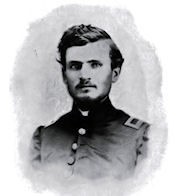
We were forced to come back from Washington by the Potomac river. There was but one Brigade in the fight [2nd Hatch’s Run] last Sunday night, the 3rd of our division. They were charged three successive times by Divisions. And a fresh division each time. It is said that Genl. Lee commanded the movements in person. They intended to break our lines and by so doing, cut off the 5th Corps, which had gone out farther on the left. But they ran foul of fighting stock and were driven back with great loss. Our artillery was placed in such a position that it cut them up terribly. Four men were found at the foot of a tree, all mangled up. The battery belonged to the “Old Bay State,” viz. 10th Mass. I did not join the regt. till Thursday; I found them in a small pine thicket. The smoke was so dense as to be able to cut in slices. Our eyes were all blood shot. The old company was right glad to see me back. Do not take what I write as self esteem! It was proposed to give me three cheers; but the plan was abandoned much to my pleasure. All the time that I was gone there had been a perfect hubbub in the company. Sergt. D. not knowing human nature, swords had to be drawn one time. It was a great pleasure to me to be welcomed back the way I was. Every one had a good word to say to me. I pray God that I may always deal with men in such a manner that I may be looked up to as one possessing a whole soul, for it is a great pleasure to one to know that he is liked. And especially one placed as I am. We have moved every day since I got back. Yesterday our regt. with the 93rd N. Y. was on fatigue, slashing timber in front of works. It was splendid wood. I cannot imagine what farmers North would say to see the whole of an immense forrest levelled in a day. We are lying now on a hill in an open field. There is a good prospect of our going in to camp, but for how long no one knows. I have found all of my things well cared for, stove and all. I have slept well since I got back. Do not, I beg of you, feel any uneasiness on my account. What ever I need I will write for. I wish you would get some yarn or worsted and get one of the Dole’s to knit me a sleeping cap; if they can’t do it, get some one else. It would be a great comfort to me to have one, I have caught a cold already. I will do the honorable when I write to them. I enjoyed my furlough hugely; but bidding you all a long farewell marred the pleasure slightly. I beg of you again, do not worry for me; although life is uncertain, it is not necessary to borrow trouble. A great many of the regiments are without officers. By the last move, our lines have been lengthened three miles. We are ignorant of the genl. result of the move. My regards to all enquiring friends, and love to all the Bradley family. Your dutiful son,
Leverett Bradley, Jr.
P. S. Captain [he always called his father that in these days], our men slightly wounded are falling off very fast. Co. B numbers only twenty-eight ready for duty. I wish you might get a place for me. I shall not expect one, because so many want them.
[He held the position of orderly sergeant, and was at many times commanding the company on account of the loss or absence of all commissioned officers.—Ed.]

February 12th.—Bright, windy, cold, and disagreeable.
There was nothing new at the department this morning. Nothing from below; nothing from South Carolina. Perhaps communications are cut between this and Charleston. All are anxious to hear the result of the anticipated battle with Sherman, for somehow all know that the order to fight him was sent from Richmond more than a week ago.
People’s thoughts very naturally now dwell upon the proximate future, and the alternatives likely to be presented in the event of the abandonment of Richmond, and consequently Virginia, by Lee’s army. Most of the male population would probably (if permitted) elect to remain at their homes, braving the fate that might await them. But the women are more patriotic, and would brave all in following the fortunes of the Confederate States Government. Is this because they do not participate in the hardships and dangers of the field? But many of our men are weary and worn, and languish for repose. These would probably remain quiescent on parole, submitting to the rule of the conqueror; but hoping still for foreign intervention or Confederate victories, and ultimate independence.
Doubtless Lee could protract the war, and, by concentrating farther South, embarrass the enemy by compelling him to maintain a longer line of communication by land and by sea, and at the same time be enabled to fall upon him, as occasion might offer, in heavier force. No doubt many would fall out of the ranks, if Virginia were abandoned; but Lee could have an army of 100,000 effective men for years.
Still, these dire necessities may not come. The slaveowners, speculators, etc., hitherto contriving to evade the service, may take the alarm at the present aspect of affairs, and both recruit and subsist the army sufficiently for victory over both Grant and Sherman; and then Richmond will be held by us, and Virginia and the Cotton States remain in our possession; and we shall have peace, for exhaustion will manifest itself in the United States.
We have dangerous discussions among our leaders, it is true; and there may be convulsions, and possibly expulsion of the men at the head of civil affairs: but the war will not be affected. Such things occurred in France at a time when the armies achieved their greatest triumphs.
One of the greatest blunders of the war was the abandonment of Norfolk; and the then Secretary of War (Randolph) is now safely in Europe. That blunder brought the enemy to the gates of the capital, and relinquished a fertile source of supplies; however, at this moment Lee is deriving some subsistence from that source by connivance with the enemy, who get our cotton and tobacco.
Another blunder was Hood’s campaign into Tennessee, allowing Sherman to raid through Georgia.
Camp Hastings, Sunday, February 12, 1865.
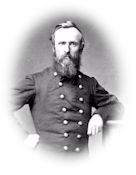
Dearest: — We reached here after a pleasant journey Thursday evening on time. No important changes here. The remnant of the unlucky Thirty-fourth is now in my camp to be consolidated with the Thirty-sixth. General Duval is quite unwell, and will go to Cincinnati to be treated for troubles affecting his hearing. General Crook has had a ball. I send you a ticket. He inquired after you all, particularly Webb and George. He is in fine health and spirits. He has become a convert to negro soldiers — thinks them better than a great part of the sort we are now getting. . . .
It is cold, windy, and snowy. My tent groans, squeaks, and flaps. The sleeping is not so comfortable as in a house these days, but is more refreshing and invigorating. The Shenandoah army is all gone. Part of Nineteenth Corps is at Savannah; the Sixth at Richmond and the most of ours. I had a brigade drill yesterday. The regiments are full, and in fine condition. The First Veterans [Twenty-third Regiment] are rather the crack men in appearance. Major Carey has resigned.
Mrs. Comly is here, that is, in town. I have not yet seen her. The cars upset with her near Newark, but she kept on this way instead of going back home. Good stuff. — Love to all.
Affectionately ever,
R.
Mrs. Hayes.
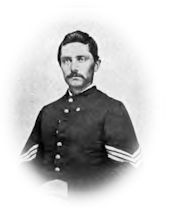
Saturday, 11th—Very pleasant weather. We started at 8 o’clock this morning and moved forward twelve miles. There was some skirmishing in front, and our forces routed the enemy from some strong positions.[1]
[1] When the Confederates had good positions, they were unable to make a strong stand and retain them. For although they could delay our army for a time at the main crossings of rivers, there was always another part of our army reaching the same river by some byroad, which after crossing would flank them, or coming up in the rear would drive them out of their defense — A. G. D.
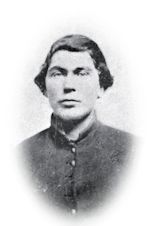
Nashville, Saturday, Feb. 11. Felt very well this morning. Heard yesterday that Benj. Hughes formerly of Spring Green, was a member of Co. E., 44th Wisconsin Infantry. Sergeant Hutchinson going there on pass, David Evans and I went along. Found the camp on College Hill three miles off. With little difficulty I spied him building a chimney. When last I saw him he was just big enough for a cow boy, but in the last four years he had goaded nature along to satisfy his patriotism so as to serve his country. Yet he was very small, but round, tough, seventeen years old. He looked much pleased to meet us, and returned with us to camp to see the rest of the boys. After dinner Griff and I visited smallpox hospital. Heard from D. J. D. but could not see him. He is yet in bed.
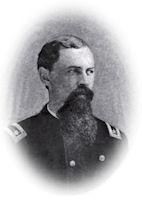
Seven miles west of Orangeburg, S. C.,
February 11, 1865.
Made 18 miles to-day. Crossed South Edisto river in rear of the corps. The river here is about 40 yards wide, with a swift current, water very clear. First 10 miles to-day was through pretty good country, the last eight miles mostly pine forest with more rolling ground than I have seen since we left the Oconee river in Georgia. Received my commission as major to-day, also two letters from you dated November 3d and January 4th. I ask pardon for thinking that you did not write regularly. The fault must be in the mails. All kinds of rumors afloat to-night of peace, war, and I don’t know what all. We came near being burned up last night, the fire crept along through the pine leaves and burned my vest, partly, and ruined my jacket, and almost spoiled my overcoat, all of which were under my head. Also burned the colonel’s pillow. The flames bursting up woke us, and I expect our first motion would have amused a very solemn man.
11th. Relieved about 11. No excitement during my tour. Billy Smith on duty with me. In evening school. Made several ignorant blunders. It vexes me to make mistakes. I wish I knew more. I am so ignorant on all subjects.
February 11th.—Cloudy and cold; froze hard last night.
Yesterday a bill was introduced into both houses of Congress authorizing the enlistment of 200,000 slaves, with consent of their owners, which will probably be amended. Mr. Miles, as a test vote, moved the rejection of the bill; and the vote not to reject it was more than two to one, an indication that it will pass.
The failure of the peace conference seems to have been made the occasion of inspiring renewed zeal and enthusiasm for the war in the United States, as well as here. So the carnival of blood will be a “success.”
The enemy claim an advantage in the late battle on the south side of the James River.
Sherman’s movements are still shrouded in mystery, and our generals seem to be waiting for a development of his intentions. Meantime he is getting nearer to Charleston, and cutting railroad communications between that city and the interior. The city is doomed, unless Hardee or Beauregard, or both, successfully take the initiative.
Here the price of slaves, men, is about $5000 Confederate States notes, or $100 in specie. A great depreciation. Before the war, they commanded ten times that price.
It is rumored that hundreds of the enemy’s transports have come into the James River. If it be Thomas’s army reinforcing Grant, Richmond is in immediate peril! Information of our numbers, condition, etc. has been, doubtless, communicated to the enemy— and our slumbering government could not be awakened!
Wigfall, of Texas, Graham, of North Carolina, Orr and Miles, of South Carolina, oppose the employment of negro troops, and Gen. Wickham, of this department, openly proclaims such a measure as the end of the Confederacy! We are upon stirring times! Senator Wigfall demands a new cabinet, etc.
Two P.M. The sun has come out; warmer. But it does not disperse the prevailing gloom. It is feared Richmond must be abandoned, and our forces concentrated farther South, where supplies may be more easily had, and where it will be a greater labor and expense for the enemy to subsist his armies.
Assistant Secretary of War, Judge Campbell, is still furloughing, detailing, and discharging men from the army; and yet he thinks the country is pretty nearly exhausted of its fighting population! His successor is not yet appointed; the sooner the better, perhaps.
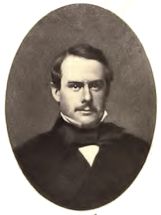
Charles Francis Adams, U.S. Minister to the U.K., to his son, Charles.
London, February 10, 1865
You ask me what effect the storming of Fort Fisher had in this country. I can only say in reply that coming as it did on the back of Sherman’s victorious march, it has for the nonce made the London Times much more respectful. At the only soiree which I have attended, the first remark a very distinguished lady to me was to congratulate me that the war was coming to an end. She had never said so before. She then commented strongly on the blundering policy of the Times which has aimed at a disruption of the Union, whilst the true interest of England should have prompted them to sustain it. She is a woman of sense, and her own opinion is worth having. But her position places her in a circle where she gets the impressions of people of higher influence in the political world. The notion that the war will not last much longer is universal. It is much strengthened by the late reports of rebels and blockade runners from the southern states. I hear all and say little, rejoice inwardly and betray no emotion.
Singularly enough, however, the public sentiment, disappointed in its, sanguine expectations of our ruin, is now taking a wholly new turn. It is whispered about that if the feud is reconciled and the Union restored, and a great army is left on our hands, the next manifestation will be one of hostility to this country. The various steps to rescind old treaty obligations, especially relating to Canada, which we have been forced to take, are cited as proof of our intentions to attack that country at once. Mr. Seward is as usual paraded as the rawhead and bloody bones before the imagination of the English people. Conscience looking back to the enormous extent to which the neutrality of the country has been abused by acts as well as expressions of sympathy with the rebels, doubtless prompts the fear of the effects of our very natural indignation. There are some who do not entirely suppress a wish that some decided course should be taken at once to ward off all these dangers. A quarrel might yet help the failing rebel cause. If it must come, the wiser way would be to provoke it at once. The only thing needed would be a pretext. And that doubtless could be readily found in the mass of complaints accumulated during the struggle. It was very certain that we had the intention very soon to press a heavy amount of claim for damages done by the Alabama, etc., which never could be allowed. Why not take ground on that subject at once?
Such is the tone of the fighting cocks! But as yet they do not venture to crow loud. The politicians are wary. Parliament will be dissolved in July. And the elections will follow. No one cares about raising a new issue. There will be a very fierce personal canvass, in which individual popularity will tell so far in many cases [as] probably to turn the scale. So far as I can observe, I think there is even more timidity here than there is with our members of Congress in advance of an election. Hence I scarcely imagine the martial tone to be likely to be heard. Very certainly not, if nothing turns up to excite the popular passions on any question. After the seats are won and seven years of tenure are in prospect, the case may be altered. Then there may be bolder utterances. Meanwhile, however, events move fast in America. The thinner ranks of the rebel armies show no signs of recuperation. Their paper money is dear at the price of old rags, for it does not pay for the making. And the heart that upheld them is gone. This stage of the disease cannot last any great length of time. There must be some relief or the collapse is at hand. I doubt whether the allies on this side will be able to stretch out a helping hand in season.
Such is the precise condition of opinion at the moment, caused by the last news of the storming of Fort Fisher ! .. .


