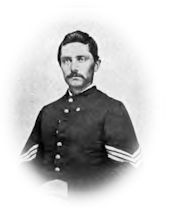
Tuesday, 7th—We had another all day, cold, drizzling rain. We left our bivouac at 7 o’clock and after marching fourteen miles stopped for the night. With every mile the road got better as we moved upon higher ground, and the forage also became more plentiful. Just after we had stacked arms to go into bivouac, our regiment was ordered to fall in again. We marched out on the Augusta and Charleston railroad to burn the bridge over the Edisto river, but the pickets, on hearing our approach, for it was too dark to see anything, all hastened across the bridge and set fire to it themselves. This saved us the trouble and we went back, reaching our bivouac about midnight, after marching in all about ten miles.

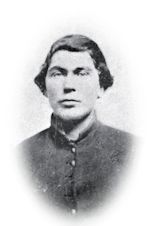
Nashville, Tuesday, Feb. 7. The ground is covered with two inches of snow and everything frozen hard, very cold. Feel very well except a severe cold that has been on me for a week. Our boys are doing guard duty with muskets in town, that they drew the day I left. Twelve men go to town every day. They do it with ill grace. Half of them return to camp ere their tour is half out.
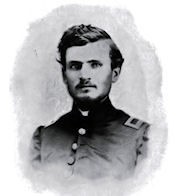
7th. Great snow storm. Six or eight inches. Read in Atlantic. Letter from home. No school.
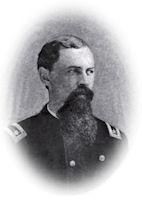
Bamber’s Station, A. & C. R. R.
February 7, 1865.
Our regiment led the corps to-day. The 17th Corps strikes the railroad at Midway, three miles to our right, and the 20th to the left five miles. We are 14 miles northwest of Branchville. The enemy are on the opposite bank of the Edisto, two miles from us. There is a great “peace” excitement among the citizens here. This day’s work cuts off all railroad communication between Georgia and the eastern part of the Confederacy. I saw another new thing (to me) in the destruction of railroads. After the iron has been heated by the burning ties, by a simple contrivance, four men twist each rail twice around. They put a clamp on each end of the rail, and put a lever in the clamp perpendicularly, and two men at each end of the lever, will put the neatest twist imaginable in the heated part of the rail. I never saw so much destruction of property before. Orders are as strict as ever, but our men understand they are in South Carolina and are making good their old threats. Very few houses escape burning, as almost everybody has run away from before us, you may imagine there is not much left in our track. Where a family remains at home they save their house, but lose their stock, and eatables. Wheeler’s Cavalry is about all we have yet found in our front and they keep afar off. The citizens fear them fully as much as they do us. A lady said to-day that she would as lief have us come as Wheeler’s men; she could see no difference. Wheeler’s men say, “Go in, South Carolina!” and the Yankees say the same thing. We got 50 bales of cotton here, which I suppose will be burned. Struck the railroad at 9:30 a.m.
February 7th.—A snow four inches in depth on the ground, and snowing. Last night Governor Smith, President Davis, Senator Oldham (Texas), Rev. Mr. Duncan, Methodist preacher, and a Yankee Baptist preacher, named Doggell, or Burroughs, I believe, addressed a large meeting in the African Church, on the subject of the Peace Mission, and the ultimatum of the United States authorities. The speakers were very patriotic and much applauded. President Davis (whose health is so feeble he should have remained away) denounced President Lincoln as ” His Majesty Abraham the First”—in the language of the press—and said before the campaign was over he and Seward might find “they had been speaking to their masters,” when demanding unconditional submission. He promised the people great successes, after our destined reverses had run out, provided they kept from despondency and speculation, and filled the ranks of the army. He denounced the speculators, and intimated that they might yet be called upon to “disgorge their earnings.”
A grand assemblage is called for next Thursday, to meet in the Capitol Square.
Congress will soon be likely to vote a negro army, and their emancipation after the war—as Lee favors it.
There was some fighting near Petersburg yesterday and the day before; but the press is reticent—a bad sign.
There is a rumor that Charleston has been evacuated!
Gen. Lee again writes that desertions occur to an alarming extent, for want of sufficient food. And he says there is enough subsistence in the country, but that the Commissary Department is inefficiently administered.
Gen. Breckinridge is in his office to-day.
A scramble is going on by the young politicians for the position of Assistant Secretary of War, and Mr. Kean is supposed to be ahead in the race. When a ship is thought to be sinking, even the cook may be appointed captain! Anything, now, to keep out of the field—such is the word among the mere politicians.
It is rumored that Gen. Pegram (since confirmed) was killed in the enemy’s attack on our right near Petersburg, and that seven brigades were engaged and repulsed the enemy. Still, there is no official confirmation—and the silence of Gen. Lee is interpreted adversely.
Senator Haynes, of Tennessee, and Senator Wigfall, of Texas, denounced the President yesterday as mediocre and malicious— and that his blunders had caused all our disasters.
Our commissioners were not permitted to land at Fortress Monroe, but Lincoln and Seward came on board.
Judge Campbell is still acting as Assistant Secretary; but he looks very despondent. If Beauregard gains a victory ——.
Camp before Petersburg, February 7th.
For three days we have held ourselves in readiness to march at a minute’s notice. It seems the Rebels, alarmed at our advance on Dansville, by way of Weldon, have concentrated their forces to oppose this advance. Well may they be alarmed, for, Dansville in our possession, all communication by railroad is cut off, and Lee’s army is shut out of the Confederacy and is thrown back on Virginia for supplies. The whole movement, on our part, consists in being ready to repel attack. We have heard nothing from our left today, except the roar of artillery, which, at times, is terrific. The weather is most uncomfortable for those having no shelter. It began to rain at 5 o’clock this morning, and has continued through the day, freezing as it falls. God pity the wounded who may be exposed tonight.
Through the smoke of battle we are eagerly looking for the “bow of peace.” The Rebels are now fighting for terms, and they cannot long maintain the unequal contest.
Monday, 6th—The weather changed again, and we had a rather cold, drizzling rain nearly all day. We left our trenches at 7 o’clock this morning and were all day in marching ten miles, the country being so very swampy. We had a great deal of corduroy to build, and the rebels blocked our way by burning a bridge over a deep channel in the swamp. There was some skirmishing in the front. We were ordered to leave all our surplus bacon in the company parade ground, and the quartermaster would send a wagon with the extra forage for us; but we were skeptical and carried all that our haversacks would hold.[1]
[1] Our company alone left a load of the finest bacon, besides other articles. It was the last we saw of our store of surplus forage. We learned later that the officers took that way of having the forage left for the negroes and poor people of the vicinity, for we had cleaned the vicinity of everything.—A. G. D.
Nashville, Monday, Feb. 6. Back in camp. Mr. Journal, I have returned after just three weeks’ absence and now hasten to resume my story. As the sun was setting in the west the ambulance came for me. Wrapped in a single blanket, I left my old comrades while they were drawing muskets and making a great noise over it. I was ushered into ward 7 with its long row of low cots, most of them occupied by men with very sore looking faces, but I had seen too many such to allow my heart to sink. I was clothed in hospital clothes and tucked into bed, where I lay for twelve days. In a few days the postules filled up, raised very large and were very painful. As I lay every inch of me seemed as though on fire. The doctor would come (a kind-hearted man) and call it “a very pretty case”, the postules being very large and thick too. I suffered no internal pain, but for a while the external agony was very great, and I longed for a cool drink of water, but was denied it.
About the 23rd my face was swollen so as to completely close my eyes and exclude the light of day for about twenty-four hours, which with matter and heat, I feared, would affect them, and in vain did I plead with the nurse to bathe them with a little water, until the doctor came next morning, which was a priceless relief. When they began to dry I recovered very fast. By keeping strict discipline on my finger nails, I was soon covered with scabs large enough for an alligator, and in due time [they] shelled off in my bed. The weather now was very cold and I suffered some in spite of half a dozen blankets. No visitors were allowed, but Griffith (kind soul, can I ever forget him) came often to the gate bringing my mail and written comments from himself, which I was permitted to answer. By keeping a lead pencil under my pillow, wrote several letters thus, home, contrary to orders, but I knew their anxiety.
Saturday, the 28th 3 P. M. the doctor pronounced me able to get up and my clothes were brought to me. I was astonished to find myself so weak. A few minutes after, two soldiers were announced at the gate with a message for me, and I staggered out to see Griff and D. Evans, which did me much good, but I had to return very soon. I gained now very fast, notwithstanding a bad cold. Monday, tent-mate Dan brought in with same malady.
Tuesday, I was sent to convalescent ward to make room for the influx. Over 500 patients in now. From 8 to 12 die daily. I was put on guard first night, six hours at a stretch to guard Rebs. Had the same every night. I began to get very lonesome soon. Had to fight terribly with the blues, much more than when in bed, and to-day, in answer to urgent request and Captain’s application, Doctor let me off. Took a bath, a new suit of clothes, and here I am. Feel quite weak, but happy to be once more amongst my comrades. Hospital life is not the life for me. Very grateful am I that I have recovered so well. Will be marked considerably, but who cares for that?
6th. Monday. In camp. Officers’ school.
Little Salkehatchie River,
February 6, 1865, 2 p.m.
Yesterday was quite warm, but my overcoat is useful again to-day. General Kilpatrick caught up with us last night, also General Williams with five brigades of the 20th A. C. So instead of waiting several days Sherman said he’d chance them for the railroad with what troops there are up. We took the road this morning. Stopped here for the 3d Division to clear the swamp of some Johnnies, which I think they have about effected.
Five p.m.—Miserable swamp, but the 3d Division only lost two men in crossing. There must have been a division of Wheeler’s here by the signs.


