
22nd. Marched at 5:30. The most uncomfortable day I ever passed. 45 2nd Ohio men with frozen feet. Much suffering throughout the division. Wind blew the snow right through us. Camped in rear of old infantry line, in awful place, with no wood. Boys went for fences about Hdqrs. Col. Pennington threatened to shoot some of the boys. Chet, Houghton, Eggleston and Smith captain’s commissions.

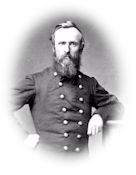
Thursday, December 22, 1864. — Last night the worst of my experience. A new camp; slight shelter; very cold; tent smoky. In all respects we are badly fixed. Issue a ration of whiskey to all.
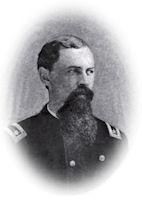
Green Square, Savannah, Camp 103d Illinois
“Provost Guards.”
December 22, 1864.
We have just by a hair’s breadth missed what would have been a most unpleasant fight. We lay on the west side of the Ogeechee, with the enemy on the opposite shore, strongly fortified. We had crawled through the mud and established a line of rifle pits within 125 yards of them; 150 portable bridges had been built in our division and I believe everything was in readiness for hot work the next day, the 20th. The morning of the 21st finds the enemy gone across the river into South Carolina. The next day we moved into town and our regiment and the 40th from our brigade are put on provost duty.
22nd. Up at 4. Rain froze as it fell. Awfully cold. At 5:30 “To horse” sounded. Soon a yell went up near the 2nd Brig., then a few shots. We were ordered to mount immediately—did it. A line could be seen on a distant hill. A few men came up within a few rods of camp. We moved to the flank, came front into line, my Batt. 1st in advance. Threw out skirmishers. Firing commenced immediately and we advanced, firing. Rebs run. Captured two and killed two. The command proved to be Rosser’s Div. which came in from the back road and from the flank. Charged the 2nd Brig. and drove it. Passed to the rear and captured several ambulance horses. Result was 30 men killed, wounded and missing on our side. 22 men captured from rebs and 10 killed. One of H Co. sabre cut, and one horse killed. Moved back and camped at Woodstock. 2nd on picket. Small force of the enemy followed. Skirmished till dark.
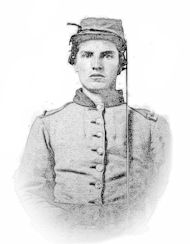
Thursday, 22d.—Overtook brigade five miles from Pulaski.

Thursday, 22d—It is quite cool. Our camp is just inside the city limits. We tore down several houses and fences with which to build “ranches,” and then spent the rest of the day in cleaning accouterments and washing our clothes. The rebels, in their haste to get away, left about one hundred and fifty pieces of artillery and a large quantity of fixed ammunition. They also left hundreds of their sick and wounded soldiers here in the hospital.
Savannah is a very nice city, on high ground, affording a good view of the South Carolina coast. The town is well laid out, having wide streets and little parks at many of the intersections. There are some fine churches here. A large number of business houses and office buildings are vacant. They had a printing press here for the making of paper money. I passed the building this morning where the press was located, and found on the sidewalk two bales of the currency, which some one had thrown out. The bundles were of about one hundred pounds each and the money consisted of tens and twenties. I helped myself to $50.00 and walked on. At the present time this money is below par. The boys are offering $1,000 to citizens for a loaf of bread, and some of the officers have offered from $4,000 to $5,000 for some one to curry their horses, but they can find no one who will accept their offers.

December 21st.—Raining; rained all night.
The following dispatch was received this morning:
“Wilmington, December 20th, 1864, 10 A.M.—The head of the enemy’s fleet arrived off this port during last night. Over thirty steamers are now assembling, and more are following.—Braxton Bragg.”
It may be hoped that Gen. Bragg will do something more than chronicle the successes of the enemy this time. He is nearer to him than when he remained at Augusta; and yet the press could be made reticent on arrivals, etc.
Lieut.-Col. Sims, Assistant Quartermaster General, has contracted with the Southern Express Company to transport all the funds of the Quartermaster’s Department—hundreds of millions!
Mr. Hunter was with the Secretary this morning, when I laid before the latter Bragg’s dispatch. I doubt not it failed to contribute to a mollification of their painful forebodings.
By Northern papers I see President Lincoln disapproves Gen. Dix’s order to troops to cross the Canada line in pursuit of raiders. Gold is $45 for one to-day.
The army has no meat this day, the commissaries, etc. have it all, and are speculating with it—it is said. So many high officials are interested, there is no remedy. We are at the mercy of the quartermasters, commissaries, railroad companies, and the Southern Express Company. The President and Secretary either cannot or will not break our shackles.
An official account states the number of houses burnt by the enemy in Atlanta to be 5000!
There is a rumor of another and a formidable raid on Gordonsville. The railroad is now exclusively occupied with the transportation of troops—perhaps for Wilmington. The raid may be a ruse to prevent reinforcements being sent thither.
The Andersonville Report belongs to the Adjutant-General’s Office, and therefore has not come back to me.
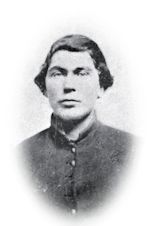
Fort Gillem, Wednesday, Dec. 21. More rain last night, cold this morning. Griff attended to the domestic affairs, washed our dirty clothes, etc. In the afternoon I wrote two letters. Snowed and blustered considerable in the afternoon. Camp is very quiet. The ennui of a soldier’s life is very heavy these disagreeable days, but we amuse ourselves by reading a great deal aloud. Two thousand five hundred more prisoners brought in to-day and coralled in jail yard.
21st. Wednesday. Orders regarding success of Sherman and Thomas, read to us near Mt. Jackson. Camped 8 miles south of Newmarket. Rained.
Wednesday, 21st.—Marched to Pulaski. Got good house to stay in at night. Snowing and very cold. Have very bad toothache.


