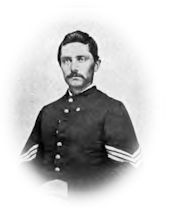
Wednesday, 21st—The last artillery firing this morning was that of a thunderstorm. It seems that kind Providence wanted a hand in the capture of the city. We received orders about 10 o’clock to be ready to march at a moment’s warning, and immediately we were ordered to march, as the rebels had evacuated the place. We started at once and before noon reached the edge of the city and went into camp, while a part of the army went in pursuit of the fleeing rebels. They left their outside works last night at 10 o’clock, and this morning left the city, crossing the Savannah river by pontoon bridges, under cover of their gunboats. Their rear guard is now five miles below, just across the river on the South Carolina side.


December 20th.—A brighter morning, cool and clear.
The President was at work yesterday. He and the Secretary and Gen. Cooper put their heads together to make up a regiment for Col. Miller in Mississippi, and designate the two field officers to be under him—from two battalions and two unattached companies.
If the Northern (purporting to be official) accounts be true, Gen. Hood has sustained an irretrievable disaster, which may involve the loss of Tennessee, Georgia, etc.
Hon. Mr. Foote declared last night his purpose to leave the city in a few days, never to resume his seat in Congress, if martial law should be allowed. He said he had information that when Charleston fell, South Carolina would conclude a treaty of peace (submission?) with the United States; and that North Carolina was prepared to follow the example! I have observed that these two States do not often incline to go together.
The great disaster would be the loss of Richmond and retreat of Lee’s army southward. This would probably be followed by the downfall of slavery in Virginia.
The Secretary of War has sent an agent to the Governor of North Carolina, to ask for special aid in supplying Lee’s army with meat—which is deficient here—or else it cannot be maintained in the field in Virginia! Very bad, and perhaps worse coming.
There is a rumor that Gen. Breckinridge has beaten Gen. Burbridge in Tennessee or Western Virginia.
Gen. R. E. Lee is in town, looking robust, though weatherworn. He complains that the department is depleting his army by details, often for private and speculative purposes, to the benefit of private individuals—speculators.
I drew my (State) salt to-day, 70 pounds, for 7 in family—20 cents per pound. It retails at a $1 per pound!
Mr. Secretary —— has sent (per Lieut.-Col. Bayne) some gold to Wilmington, to buy (in Nassau) loaf sugar for his family, to be brought in government steamers.
My son Thomas could get no beef ration to-day—too scarce.
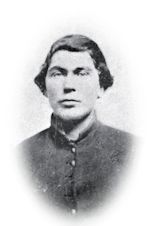
Fort Gillem, Tuesday, Dec. 20. Everything froze up hard last night, and it was very cold. Suffered considerable on post. Griff and I wished to go to town, volunteered to load rations so as to go. Had to wait until late in the afternoon for our team. Drew hard-tack and salt junk. Visited Sanitary Commission rooms, obtained a good supply of reading matter. Bought stationery to write letters and returned to camp. It is turning warmer, rains again.
The papers tell us of the triumphant arrival of our gallant leader Sherman at the coast. Invests Savannah, and we expect to join him sooner or later. Beside this glorious success the utter defeat of his opponent and fellow raider, Hood, is insignificant. “The good time’s coming.” Eighteen teams out all the afternoon moving batteries.
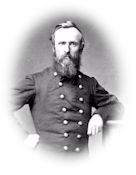
Camp at Stephenson’s Depot, Virginia,
December 20, 1864.
Dear Uncle: — We broke camp at Camp Russell yesterday at early daylight and marched to this place on the railroad from Harpers Ferry towards Winchester. It rained, snowed, “blew, and friz” again. Awful mud to march in and still worse to camp in. But today it is cold and none of us got sick, so far as I know. Our First Division took cars to join Grant. It is said we shall follow in a day or two. This is not certain, but I shall not be surprised if it is true. I prefer not to go, and yet one feels that it is almost necessary to be present at the taking of Richmond. I am content, however, to go. I believe in pushing the enemy all winter if possible. Now that we have a decided advantage is the time to crowd them. Things look as if that were to be the policy.
I like the new call for troops. What good fortune we are having. If Sherman takes Savannah and then moves north, this winter will be the severest by far that our Rebel friends have had.
I received today your letter of the 14th enclosing Uncle Austin’s about the sad fate of Sardis. I will do what I can to get further information, but we are no longer with the Nineteenth Corps and may not again see them.
I am sorry to hear you have a severe cold. I am getting more nervous when I hear of your taking cold. Don’t try to visit Lucy or anybody else in the winter.
I am afraid I shall not get to visit you this winter.
Sincerely,
R. B. Hayes.
P. S. — There is a short but tolerably fair account of the battle of Winchester in Harper’s Monthly of January. It is written by somebody in the Nineteenth Corps. You will hardly read it with such emotion as I do. The writer calls our force “the Eighth Corps.” When you read on the 199th page his account of our battle-yell as we advanced, and of the Rebel musketry which met it, you will remember that I led the advance brigade of the advance division, and that perhaps the happiest moment of my life was then, when I saw that our line didn’t break and that the enemy’s did.
23d. — It is pretty certain [that] we do not go to Grant; probably in a week or two to Cumberland or West Virginia.
S. Birchard.
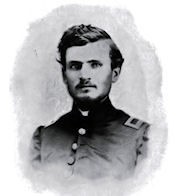
20th. Up at four. An early breakfast. 3rd Div. started up the valley, while 1st and 2nd went in another direction with 10 days’ rations. Camped at Woodstock.

December 20.—We have heard rumor after rumor about the battle in Tennessee, which was fought last month at Franklin. It is now confirmed that we have gained a victory, and that our army is closely investing Nashville. As usual with our victories, a darkened shadow hangs over them, that vails their brightness. It is the vision of the terrible carnage, and the spirits of the mighty dead, but
“Is’t death to fall for freedom’s right?
He’s dead alone that lacks her right!”
We have been told that at the battle our dead lay in heaps; our men stormed and took every breastwork that the foe had. Many a brave spirit has winged its flight to regions above. The gallant Cleiburne is among the slain, General Strahl, and many others of our best men. Mobile, as usual, is a loser. In a letter received from my brother, he informs me of the death of two members of his company, Mr. N. Leonard and Mr. M. Kavanaugh, and of many being wounded.
The battle was fought on the 30th November, commencing at 3 P. M., and raging until 3 next morning. It is said that the scene presented when day dawned was appalling; rider and horse lay in the trenches, one lifeless mass. Well, God alone knows what is best. We can but say, “Thy will be done.”
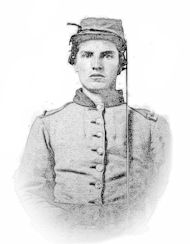
Tuesday, 20th.—Brigade came back past last night, and left some of us behind. Marched eighteen miles. A Mrs. Lidle gave us her kitchen to stay in; treated us very kindly. Cold and rainy.
Tuesday, 20th—Cloudy and windy this morning. Heavy cannonading with some skirmishing was kept up all day. Our batteries silenced the rebels’ batteries at every point. Four companies from our regiment went out last night to reinforce the details on building fortifications. The walls of the forts are to be twenty feet thick. We have a miserable camping ground right on the edge of the swamp, but we cleaned up a camp and at 4 o’clock this afternoon had company inspection. We have very poor water to use, having to get it from the swamp. But we are now drawing full rations, for which we are very thankful. All is quiet in the rear.
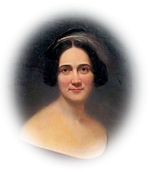
December 19th.—The deep waters are closing over us and we are in this house, like the outsiders at the time of the flood. We care for none of these things. We eat, drink, laugh, dance, in lightness of heart.
Doctor Trezevant came to tell me the dismal news. How he piled on the agony! Desolation, mismanagement, despair. General Young, with the flower of Hampton’s cavalry, is in Columbia. Horses can not be found to mount them. Neither the Governor of Georgia nor the Governor of South Carolina is moving hand or foot. They have given up. The Yankees claim another victory for Thomas.[1] Hope it may prove like most of their victories, brag and bluster. Can’t say why, maybe I am benumbed, but I do not feel so intensely miserable.
[1] Reference is here made to the battle between Hood and Thomas at Nashville, the result of which was the breaking up of Hood’s army as a fighting force.
December 19th.—The darkest and most dismal day that ever dawned upon the earth, except one. There was no light when the usual hour came round, and later the sun refused to shine. There was fog, and afterward rain.
Northern papers say Hood has been utterly routed, losing all his guns!
A letter from Mr. —— to ——, dated Richmond, December 17th, 1864, says: “I have the honor to report my success as most remarkable and satisfactory. I have ascertained the whole Yankee mail line, from the gun-boats to your city, with all the agents save one. You will be surprised when informed, from the lowest to the highest class. The agent in your city, and most likely in your department, has yet to be discovered. This is as certain as what we have learned (his arrest, I mean), for the party in whose hands the mail is put coming from your city is known to us; and we have only to learn who gives him the mail, which can be done upon arrest, if not sooner, to know everything. What shall be done with the parties (spies, of course) when we are ready to act? If you ever intimate that trials are tedious, etc., the enemy seize citizens from some neighborhood as hostages, when their emissaries are disturbed. I will dispatch, if it be authorized, and that will end the matter. The lady I spoke to you of is the fountain-head. What to do with females troubles me, for I dislike to be identified with their arrest.
“I request that a good boat, with three torpedoes, and a man who understands working them, be sent to Milford to report to me at Edge Hill. Let the man be mum on all questions. I would meet him at Milford, if I knew the day (distance is twenty-five miles), with a wagon, to take him, torpedoes, and boat to the point required. I must be sure of the day.
“Have the following advertisement published in Monday’s papers:
“‘Yankees Escaped! $1000 Reward !—A Yankee officer and three privates escaped from prison on Thursday night, with important matter upon their persons. The above reward will be given for their detection.’
“Let me hear from you through Cawood’s Line, upon receipt of this. Respectfully, etc. ——.”
We have the spectacle now of three full generals—Johnston, Beauregard, and Bragg—without armies to command; and the armies in the field apparently melting away under the lead of subordinate, if not incompetent leaders. So much for the administration of the Adjutant-General’s office.
Governor Smith is still exempting deputy sheriffs, constables, etc.—all able-bodied.
It is rumored on the street that we intend evacuating Savannah. How did that get out—if, indeed, such is the determination? There are traitors in high places—or near them.
It is also rumored that the Danville Railroad has been cut. I don’t believe it—yet.
There is deep vexation in the city—a general apprehension that our affairs are rapidly approaching a crisis such as has not been experienced before. There is also much denunciation of the President for the removal of Gen. Johnston from the command of the Army of Tennessee.
Hon. Mr. Foote declared, Saturday, that he would resign his seat if the bill to suspend the writ of habeas corpus, now pending, became a law. There is much consternation—but it is of a sullen character, without excitement.
The United States Congress has ordered that notice be given Great Britain of an intention on the part of the Federal Government to increase the naval force on the lakes; also a proposition has been introduced to terminate the Reciprocity Treaty. And Gen. Dix orders his military subordinates to pursue any rebel raiders even into Canada and bring them over. So, light may come from that quarter. A war with England would be our peace.
At 2 P.M. it was rumored that Charleston is taken and Beauregard a prisoner. Also that Gen. Jos. E. Johnston (in the city) says Richmond will be evacuated in ten days. I do not learn what gold sells at to-day! I suspect some coup d’état is meditated.


