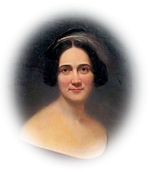
Camp Russell, December 6, 1864.
My Darling: — We are very comfortable and very jolly. No army could be more so. We have had no orders to build winter quarters, but we have got ready for rough weather, and can now worry through it. . . .
We have horse-races, music, church (sic!), and all the attractions. No fighting, which makes me hope I shall get off the last of this month to see my darling and the dear ones.
Affectionately,
R.
Mrs. Hayes.
Tuesday, 6. — Good weather. The battle at Franklin, Tennessee, was a fortunate escape from a disastrous defeat. It was probably also a damaging blow, perhaps severely so. Nashville can probably hold out. The situation there is interesting with a favorable look for us.
December 6th, 1864.
I find, on inquiry, the time has not yet come for me to visit my loved home. Since the fourteenth of last month, furloughs have only been given in extreme cases. They are now entirely suspended, for a brief period, in the Ninth Corps.
Grant is concentrating his forces. The Sixth Corps has just arrived, and is moving to the left. The Nineteenth Corps is on the way. Porter is collecting his fleet of ironclads in the vicinity of Dutch Gap. Butler’s canal is nearly completed. Should this canal prove to be a success, Porter may make a desperate attempt to reach the Rebel Capital, the land force co-operating on the right and left. But this move, whatever it may be, is not the cause of furloughs being withheld, for the order is confined to the Ninth Corps. Men are going, every day, from other portions of the army. General Burnside was here on Saturday, and returned to Washington on Sunday. On Monday the order was issued: “No more furloughs from the Ninth Corps until further orders.”
Lieutenant Colonel Swift is trying to get leave to take the regiment to Michigan to recruit. General Wilcox tells him the old members have seen more than their share of hard service, and advises him to let them remain where they are until their term of service expires. Swift is ambitious, and has an “itching palm” to wear the silver eagle.
December 6th.—Bright and beautiful. Indian summer apparently.
All quiet below—but it is anticipated by some that a battle will occur to day, or in a day or so.
The enemy’s negro troops have been brought to this side of the river, and are in full view on picket duty.
The Signal Bureau reports a large number of transports descending the Potomac a few days ago; probably Sheridan’s army, to reinforce Grant.
And yet our conscription superintendents, under orders, are busily engaged furloughing and detailing the rich slaveowners! It is developing a rapidly growing Emancipation party, for it is the establishment of a privileged class, and may speedily prove fatal to our cause. Our leaders are mad, and will be destroyed, if they persist in this policy.
Fort Gillem, Tuesday, Dec. 6. A pleasant day. Nothing startling. Artillery firing and skirmishing as usual. Some of our boys have been to the post line, report the enemy still throwing up works for artillery and infantry. Camp is full of wild rumors about Forrest’s venture against Nashville, but it is not reliable. Trains arrived from the North as usual. Wrote to Hannah this afternoon. Captain Hood has received orders to draw horses. This indicates work ahead of us.
6th. Tuesday. In camp. Bill Smith officer of the day.
Eden Ferry, Ogeechee river,
December 6, 1864.
We lay in camp until 1 p.m. when we suddenly pulled out and made this point, and had works up by dark. There was a good wagon bridge over the river at this point, which the Rebels partially destroyed. But a portion of our 3d Brigade, which had the advance, got across on the remains and stirred up a little skirmish. Killed four Rebels without any loss to us.
Our 2d Division got across three miles below. The 3d, I guess is with them. Hear nothing of the other corps. In the swamps to-day I saw more of the “barren lemon tree.” We were talking over last night what this army had cost the Confederacy since the 4th of October last, when we started from Eastpoint after Hood. We all agree that the following estimate is not too high in any particular: 100,000 hogs, 20,000 head of cattle, 15,000 horses and mules, 500,000 bushels of corn, 100,000 of sweet potatoes. We are driving with us many thousand of the cattle. The destruction of railroad property has been complete whenever within our reach. I can learn nothing of the prospect of a fight at Savannah, or whether we are going there. All think, though, that we will see tide-water this week. People here say they often hear the firing both at Savannah and Charleston.
Tuesday, 6th—We lay in camp all day. The day was spent in washing, cleaning and mending our clothes. The long march is beginning to tell on our clothing and shoes. My shoes are whole yet, but owing to so much sand, and wading through water, my feet are sore. My right foot is worn through on the bottom, and my toes are wet with blood every day. We are now within forty-five miles of Savannah, Georgia, and about ninety miles from Charleston, South Carolina. We can hear the large guns roaring from both places. The rebels are still retreating before us without much fighting. We are still in a rich country for foraging. Each regiment sends out its foraging party and we have plenty of sweet potatoes and fresh pork. We will have better roads now for marching as we approach Savannah. All is quiet in the rear of the army.
Monday, December 5. — Major Milton and Dr. Spencer were here to see me. Told them about my rheumatism; were here some time. Day pleasant. Application to go to camp refused.
December 5th.—Miss Olivia Middleton and Mr. Frederick Blake are to be married. We Confederates have invented the sit-up-all-night for the wedding night; Isabella calls it the wake, not the wedding, of the parties married. The ceremony will be performed early in the evening; the whole company will then sit up until five o ‘clock, at which hour the bridal couple take the train for Combahee. Hope Sherman will not be so inconsiderate as to cut short the honeymoon.
In tripped Brewster, with his hat on his head, both hands extended, and his greeting, “Well, here we are!” He was travel-stained, disheveled, grimy with dirt. The prophet would have to send him many times to bathe in Jordan before he could be pronounced clean.
Hood will not turn and pursue Sherman. Thomas is at his heels with forty thousand men, and can have as many more as he wants for the asking. Between Thomas and Sherman Hood would be crushed. So he was pushing—I do not remember where or what. I know there was no comfort in anything he said.
Serena’s account of money spent: Paper and envelopes, $12.00; tickets to concert, $10.00; tooth-brush, $10.00; total, $32.00.