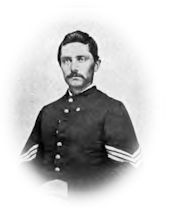
Tuesday, 29th—We left bivouac at 8 a. m. and marched twenty miles today, going into camp about dark. The Eleventh Iowa acted as rear guard. We had good roads, there being no hills. The country is very flat and heavily timbered and the soil is sandy, mixed with clay. We are on two-fifths rations now, but the country still affords additional rations, such as potatoes and pork. Our general direction is southeast on the west side of the Savannah and Macon railroad. All is quiet in front.


November 29th.—Clear, and warm as summer almost. Another dispatch from Bragg:
“Augusta, November 28th, 1864.—On the 26th instant, the enemy started a heavy cavalry force in this direction, from his main body near Sandersville; Gen. Wheeler promptly following, leaving a portion of his force to confront Sherman. Kilpatrick reached vicinity of Waynesborough yesterday, where Wheeler overtook and attacked him. A running fight has continued to this time; the advantage with us. We are driving them toward Millen. Young’s command has just arrived, and will go forward to Wheeler, who will, I hope, be able to mount most of them from his captures. Devastation marks the enemy’s route. Hear nothing from the movements of the enemy’s infantry, since Wheeler left their front. I fear they may cross the Savannah, and make for Beaufort. It is perfectly practicable.”
The number of deserters, under General Order 65, received here and sent to Abingdon, Va., is 1224 men.
Senator Waldo P. Johnson, Missouri, told me he would move, to-day, to allow the civil officers, etc. to buy rations and clothes of government, at schedule prices. This would be better than an increase of salary.
No movements below, to-day, that I hear of.
Gen. Jos. E. Johnston was at the department to-day, and was warmly greeted by his friends. If Sherman’s campaign should be a success, Johnston will be a hero; if the reverse, he will sink to rise no more. A sad condition, for one’s greatness to depend upon calamity to his country!

Nashville, Tuesday, Nov. 29. An unpleasant day. Camp very quiet, the usual number going to town on their passes. Camp policed and looks nice. Detail gone out to fix up camp of the 10th Ohio. This is a good omen, as their men will likely bring us lumber to pay for it. Captain Hood was mustered this morning, now is in command of Battery, with straps on. Read all the forenoon and wrote to sister Ellen. Mail came in and I received one from Jane, E. C, and John; papers from T. L. What kind of a being would I be were it not for these heavenly messengers from home. It is they that give courage in danger, cheerfulness in camp, and happy dreams which I expect to-night.
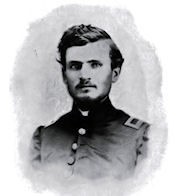
29th. Tuesday. Crossed the Big North at Cold Springs Gap. Passed through Wardensville and got dinner and fed. Co. “C.” eight men. Very disagreeable march last night. Beautiful day, mild and delightful. Am happy as a lark in the sunshine. Enemy reported at Moorfield. Went on after half an hour’s rest. God grant us success if we meet him. May the right soon prevail and this cruel war end. Camped on the Shenandoah mountain top.
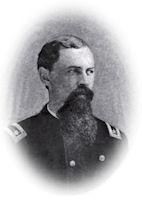
Ten miles south of Sevastopol,
November 29, 1864.
All day in an awful pine forest, hardly broken by fence or clearing. I never saw such a lonesome place. Not a bird, not a sign of animal life, but the shrill notes of the tree frog. Not a twig of undergrowth, and no vegetable life but just grass and pitch pine. The country is very level and a sand bed. The pine trees are so thick on the ground that in some places we passed to-day the sight was walled in by pine trunks within 600 yards for nearly the whole circle. Just at dusk we passed a small farm, where I saw growing, for the first time, the West India sugar cane. One of the boys killed the prettiest snake I ever saw. It was red, yellow and black. Our hospital steward put it in liquor. We made about 11 miles to-day.
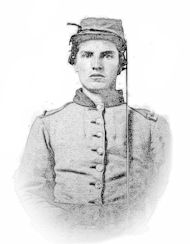
Tuesday, 29th.—12 M. Pretty heavy cannonading on right. Reported Cheatham’s and Stewart’s Corps crossed river early this morning and are going round Federals. Late in afternoon Pettus’ Brigade crossed river near town; charged Yanks and drove them back so could put in pontoon.

Monday, November 28. — Colonel Means came here to-day with Dr. Spencer. Dr. S. is to examine the officers for exchange. He told Colonel Marshall that he was to go. Received a note from Major Chambliss and Miss Currier, a cousin of Colonel Greene’s. Day pleasant. Wrote to Mr. Caldwell about my exchange.
Monday, 28th—We started at 7 o’clock this morning, marched fifteen miles, and went into camp at 5 p. m. Our division took up the rear on our march today and we had good roads for marching, with the exception of a small swamp which lay in our path. This is a fine country and there is plenty of forage. All is quiet in front, the rebels retreating without puffing up a fight.[1]
[1] Almost every day after leaving Atlanta large numbers of negroes, women, children and old men, came, some of them walking miles, to see the Yankees go by. The soldiers in the ranks would engage them in conversation and the odd remarks the negroes would make were often quite amusing. They were asked many questions, one as a joke, a favorite one with the boys, was asking the nice mulatto girls to marry them; the answer invariably would be in the affirmative. These incidents as well as others made a change, and broke the monotony of our long, weary marches.—A. G. D.
November 28th.—We dined at Mrs. McCord’s. She is as strong a cordial for broken spirits and failing heart as one could wish. How her strength contrasts with our weakness. Like Doctor Palmer, she strings one up to bear bravely the worst. She has the intellect of a man and the perseverance and endurance of a woman.
We have lost nearly all of our men, and we have no money, and it looks as if we had taught the Yankees how to fight since Manassas. Our best and bravest are under the sod; we shall have to wait till another generation grows up. Here we stand, despair in our hearts (” Oh, Cassandra, don’t! “shouts Isabella), with our houses burning or about to be, over our heads.
The North have just got things ship-shape; a splendid army, perfectly disciplined, with new levies coming in day and night. Their gentry do not go into the ranks. They hardly know there is a war up there.
November 25th.—Sherman is thundering at Augusta’s very doors. My General was on the wing, somber, and full of care. The girls are merry enough; the staff, who fairly live here, no better. Cassandra, with a black shawl over her head, is chased by the gay crew from sofa to sofa, for she avoids them, being full of miserable anxiety. There is nothing but distraction and confusion. All things tend to the preparation for the departure of the troops. It rains all the time, such rains as I never saw before; incessant torrents. These men come in and out in the red mud and slush of Columbia streets. Things seem dismal and wretched to me to the last degree, but the staff, the girls, and the youngsters do not see it.
Mrs. S. (born in Connecticut) came, and she was radiant. She did not come to see me, but my nieces. She says exultingly that “Sherman will open a way out at last, and I will go at once to Europe or go North to my relatives there.” How she derided our misery and “mocked when our fear cometh.” I dare say she takes me for a fool. I sat there dumb, although she was in my own house. I have heard of a woman so enraged that she struck some one over the head with a shovel. To-day, for the first time in my life, I know how that mad woman felt. I could have given Mrs. S. the benefit of shovel and tongs both.
That splendid fellow, Preston Hampton; “home they brought their warrior, dead,” and wrapped in that very Legion flag he had borne so often in battle with his own hands.
A letter from Mrs. Davis to-day, under date of Richmond, Va., November 20, 1864. She says: “Affairs West are looking so critical now that, before you receive this, you and I will be in the depths or else triumphant. I confess I do not sniff success in every passing breeze, but I am so tired, hoping, fearing, and being disappointed, that I have made up my mind not to be disconsolate, even though thieves break through and steal. Some people expect another attack upon Richmond shortly, but I think the avalanche will not slide until the spring breaks up its winter quarters. I have a blind kind of prognostics of victory for us, but somehow I am not cheered. The temper of Congress is less vicious, but more concerted in its hostile action.” Mrs. Davis is a woman that my heart aches for in the troubles ahead.
My journal, a quire of Confederate paper, lies wide open on my desk in the corner of my drawing-room. Everybody reads it who chooses. Buck comes regularly to see what I have written last, and makes faces when it does not suit her. Isabella still calls me Cassandra, and puts her hands to her ears when I begin to wail. Well, Cassandra only records what she hears; she does not vouch for it. For really, one nowadays never feels certain of anything.


