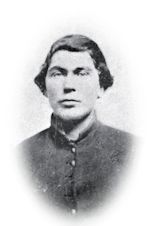
Nashville, Monday, Nov. 28. A pleasant day. Company turned out this morning. Carried down the army’s boxes and wood to our new camp. Hard work, but it dispensed with three guards. Wrote letter in the afternoon and commenced reading Jane Eyre. A beautiful silk flag was to be hoisted in our camp that we have bought by subscription for $75.00. May its folds ever wave over us in victory. Hood with 30,000 rebels reported moving on this place, and Thomas is below him. Gen. A. J. Smith is in town. His command, 16th Army Corps, is arriving from Missouri.

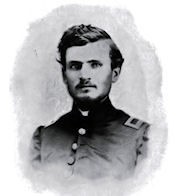
28th. Monday. In camp all day. Got mustered as 1st Lt. After supper, “General” and “Boots and Saddles” blew. Lay till twelve and then pulled out on back grade and Moorfield Pike.

J.B. Jones mentions graves of 12,000 Federal prisoners at Andersonville. – A Rebel War Clerk’s Diary
November 28th.—Calm and warm; clouds and sunshine, without wind.
All quiet below. It is reported that one of our picket boats in the James River deserted last night. It is said the crew overpowered the officers and put them ashore, and then the boat rowed down to the enemy.
I am informed by Capt. Warner that there are 12,000 graves of Federal prisoners at Andersonville, Ga. That climate is fatal to them; but the government cannot feed them here, and the enemy won’t exchange.
A dispatch from Gen. Bragg:
“Augusta, November 27th, 1864.—We have lost communication with the front. A small cavalry raid cut the Savannah Railroad and telegraph, this morning, at Brier Creek, twenty-six miles from here. Gen. Wheeler was, yesterday, confronting the enemy’s infantry at Sandersville. An officer, who left Macon on the 23d, states that one corps of the enemy was still confronting us there; our force not exceeding 5000, nearly all militia. The force here, including all available reserves, does not exceed 6000 effectives: only one battery. I am not yet advised from Charleston and Savannah, but know the means are small. Neither point could long resist the enemy’s whole force; hence my remarks about concentration. Gen. Hardee has gone to Savannah. Wheeler will continue to confront and harass the enemy. I have not learned the strength of his command. He estimates the enemy’s force at about 30,000.”
Gen. Beauregard has published a short proclamation, saying he will soon arrive to the rescue in Georgia. Here, then, will be war between the two B.’s—Bragg and Beauregard; and the President will be as busy as a bee. Meantime, Sherman may possess the land at pleasure.
A long letter (twenty-five pages) from Gov. Brown, Georgia, came to hand to-day, combating, in replication, one from the Secretary relating to calling out all the militia of Georagia, etc. State rights and the Constitution are discussed in extenso, and many a hard blow is aimed at the President. The Governor regards the Secretary as merely the instrument or head clerk of the President, whom he sneers at occasionally. But he denounces as vile the President himself, and refuses to obey the call. What he will do with the militia must soon be known, for Sherman is there.
A great stir among the officers on bureau and department duty in Richmond! Congress has called on the President for a list of all commissioned officers here, their ages, etc., and how many of them are fit for duty in the field. This will be dodged, of course, if possible.
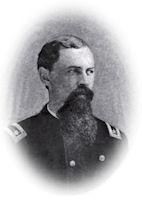
Old Indian Battle Ground, near Drummond,
November 28, 1864.
Made a dozen miles to-day through the thickest pine woods I ever saw. There is no white or yellow pine here; it is all pitch. I think the division has been lost nearly all day. We have followed old Indian trails four-fifths of the time.
The foragers have found a large number of horses and mules in the swamps to-day. Plenty of forage. Sergeant Penney, of my company, died in the ambulance to-day. He was taken sick in the ranks at 8 p.m., 26th, of lung fever. He has never been right healthy, but when well was always an excellent soldier. Lieutenant Dorrance swallowed his false teeth a few nights ago, and complains that they don’t agree with him.
I hear that Wheeler jumped the 20th Corps yesterday and that they salivated him considerably. We caught a couple of his men to-day, on our road, stragglers. We pick up a good many stray Rebels along the road, but they are not half guarded and I think get away nearly as fast as captured.
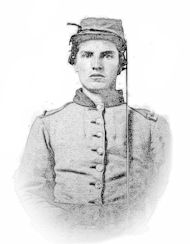
Monday, 28th.—Ordered to move at day-light. Federals evacuated Columbia last night. We marched through town; Federals just across Duck River. Brigade moved about two miles to left of railroad bridge. Shelled us nearly all the way, but did no damage. Bridge burning, and Yanks on opposite side of river fortifying. I was sent with detail of thirty from our company to a fort as sharp-shooters, about five hundred yards distant. Kept up shooting all day. Ball struck my gun and glanced off and struck another man on head, wounding him slightly. No others hurt, as we were well protected in fort.

Sunday, November 27. — To be marked with a white cross. Over two hundred letters received here to-day, all old mail. I received four, one from James, one from Howland, Frank Balch and O. B. L. Day quite warm and pleasant.
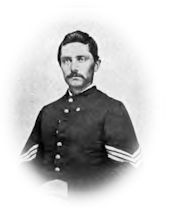
Sunday, 27th—We started at 8 o’clock this morning, marched eight miles, and went into camp for the remainder of the day. On our march this forenoon our division, the Third, destroyed ten miles of the railroad east of the Oconee river. The Fifteenth Corps is off on our right about two miles, while the Fourteenth and the Twentieth with Kilpatrick’s cavalry are off on the left, out toward Augusta, Georgia. All is quiet in front. This is a very fine country, thickly settled and with some very nice farms, though the soil is very sandy and there is considerable pine timber.
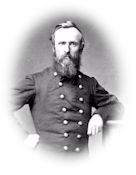
Camp Russell, November 27, [1864]. Sunday.
Dear Mother: — We are not in winter quarters yet. The continued presence of the Rebel army in our front, or Sherman’s campaign, or Grant’s, or something else, keeps us in suspense. But we are gradually improving our condition and quarters until now we are pretty comfortable, and if we finally stay here for the winter, I, for one, shall not grumble.
We had a jovial Thanksgiving. A fair supply of turkeys and other good things from the cities, together with good weather, made the day cheerful.
The railroad, it is supposed, will be finished to within four or five miles of us this week. We shall then have mails and supplies with some regularity.
I still hope to get settled in time to visit [home] during the holidays. My kind regards to Mrs. Wasson and Sophia.
Affectionately, your son,
R.
Mrs. Sophia Hayes.
Sunday, 27. — A ride with Colonel Comly; a visit to General Crook. A fine day; a brigade dress parade. All pleasant.
November 27th.—Cloudy and warmer; slight rain. Nothing from Bragg this morning. Nothing from below the city.
When I entered the Secretary’s room this morning, I found him as grave as usual. L. Q. Washington, son of Peter Washington, once a clerk under President Tyler (and he still remains in the United States), and grandson of Lund Washington, who, we learn by one of the published letters of Gen. Washington, was his overseer, with no traceable relationship to his family, was seated with him. He is chief clerk to Mr. Benjamin, a sinecure position in the State Department. He was placed there by Mr. Hunter, after writing a series of communications for the Examiner, as Mr. Pollard informed me, denunciatory of Mr. Stephens, Vice-President Confederate States. Mr. Kean and Mr. Shepherd, the clean chief clerk, were also present, enjoying the Hon. Secretary’s confidence. They are all comparatively young men, whom the Secretary has not assigned to positions in the field, although men are alone wanted to achieve independence. They were discussing a resolution of Congress, calling for the names, ages, etc. of the civil and military officers employed by the Secretary in Richmond, or it might have been the subject of the removal of the government, or the chances of success, etc., or the President’s appointment of Gen. Bragg to command the army in Georgia, or Mr. Hunter’s prospects for the Presidency. No matter what.
It is a dismal day, and a settled vexation is on the faces of many of the officials. But if the time should come for flight, etc., I predict many will have abundance of funds in Europe. The quartermasters, commissaries, etc. will take care of themselves by submission. The railroad companies have already taken care of themselves by their partnership with the speculators. The express company bribes all branches of the government, and I fear it has obliged some of the members of the President’s military or domestic family.
By a report from the Niter and Mining Bureau, it appears that thirteen furnaces of the thirty odd in Virginia have ceased operations. Several have been destroyed by the enemy; the ore and fuel of others have become exhausted; and those in blast threaten to cease work for want of hands, the men being put in the army.


