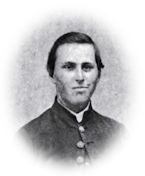
November 15th. Nothing special just at this time. We enjoy our camp and this town. Hope we go into winter quarters and remain here for duty. The town and railroad must be protected. No bad winter weather so far. Regular duty is kept up from day to day. Picket, guard, drilling, cutting wood for camp. The health of our regiment, at this time, is good.

November 13th. Arrived in camp early this morning. Pleased with our trip to Connecticut. Happy that our regiment was selected. Again on duty. Hope to remain here during the coming winter. In camp in the Faulkner’s Woods, a good place.
November 11th. Had a very pleasant short visit at home. The regiment assembled this forenoon, soon in line, on the march through New Haven, to the railroad station. We received a great send off by the citizens of New Haven, cheering and wishing us good luck. Soon on board train bound for New York. Made good time. Marched through the city. All quiet. No toughs in sight. Mr. Lincoln’s election made things quiet. Crossed the Cortlandt Street ferry to Jersey City. Soon on board train, bound for Martinsburg, which we were anxious to reach.
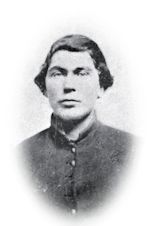
Nashville, Sunday, Nov. 20. Happy to inform you, dear Journal, that it did not rain a great deal to-day, but no ray of sunshine appeared to warm our tents or dry our clothes. The Major seems to be very partial to us, for yesterday he called for a detail to put up headquarters tents. To-day again he has fifteen men hauling stone, etc. to build chimneys. I wish he would like some other Battery as well. In the evening a few scarlet tints could be seen on the western horizon, and our prophets predict a pleasant day to-morrow. I sincerely hope it will be so. Received a few papers by mail, no letters.
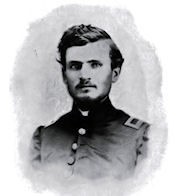
20th. Sunday. Rest of regt. on picket. Wrote to Lizzie Cobb. Drew rations and ammunition.
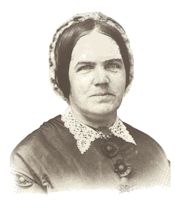
November 20, 1864.
This is the blessed Sabbath, the day upon which He who came to bring peace and good will upon earth rose from His tomb and ascended to intercede for us poor fallen creatures. But how unlike this day to any that have preceded it in my once quiet home. I had watched all night, and the dawn found me watching for the moving of the soldiery that was encamped about us. Oh, how I dreaded those that were to pass, as I supposed they would straggle and complete the ruin that the others had commenced, for I had been repeatedly told that they would burn everything as they passed.
Some of my women had gathered up a chicken that the soldiers shot yesterday, and they cooked it with some yams for our breakfast, the guard complaining that we gave them no supper. They gave us some coffee, which I had to make in a tea-kettle, as every coffeepot is taken off. The rear-guard was commanded by Colonel Carlow, who changed our guard, leaving us one soldier while they were passing. They marched directly on, scarcely breaking ranks. Once a bucket of water was called for, but they drank without coming in.
About ten o’clock they had all passed save one, who came in and wanted coffee made, which was done, and he, too, went on. A few minutes elapsed, and two couriers riding rapidly passed back. Then, presently, more soldiers came by, and this ended the passing of Sherman’s army by my place, leaving me poorer by thirty thousand dollars than I was yesterday morning. And a much stronger Rebel!
After the excitement was a little over, I went up to Mrs. Laura’s to sympathize with her, for I had no doubt but that her husband was hanged. She thought so, and we could see no way for his escape. We all took a good cry together. While there, I saw smoke looming up in the direction of my home, and thought surely the fiends had done their work ere they left. I ran as fast as I could, but soon saw that the fire was below my home. It proved to be the gin house [cotton gin] belonging to Colonel Pitts.
My boys have not come home. I fear they cannot get away from the soldiers. Two of my cows came up this morning, but were driven off again by the Yankees.
I feel so thankful that I have not been burned out that I have tried to spend the remainder of the day as the Sabbath ought to be spent. Ate dinner out of the oven in Julia’s [the cook’s] house, some stew, no bread. She is boiling some corn. My poor servants feel so badly at losing what they have worked for; meat, the hog meat that they love better than anything else, is all gone.
Saturday, November 19. — Heard of Sherman’s advance from Atlanta. The officers who came here last night were sent back to the stockade. Began to rain this afternoon. One of the men who escaped on the way to Florence was brought in here.
Near Hillsboro, November 19, 1864.
Have been foraging to-day. Crossed the Ocmulgee at Ocmulgee Mills, on pontoons. This river is much like the Chattahoochie, but not so broad. I am lost from the division tonight and camped near the 2d Division. By the kindness of Mrs. Elizabeth Celia Pye, I occupy a feather bed to-night. It is the first house I have been in for the last three months. She understood from the Rebels that we burned all houses and she took all her things out and hid them in the woods. The foragers found them and brought them in to her. Had an excellent supper with the boys. This is a level, fine country, and has been well cultivated

Saturday, 19th—There was some rain last night and the roads today are very slippery, which as the country is so hilly, makes difficult marching. We marched fifteen miles and went into bivouac. Our division was in the rear of the Seventeenth Corps, the infantry marching at one side of the road so that the artillery and wagon trains could move together and all go into bivouac earlier and at the same time. The country is thickly settled. The citizens on the approach of our army left their homes and fled to Macon. We passed through Hillsboro at 10 a. m., and the town being deserted, many of the vacant houses were burned by our men. We heard the sound of cannon off to our right in the direction of Macon.
November 19th.—Rained all night, and still rains. All quiet below, save the occasional bomb thrown by our iron-clads.
Gen. and Hon. R. K. Wright, of Georgia, is said to have gone to Washington to negotiate a peace for Georgia.
A dispatch from Gen. Wheeler, dated yesterday, 12 miles from Forsyth, says: “I think definite orders should be sent to officers in command here, as to the line of policy to be pursued—particularly as to defending Macon, Augusta, or Columbus. If not to be defended, government stores should be removed, on enemy’s approach, if possible. An officer should be sent to command everything, who knows the views, wishes, and plans of the government.” I think so too!
The papers think that Grant is about to try again to force his way into Richmond, as soon as the weather will permit.
We had a delicious treat of persimmons to-night—a quart bought for a dollar. They were delicious, and we enjoyed them hugely. Also a quart of apples, for which we paid a dollar.


