Following the American Civil War Sesquicentennial with day by day writings of the time, currently 1863.

Three miles south of Kingston, October 12, 1864.

Started at daylight this morning. The Rebels were then at Rome. Stopped here at 5 p.m. It is understood that the Rebel Army has moved southwest into Alabama.

Passed through the best country to-day that we have seen in Georgia. We are camped on what has been a splendid plantation (equal to anything on Copperas creek), and on the only clover field, I think, in Georgia. This is about the only ground on which I have seen the Jamestown weed, plantain, or clover. We are very scare of forage, and the officers turned their horses out on the clover to graze. The Northern stock enjoyed it exceedingly, but the Southern horses did not know enough to eat it. They nosed around among the rich bundles of clover to pick out the weeds and hard wild grass, the latter not near as good as our poorest prairie grass.

(A duplicate of dates.) October 12, 1864.

Last night while our train was passing through Cassville, a town four miles south of Kingston, an ambulance gave out and the driver unhitched and concluded to stay all night. That was some three miles from where we stayed. Nine stragglers also laid down beside the ambulance for the night. The 17th Corps came through there to-day and found the driver dead, with a bayonet thrust through him, and the traps of the nine men laying around. The horses and nine men are missing. I heard to-night that the bodies of the nine men had been found altogether. Our men burned the town. I expect we will lie here tomorrow, and if Hood’s army is in this vicinity go for it next day. Nobody thinks he will dare to fight us. We have parts of five corps here.

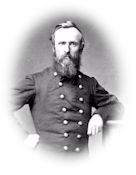
Camp Near Strasburg, Virginia, October 12, 1864.

Dear Uncle Scott: — I am much obliged for your letter announcing the arrival of the big boy and the welfare of his mother. I had been looking for news somewhat anxiously. I intended to have had a daughter, but I failed to see the new moon over my right shoulder. I am glad to hear he promises to be a good boy, as Aunt Phoebe writes Dr. Joe.

We had a quiet election here yesterday. My old brigade, Ohio voters, were unanimous — the two veteran regiments voting as follows: Twenty-third — two hundred and sixty-six Union; Thirty-sixth — two hundred and fifty-nine ditto, and no Copperheads. The whole of Crook’s Command stands fourteen hundred Union and two hundred Democrats in round numbers — three-fourths of the Democrats being in companies from Monroe and Crawford [counties].

Our campaign in the Valley is supposed to be ended. It winds up with a most signal cavalry victory. It is believed that the Sixth and Nineteenth Corps with Sheridan’s splendid cavalry will join Grant and that Crook’s hard-worked command will have the duty of guarding the Baltimore and Ohio Railroad in winter quarters. We hope this is correct. If so, I shall probably get home by Christmas for a good visit.

I am compelled to write this on the half sheet of your letter. — Love to all.

Sincerely,

R. B. Hayes.

Matthew Scott Cook.
Chillicothe, Ohio.

Wednesday, October 12. — Navy went about 5 A.M. We were not allowed to see them off. Meade kindly sent me his hammock. It seemed dreadfully dull all day, and we missed them very much. They were almost all of them very pleasant companions. Mr. John Caldwell was here to-day, and I gave him a draft in triplicate on Father for $50 in gold. He exchanged it at the rate of 24 for 1, making $1200 in Confederate money. I paid him back the $55 which I borrowed, and he returned me my receipt for the same. I lent Charlie Amory $50 and paid Colonel Marshall $50 and took $45 myself, leaving $1000 in the hands of Lieutenant Belcher. Colonel Marshall had a chill in the afternoon.

October 12 — We are still sojourning at General Sheridan’s headquarters, and under strict surveillance in the midst of an infantry camp. We are consigned to the limits of a little square patch out in an open field, without the least sign of shelter. So far our diet has been very simple. The quality of our rations is excellent, but the quantity is considerably below the danger line of dyspepsia. Uncle Sam, the dear generous old soul, is determined that we shall not suffer any pains or disagreeable uneasiness from indigestion or dyspepsia while we are under the kind and hospitable care of his faithful patriots. And our sleeping apartment is as airy as a mountain wind. We wrap our blankets around us and lie down to soothing slumber and pleasant dreams on the cold wet ground without the least shelter against storm or rain. General Sheridan burns a red light at his headquarters all night.

12th. Wednesday. In camp all day.

image

October 12th.—Bright and beautiful. All quiet below, save an occasional booming from the fleet.

Nothing from Georgia in the papers, save the conjectures of the Northern press. No doubt we have gained advantages there, which it is good policy to conceal as long as possible from the enemy.

Squads of able-bodied detailed men are arriving at last, from the interior. Lee’s army, in this way, will get efficient reinforcements.

The Secretary of the Treasury sends a note over to the Secretary of War to-day, saying the Commissary-General, in his estimates, allows but $31,000,000 for tax in kind—whereas the tax collectors show an actual amount, credited to farmers and planters, of $145,000,000. He says this will no doubt attract the notice of Congress.

Mr. Peck, our agent to purchase supplies in North Carolina, has delivered no wheat yet. He bought supplies for his family; 400 bushels of wheat for 200 clerks, and 100 for Assistant Secretary of War, Judge Campbell, and Mr. Kean, the young Chief of the Bureau. This he says he bought with private funds; but he brought it at the government’s expense. The clerks are resolved not to submit to his action.

I hear of more desertions. Mr. Seddon and Mr. Stanton at Washington are engaged in a singular game of chance. The harsh orders of both cause mutual abandonments, and now we have the spectacle of men deserting our regiments, and quite as many coming over from the enemy’s regiments near the city.

Meantime Gen. Bragg is striving to get the able-bodied men out of the bureaus and to place them in the field.

The despotic order, arresting every man in the streets, and hurrying them to “the front,” without delay, and regardless of the condition of their families—some were taken off when getting medicine for their sick wives—is still the theme of execration, even among men who have been the most ultra and uncompromising secessionists. The terror caused many to hide themselves, and doubtless turned them against the government. They say now such a despotism is quite as bad as a Stanton despotism, and there is not a toss-up between the rule of the United States and the Confederate States. Such are some of the effects of bad measures in such critical times as these. Mr. Seddon has no physique to sustain him. He has intellect, and has read much; but, nevertheless, such great men are sometimes more likely to imitate some predecessor at a critical moment, or to adopt some bold yet inefficient suggestion from another, than to originate an adequate one themselves. He is a scholar, an invalid, refined and philosophical—but effeminate.

Tuesday, 11th.—Marched to Lowry’s Chapel eighteen miles from Resacca.

Etowah Bridge, Tuesday, Oct. 11. This morning as we awoke the bugles of the 4th and 14th Army Corps resounded through the hills, and the plain in front of our camp was covered with camp fires, looking “as of old”. They had marched nearly all night, many of them very hungry. Opened ten boxes of surplus hard-tack for those that came after them during the night. They again filed out 6 A. M., many of them without a wink of sleep. Advance of the old 15th Army Corps came in sight 8 A.M. having marched ten miles before breakfast. Moving very rapidly. Pioneers digging rifle pits. Battery boys worked on the old embrasure till 3 P. M., when the assembly sounded and orders given to hitch up and prepare to move immediately. Somewhat surprised we hastily made the necessary preparations, stood harnessed up half an hour, when the order was countermanded and estimate sent in of horses necessary to move the Battery. Commenced writing to John but was interrupted by the arrival of a heavy mail. I received but one.

Tuesday, 11th—The weather has been cool and pleasant for several days. Our entire corps started early this morning at 2 o’clock, going as we suppose, to Kingston. We marched through to Cartersville, where we went into camp for the night.

We hear that there was a hard fight at Altoona yesterday with fearful loss of life on both sides, but Hood had to give up trying to capture the place. It is reported that Hood is now moving toward Rome, Georgia.

Allatoona Pass, October 11, 1864.

Our corps moved at the setting of the sun, and continued moving until we were all confoundedly tired. I never saw the men so noisy, funny, or in any way or every way feeling half so good. After we had marched about eight miles, one of Howard’s staff came back along the line and informed us that Sherman had just notified Howard that Richmond is ours. Everybody believed it, but nobody cheered. They were saving the yells for the confirmation. We camped at 1 a.m. with orders for reveille at 4 and march at 5 a.m.