Tuesday, October 11. — The navy officers received orders to go to Richmond this A.M. They were the happiest set of men I have ever seen. In the afternoon we sang “Auld Lang Syne,” etc. All day they were busy giving away blankets, etc. I sent a letter to Raish and one to Hiram. Had our windows fixed to-day by boarding the upper part, and putting a sliding board for the lower sash. Day pleasant. Last night cold. Filler went with the navy.

Richland Jail, Columbia, S. C., Sept. 25, 1864.
(Oct. 11. Am very well and in good spirits. [over])
Dear Father, — Have heard nothing from home except the letter written on 29th ult., enclosing one from Alice. I am going to send this letter by a different channel, and think you might answer through the same way. Your letters would then come with more certainty.
Dr. Marks called again to see me this week. He seems in very feeble health and I am afraid will not live long.
The navy officers will probably leave here next week. I shall send letters by them.
Am well and comfortable. Captain Amory the same.
Time passes rather slowly here. We have nothing to do except reading and card-playing. In the day-time we walk about the yard, and amuse ourselves with an occasional game of quoits. I usually write you twice a week, and hope that you receive most of the letters. We are allowed to subscribe for the papers, and have the news from Richmond and Charleston. The prisoners confined here are almost all of them in good health. Indeed, there have been no very serious cases of sickness since we have been here. Both Captain A. and myself are well provided with everything, so that you need not feel anxious on account of our health. . . .
(Written on back of letter)
Dear Father, — As the navy officers start to-morrow I thought I would send this note by them. As you see from the original date, it is some time since the ink part was written. We are all well here. A Mr. John Caldwell called here last Friday and offered to cash my draft on you for any amount. So you see I am all right. I shall give him a draft for 50 dollars in gold, which will last me some time, although I have to pay some borrowed money out of it. Almost all the officers in the Southern Confederacy are now confined in a stockade about two miles from this town. They were sent here from Charleston. I hear that the privates in C. are dying at the rate of 100 a day from yellow fever. They are so worn out by their imprisonment that they are fit subjects for any epidemic. Tell Hannah that her letter of Sept. 16th reached me about two days ago. Was very glad indeed to get it. In future when writing me you had better put care of Captain Senn, who commands our guard. Ensign Tillson of the navy will probably deliver this.
An outbreak occurred among the prisoners brought from Charleston the other day. Several managed to get away. . . .
11th. Tuesday. In camp till 4 P. M. Moved to position on Cedar Creek, passing Fisher’s Hill, via Pike and Strasburg. Camped near Middletown.
October 11th.—Bright and pleasant. All is quiet below.
From Georgia we have many rumors. It is reported that a battle has been fought (second time) at Altoona, which we captured, with 4000 prisoners; that Rome has been taken, with 3000 negro prisoners; and, finally, that we have Atlanta again. I have seen no such dispatches. But the gentleman who assured me it was all true, has a son a clerk at the President’s office, and a relative in the telegraph office. Dispatches may have come to the President; and, if so, it may be our policy to forbid their publication for the present, as the enemy would derive the first intelligence of their disaster from our newspapers.
Well, Gen. Gardner reports, officially, that of the number of exempts, and of the mixed class of citizens arrested in the streets, and summarily marched to the “front,” “a majority have deserted!” Men, with exemptions in their pockets, going to or returning from market, have been seized by the Adjutant-General’s orders, and despotically hurried off without being permitted even to send a message to their families. Thousands were entrapped, by being directed to call at Gen. Barton’s headquarters, an immense warehouse, and receive passes; but no Gen. Barton was there—or if there, not visible; and all the anxious seekers found themselves in prison, only to be liberated as they were incorporated into companies, and marched “to the front.” From the age of fifteen to fifty-five, all were seized by that order—no matter what papers they bore, or what the condition of their families—and hurried to the field, where there was no battle. No wonder there are many deserters—no wonder men become indifferent as to which side shall prevail, nor that the administration is falling into disrepute at the capital.
October 10.—I am cast down by hearing that J. P. has been captured; he was caught while scouting in the enemy’s lines, on James River. Poor child! I feel very, very anxious about him.
Our army in the Valley has regained its foothold, the enemy having retreated. B. C. had his horse killed under him in a fight near Waynesborough, but he escaped unhurt.
The Federal Army below Richmond advanced a few days ago, and took “Fort Harrison.” We live now amid perpetual firing of cannon. The loss of Fort Harrison is, I am afraid, a very serious loss to us. The enemy made a second advance, which has been handsomely repulsed. They seem to be putting forth their utmost efforts against us. I pray that our armies may be able to resist them and drive them to their own land.
Monday, 10th.—Crossed Coosa River, 9 A. M. Marched fourteen miles on Dirt Town Road.
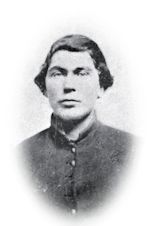
Etowah Bridge, Monday, Oct. 10. Hailed the coming day with gladness this morning as it was so very cold we suffered from it. More like Wisconsin than Georgia. Found the infantry under arms since 3 A. M. and another “scare” prevailing. Fell out to work at 7, pioneers helping us. Ordnance train came up from town this morning and deposited their stores inside of the fort, filling our magazines with artillery ammunition; 90 boxes of three inch rifle; 40 12-pounder guns; 150 boxes of infantry ammunition, guns, sabres and other stores piled up inside the works covered with tarpaulins. A sergeant and seven men with them as guards, to guard our guns also, which lightens our duty greatly. Only three guards on duty.
General Sherman in Cartersville since this morning. The 23rd Army Corps marching through all day, almost on a double quick. His whole army is making a retrograde movement except the 20th Army Corps which is in Atlanta, fortifying it so as to hold it against Hood’s whole army, if necessary. He (Hood) is now north of the Chattahoochee River threatening some northern point. It is confidently expected that he will soon have reason to repent of his rashness. The troops are somewhat disappointed in being obliged to take the field so soon after the capture of Atlanta. In the evening I walked to town with Ed. Hayes. Saw the great but unassuming genius that holds in his hands the fate of the noble Army of the West. He appeared in a brown study, constantly walking with his hands in his pockets, more like a farmer than a general. The Etowah bridge completed by sundown. Disappointed by the non-arrival of mail.
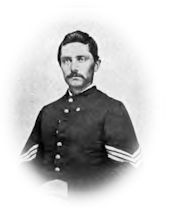
Monday, 10th—A large detail from our regiment was put to work on the railroad. Three of us, Hiram Frank, John D. Moore and I, took French leave this afternoon and climbed to the top of Kenesaw mountain. It is a grand view from the mountain, but we had to pay for our sightseeing, for when we got back to camp we found that our command had left. They were ordered to go on the double-quick to Altoona, Georgia, and we had to run about four miles before we caught up with them. Our bunkmates were carrying our knapsacks, haversacks, canteens and rifles, with all accouterments, and they were about as thankful as we were when we caught up with them.[1]
[1] General Corse had flagged Sherman for reinforcements, as Hood was trying to capture the place. Our army had about one million rations stored at Altoona. Sherman flagged: “Hold the fort; I am coming,” and General Corse answered back that he’d hold the fort to the death if need be.—A. G. D.
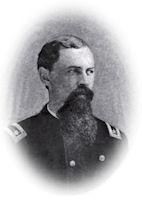
Near Kenesaw Mountain, October 10, 1864.
Was on the ground we charged on the 27th of June, and also on top of Kenesaw to-day. Very fine view, but nothing like equal to that from Lookout. The signal station here communicates direct with Atlanta, Allatoona and Roswell.
I picked up some black oak acorns to-day from a tree that shades the graves of 12 or 15 of our soldiers, mostly from our regiment, who fell on the 27th. They were buried where they fell. That charge was the maddest folly of the campaign.
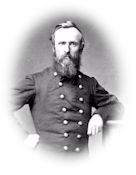
Headquarters Second Infantry Division A. W. Va.,
Camp Near Fisher’s Hill, South Of Strasburg, Virginia,
October 10, 1864.
Dearest: — I am very anxious to hear from you. I hope you are doing well.
We have slowly returned from our splendid campaign to this point. The Rebel cavalry impudently undertook to harass us as we approached here. General Sheridan halted his army and sent his cavalry back supported by two of my infantry regiments (Ninth and Fourteenth Virginia) and gave them a complete flogging, capturing their cannon (nine), train, and many prisoners. They were chased from the field at a run for twenty miles.
I don’t know when we shall return to Winchester, but probably soon. This valley will feed and forage no more Rebel armies. It is completely and awfully devastated — “a belt of desolation,” as Sherman calls it for one hundred and twenty-five miles or more from our lines. — My love to all.
Ever affectionately,
R.
P. S. — Just heard through Captain Douglass (10 A. M.) that I am the father of another boy. God bless the boy — all the boys — and above all the mother. — H.
Mrs. Hayes.


