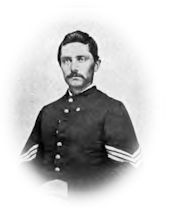
Friday, 7th—Weather still pleasant. Company drill two hours a day. Our brigade came out in review and was inspected by General Smith. A statement was read to us by the assistant adjutant general of our brigade, stating our loss at Richmond, and also that of the enemy. Our loss was seven thousand killed and two thousand taken prisoners, while that of the enemy was forty thousand in killed, wounded and prisoners.

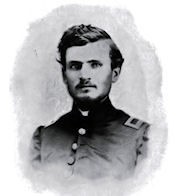
April 7th. Marched out, 32 reb colors behind Custer. Crossed S. S. R. R. at Rice’s Depot. Passed through Prince Edward’s C. H. and camped on a fork of the Appomattox. Lee’s army off to the right on the Lynchburg road.
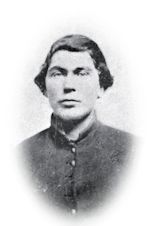
Chattanooga, Friday, April 7. A very heavy rain fell all last night, accompanied with vivid lightning and heavy thunder, which scared our sentinel on the guns off his beat, piteously imploring the corporal in tears to relieve him if he had any sympathy for him, which is the cause of some merriment in camp this morning.
The forenoon spent in dividing horses to the different platoons. Afternoon they were assigned to the men. Our teams are composed of good horses, but the cannoneers’ horses are the leavings, and a very poor-looking set. We drew them by lot, and I drew a bony plug, not yet of age, I should judge. Corporal Parish has assigned me to No. 3 on the gun. My duty will be to “tend the vent.” I would rather have another number as it is a heavy responsibility in action.
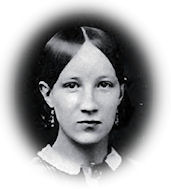
April, 1865.—What a month this has been. On the 6th of April Governor Fenton issued this proclamation: “Richmond has fallen. The wicked men who governed the so-called Confederate States have fled their capital, shorn of their power and influence. The rebel armies have been defeated, broken and scattered. Victory everywhere attends our banners and our armies, and we are rapidly moving to the closing scenes of the war. Through the self-sacrifice and heroic devotion of our soldiers, the life of the republic has been saved and the American Union preserved. I, Reuben E. Fenton, Governor of the State of New York, do designate Friday, the 14th of April, the day appointed for the ceremony of raising the United States flag on Fort Sumter, as a day of thanksgiving, prayer and praise to Almighty God, for the signal blessings we have received at His hands.”
April 7th.—Richmond has fallen and I have no heart to write about it. Grant broke through our lines and Sherman cut through them. Stoneman is this side of Danville. They are too many for us. Everything is lost in Richmond, even our archives. Blue black is our horizon. Hood says we shall all be obliged to go West—to Texas, I mean, for our own part of the country will be overrun.
Yes, a solitude and a wild waste it may become, but, as to that, we can rough it in the bush at home.
De Fontaine, in his newspaper, continues the old cry. “Now Richmond is given up,” he says, “it was too heavy a load to carry, and we are stronger than ever.” “Stronger than ever?” Nine-tenths of our army are under ground and where is another army to come from? Will they wait until we grow one?
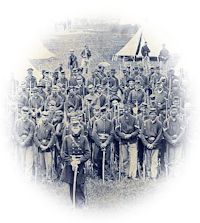
April 7th.
These are busy days with us; days of glorious activity, wherein we reap fruits of former toil. Our harvest time of victory, watered by tears and enriched by blood, is yielding bountifully. I have no time to give details; not even an outline of what has transpired during the past week.
We left Petersburg day before yesterday, and marched out on the South Side Railroad to near Southerland Station, where every man, not otherwise employed, was placed on picket. Yesterday we started at 9 o’clock and marched sixteen miles, which brings us twenty-five miles from Petersburg. We expect the cars will run as far as this place tomorrow.

Mrs. Lyon’s Diary.
Jonesboro, April 7.—The General sent his ambulance for me to ride in this morning. I am very glad, I shall be much more comfortable. He apologized for not doing it before. He said he thought I had been provided for more comfortably, and that he would see that I was supplied with all the comforts he could command.
We came through very comfortably, and have found a good, large house to live in. We have the parlor, and a large room with a good bed, where we can rest very well.

Thursday, April 6. — Went to corps headquarters. Started about 12 o’clock, and moved through Black and Whites. About two miles beyond went into camp. Started again about 7, and reached Nottaway Court House, where we were sent to guard a bridge.
[My notes end here. The following letters carry the record to the end of my military life.]

April 6.—We have just heard that Richmond has fallen; and I am not sorry, as I feel certain we shall never have peace until the enemy has possession of all our large towns, and then they will see that they have work still before them to conquer the South.
Mrs. N. has gone to visit Mrs. Dr. Porter, an old friend from Tennessee. She is as lovely as ever, but her health is very bad. I have nothing to give her to eat but bacon and corn-bread; we have very little milk. I have got so that I can eat corn-bread as well as any southerner.
Mrs. Fyffe finds the living very hard, and the doctors grumble not a little. I tell them it is all for the good of the cause. Our attendants do not get near enough of such food as we have; I have seen them many a time dining on less than an ounce of bacon, and a piece of corn-bread half an inch thick and about six inches square. We have one very sick man, who can not eat that. I have very little coffee, and every now and again make him a cup of it. I went to see Mrs. Ware, whom I met at Ringgold. Her son is now quite well, and going about on crutches. She informed me that the people here, with few exceptions, do not fare any better than we do, and that many of them do not get as much.

April 6th.—Showery morning.
I perceive no change, except, perhaps, a diminution of troops, which seems to confirm the reports of recent battles, and the probable success of Lee and Johnston. But all is doubt and uncertainty.
The military authorities are still reticent regarding the fate of those remaining in Richmond. We are at their mercy, and prepared for our fate. I except some of our ladies, who are hysterical, and want to set out on foot “for the Confederacy.”


