
Thursday, 6th—News comes that General Grant has taken Richmond with five thousand prisoners and five hundred pieces of artillery. We also hear that Mobile has been taken with twenty thousand prisoners and a large number of guns. Glorious news!


6th. Drew rations in the night. Moved at 7—whole army. Cavalry to the left of Burkeville. Charged the reb wagon train. Scattered the skirmish line and charged each way. Chester and myself charged nearly 4 miles, nearly to the head of train—no support. (Battle of Sailor’s Creek.) Chester wounded in the head. Eggleston and Smith got several pieces of artillery. Got back to command by a circuitous route, the rebs having cut us off. Two divisions charged mounted and were repulsed. Reformed and charged again with success, the 6th Corps engaging the rear. Lt. Stearns killed. Several Co. “C” captured. Several thousand prisoners, many colors, Generals and cannon. 2nd credited 650 prisoners, 60 officers and 4 pieces of artillery. Lost good men.[1]
[1] In a letter from Capt. Chester dated March 23, 1914, regarding the fighting at Sailor’s Creek he says:
“Our regiment and brigade was ordered to charge Lee’s wagon train in sight, across a small stream with banks on the farther side. Our regiment was, as I remember it, the last one in the column so were the left of the line of battle or attack. We struck the wagon train and commenced taking prisoners. All formation of company or regiment was broken, every soldier acting independently. The driver of a mule team refused to stop when I ordered him to do so, and I was about to shoot him when it occurred to me that if I killed the driver the team would continue to go just the same. So I rode up to the “lead” mule (the one on the left hand side of head pair) and shot it. That stopped the entire team and blocked the narrow road. I then captured a rebel Major and turned him over to Sergt. Waters of Co. H to take to the rear. As soon as that was done Joe T. Haskell—now of Wellington—came to me. Capt. Tenney with his orderly, and Lieut. Stearns, came up, so there were five of us. We turned to the right and rode to the top of the bank or bluff and there the rebel train was in full sight again a mile or more from where we first charged it. The five men took position several rods apart so as to cover or show quite a line. As we showed ourselves the train guard fired on us. We each turned and called out loudly for the “pretended battalions” in the ravine to charge. We advanced on the gallop firing our revolvers and shooting as we went. The train guard was stampeded and ran. We followed along the train for a quarter of a mile to where the fence had been thrown down and the wagons were going into a piece of woods. I was a few rods from the fence when a rebel from behind a tree in the woods fired at me and missed hitting me. I fired my revolver at him, to no effect, however. He then reloaded his gun, stepping from behind the tree in doing so, then rested his gun beside the tree and took deliberate aim at me, and fired. The bullet knocked me from my horse. Capt. Tenney rode up, caught my horse and told me I was all right. I supposed I was mortally wounded. Haskell came to me and taking a suit case from a wagon found some white cloth and tied up my head. In the meantime other men came up and Capt. Tenney and Lt. Stearns led them to attack the train again going through the woods, some distance I think. Somewhere after leaving me Lieut. Stearns was killed by a train guard.”
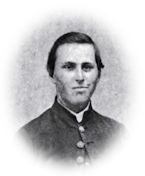
April 6th. A cold rain storm this morning. Nothing to do but try and keep comfortable. Discussing the war question, and what the indications are about our getting home. General Lee has not surrendered as yet. Perhaps there may be much more fighting. One question is, it may turn into a guerilla warfare, owing to so many mountains in the South.
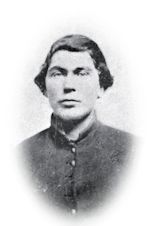
Chattanooga, Thursday, April 6. Very rainy and wet. No duty till noon when orders came to draw horses immediately, so to-night we have one hundred and forty-five horses in our new stables. Rather a poor quality all through. Much curiosity is manifested by some as to what and where they are to be. Drivers are anxious to receive the best teams. They will not be apportioned till to-morrow.
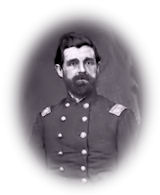
Colonel Lyon.
Written at Greenville.
We made a long march and reached here, 75 miles above Knoxville, last evening. We have orders to move on to Jonesboro, 35 miles further. Adelia travels in an ambulance, and we are well and happy.
The 13th did not vote. I know that I am beaten and I did not care to swell my vote with that of my own regiment. They would all have voted for me. I have never expected for a moment to be elected. I suppose I am defeated by at least 5,000. I know that some of my best friends were committed to Judge Noggle long before I was nominated, and could not do otherwise than support him.
Everybody is in good spirits over the news from Richmond.

–
Mrs. Lyon’s Diary.
Greenville, April 6, 1865.—There seems to be no rest for us. Yesterday we were indulging in the hope of staying here for some time and had quite a settled feeling. If I had not been tired I would have unpacked my trunks, but I was fortunate in not doing so. We are again ordered to march to Jonesboro, 35 miles farther. I shall have to go behind the mules again.
We started. The mules ran down the hill as usual, and when we were three miles out we broke an axle. I then rode in an ambulance for ten miles, seated with the driver. Stayed here all night. Some of the boys march right along with us over these mountains to keep the ambulance from turning over, the road is so steep and sidling. I had much rather march than to ride in this way, but they will not allow me to for fear I will get sick; and then we have to ford so many rivers, when I have to be in the carriage. I sometimes think we never can get up and down the bank; but I find it much better sitting with the driver. Since we have been on this march some of the men run on ahead of the regiment, when we are to stop over night, and gather hay or straw, or get pine boughs for me to sleep on. They do not seem to think that I am in the way at all. They have shown me so much kindness in preparing something for me to sleep on, I shall never forget it.

6th.—Mr. Lincoln has visited our devoted city to-day. His reception was any thing but complimentary. Our people were in nothing rude or disrespectful; they only kept themselves away from a scene so painful. There are very few Unionists of the least respectability here; these met them (he was attended by Stanton and others) with cringing loyalty, I hear, but the rest of the small collection were of the low, lower, lowest of creation. They drove through several streets, but the greeting was so feeble from the motley crew of vulgar men and women, that the Federal officers themselves, I suppose, were ashamed of it, for they very soon escaped from the disgraceful association. It is said that they took a collation at General Ord’s—our President’s house!! Ah! it is a bitter pill. I would that dear old house, with all its associations, so sacred to the Southerners, so sweet to us as a family, had shared in the general conflagration. Then its history would have been unsullied, though sad. Oh, how gladly would I have seen it burn! I have been nowhere since Monday, except to see my dear old friend Mrs. R., and to the hospital. There I am not much subjected to the harrowing sights and sounds by which we are surrounded. The wounded must be nursed; poor fellows, they are so sorrowful! Our poor old Irishman died on Sunday. The son of a very old acquaintance was brought to our hospital a few days ago, most severely wounded—Colonel Charles Richardson, of the artillery. We feared at first that he must die, but now there is a little more hope. It is so sad that after four years of bravery and devotion to the cause, he should be brought to his native city, for the defence of which he would have gladly given his life, dangerously if not mortally wounded, when its sad fate is just decided. I love to sit by his bedside and try to cheer him; his friends seem to vie with each other in kind attentions to him.
We hear rumours of battles, and of victories gained by our troops, but we have no certain information beyond the city lines.
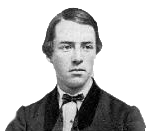
Wednesday, April 5. — Men relieved from picket about 12 noon, and started on march again. Weather very warm and hot. Had a very disagreeable march, halting every few minutes, until we reached Wellsville, about 31 miles from Petersburg. Went into camp for the night.

April 5.—News has come that Selma is in the hands of the enemy, who have destroyed it, and are en route for Montgomery. Dr. de Yampert’s home is near Selma, and he has no doubt but that it is now in their possession. He says he does not care, as he expected to lose his all.
Dr. Bemiss is here on a tour of inspection; I am much pleased to see him again; it is like seeing a very old friend to meet any of our former surgeons. He is low-spirited, and it is not much wonder, as he has been separated from his wife and children a long time, and there seems little chance at present of his seeing them soon; and, what adds to the trouble, communication through the lines is very uncertain. These are things we try not to think about.
Mrs. Newsom arrived to-day. She does not intend remaining, but is trying to reach the army in North Carolina, as her brother is there. She is leaving two of her negroes, a man and his wife, with Dr. de Yampert.

April 5th.—Bright and pleasant.
Stayed with my next door neighbors at their request last night— all females. It was quiet; and so far the United States pickets and guards have preserved perfect order.
The cheers that greeted President Lincoln were mostly from the negroes and Federals comprising the great mass of humanity. The white citizens felt annoyed that the city should be held mostly by negro troops. If this measure were not unavoidable, it was impolitic if conciliation be the purpose.
Mr. Lincoln, after driving to the mansion lately occupied by Mr. Davis, Confederate States President, where he rested, returned, I believe, to the fleet at Rocketts.
This morning thousands of negroes and many white females are besieging the public officers for provisions. I do not observe any getting them, and their faces begin to express disappointment.
It is said all the negro men, not entering the army, will be put to work, rebuilding bridges, repairing railroads, etc.
I have seen a New York Herald of the 3d, with dispatches of the 1st and 2d inst. from Mr. Lincoln, who was at City Point during the progress of the battle. He sums up with estimate of 12,000 prisoners captured, and 50 guns.
The rumor of a success by Gen. Lee on Monday is still credited. Per contra, it is reported that President Davis is not only a captive, but will soon be exhibited in Capitol Square.
The Rev. Mr. Dashiell, who visited us to-day, said it was reported and believed that 6000 South Carolina troops threw down their arms; and that a large number of Mississippians deserted— giving such information to the enemy as betrayed our weak points, etc.
Three P.M. I feel that this Diary is near its end.
The burnt district includes all the banks, money-changers, and principal speculators and extortioners. This seems like a decree from above!
Four P.M. The Square is nearly vacated by the negroes. An officer told me they intended to put them in the army in a few days, and that the Northern people did not really like negro equality any better than we did.
Two rumors prevail: that Lee gained a victory on Monday, and that Lee has capitulated, with 35,000 men.
The policy of the conquerors here, I believe, is still undecided, and occupies the attention of Mr. Lincoln and his cabinet.
Wednesday, 5th—The regimental chaplains are occupying the pulpits of the different churches of Goldsboro and conducting nightly meetings. A large number of the boys are attending and a great many are coming forward and professing the name of the Lord. May the work continue until all have made the profession.


