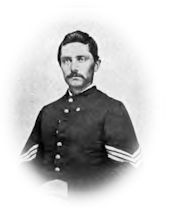
Tuesday, 4th—The quartermaster distributed new clothing today. I drew a hat, a pair of shoes and a pair of socks. We are enjoying full rations again, and also our new clothing. We no longer have to search our haversacks for a crumb of hardtack.

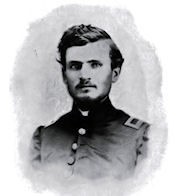
4th. Up at daylight. Sent telegram home. Moved up the Appomattox, our Div. in advance. Captured 300 or 400 prisoners, 5 guns and many wagons. Hill’s Corps and cavalry on our front. Near Bevil’s Bridge enemy made a stand at a crossroads to get a part of their column by. Artillery opened and rebs ran. Our regt. did not become engaged. Went out to pick up wounded. Quite a number of deserters. Camped on this ground. Richmond ours. God hasten peace. Clear and pleasant. Cavalry moved on up the Appomattox. 1st Div. in advance. Would that I could see mother now in her distress. Passed a part of the infantry. Made a feint towards Amelia C. H. Went into camp. 2nd on picket. Moved out again at 11 P. M. Returned to main road and marched all night.
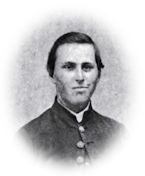
April 4th. Relieved from picket this morning. On reaching camp there was great rejoicing over the good news. Reports continue to come about General Grant’s success. Shouting and singing, glory hallelujah on all sides. Citizens and soldiers cheering over the good news. Bands and drum corps making all the music they can. We are at liberty to go and come as we please. Duty suspended as far as can be. In and out of town as we please. A happy time. The Union people in town are keeping open house. The soldiers are made welcome. The glorious Yankee Army are surely in Richmond. We are all thankful for the good news. This summer will surely find us in good old Connecticut. The singing and cheering is continuous.
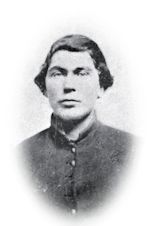
Chattanooga, Tuesday, April 4. The morning Gazette gives nothing but a confirmation of yesterday’s news. The day is pleasant and men to work the engine of war are still being transported Knoxville-ward. Lee now will look for a green spot in a Confederate oasis in which to rest his weary limbs, I suppose. It aint East Tennessee, Sir.
This afternoon orders came to draw horses and we thought of marching ahead, but were withdrawn, military usage. Some in camp are already discussing when they will get home by virtue of the “end of the war”. One-year men think we will all be home by July. Some veterans think “New Year’s about the time.” I wish they could all go when I go, but there is much to do yet, ere harmony and peace can be restored, and the soldier must do it.
April 4th.
I have slept one night in Petersburg. Again, with knapsack packed, I am ready for the move. I have no time to chronicle particulars; would that I had. This much I will say: I am about as happy as man can be far from his loved ones. Yesterday was a glorious day for the Nation and for us.

Mrs. Lyon’s Diary.
Bull’s Gap, April 4.—I expect we shall stay here some time, they are so nicely situated. The whole 4th Corps makes a fine show in camp. We shall settle down now and have a nice visit after all.
Later.—We have just had orders to march to Greenville at six o’clock in the morning. What a long rest!
Monday, April 3. — Reached Fortress Monroe about 7.30. A.M. Several officers came on board. Among others Colonel Cutting of General Burnside’s staff. Heard that an attack had been ordered on Petersburg by the Sixth and Ninth Corps. Colonel Jarves was left here. Reached City Point at 3 P.M., when we heard the glorious news of the capture of Petersburg, and the evacuation of Richmond. Saw thousands of prisoners who had been captured by our army, many of them guarded by marines and sailors, who seemed to enjoy their duty hugely. Took the train for the front, and by General Warren’s advice got out at Meade Station. Sent my things into Petersburg by a mail wagon. Crossed our lines through Fort Stedman and went to General Willcox’s headquarters in Petersburg. Could find out nothing about our division. Saw the quartermaster sergeant, and took his horse. Left Captain Shurtleff with baggage. Rode about 8 or 9 miles and met our train. Stayed over night with Lieutenant French.

April 3.—Have a very nice lady, Mrs. Fyffe, assisting mo. She is a refugee from Chattanooga. She came out of Chattanooga on a visit to some friends a few miles in the country; while she was there our army took possession of Lookout Mountain, and she found herself within our lines and cut off from her family. She tried very hard to get back, as she had left her house and in it an only child, a married daughter, very sick, but her entreaties were of no avail, Rosecrans had given orders on no account to permit any woman to cross the lines, as they were worse rebels than the men. Mrs. F. remained on the mountain, living in a house about half-way up, for some weeks, within sight of her daughter’s home, and between the firing of both armies. Finding she could not get into Chattanooga, she came South. She is now in great distress, having heard but once from her daughter since she left.
The citizens of Chattanooga have suffered all kinds of indignities from the Federals. I have been told that Mrs. Whitesides has been sent North, and that herself and family are now in prison. I knew Mrs. W. well; she was a perfect lady. I had heard her say before I left Chattanooga, that if the enemy should come there she intended remaining, as she had a family of seven children, and could not leave her home with them. She felt certain that the Federals would not molest her if she kept quiet; but it appears she has given them more credit for philanthropy than they deserved. I can not understand this, as I believed as she did about remaining quiet.
I have thought, if I should ever be so unfortunate as to be in the “enemy’s lines,” that by taking little or no notice of them I should be unmolested; as I think many of our ladies have been in fault, by giving a warm and open expression to their feelings, when silence would have much better become them, and spoken more eloquently their wrongs. “Discretion is the better part of valor,” in this as well as in other cases. When we are in the lion’s gripe, it is no sign of cowardice to use every means that wisdom can suggest to extricate ourselves. I feel confident that neither we nor our cause have ever gained any thing by walking around the flag instead of under it, or using insulting language when silence would have much better become us. A flag is nothing but a symbol, and walking around it can not take away the reality of being under it. And we much oftener lower ourselves by insulting language than the person whom we abuse.
I have been told that it was on account of Mrs. W.’s wealth that she and her children have been imprisoned, but the enemy could have taken that without such harsh measures.
April 3d.—Another clear and bright morning. It was a quiet night, with its million of stars. And yet how few could sleep, in anticipation of the entrance of the enemy! But no enemy came until 9 A.M., when some 500 were posted at the Capitol Square. They had been waited upon previously by the City Council, and the surrender of the city stipulated—to occur this morning. They were asked to post guards for the protection of property from pillage, etc., and promised to do so.
At dawn there were two tremendous explosions, seeming to startle the very earth, and crashing the glass throughout the western end of the city. One of these was the blowing up of the magazine, near the new almshouse—the other probably the destruction of an iron-clad ram. But subsequently there were others. I was sleeping soundly when awakened by them.
All night long they were burning the papers of the Second Auditor’s office in the street—claims of the survivors of deceased soldiers, accounts of contractors, etc.
At 7 A.M. Committees appointed by the city government visited the liquor shops and had the spirits (such as they could find) destroyed. The streets ran with liquor; and women and boys, black and white, were seen filling pitchers and buckets from the gutters.
A lady sold me a bushel of potatoes in Broad Street for $75, Confederate States money—$5 less than the price a few days ago. I bought them at her request. And some of the shops gave clothing to our last retiring guards.
Goods, etc. at the government depots were distributed to the poor, to a limited extent, there being a limited amount.
A dark volume of smoke rises from the southeastern section of the city, and spreads like a pall over the zenith. It proceeds from the tobacco warehouse, ignited, I suppose, hours ago, and now just bursting forth.
At 8½ A.M. The armory, arsenal, and laboratory (Seventh and Canal Streets), which had been previously fired, gave forth terrific sounds from thousands of bursting shells. This continued for more than an hour. Some fragments of shell fell within a few hundred yards of my house.
The pavements are filled with pulverized glass. Some of the great flour mills have taken fire from the burning government warehouses, and the flames are spreading through the lower part of the city. A great conflagration is apprehended.
The doors of the government bakery (Clay Street) were thrown open this morning, and flour and crackers were freely distributed, until the little stock was exhausted. I got a barrel of the latter, paying a negro man $5 to wheel it home—a short distance.
Ten A.M. A battery (United States) passed my house, Clay Street, and proceeded toward Camp Lee. Soon after the officers returned, when I asked the one in command if guards would be placed in this part of the city to prevent disturbance, etc. He paused, with his suite, and answered that such was the intention, and that every precaution would be used to preserve order. He said the only disturbances were caused by our people. I asked if there was any disturbance. He pointed to the black columns of smoke rising from the eastern part of the city, and referred to the incessant bursting of shell. I remarked that the storehouses had doubtless been ignited hours previously. To this he assented, and assuring me that they did not intend to disturb us, rode on. But immediately meeting two negro women laden with plunder, they wheeled them to the right about, and marched them off, to the manifest chagrin of the newly emancipated citizens.
Eleven A.M. I walked down Brad Street to the Capitol Square. The street was filled with negro troops, cavalry and infantry, and were cheered by hundreds of negroes at the corners.
I met Mr. T. Cropper (lawyer from the E. Shore) driving a one-horse wagon containing his bedding and other property of his quarters. He said he had just been burnt out—at Belom’s Block —and that St. Paul’s Church (Episcopal) was, he thought, on fire. This I found incorrect; but Dr. Reed’s (Presbyterian) was in ruins. The leaping and lapping flames were roaring in Main Street up to Ninth; and Goddin’s Building (late General Post-Office) was on fire, as well as all the houses in Governor Street up to Franklin.
The grass of Capitol Square is covered with parcels of goods snatched from the raging conflagration, and each parcel guarded by a Federal soldier.
A general officer rode up and asked me what building that was —pointing to the old stone United States Custom House—late Treasury and State Departments, also the President’s office. He said, “Then it is fire-proof, and the fire will be arrested in this direction.” He said he was sorry to behold such destruction; and regretted that there was not an adequate supply of engines and other apparatus.
Shells are still bursting in the ashes of the armory, etc.
All the stores are closed; most of the largest (in Main Street) have been burned. There are supposed to be 10,000 negro troops at Camp Lee, west of my dwelling.
An officer told me, 3 P.M., that a white brigade will picket the city to-night; and he assured the ladies standing near that there would not be a particle of danger of molestation. After 9 P.M., all will be required to remain in their houses. Soldiers or citizens, after that hour, will be arrested. He said we had done ourselves great injury by the fire, the lower part of the city being in ashes, and declared that the United States troops had no hand in it. I acquitted them of the deed, and told him that the fire had spread from the tobacco warehouses and military depots, fired by our troops as a military necessity.
Four P.M. Thirty-four guns announced the arrival of President Lincoln. He flitted through the mass of human beings in Capitol Square, his carriage drawn by four horses, preceded by out-riders, motioning the people, etc. out of the way, and followed by a mounted guard of thirty. The cortege passed rapidly, precisely as I had seen royal parties ride in Europe.
Monday, 3d—Fine weather continues, and camp routine the same. We are enjoying our fine camp ground, and to prevent our becoming stale, we have to keep up regular drill for our next campaign.


