Following the American Civil War Sesquicentennial with day by day writings of the time, currently 1863.

Monday, 3rd. Yesterday I wrote to mother and sisters.[1] The fighting of Saturday was most severe. The 2nd Ohio lost 35 killed and wounded in the two days. 5 officers. Trees completely riddled where we were. How so few fell I can not see. Brilliant affair—but oh the cost. Petersburg ours, too. It seems hard to lose dear friends when peace seems so near. Picket’s Div. captured nearly entire. Wrote the sad news home, also wrote Richard Bail’s people. Moved out at 9 A. M. Crossed the south side R. R. between Fords and Sutherlands. 5th Corps across. Very little firing heard today. 1st Div. struck the rebs near the river road. Firing after dark.


[1] Letter from L. H. Tenney to his Mother and Sisters

Oak Grove, Alabama, Sunday P. M., April 1, 1866.

My Dear Mother and Friends:

I wonder if nearly the same thoughts are not in your mind this P. M. which are in mine.

The sun is just about as low now at 6 o’clock as it was a year ago, when our noble boy, Theodore, fell in the thickest of the fight, face towards the enemy, there in the pine woods at Five Forks. How vividly everything of that sad and yet memorable day comes up to me.

March 31st was a hard day for us. The enemy had driven our cavalry (save one division) from Five Forks nearly back to Dinwiddie Court House. Our Division was sent for (it was behind, hard at work, getting the train through the mud) and went forward at a trot. As we neared the Court House and heard the volleys of musketry, the cheers of the rebels, and saw our men falling back—many straggling—we knew that there was work ahead. How quiet our boys were during the few minutes while we were regaining our organizations. Soon we went forward at a gallop. A half mile at this pace and we came to Custer’s and Sheridan’s colors near an unsupported battery and in sight of the rebel line.

Advancing across a small valley before us, our regiment in advance, we dismounted, formed line by battalions and on double quick started forward in less time, I believe, than I have been in telling it.

The brave Custer, with staff and orderlies, colors flying, went forward with us.

We gave one Second Ohio yell, perhaps a little more faintly than at other times, for the prospect looked dark, and other regiments took it up. The rebel line faced about, but though stragglers left hurriedly, marched slowly. I was afraid. We were within range. It seemed the only thing to do, for we were too few to form a line and hold our position. Another charge was ordered. The Div. colors were not behind. We had hardly started again with a yell, than that rebel line, Pickett’s Div. of Infantry in our front, faced about, fired a volley and came forward on the double quick.

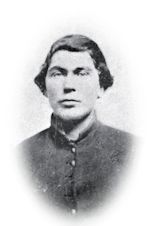
My horse had been shot and I had taken position behind a tree. Thede was a short distance behind me. How well I remember how he exclaimed: “Oh what makes them run,” and then: “Lume, Luman, come, our men are falling back, we’ll get captured!”—and how closely he kept by me, always following me, as I went back slowly through the edge of the woods, my lungs troubling me. The sun had gone down and darkness came when we regained the ground where we had dismounted. We threw up rail breastworks and waited for the rebels. They were cautious, advanced skirmishers found our position and fell back to camp in sight of us. Volunteers were called for or rather “the best men” to a certain number were sent out as scouts to learn the whereabouts and whatabouts of the enemy. Thede was among the number. Without supper or sleep, we awaited the dawn of the day. Quite a number of our boys had fallen, among then Capt. Newton. We talked about our casualties, and the narrow escape of many, and wondered what the morrow would bring. We felt that the fighting was to be decisive, but knew not whether one day would bring victory.

Occasional shots were fired by skirmishers. Morning came. The scouts reported that the enemy had commenced falling back just before day. Sheridan came out with his colors. Our horses were brought up and we marched forward. After going a mile firing commenced on our flank. We countermarched, dismounted, formed line and advanced again, driving cavalry before us. We had missed breakfast, and the boys were weighed down with ammunition, so they left their haversacks upon their horses.

Theodore looked pale and tired—said his bowels were troubling him. It was afternoon before we reached the enemy’s position at Five Forks. We attacked and were repulsed. A gap between the Cavalry and Infantry was discovered, so that two hours were spent moving to the right and then to the left, in front of and in range of the enemy’s works. Here, weak, faint and hungry, we threw up sufficient works of logs, etc., to cover our bodies when lying down. Thede and I were together. He got some crumbs of crackers from my saddle.

It was now four o’clock when the bugles sounded the charge, and the boys, forgetting their weariness, jumped up and vied with each other in advancing to within a few rods of the works, dark with clouds of smoke and belching guns. How grim, savage and hateful everything looked in our front!

You remember well the rest—the next charge—the bravery of the boy, his fall, his devotion to duty, certainty of death, remembrance of his sins, and faith for their forgiveness through Christ—the kind messages to Ma—and then his falling so peacefully to sleep. I never can forget the firm but pleasant look upon his countenance, as he lay among the groaning, dying and dead at the hospital. Then his burial. I thanked God that his brother could be with him in his last moments and lay his remains away to rest till the final trumpet call.

My thoughts were sad as I groped my way through the dark woods to our camp. I thought particularly of the mourning at home. I knew that you would be sad to feel that the boy should be taken in his youth, the hope of his mother and joy of his friends, and yet I felt that you would inwardly thank God that his death had brought glory to Him and freedom to men. The dearer he was to his friends, the brighter his hopes, the greater the sacrifice was in the eyes of God. We ought to feel—I do—that we have a living interest in this great good accomplished and sealed by the blood of our dearest friends. And we certainly have reason to trust that Theodore’s inheritance is in Heaven, drawing us thither.

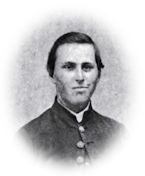
Luman H. Tenney.

_

Note—One year after the above letter, on April 16, 1867, Luman Harris Tenney and Frances Delia Andrews were married at Oberlin, Ohio.

And about a year and a half later when the brother and mother went to Virginia to look up the burial place of “Brother Theodore” the following letters were written to me in our home in Sandusky, Ohio.

F. D. T., Feb. 5, 1914.

_

Petersburg, Va., Nov. 12, 1868.

Thursday morning.

My Sweet Child:

We arrived here safely a few minutes ago. One of Ma’s first remarks after getting here was, “I wish Fannie, Minnie and Melissa could be here with us today.” I have made the same wish in regard to my darling wife every day since I left her and the dear baby. (Bernard.)

We reached Washington Tuesday evening rather late. Yesterday spent the morning in looking up records. Found that Theodore was buried here in National Cemetery, “Poplar Grove,” about two miles out.

Shall undoubtedly leave him.

Yesterday afternoon we drove over to Arlington Heights and the National Cemetery there, where some 13,000 soldiers rest—

“Sleep the sleep that knows not waking,

Dream of battlefields no more.”

We shall go early to the cemetery and probably to Richmond for the night. Much love, dear child, from

Your devoted husband,

Luman.

_

Washington, D. C., Nov. 14, 1868.

My Own Dear Fannie:

We reached here last evening after a very satisfactory visit at Petersburg and Richmond and pleasant trip back. * * * We found Theodore’s grave very pleasantly situated in the National Cemetery near Petersburg. Everything seemed very satisfactory to Ma. We got flowers and put on the grave. * * *

Shall probably reach home Thursday.

Kiss our sweet “da-da” treasure many times for me. Accept much love, dear Fannie, from

Your Luman.

April 3d. Detailed for picket. Located out on outpost on the Tuscaror road, leading to the North Mountain, about one mile out of town. Have done picket duty on this road many times. At the edge of town all roads are barricaded and closed for the nights, to prevent a sudden dash from the guerillas and Confederate scouts. Report comes tonight that General Grant has taken Richmond and that General Lee has retreated. Good news.

Chattanooga, Monday, April 3. Richmond is taken. Victory! Victory!! Victory!!! After three years of long, anxious and prayerful waiting for this crowning news, it at last comes with the verifying signatures of A. Lincoln, U. S. Grant and E. M. Stanton. It reached camp in the shape of an extra about 2 P. M. in but a few hours after it was known in Washington. And when it came I was hardly able to receive it, and I still could but fear of a contradiction that hithertofore has been so painful. Its effect on the camp was curious, each one moving briskly aglow with animation. Organized cheers is played out amongst old soldiers, but the broken, wild Indian-like whoops that pierced the air nearly all the afternoon would almost be considered terrific by “tame people”. At 6 P. M. one hundred guns were fired from the surrounding hills. Each boom, called forth a hearty response from the many tented hills and hollows of Chattanooga, and seemed to crush the last lingering doubt in every bosom. Who will dare doubt that the end is to be glorious?

Camp Hastings, April 3, 1865.

Dear Colonel: — That sounds better, don’t it? Your commission was sent three weeks ago, as I was told by Harry Thompson. There has been some oversight or negligence. I know Colonel Comly would not purposely withhold it.

The Twenty-third is in a nice camp near town, doing provost duty. You could enjoy yourself with them as soon as you can hobble about a little. . . .

General Crook has command of the cavalry of the Army of the Potomac. Just for the name of the thing, he took command of this Department for a day or two. He came out to our camp. We gave him a regular jolly mass-meeting sort of reception, which he and all of us enjoyed. I think it better for him as it is.

We are all ready to move. The talk is that we shall go soon. Hancock has at Halltown about ten thousand to fifteen thousand men, six or eight new Ohio regiments of the number. … .

Sincerely,

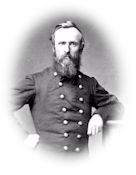
R. B. Hayes.

Lieutenant-colonel Russell Hastings,
Willoughby, Ohio.

Camp Hastings, April 3, 1865.

Dear Mother: — . . . I am to have a new command in Hancock’s Corps. Either veterans or a brigade of new Ohio troops. I shall probably prefer the latter, as it is not likely to continue a great while. I leave Cumberland tomorrow. The new command is near Harpers Ferry. Letters addressed to me via Harpers Ferry will reach me.

Affectionately,

R.

Mrs. Sophia Hayes.

April 3d.—Saw General Preston ride off. He came to tell me good-by. I told him he looked like a Crusader on his great white horse, with William, his squire, at his heels. Our men are all consummate riders, and have their servants well mounted behind them, carrying cloaks and traps—how different from the same men packed like sardines in dirty railroad cars, usually floating inch deep in liquid tobacco juice.

For the kitchen and Ellen’s comfort I wanted a pine table and a kitchen chair. A woman sold me one to-day for three thousand Confederate dollars.

Mrs. Hamilton has been disappointed again. Prioleau Hamilton says the person into whose house they expected to move to-day came to say she could not take boarders for three reasons: First, “that they had smallpox in the house.” “And the two others?” “Oh, I did not ask for the two others!”

Inside of Petersburg, April 3d, 1865.

I was cut short off night before last by orders to “get ready to move, immediately.” Petersburg is ours, at last. The fighting yesterday was terrific, lasting from 3 o’clock in the forenoon until dark. The Seventeenth was not engaged; was detailed as Provost Guard. The First Division entered the city early this morning. I can write no more now. Everybody shouting. My heart overflows with happiness, too deep for words.

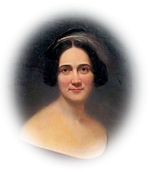
Mrs. Lyon’s Diary.

April 3.—We were nearly all day on the road. Had dinner on the cars, what the men had provided for themselves, about like a soldier’s dinner, something to keep the stomach from getting empty. William met us at the depot. We walked to the camp. They have selected a very pleasant spot about half a mile from the depot, and all the way up hill. I was so glad to get there.

April 3.— Agitated and nervous, I turn to my diary to-night as the means of soothing my feelings. We have passed through a fatal thirty-six hours. Yesterday morning (it seems a week ago) we went, as usual, to St. James’s Church, hoping for a day of peace and quietness, as well as of religious improvement and enjoyment. How short-sighted we are, and how little do we know of what is coming, either of judgment or mercy! The sermon being over, as it was the first Sunday in the month, the sacrament of the Lord’s Supper was administered. The day was bright, beautiful, and peaceful, and a general quietness and repose seemed to rest upon the congregation, undisturbed by rumours and apprehensions. While the sacred elements were being administered, the sexton came in with a note to General Cooper, which was handed him as he walked from the chancel, and he immediately left the church. It made me anxious; but such things are not uncommon, and caused no excitement in the congregation. The services being over, we left the church, and as the congregations from the various churches were being mingled on Grace Street, our children, who had been at St. Paul’s, joined us, on their way to the usual family gathering in our room on Sunday. After the salutations of the morning, J. remarked, in an agitated voice, to his father, that he had just returned from the War Department, and that there was sad news—General Lee’s lines had been broken, and the city would probably be evacuated within twenty-four hours. Not until then did I observe that every countenance was wild with excitement. The inquiry, “What is the matter?ran from lip to lip. Nobody seemed to hear or to answer. An old friend ran across the street, pale with excitement, repeating what J. had just told us, that unless we heard better news from General Lee the city would be evacuated. We could do nothing; no one suggested any thing to be done. We reached home with a strange, unrealizing feeling. In an hour J. (who is now Professor of Mathematics in the Naval School) received orders to accompany Captain Parker to the South with the Corps of Midshipmen. Then we began to understand that the Government was moving, and that the evacuation was indeed going on. The office-holders were now making arrangements to get off. Every car was ordered to be ready to take them south. Baggage-wagons, carts, drays, and ambulances were driving about the streets; every one was going off that could go, and now there were all the indications of alarm and excitement of every kind which could attend such an awful scene. The people were rushing up and down the streets, vehicles of all kinds were flying along, bearing goods of all sorts and people of all ages and classes who could go beyond the corporation lines. We tried to keep ourselves quiet. We could not go south, nor could we leave the city at all in this hurried way. J. and his wife had gone. The “Colonel,” with B., intended going in the northern train this morning— he to his home in Hanover County, and she to her father’s house in Clarke County, as soon as she could get there. Last night, when we went out to hire a servant to go to Camp Jackson for our sister, we for the first time realized that our money was worthless here, and that we are in fact penniless. About midnight she walked in, escorted by two of the convalescent soldiers. Poor fellows! all the soldiers will go who can, but the sick and wounded must be captured. We collected in one room, and tried to comfort one another; we made large pockets and filled them with as many of our valuables as we could suspend from our waists. The gentlemen walked down to the War Office in the night to see what was going on. Alas! every sight and sound was grievous and heavy.

A telegram just received from General Lee hastened the evacuation. The public offices were all forsaken. They said that by three o’clock in the morning the work must be completed, and the city ready for the enemy to take possession. Oh, who shall tell the horror of the past night! Hope seemed to fade; none but despairing words were heard, except from a few brave hearts. Union men began to show themselves; treason walked abroad. A gloomy pall seemed to hang over us; but I do not think that any of us felt keenly, or have yet realized our overwhelming calamity. The suddenness and extent of it is too great for us to feel its poignancy at once. About two o’clock in the morning we were startled by a loud sound like thunder; the house shook and the windows rattled; it seemed like an earthquake in our midst. We knew not what it was, nor did we care. It was soon understood to be the blowing up of a magazine below the city. In a few hours another exploded on the outskirts of the city, much louder than the first, and shivering innumerable plate-glass windows all over Shockoe Hill. It was then daylight, and we were standing out upon the pavement. The Colonel and B. had just gone. Shall we ever meet again? Many ladies were now upon the streets. The lower part of the city was burning. About seven o’clock I set off to go to the central depot to see if the cars would go out. As I went from Franklin to Broad Street, and on Broad, the pavements were covered with broken glass; women, both white and coloured, were walking in multitudes from the Commissary offices and burning stores with bags of flour, meal, coffee, sugar, rolls of cotton cloth, etc.; coloured men were rolling wheelbarrows filled in the same way. I went on and on towards the depot, and as I proceeded shouts and screams became louder. The rabble rushed by me in one stream. At last I exclaimed, “Who are those shouting? What is the matter?” I seemed to be answered by a hundred voices, “The Yankees have come.” I turned to come home, but what was my horror, when I reached Ninth Street, to see a regiment of Yankee cavalry come dashing up, yelling, shouting, hallooing, screaming! All Bedlam let loose could not have vied with them in diabolical roarings. I stood riveted to the spot; I could not move nor speak. Then I saw the iron gates of our time-honoured and beautiful Capitol Square, on the walks and greensward of which no hoof had been allowed to tread, thrown open and the cavalry dash in. I could see no more; I must go on with a mighty effort, or faint where I stood. I came home amid what I thought was the firing of cannon. I thought that they were thundering forth a salute that they had reached the goal of their ardent desires; but I afterwards found that the Armory was on fire, and that the flames having reached the shells deposited there for our army, they were exploding. These explosions were kept up until a late hour this evening; I am rejoiced they are gone; they, at least, can never be turned against us. I found the family collected around the breakfast-table, and was glad to see Captain M’s family with them. The captain has gone, and the ladies have left their home on “Union Hill” to stay here among friends, Colonel P. having kindly given them rooms. An hour or two after breakfast we all retired to our rooms exhausted. No one had slept; no one had sought repose or thought of their own comfort. The Federal soldiers were roaming about the streets; either whiskey or the excess of joy had given some of them the appearance of being beside themselves. We had hoped that very little whiskey would be found in the city, as, by order of the Mayor, casks were emptied yesterday evening in the streets, and it flowed like water through the gutters; but the rabble had managed to find it secreted in the burning shops, and bore it away in pitchers and buckets. It soon became evident that protection would be necessary for the residences, and at the request of Colonel P. I went to the Provost Marshal’s office to ask for it. Mrs. P. was unfortunately in the country, and only ladies were allowed to apply for guards. Of course this was a very unpleasant duty, but I must undertake it. Mrs. D. agreed to accompany me, and we proceeded to the City Hall—the City Hall, which from my childhood I had regarded with respect and reverence, as the place where my father had for years held his courts, and in which our lawyers, whose names stand among the highest in the Temple of Fame, for fifty years expounded the Constitution and the laws, which must now be trodden under foot. We reached it. After passing through crowds of negro soldiers there, we found on the steps some of the elderly gentlemen of the city seeking admittance, which was denied them. I stopped to speak to Mr. —— ., in whose commission house I was two days ago, and saw him surrounded by all the stores which usually make up the establishment of such a merchant; it was now a mass of blackened ruins. He had come to ask protection for his residence, but was not allowed to enter. We passed the sentinel, and an officer escorted us to the room in which we were to ask our country’s foe to allow us to remain undisturbed in our own houses. Mrs. D. leant on me tremblingly; she shrank from the humiliating duty. For my own part, though my heart beat loudly and my blood boiled, I never felt more high-spirited or lofty than at that moment. A large table was surrounded by officials, writing or talking to the ladies, who came on the same mission that brought us. I approached the officer who sat at the head of the table, and asked him politely if he was the Provost Marshal. “I am the Commandant, madam,” was the respectful reply. “Then to whom am I to apply for protection for our residence?” “You need none, madam; our troops are perfectly disciplined, and dare not enter your premises.” “I am sorry to be obliged to undeceive you, sir, but when I left home seven of your soldiers were in the yard of the residence opposite to us, and one has already been into our kitchen.” He looked surprised, and said, “Then, madam, you are entitled to a guard. Captain, write a protection for the residence on the corner of First and Franklin Streets, and give these ladies a guard.” This was quickly done, and as I turned to go out, I saw standing near me our old friend, Mrs. ——. Oh! how my heart sank when I looked into her calm, sad face, and remembered that she and her venerable and highly esteemed husband must ask leave to remain in peace in their home of many years. The next person who attracted my attention was that sweet young girl, S. W. Having no mother, she of course must go and ask that her father’s beautiful mansion may be allowed to stand uninjured. Tears rolled down her cheeks as she pressed my hand in passing. Other friends were there; we did not speak, we could not; we sadly looked at each other and passed on. Mrs. D. and myself came out, accompanied by our guard. The fire was progressing rapidly, and the crashing sound of falling timbers was distinctly heard. Dr. Read’s church was blazing. Yankees, citizens, and negroes were attempting to arrest the flames. The War Department was falling in; burning papers were being wafted about the streets. The Commissary Department, with our desks and papers, was consumed already. Warwick & Barksdale’s mill was sending its flames to the sky. Cary and Main Streets seemed doomed throughout; Bank Street was beginning to burn, and now it had reached Franklin. At any other moment it would have distracted me, but I had ceased to feel any thing. We brought our guard to Colonel P., who posted him; about three o’clock he came to tell me that the guard was drunk, and threatening to shoot the servants in the yard. Again I went to the City Hall to procure another. I approached the Commandant and told him why I came. He immediately ordered another guard, and a corporal to be sent for the arrest of the drunken man. The flames had decreased, but the business part of the city was in ruins. The second guard was soon posted, and the first carried off by the collar. Almost every house is guarded; and the streets are now (ten o’clock) perfectly quiet. The moon is shining brightly on our captivity. God guide and watch over us!

Sunday, April 2, 1865. — Left Washington at 3, in the boat for City Point. Had a very pleasant sail down the river. Colonel Jarves and Captain Shurtleff were with me. Met Colonel Forbes on the boat.