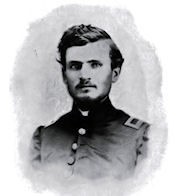
15th. Reveille at 1:30. Moved out on wrong road. Went to Ashland—stayed all day. Pickets rebel division came up and attacked us. 2nd drove back the advance. 2nd N. Y. lost several men. Camped north of the North Anna at 12 P. M. Heard firing from Richmond.

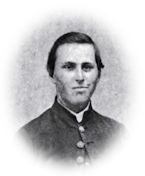
March 15th. Orders received for our regiment to report at Martinsburg. Must leave our winter quarters at Halltown. We are relieved by the 144th Indiana Regiment. Busy packing up, as we are to march tomorrow. Will pass one more night in our winter quarters. Time has passed very pleasant in this camp during the winter.
March 15th.—Warm and cloudy. My cabbages coming up in the garden.
The papers contain no war news whatever, yet there is great activity in the army.
Sheridan’s column is said to be at Ashland, and Grant is reported to be sending swarms of troops to the north side of the river, below, “in countless thousands.”
The President’s message, for the completion of which Congress was desired to remain, has been sent in. I will preserve this splendidly exordiumed and most extraordinary document. It is a great legal triumph, achieved by the President over his enemies in Congress, and if we are permitted to have more elections, many obnoxious members will be defeated, for the sins of omission and commission. The President strikes them “between wind and water,” at a time, too, when no defense would be listened to, for he says the capital was never in such danger before, and shows that without prodigious effort, and perfect co-operation of all branches of the government, the cause is lost, and we shall have negro garrisons to keep us in subjection, commanded by Northern officers. He will have the satisfaction, at least, of having to say a portion of the responsibility rested with his political opponents. Mr. Benjamin, who is supposed to have written a portion of the message, was very jubilant yesterday, and it is said the President himself was almost jocund as he walked through the Capitol Square, returning home from his office.
It is now rumored that a French agent is in the city, and that the President, besides his message, sent to Congress a secret communication. I doubt—but it may be so.
Gen. Hood is here, on crutches, attracting no attention, for he was not successful.
Judge Campbell, Assistant Secretary of War, said to Mr. Wattles, a clerk, to-day, that we were now arrived at the last days of the Confederacy. Mr. Wattles told me that the judge had been convinced, as far back as 1863, that the cause was nearly hopeless.
Some 1200 of Fitz Lee’s cavalry passed through the city at 2 P.M. Gen. Longstreet has been ordered by Gen. Lee to attack Sheridan. He telegraphs back from north of the city that he “cannot find them,” and this body of cavalry is ordered to reconnoiter their position. I know not how many more men Fitz Lee has in his division, but fear at least half have passed.
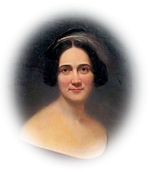
March 15th.—Lawrence says Miss Chesnut is very proud of the presence of mind and cool self-possession she showed in the face of the enemy. She lost, after all, only two bottles of champagne, two of her brother’s gold-headed canes, and her brother’s horses, including Claudia, the brood mare, that he valued beyond price, and her own carriage, and a fly-brush boy called Battis, whose occupation in life was to stand behind the table with his peacock feathers and brush the flies away. He was the sole member of his dusky race at Mulberry who deserted “Ole Marster” to follow the Yankees.
Now for our losses at the Hermitage. Added to the gold-headed canes and Claudia, we lost every mule and horse, and President Davis’s beautiful Arabian was captured. John’s were there, too. My light dragoon, Johnny, and heavy swell, is stripped light enough for the fight now. Jonathan, whom we trusted, betrayed us; and the plantation and mills, Mulberry house, etc., were saved by Claiborne, that black rascal, who was suspected by all the world. Claiborne boldly affirmed that Mr. Chesnut would not be hurt by destroying his place; the invaders would hurt only the negroes. “Mars Jeems,” said he, “hardly ever come here and he takes only a little sompen nur to eat when he do come.”
Fever continuing, I sent for St. Julien Ravenel. We had a wrangle over the slavery question. Then, he fell foul of everybody who had not conducted this war according to his ideas. Ellen had something nice to offer him (thanks to the ever-bountiful Childs!), but he was too angry, too anxious, too miserable to eat. He pitched into Ellen after he had disposed of me. Ellen stood glaring at him from the fireplace, her blue eye nearly white, her other eye blazing as a comet. Last Sunday, he gave her some Dover’s powders for me; directions were written on the paper in which the medicine was wrapped, and he told her to show these to me, then to put what I should give her into a wine-glass and let me drink it. Ellen put it all into the wine-glass and let me drink it at one dose. “It was enough to last you your lifetime,” he said. “It was murder.” Turning to Ellen: “What did you do with the directions?” “I nuwer see no d’rections. You nuwer gimme none.” “I told you to show that paper to your mistress.” “Well, I flung dat ole brown paper in de fire. What you makin’ all dis fuss for? Soon as I give Missis de physic, she stop frettin’ an’ flingin’ trout, she go to sleep sweet as a suckling baby, an’ she slep two days an’ nights, an’ now she heap better.” And Ellen withdrew from the controversy.
“Well, all is well that ends well, Mrs. Chesnut. You took opium enough to kill several persons. You were worried out and needed rest. You came near getting it—thoroughly. You were in no danger from your disease. But your doctor and your nurse combined were deadly.” Maybe I was saved by the adulteration, the feebleness, of Confederate medicine.
• • • • • • • •
A letter from my husband, written at Chester Court House on March 15th, says: “In the morning I send Lieut. Ogden with Lawrence to Lincolnton to bring you down. I have three vacant rooms; one with bedsteads, chairs, washstands, basins, and pitchers; the two others bare. You can have half of a kitchen for your cooking. I have also at Dr. Da Vega’s, a room, furnished, to which you are invited (board, also). You can take your choice. If you can get your friends in Lincolnton to assume charge of your valuables, only bring such as you may need here. Perhaps it will be better to bring bed and bedding and the other indispensables.”
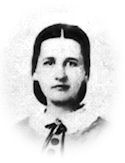
March 15th, 1865.—I am afraid we have the swell-head because we repulsed the enemy and made him take to his gun-boats. It seems to have put new life and hope in us all. The news from the armies is a mixture of good and bad; more funds are needed for the hospitals and Leon County is preparing for a concert, in which the entire musical talent will be called out and great things are expected. It will take some time to get this elaborate entertainment ready for the public, so the 9th of April has been appointed as the most suitable time.
Cousin Bettie will play “Une Pluie du Perle” and cousin Fannie Nash will play “Sleeping I Dreamed Love.” Sister Mart and Cousin Jennie are practising a beautiful German duet. If I knew German I would tell the name but I cannot even be sure I would spell it right and I know I could never pronounce it. Everybody who is at all musical is in this concert but I am only a listener.
These arrangements were made yesterday. Cousin Jewel is going to play a lovely Nocturne. She is a genius in music and she thinks they are taking too much time in preparing for the concert. Isn’t it funny how people differ even in little matters like this?
Father’s fever patients are well again and returned today to camp but Mr. Blount and Mr. Clendenning will never be well again. The enemy have possession of the home, in the Valley of the Shenandoah, where Mr. Blount used to live and Mr. Clendenning’s mother lived in Atlanta, until the Yankees burned her out. Father will keep them until they want to make a change.
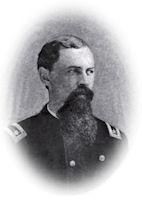
March 14, 1865.
It is supposed we will be here two or three days, to get some shoes up the river.
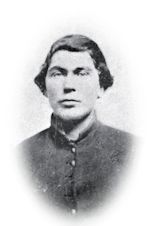
Chattanooga, Tuesday, March 14. Coming off guard, I was exempt from work, therefore went to town on pass, General Thomas’s special headquarters train having just brought him in from Nashville. Called on Lieutenant Silsby while returning, but he was not at home. Dan J. Davis came in about noon. Very glad to see him, looks very well with scarcely a trace of smallpox. There are five in the tent now, and we must keep very still for want of room.
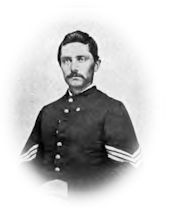
Tuesday, 14th—I went out early this morning with the foraging party of our division, in search of feed for the horses and mules. We came to a rich plantation about four miles out, with corncribs well filled, and in a short time we had the wagons loaded. Some of us had been put to loading the wagons while others went to get the chickens and other things. After the boys had caught and loaded all the chickens and upset fully a hundred beehives, they called out, “The rebels are coming!” We had just finished loading the wagons, but that call was enough to frighten the teamsters, and they put the whip to the mules, starting off on a dead run. The road ran through a heavy timber, but it was wide and perfectly level, and they galloped the teams the whole way back to our bivouac. It was every fellow for himself, and I never ran faster in my life. A commissioner from Cornell College[1] was in camp today for the purpose of raising money to educate the orphan children of soldiers and sailors. Our company raised $229.00.
[1] College at Mt. Vernon, Iowa.
14th. Moved out at daylight. When 6 miles from the South Anna ground squirrel bridge, my battalion was ordered forward at a trot to support the 1st Conn. in a chase after Early with 300 men. Kept up the chase 12 miles. Crossed the Chickahominy—10 miles from Richmond—scattered the force. Custer offered 30 days’ furlough to the captor of Early. Kept up the trot into Ashland, recrossing Chickahominy. No force. Very sore, chafed and tired. Moved back north of South Anna. Many horses played out. Ours did well. Lost but one. Held them at a square trot. Anniversary of an eventful day in my life. Have thought a great deal today of this day a year ago and the other days near them. It makes me sad to review them.
March 14th. This morning the 131st Ohio Regiment located near our camp. A new regiment. Just organized. Real young, fine looking fellows. Hope they won’t be obliged to see hard service, for war is a cruel thing.


