Chattanooga, Friday, March 3. On guard. Very wet day. Rained all day and night. Mail arrived with a letter from T. L. All very well with the exception of dear mother. She still is suffering severely. How much longer can her frail nature withstand it? It is hard to give her up here and never more to see her loving face. Must she go without welcoming her Jenk’s return? But still I feel it would be better for her to leave her troubles and sufferings, and go to the land where her treasures are, there to enjoy endless day.

St. Helena Village, S.C., March 3, 1865.
I just scribble a note to thank you all, tell you I am well, and that I am, as you suppose, busy distributing to the refugees. We clothed about one hundred almost naked and entirely filthy people, who had had no change of clothing for months, and who had generally been very ill. Then the supply stopped. There arrived just five boxes and a barrel for me, and these we gave. But no other boxes have come since, and the people come to our yard and stand mute in their misery, not annoying me with questions, but just watching me to see if I have any news of the coming clothing for them. There some of them stand nearly every morning when I go to school, and there they are when we come home. I believe there are some boxes for me and many for Mr. Tomlinson at the Head, but the storm, we suppose, has cut off the supply of coal, and the steamers cannot bring them up. For the same reason no rations could be brought up for them, and there has been something very like starvation here. I have, fortunately, had some money of Mr. Wright’s, and I have bought rice from Mr. Ruggles, and to avoid actually giving to beggars, have only supplied such as Hastings designated as starving, except in a few cases where we had personal knowledge of the people. I think the little grits and rice we have given have kept soul and body together more than once. They have found out that we will buy moss from the trees for our cow who, stupid beast, will not eat hay.
I am elected superintendent of the Philadelphia schools and agent for the Pennsylvania Freedmen’s Relief Association down here.
My box has not come, nor the schooner been heard of. This stormy weather has kept it out, I suspect. Thank H. for both drafts.
What a pleasure my life is!

Friday, 3rd—It is still raining. We left our dismal camp at 7 a. m. and marched eleven miles, going into bivouac near Cheraw. The First Division of the Seventeenth Corps drove the rebels out of their works on Thompson creek and on through Cheraw and across the Great Pedee river. They captured seventeen cannon, three thousand stand of small arms and a number of prisoners. Cheraw is quite a business town and had been a manufacturing center for the rebel army. It is at the head of navigation on the Great Pedee river and has a railroad running to Charleston, South Carolina.

March 3d.—Raining and cold. This morning there was another arrival of our prisoners on parol, and not yet exchanged. Many thousands have arrived this week, and many more are on the way. How shall we feed them? Will they compel the evacuation of the city? I hope not. Capt. Warner, Commissary-General, is here again; and if assigned to duty, has sufficient business qualifications to collect supplies.
Thank God, I have some 300 pounds of flour and half that amount of meal—bread rations for my family, seven in number, for more than two months! I have but 7½ pounds of meat; but we can live without it, as we have often done. I have a bushel of peas also, and coal and wood for a month. This is a guarantee against immediate starvation, should the famine become more rigorous, upon which we may felicitate ourselves.
Our nominal income has been increased; amounting now to some $16,000 in paper—less than $300 in specie. But, for the next six months (if we can stay here), our rent will be only $75 per month—a little over one dollar; and servant hire, $40—less than eighty cents.
It is rumored that Gen. Early has been beaten again at Waynesborough, and that the enemy have reached Charlottesville for the first time. Thus it seems our downward career continues. We must have a victory soon, else Virginia is irretrievably lost.
Two P.M. The wind has shifted to the south; warm showers.
Three P.M. It is said they are fighting at Gordonsville; whether or not the enemy have Charlottesville is therefore uncertain. I presume it is an advance of Sheridan’s cavalry whom our troops have engaged at Gordonsville.
New Market, S. C., March 2, 1865.
A disagreeable, half drizzle, half sprinkle, all last night and to-day. Our brigade in advance and made 10 miles. Poor country, but pretty well settled. Many of the men have had no breadstuffs for three days. They drew two days of hardbread February 18th, and have foraged everything else we have had since. Don’t know when we draw again. Still have our 8 days of “tack” in the wagons. We will get plenty of forage again to-morrow. Can hear nothing of the enemy. We left Darlington 20 miles on our right to-day and will probably strike the Peedee near Society Hill.
Colonel Lyon’s Letters.
Huntsville, Ala., March 2, 1865.—I write this morning in the office, surrounded by a crowd of officers, therefore can write but little. I do not hear a word from my application for leave for you to visit me. The failure to answer is equivalent to a refusal, and I fear that we must give it up. There may be a good reason, but I do not believe it, yet we are compelled in this service to endure a good many annoying and humiliating things.
I see the people North are in high spirits over the evacuation of Charleston and Wilmington, etc. I am entirely unable to see the importance of these evacuations to us. I can not see that these movements will have much influence in closing the war. We must crush and destroy their armies before the war will end, and we are making but little headway in that direction in the East. But we must be patient, and if there is another year of heavy fighting we must not be surprised or disheartened. We are bound to conquer in the end.
Chattanooga, Thursday, March 2. Rained fine and constant all night and all day, but we are dry and comfortable in our bed of sawdust. Read Tennyson’s new poem Enoch Arden this forenoon, and think it one of the finest poems I have ever read in English. Wrote to T. L. and read an old Atlantic Monthly in the afternoon. No mail for me.
Thursday, 2d—Still in camp. It was misty all day. One of our rebel prisoners was shot today at corps headquarters. He had to pay the penalty for the rebels’ treatment of one of our men, from Company H, Thirty-fourth Illinois, whom they held as a prisoner and shot without provocation. When the prisoners at our headquarters were told that one of them had to pay the penalty, they drew lots, and it fell to a middle-aged man to die. The man was given time to write a letter to his family and then after bidding his comrades farewell, he was led out and shot.

2nd. Thursday. Commenced to rain early. Our div. in advance. Massed just before reaching S. Reached our old camp at Waynesboro at 3 P. M. The Va. Brigade formed mounted. We formed dismounted. Went out where we could see the rebel line on a hill and in the woods, running almost around W. 2nd Ohio in advance as skirmishers. Forward was given and the 2nd went forward until it carried the woods and the hill, driving the Johnnies pell-mell. I was mounted and went in on the muscle, when the rebs gave way. Took a great many prisoners myself. Captured 1,300 prisoners, 10 guns and 150 wagons and 10 stands of colors. Advance charged through the gap and burned a heavy amount of supplies at Greenville. Gen. Early barely escaped capture. It is a wonder to me how the boys stood it so well. Gen. Custer gave us great credit. Camped just through the gap. Raining.
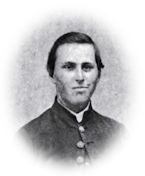
March 2d. Last night a shot was heard beyond our outpost. Could not learn the cause. It seemed to be in the direction of Charlestown. About nine o’clock this morning I received a call from Captain Kibbe, Officer of the Guard, asked for any information that I could give. I could not give him any as it was beyond our outpost. Putting a man in charge of the outpost, the Captain ordered me to go with him for an investigation. The people we called on had not noticed it. They became used to the report of a gun and did not pay any attention to it. At the home of a Mr. Snyder we were invited in and received very pleasantly. As it came time for us to go, as it was getting near noon, they urged us to remain to dinner. The invitation was accepted. The family consisted of Mr. and Mrs. Snyder and two young daughters. Mrs. Snyder was in very poor health, the daughters doing the house work. A fine chicken dinner was served for which we were very thankful. After dinner Mr. Snyder invited us out to take a look over his place. He was the owner of a grist and saw mill, and a large farm. We were treated very kindly by the whole family. All expressed sorrow over the war. The location was near Charlestown. When the time came for us to go, we received a very cordial invitation to call again. We made our way back to the picket post after our very enjoyable time and good dinner, on Sunday, March 2d, 1865.
At 3 P. M. we were relieved from picket duty. Made our way to camp with pleasant recollections of the good time that came to us on this Sunday on picket duty along the line of the Harper’s Ferry and Winchester Railroad.


