Following the American Civil War Sesquicentennial with day by day writings of the time, currently 1863.

January 2012

Romney, January 19, 1862.

We left Unger’s Monday morning and reached here on Wednesday, after three days’ hard march on roads as bad as rain, sleet and snow could make them. For some time since we reached here it has been raining, and the whole country is flooded with water. Since we left Winchester three weeks ago, we have indeed been making war upon the elements, and our men have stood an amount of hardship and exposure which I would not have thought was possible had I not witnessed it. In passing through it all, I have suffered but little, and my health is now as good as it ever was. Whilst this is true of myself, our ranks had been made thinner by disease since we left Winchester. Two battles would not have done us as much injury as hard weather and exposure have effected. After writing to you last Sunday, I concluded to write to the Governor to consider my resignation as withdrawn and I would trust to the chance of getting a furlough to go home. I am promised it as soon as Echols returns, and his furlough is out sixteen days from this time. I hope Jackson will have concluded by that time that a winter campaign is fruitful of disaster only, as it has been, and will put us at rest until spring. Then I may expect to see you.


Now, darling, just here the mail has come to hand, bringing your letter of the 15th inst. and the gratifying news that all are well at home. You say the sleet and snow were falling whilst you wrote, and you felt some anxiety lest I might be exposed to it. You were just about right. I left that morning at daybreak and marched in sleet and snow some fifteen miles to this place. When I got here the cape of my overcoat was a sheet of ice. If you have hard times, you may console yourself by knowing that I have hard times, too. I am amused with your fears of an inroad of the Yankees into Rockbridge. Their nearest force is about eighty miles from you, and if the roads in that section have not improved very much, they will have a hard road to travel. You all are easily scared. By the time you had been near the Yankees as long as I have, you would not be so easily frightened.

You must come to the conclusion which has forced itself upon me some time since. Bear the present in patience, and hope for the best. If it turns out bad, console ourselves with the reflection that it is no worse. We can see nothing of the future, and it is well for us we don’t. I have but little idea to-day where I will sleep to-night, or what shall be doing to-morrow. Our business is all uncertainties. I have been in great danger only once since I have been in the service, yet I suppose I have thought a hundred times that we were on the eve of a battle which might terminate my life. Now, after all, Love, I think it best to trouble myself little with fears of danger, and to find happiness in the hope that you and I and our dear children will one day live together again happily and in peace. It may be, dearest, this hope will never be realized, yet I will cherish it as my greatest source of happiness, to be abandoned only when my flowing blood and failing breath shall teach me that I have seen the last of earth. All may yet be well with us.
JANUARY 19TH.—There has been a storm on the coast, sinking some of the enemy’s ships. Col. Allen, of New Jersey, was lost. He was once at my house in Burlington, and professed to be friendly to the Southern cause. I think he said he owned land and slaves in Texas.

U. S. Flag-Ship Hartford,

Philadelphia, Jan. 19, 1862.

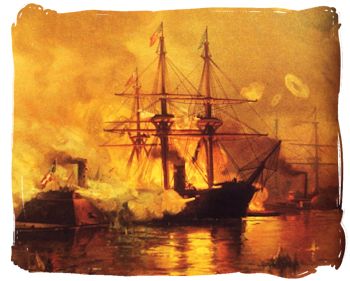
This morning, at 10 o’clock, the U. S. screw sloop Hartford was put in commission as the flag-ship of the Western Gulf Blockading Squadron. The following is a list of officers ordered to join her:

Flag Officer—David G. Farragut.

Fleet Captain—Henry H. Bell.

Commander—Richard Wainwright.

Lieutenant and Executive Officer—Jas. S. Thornton.

Lieutenant and Ordnance Officer—Albert Kautz.

Surgeon—W. Maxwell Wood.

Assistant Surgeon—Joseph Hugg.

Paymaster—George Plunkett.

Master—John C. Watson.

Acting Masters—D. S. Murphy, C. Desames, Jos. G. Lewis .

Marine Officers-1st Lieut., John L. Broome; 2d Lieut., Geo. Heisler.

Flag Officer’s Secretary—Thomas Walden.

Flag Officer’s Clerk—B. S. Osbon.

Acting Midshipmen—H. B. Tyson, E. C. Hazeltine, Jno.

H. Reed, H. J. Blake.

Engineers—Chief, J. B. Kimball; 2d Assistant, Jno. Purdy,

E. B. Latch, F. A. Wilson; 3d Assistant, C. M. Burchard,

Isaac Degraff, A. K. Fulton, C. J. COOPER.

Boatswain—James Walker.

Gunner—Jas. Duncan.

Acting Carpenter—J. H. Conley .

Acting Sailmaker—Jno. A. Holbrook.

Clerks—Captain’s, A. D. Bache; Fleet Captain’s, T. B. Waddell; Paymaster’s, F. C. Plunkett.

Master’s Mates—E. J. Allen, Thos. Mason, Lewis S. Locke.

The first business of the crew was to put the ship in sailing order, which, with taking on board provisions and the like, occupied several days. We dropped down to Newcastle, Del. and remained a couple of days, and then went back to Fort Mifflin and took in powder, which is said to be the last article taken on board before sailing, and the first article discharged on returning from a cruise. We then dropped down to Newcastle again, and after receiving on board the Flag Officer and the Fleet Captain, Henry H. Bell, with a salute, proceeded to sea.

January 19.—A battle took place to-day at Mill Springs, near Somerset, Ky., between the National forces under command of General Geo. H. Thomas, and the rebel forces, commanded by General F. K. Zollicoffer, resulting in the utter rout and defeat of the rebels. The Confederates commenced the attack at half-past five in the morning. The fight lasted till late in the afternoon,

when the rebels were driven off the field in great confusion, their leader, General Zollicoffer, being among the slain. On reaching their entrenchments, a few miles distant from the scene of action, they were cannonaded until dark, by the National batteries, and during the night succeeded in making good their escape across the Cumberland River. About one hundred and fifty rebel prisoners were taken, and ton guns, about one hundred wagons, upwards of twelve hundred horses and mules, large quantities of small arms, with subsistence and hospital stores captured. Besides these a large number of flags were taken on the field of battle, and in the deserted entrenchments.—(Doc. 16.)

— This evening the United States gunboat Itasca captured the schooner Lizzie Weston, of Apalachicola, Fla., loaded with two hundred and ninety-three bales of cotton, one hundred and fifty-two thousand five hundred pounds, bound for Jamaica or a market. She was sent in charge of a prize crew to Philadelphia.

—Colonel Williams’ regiment of Pennsylvania cavalry passed through Louisville, Ky., on their way to Munfordville, where they will take a position a few miles beyond Green River. They are well supplied with arms, though their horses are not generally up to the requirements of active service.—Louisville Journal, January 20.

18th. Rode out into the country with Delos and John. Got some milk.

18th.—I visited Washington to-day, through such rain and such mud, as no civilized country, save this, can sustain, and preserve its character for purity. Am back to-night. On my return, I find on my table the following: ” General Order No. 11.

“Headquarters, &c.

“When the time arrives for the troops of this Brigade to move, the following will be the allowance of the means of transportation:

“Five wagons to the companies of a Regiment (two wagons to each company); one wagon to the Regimental Hospital.

“Each wagon will carry the forage for its horses. The sixty rounds of reserved ammunition will be carried in extra wagons. In the company, wagons will be carried rations for two or three days, company mess equipage, and officers’ baggage, which will in no case exceed the amount by regulations for baggage in the field. The forage for horses of regimental and field officers will have to be carried in their wagons. This notice is given so that soldiers and officers may be aware, that all property not above mentioned, to be preserved, had better be removed, for if the troops march, it is probable the first notice given will be the presence of wagons for loading,

“By order of Brig. Gen. ––––.”

Now that begins to look like business, and if our General means to put us in the way of doing something—if it will only not prove another counterfeit cry of “wolf”—we shall be pleased. Gen. McClellan has already grown several inches in the estimation of those whose confidence began to get shaky. I do not like that expression of “for if the troops march.” It looks a little wolfy. But I shall try to think it means “go in.”

Saturday, 18th—Some of the boys went out on a scouting expedition, but did not meet with any success.

To Mrs. Lyon

Cairo, Sat., Jan. 18, 1862.—We arrived here last night, slept in the cars, and have this moment taken possession of the barracks. Do not know when we shall go. It rained, thundered and lightened all night. The storms here are terrific. I never saw mud before. It is sublime beyond description. The mud here is ankle deep everywhere off the sidewalks, and you may judge what sort of traveling it is.

Saturday, January 18th 1862

Weather still soft and the crossings horrible. For the first time in Washington I saw boys cleaning off the crossing on [our?] street, and taxing the passers bye. Mr Short of Buffalo (the “Greek fire Bomb” inventor) called upon me today. He married my cousin (long ago). Expect him to go to church with us tomorrow. I had quite a lengthy conversation with Geo W Prentice in the office today. He questions a great deal, listens attentively to all that is said, but rarely expresses an opinion in conversation. No particular news in the City, did not go on to the Ave tonight, staid at home. “Bud” came from the Presidents about dark. Young “Bob” Lincoln has just got home from Cambridge to spend the vacation.

______

The three diary manuscript volumes, Washington during the Civil War: The Diary of Horatio Nelson Taft, 1861-1865, are available online at The Library of Congress.

Saturday, January 18, 1862. — Attempting to rain this morning. All important movements everywhere stopped by the rain and mud already. Still further “postponement on account of weather.” How impatiently we look for action on Green River [and] at Cairo. As to the Potomac, all hope of work in that quarter seems to be abandoned. Why don’t they try to flank the Rebels — get at their communications in the rear? But patience! Here we are in a good position to get in the rear via two railroads. Suppose two or even three or four bodies of men were to start, one by way of Lewisburg for White Sulphur Springs and Jackson Depot, one via Peterstown and Union, east side of New River, for Central Depot, one via Princeton and Parisburg [Pearisburg] right bank of New River, for Dublin, and another via Logan Court-house for some point lower down on the railroad.

A heavy rain falls — warm, spring-like, copious. The scenery of New River is attractive. The river runs in a deep gorge cut through the rock to a depth of one thousand to two thousand feet. The precipitous cliffs, occasionally cut through by streams running into the river, the rapid rushing river, and brawling mountain streams furnish many fine views. The Glades, a level region near Braxton and Webster Counties, where streams rise, and a similar region, called the Marshes of Cool, are the cattle grounds of this part of western Virginia. Braxton and Webster are the haunts of the worst Rebel bushwhackers of the country. Steep mountains, deep gorges and glens afford them hiding-places. They are annoying but not dangerous except to couriers, mail-carriers, and very small parties. They shoot from too great a distance at large parties to do much harm. .