20th. Received letter from Fannie and finished letter to her. Wrote requisitions to balance wood drawn. Were mounted and started from Fort Leavenworth at ten A. M. Traveled about twenty miles over the rolling prairies, and encamped in a piece of woods on an Indian farm. Country finely settled. Indians upon the woodland. Saw a prairie wolf.
February 2012
Thursday Feb 20th 1862
This has been a bright pleasant day, quite a rarity for a month past. There is no particular news in the papers. I have been down onto the Ave this evening. Called upon Mr Daws M.C. who is sick at his rooms co[rne]r of 8th & Ave, bought some maps and two Flags in view of the Celebration of the 22nd. I must make arrangements tomorrow to illuminate on Saturday night. We hear tonight with much sorrow that our little friend Willie Lincoln died at 5 p.m. He had been sick for near three weeks with Typhoid fever. “Bud” has been to see him or to enquire about him almost every day. He and his Mother were there yesterday about noon. Willie was then thought to be better. He was an amiable good hearted boy, was here with our boys almost every day or our boys were there. We all got much attached to him & “Tad” his Brother. He had more judgment and foresight than any boy of his age that I have ever known, poor Willie we all lament.
______
The three diary manuscript volumes, Washington during the Civil War: The Diary of Horatio Nelson Taft, 1861-1865, are available online at The Library of Congress.

FEBRUARY 8TH to 20TH.—Such astounding events have occurred since the 8th instant, such an excitement has prevailed, and so incessant have been my duties, that I have not kept a regular journal. I give a running account of them.
Roanoke has fallen before superior numbers, although we had 15,000 idle troops at Norfolk within hearing of the battle. The government would not interfere, and Gen. Huger refused to allow the use of a few thousand of his troops.
But Gen. Wise is safe; Providence willed that he should escape the “man-trap.” When the enemy were about to open fire on his headquarters at Nag’s Head, knowing him to be prostrated with illness (for the island had then been surrendered after a heroic defense), Lieutenants Bagly and Wise bore the general away in a blanket to a distance of ten or fifteen miles. The Yankees would have gladly exchanged all their prisoners for Gen. Wise, who is ever a terror to the North.
Capt. O. Jennings Wise fell, while gallantly cheering his men, in the heat of the battle. A thousand of the enemy fell before a few hundred of our brave soldiers. We lost some 2,500 men, for there was no alternative but to surrender.
Capt. Wise told the Yankee officers, who persisted in forcing themselves in his presence during his dying moments, that the South could never be subjugated. They might exterminate us, but every man, woman, and child would prefer death to abject subjugation. And he died with a sweet smile on his lip, eliciting the profound respect of his most embittered enemies.
The enemy paroled our men taken on the island; and we recovered the remains of the heroic Capt. Wise. His funeral here was most impressive, and saddened the countenances of thousands who witnessed the pageant. None of the members of the government were present; but the ladies threw flowers and evergreens upon his bier. He is dead—but history will do him justice; and his example will inspire others with the spirit of true heroism.
And President Tyler is no more on earth. He died after a very brief illness. There was a grand funeral, Mr. Hunter and others delivering orations. They came to me, supposing I had written one of the several biographies of the deceased which have appeared during the last twenty years. But I had written none—and none published were worthy of the subject. I could only refer them to the bound volumes of the MADISONIAN in the State library for his messages and other State papers. The originals are among my papers in the hands of the enemy. His history is yet to be written—and it will be read centuries hence.
Fort Henry has fallen. Would that were all! The catalogue of disasters I feared and foretold, under the policy adopted by the War Department, may be a long and a terrible one.
The mission of the spies to East Tennessee is now apparent. Three of the enemy’s gun-boats have ascended the Tennessee River to the very head of navigation, while the women and children on its banks could do nothing more than gaze in mute despair. No batteries, no men were there. The absence of these is what the traitors, running from here to Washington, have been reporting to the enemy. Their boats would no more have ventured up that river without the previous exploration of spies, than Mr. Lincoln would dare to penetrate a cavern without torch-bearers, in which the rattle of venomous snakes could be heard. They have ascended to Florence, and may get footing in Alabama and Mississippi!
And Fort Donelson has been attacked by an immensely superior force. We have 15,000 men there to resist, perhaps, 75,000 Was ever such management known before? Who is responsible for it? If Donelson falls, what becomes of the ten or twelve thousand men at Bowling Green?
COLUMBIA, S. C, February 20, 1862.—Had an appetite for my dainty breakfast. Always breakfast in bed now. But then, my Mercury contained such bad news. That is an appetizing style of matutinal newspaper. Fort Donelson¹ has fallen, but no men fell with it. It is prisoners for them that we can not spare, or prisoners for us that we may not be able to feed: that is so much to be “forefended,” as Keitt says. They lost six thousand, we two thousand; I grudge that proportion. In vain, alas! ye gallant few—few, but undismayed. Again, they make a stand. We have Buckner, Beauregard, and Albert Sidney Johnston. With such leaders and God’s help we may be saved from the hated Yankees; who knows?

______
¹ Fort Donelson stood on the Cumberland River about 60 miles northwest of Nashville. The Confederate garrison numbered about 18,000 men. General Grant invested the Fort on February 13, 1862, and General Buckner, who commanded it, surrendered on February 16th. The Federal force at the time of the surrender numbered 27,000 men; their loss in killed and wounded being 2,660 men and the Confederate loss about 2,000.
February 20.— Gen. Mitchell sent a cavalry force to Russellville, Ky., and captured eleven rebels.—One thousand rebel prisoners, captured at Fort Donelson, Tenn., mostly Mississippians and Texans, left Cairo, 111., to-night, for Chicago.
—Isham G. Harris, rebel Governor of Tennessee, addressed a message to the Legislature of the State, giving his reasons for removing the records of the government to and convening the Legislature at Memphis, in accordance with a joint resolution of the Senate and House of Representatives, providing for such a necessity. He states that the reverses to the confederate arms, leaving the State open from the Cumberland Gap to Nashville; the National victories on the Tennessee and Cumberland Rivers, enabling the enemy to penetrate the heart of the State with impunity, and the fact that Gen. Johnston had fallen back south of Nashville, with his army, had left the State capital in a wholly defenceless condition. The removal to Memphis then became unavoidable. He complains of the difficulties he had found in organizing well-disciplined and equipped troops for the confederate government, urges a remodelling of the State militia system, and expresses his conviction that the invader will yet be driven from the soil of Tennessee.—(Doc. 59.)
— This morning the United States steamer Stepping Stones, with a launch and boat’s crew from the Yankee, went on a reconnoissance up Occoquan Creek, Va., some four miles. Lieut. Eastman sent out Acting Master Lawrence with the launch, who visited the north and south shores of the creek, penetrating a short distance into the interior, but without finding any signs of the rebels. Just as the launch was leaving the south side of the creek, a brisk fire was opened on them by the rebels, from five or six field-pieces posted in a clump of woods. Some forty shells were thrown by the enemy, all of which flew uncomfortably near the Stepping Stones, but doing no damage save slightly tearing the flag. The fire was returned from the Stepping Stones, and a howitzer in the launch plunged a shower of rifled shot into the cover of the rebels, which undoubtedly damaged them, as their fire soon slackened.—(Doc. 53.)
—The Richmond Enquirer of this date, says: “An immense defence meeting was held in Memphis, Tenn., last week. Resolutions were passed, appointing committees in each ward of the city, to form a complete military organization, and to drill the levies. It was also resolved that the times demanded the proclamation of martial law in Memphis. In the afternoon, most of the stores on Front row, and many of these on Main street, closed their doors, in compliance with a proclamation from the Mayor. A considerable number of citizens, who had given in their names to join the defence organization, met in the Council Chamber in the evening, and went out in procession to drill.”
—Winton, N. C, was burned by the forces of Gen. Burnside. The Federal troops, with gunboats, ascended the Chowan River, where the rebels opened a heavy fire upon them. The National troops landed and destroyed the town. —(Doc. 54)
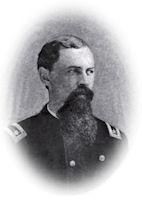
Headquarters 7th Illinois Cavalry,
Cape Girardeau, Mo., February 19, 1862.
Aren’t things working right now? Do you notice the accounts of the old 8th, and will you say again that I got out of her ranks at the right time? I knew that the 8th would never make her colonel (God bless him!) to blush, or dishonor her friends or herself. I have seen only the St. Louis papers of 18th with very meager dispatches, but enough to know that she had the “post of honor” and plenty of fighting. Two hundred of them with Major Post are prisoners. I’ll bet my life Company E is not among them. If the Rebels will keep the major and exchange the men the regiment will gain. If I was in the 8th yet and knew what I do now I wouldn’t leave her for any commission there is in this post. I’ve got a good easy place here and have the good will of everybody around me, but my soul and sympathies are with the 8th, and it makes me sick to think what a fool I was to leave her. I’ll be shot if I don’t love that regiment more than I do the whole world beside. I never thought of it so much untill I got away. I expect some of our boys of my old mess are killed, but its all right, “military necessity,” somebody has to go under. Eight or nine boatloads of prisoners have passed here to-day. They look a little better than our Missouri prisoners but are not uniformed, although comfortably dressed.
Wednesday 19th
Rain all day, roads and crossing are in a horrible condition. The news looks favorable for further Victories to be heard of before long. The whole country is jubilent over the past. I have not been out tonight. After dinner I cleaned out the Aquarium and put in fresh water. The Eel has been burrowed in the sand all winter, have not seen him before in three months, he is very active. Got a Tribune of the newsboy and have read all the evening.
______
The three diary manuscript volumes, Washington during the Civil War: The Diary of Horatio Nelson Taft, 1861-1865, are available online at The Library of Congress.
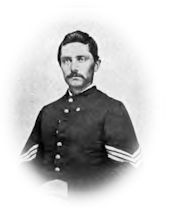
Wednesday, 19th—News came that Roanoke Island has been taken by our men. It is reported that our company will leave for California, Missouri, in three or four days and all are rejoicing that our stay here is about over.
19th. Commenced letter to Fannie. Cold better.
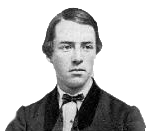
Wednesday, February 19. — A stormy day. In the evening we went to a supper given by General Martindale’s staff. It was really a very fine supper, especially for a camp one. They had a handsome bill of fare, with gilt, etc., and quite a handsome-looking table. The chandelier for the occasion was made of bayonets fastened on to a wooden circle, and in the end of the bayonet where it fastens onto the gun, were placed the candles. There were two of these circles, one above the other, producing a gay-and-festive-looking object. The festivities were kept up until twelve. Speeches and toasts were given and responded to with much enthusiasm, and songs, etc., made the evening pass quite pleasantly.


