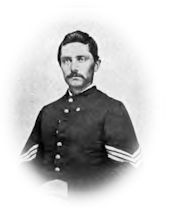
Friday, 21st—We are to bid goodby to Lookout Station tomorrow. Some of the good people living here are sorry to see us go. May they have success for their loyalty to the Union cause.
February 2012
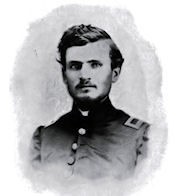
Feb. 21st. Continued our journey and reached Kansas City a little after noon. Arrested two men pretending to be secessionists—drunk. Encamped out on snow and ice a little distance from town. Major heard of a gang of jay-hawkers and secessionists at Independence under Parker and Quantrell. He detailed 150 men to go after them under Lieutenant Nettleton. Brownell and I got leave to go too. Was up nearly all night issuing cartridges and preparing to go.
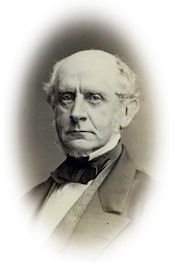
London, February 21,1862
Of course if you remain on the island there can be little use for your arm of the service, so I presume you may be employed mainly in the labor of the manège. And even if on the mainland I cannot well conceive what business you can have in a region so sparsely settled with whites and with few elements of aptitude for military operations. Neither Savannah nor Charleston can be taken by cavalry, and apart from these ports what is there in that country important to the object of the war?
To be sure you may individually obtain much insight into the economy of that densely populated slave region, and thus reinforce your means of speculating on the cotton producing theory. If so, I should very well like to see the conclusions to which you may come. To me at this distance it looks very much as if the slave tenure must be irreparably damaged by the social convulsion through which the country is passing, but I confess myself puzzled to see what is likely to take its place. I learn that some letters reach here from Carolina planters declaring that they are utterly ruined. The end to them may then be emigration. And what then? Is it a community of negroes requiring to be taught the very rudiments of social and political economy? . . .
The Trent affair has proved thus far somewhat in the nature of a sharp thunderstorm which has burst without doing any harm, and the consequence has been a decided improvement of the state of the atmosphere. Our English friends are pleased with themselves and pleased with us for having given them the opportunity to be so. The natural effect is to reduce the apparent dimensions of all other causes of offense. The Manchester people are patient and uncomplaining. The distress is not yet of such a kind as to give rise to much uneasiness, and the blockade shuts up the expectation of cotton enough to stimulate the prospect of production in other quarters, so that England shall not be again subject to a similar catastrophe. In the meantime industry naturally seeks new channels, and emigration affords a steady outlet. So that I am now quite encouraged to think that the prospect of interference with us is growing more and more remote. All that I have ever sought for has been the opportunity of developing our policy of repression. At first I confess I had little confidence in its success. But of late I have been thinking better and better of it. And it seems to me that the same impression is growing all around me. . . . The struggle is a tremendous one, and must not be measured hastily. I pity the people of the southern states, but I have no mercy for their profligate leaders, who have wantonly brought them to such a catastrophe.
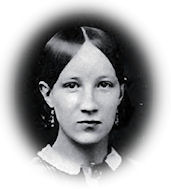
February 21.—Our society met at Fanny Palmer’s this afternoon. I went but did not stay to tea as we were going to Madame Anna Bishop’s concert in the evening. The concert was very, very good. Her voice has great scope and she was dressed in the latest stage costume, but it took so much material for her skirt that there was hardly any left for the waist.
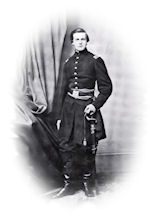
Hall’s Hill, Va., Feb. 21, 1862.
Dear Sister L.:—
We have most glorious news every day. Fort Henry is taken, and immediately followed by the surrender of Roanoke Island. We haven’t done cheering over that victory, before we hear of another and greater, the fall of Fort Donelson and the capture of fifteen thousand rebels. Right on the heels of this comes the evacuation of Bowling Green, defeat of the rebel cavalry near Winchester, and last the capture of Price and his army in Missouri. We have also a report of the surrender of Savannah without firing a gun. This came from the rebels, and, as they have prohibited the passage of any more news from Norfolk, I am inclined to think there’s something in it. We will soon hear direct from the fleet. The rebels are beginning to feel heartily sick of their madness, if we may judge by their acts. We hear that Vice President Stephens has resigned and advised the rebels to lay down their arms and surrender. Governor Letcher has done the same. The rebels are evacuating Columbus to escape the fate of their friends in Fort Donelson, and to-day’s Press says that they are leaving Centreville and Manassas to protect Richmond. If this is true we may be following them up in a very short time and completely whip them by the middle of March. Things certainly look brighter every day. The boys are already talking of what they’ll er every day. The boys are already talking of what they’ll do when they get home. I think I shall go home by way of New York and stop there for a short visit, and perhaps call at Ararat. What do you think of that for counting chickens before the process of incubation is completed?
It’s a pleasant day and the “old tiger” has got the battalion putting them through the tallest kind of double quick steps. A somewhat distinguished (in his line) votary of Terpsichore said to me the other day, “I always liked a quick step, but hang your double quick. Single quick is fast enough for me.”
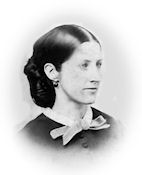
Eliza Woolsey Howland to Joe Howland.
February 21
We went yesterday to the Navy Yard and were very much interested in all we saw. They make 15,000 Enfield rifle and musket balls in every twelve hours, or 30,000 while (as now) they work day and night! They also turn out 800 rifled and other cannon balls a day, and three rifled brass cannons a week, besides the ordinary work of a ship-yard and naval station. Our usual luck attended us, for we fell in, by mere chance, with a young naval officer whom Hatty had met in Rome, and he took us about and, best of all, showed us all the rebel flags which are to be presented to Congress, so we had an opportunity, which probably no other outsiders have had, of trampling them privately under foot. The flags of Fort Donelson and Fort Henry were there—fresh and new and without the trace of a bullet hole—those taken from Roanoke and Hatteras, and the famous palmetto one which was replaced by the Stars and Stripes at Hilton Head. There was also a pretty little company flag made of choice silk and embroidered by ladies’ hands.
. . . Later. … News from Charley. “Inside of Hatteras inlet, just going up to Roanoke Island.” The voyage had been rough and wretched but he was well and happy. . . .
We had no letters of interest yesterday except one from Carry, which Mother enclosed to Charley at Roanoke Island. She gave a very funny account of a wretched swollen face she has had. The Doctor recommended a leech, so they sent for one, but were completely at a loss to tell its head from its tail, and finally with many pokes from a hairpin (a new use) they wriggled it into the tube and trusted to Providence to turn it right end up! During the process, however, she was foolish enough to faint dead away, and no sooner had she revived than Miss Parsons did the same. And Carry wanted to go as army nurse!
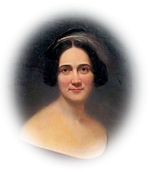
February 21st.—A crowd collected here last night and there was a serenade. I am like Mrs. Nickleby, who never saw a horse coming full speed but she thought the Cheerybles had sent post-haste to take Nicholas into co-partnership. So I got up and dressed, late as it was. I felt sure England had sought our alliance at last, and we would make a Yorktown of it before long. Who was it? Will you ever guess?—Artemus Goodwyn and General Owens, of Florida.
Just then, Mr. Chesnut rushed in, put out the light, locked the door and sat still as a mouse. Rap, rap, came at the door. “I say, Chesnut, they are calling for you.” At last we heard Janney (hotel-keeper) loudly proclaiming from the piazza that “Colonel Chesnut was not here at all, at all.” After a while, when they had all gone from the street, and the very house itself had subsided into perfect quiet, the door again was roughly shaken. “I say, Chesnut, old fellow, come out—I know you are there. Nobody here now wants to hear you make a speech. That crowd has all gone. We want a little quiet talk with you. I am just from Richmond.” That was the open sesame, and to-day I hear none of the Richmond news is encouraging. Colonel Shaw is blamed for the shameful Roanoke surrender.¹
Toombs is out on a rampage and swears he will not accept a seat in the Confederate Senate given in the insulting way his was by the Georgia Legislature: calls it shabby treatment, and adds that Georgia is not the only place where good men have been so ill used.
The Governor and Council have fluttered the dove-cotes, or, at least, the tea-tables. They talk of making a call for all silver, etc. I doubt if we have enough to make the sacrifice worth while, but we propose to set the example.

______
¹ General Burnside captured the Confederate garrison at Roanoke Island on February 8, 1862.
February 21.—The Richmond Whig, of this date, has the following: “We had not supposed it was seriously contemplated in any quarter to call out into active service the whole male population of the State. The proposition of Governor Letcher, to have all over sixteen and under sixty five, in cities, drilled for the defence of their respective localities, is a different affair. That may be practicable, and, under circumstances, might be desirable. But we have very great doubts whether such a mass would effect more good than mischief. But in respect to the rural districts, to call out the whole male population over sixteen and under sixty-five, or even between eighteen and forty-five, would be a mischievous and inexcusable folly. In the first place, we have not arms to put in their hands. That objection alone is sufficient. In the second place, it would ruin the industrial pursuits of the State, and leave us without the means of prosecuting the war beyond the present session.
“We hear that the rage for volunteering is greater than it has been since the beginning of the war. There will be no want of men, without any extraordinary legislation, if they can only get arms and leaders to conduct them against the enemy. If there should be any deficiency, it could be easily supplied by a draft on the superabundance of ‘able-bodied’ young men in the Commissary and Quartermaster’s Department.
“Far better this expedient than to draw the boys from their books, and the old men from their useful labors.”
—Rumors of the partial evacuation of Manassas, Va., by the rebels, were prevalent in Washington to-day, but they were not generally credited.
—A Battle took place, to-day, about seven miles from Fort Craig, near Valverde,[1] on the Rio Grande, New-Mexico, between the rebel forces under Col. Steele, and the National forces commanded by Col. Canby. The battle lasted from nine o’clock in the morning till sundown, and resulted in the defeat of the National troops, who were obliged to retreat to the Fort. McRae’s battery of six pieces was captured by the rebels, after a gallant defence in which Capt. McRae was killed.— (Doc. 55.)
—Capt. Nathaniel P. Gordon, commander of the slave-ship Erie, was executed at New-York, according to sentence. About three o’clock in the morning he attempted to commit suicide by swallowing strychnine, which he had concealed in his cell, but the exertions of three physicians managed to prolong his life sufficiently to allow the execution, which took place at a quarter past twelve o’clock.
—The first battalion of Connecticut cavalry, three hundred and twenty-five men, under the command of Major Judson M. Lyon, passed through New-York City en route for Wheeling, Va., to join Gen. Rosecrans.
— The Massachusetts Thirty-first regiment, and five companies of the Thirteenth Maine regiment, sailed to-day from Boston, Mass., in the steamer Mississippi for Ship Island.
[1] Valverde is a small village, situated on the left bank of the Rio del Norte, or Rio Grande, near the border of New-Mexico and Arizona. Fort Craig is ten miles north of this point, on the same river. Col. Kit Carson, who is said to have done good service with his regiment, deployed as skirmishers, has had his headquarters at Albuquerque for some time, and appears to have arrived at the scene of conflict at a most opportune time.
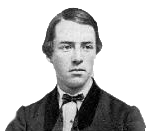
Thursday, February 20. — I went to Washington to-day in an ambulance, with Sam and Michael and one of the telegraph operators. We went on the corduroy road, and such riding I never felt in my life before, the wagon creaking and shaking in every joint, and I myself feeling as if I were doing the same. Up two or three feet in the air at one moment, and down again the next. Driving in the mud compared with it is like the difference between riding in a carriage and in a tip-cart. I went in to get some things for Captain Norton,[1] and to have my photograph taken. I think I have a very good proof, but shall not get it till Monday. The day was chilly, and a blanket thrown over my knees was a welcome protection. When I came out here I found that General McClellan and staff had been here, and in fact were here, for I reached camp just in time to see them mount and ride off. I am sorry I was not here, as I should have liked to be introduced to McClellan. I had a small tent placed before mine as an entrance. Quite an improvement.
Thursday, 20th—No news of importance. Grant’s recent victories have made the Union sentiment stronger in this locality, which will be a big help to the few Union men left here.


